
BIOC-200 · Lesson 9 of 12 · 24 min
Bioenergetics and ATP
▶ Video coming soon A video version of this lesson is on the way.
Every living thing must constantly capture energy and spend it. A cell builds proteins and nucleic acids, pumps ions uphill, moves and divides, and all of these activities need a supply of free energy. Bioenergetics is the study of how cells obtain, store and use that energy. The rules are the rules of thermodynamics, which apply to a bacterium exactly as they apply to a steam engine. What is special about life is the way it couples energy-releasing reactions to energy-requiring ones, using a small number of common carriers, above all ATP. This lesson applies the thermodynamics met in general chemistry, and developed fully in CHEM-271, to the reactions of the cell.
Free energy and direction
Whether a reaction can happen on its own at constant temperature and pressure is decided by its change in Gibbs free energy, ΔG. If ΔG is negative the reaction is exergonic and can proceed spontaneously; if it is positive the reaction is endergonic and will not proceed unless energy is supplied; if it is zero the reaction is at equilibrium. ΔG says nothing about speed. Many exergonic reactions are very slow without an enzyme, as Lesson 5 showed, and enzymes do not change ΔG.
ΔG depends on the concentrations of reactants and products as well as on the reaction itself. For a reaction A + B ⇌ C + D,
Here R is the gas constant, 8.314 J/(mol·K), T is the absolute temperature, and ΔG°′ is the standard free energy change. Biochemists use a modified standard state, marked by the prime: all reactants and products at 1 M except H⁺, which is taken at pH 7 rather than 1 M, and water, whose concentration is folded into the constant. At equilibrium ΔG = 0, so ΔG°′ = −RT ln K′eq. A reaction with ΔG°′ of −5.7 kJ/mol at 25 °C has an equilibrium constant of 10; each further −5.7 kJ/mol multiplies K′eq by ten.
The distinction between ΔG and ΔG°′ matters a great deal in cells. The standard free energy change describes a reaction under conditions that never occur in a cell; the actual ΔG depends on the real concentrations. A reaction with a positive ΔG°′ can run forward in the cell if its products are kept low, for example because the next enzyme removes them as fast as they form. Several reactions of glycolysis work this way, as Lesson 10 shows.
Free energy changes add up
Free energy is a state function, so the ΔG values of sequential or coupled reactions simply add. This is the key to how cells drive endergonic reactions. Consider making glucose 6-phosphate from glucose and inorganic phosphate (Pi). On its own the reaction is uphill, with ΔG°′ = +13.8 kJ/mol. The hydrolysis of ATP to ADP and Pi is downhill, with ΔG°′ = −30.5 kJ/mol. If an enzyme couples the two, transferring the phosphate directly from ATP to glucose, the overall reaction, glucose + ATP → glucose 6-phosphate + ADP, has ΔG°′ = +13.8 − 30.5 = −16.7 kJ/mol and goes readily. That enzyme is hexokinase. Coupling works only when the two reactions share a common intermediate or happen together on one enzyme; simply mixing an exergonic reaction with an endergonic one in the same flask does nothing.
ATP, the energy currency
Adenosine triphosphate consists of adenine, ribose and a chain of three phosphate groups, named alpha, beta and gamma from the ribose outward. The bonds linking the phosphates are phosphoanhydride bonds, and their hydrolysis releases a large amount of free energy. They are sometimes called high-energy bonds, but the energy is not stored in the bonds themselves; it comes from the difference in free energy between ATP plus water and its products. Several factors make that difference large. At pH 7 ATP carries about four negative charges close together, and hydrolysis relieves the repulsion between them. The products, ADP and phosphate, are each stabilized by resonance, with their negative charges spread over several oxygen atoms. And the products interact more favourably with water than ATP does.
In cells, ATP is hydrolysed under conditions far from standard. In a typical liver cell ATP is about 3.5 mM, ADP about 1.5 mM and Pi about 5 mM, and the ratio of products to reactant is low, which makes the actual ΔG much more negative than ΔG°′: usually between −50 and −60 kJ/mol. The worked example calculates this. Magnesium ions also matter: in cells nearly all ATP is bound to Mg²⁺, and most enzymes that use ATP actually use the Mg-ATP complex.
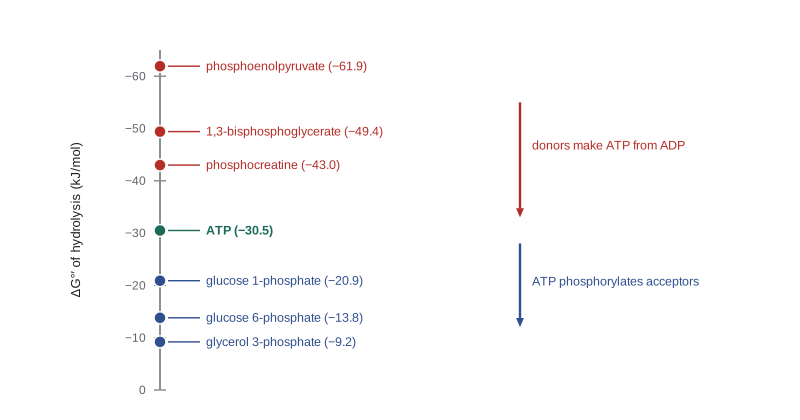
| Compound | ΔG°′ of hydrolysis (kJ/mol) |
|---|---|
| Phosphoenolpyruvate | −61.9 |
| 1,3-Bisphosphoglycerate | −49.4 |
| Phosphocreatine | −43.0 |
| ATP → ADP + Pi | −30.5 |
| ATP → AMP + PPi | −45.6 |
| Glucose 1-phosphate | −20.9 |
| Glucose 6-phosphate | −13.8 |
| Glycerol 3-phosphate | −9.2 |
The table shows why ATP is so useful. It sits in the middle of the scale. Compounds above it, with more negative free energies of hydrolysis, such as phosphoenolpyruvate and 1,3-bisphosphoglycerate, can transfer their phosphate to ADP and so make ATP; this happens in glycolysis. Compounds below it, such as glucose and glycerol, can accept phosphate from ATP. ATP therefore acts as a carrier that takes phosphate groups, and the energy that goes with them, from the reactions of fuel breakdown to the reactions that need them. Phosphocreatine serves as a reserve in muscle: during a sprint, the enzyme creatine kinase transfers its phosphate to ADP and keeps ATP levels steady for the first few seconds of intense effort.
How ATP drives work
ATP rarely drives a reaction simply by being hydrolysed nearby. Instead it usually transfers part of itself to a substrate or an enzyme, creating a reactive intermediate. When glutamine is made from glutamate and ammonia, the enzyme glutamine synthetase first transfers the gamma phosphate of ATP to glutamate, forming a phosphorylated intermediate that ammonia can attack. When amino acids are attached to their tRNAs before protein synthesis, ATP transfers its AMP part to the amino acid, releasing pyrophosphate (PPi), which is then hydrolysed by pyrophosphatase; that second hydrolysis pulls the reaction firmly forward. In muscle contraction and in pumps such as the sodium-potassium ATPase, binding ATP, hydrolysing it and releasing ADP and phosphate drives a cycle of shape changes in the protein, which does mechanical or osmotic work.
The amount of ATP turned over is astonishing. An adult human contains only about 50 grams of ATP at any moment, enough to supply energy for about a minute, yet uses roughly their own body weight in ATP every day. Each ATP molecule is therefore recycled from ADP more than a thousand times a day. Cells cannot store ATP in bulk; they store fuels such as glycogen and fat and regenerate ATP from them continuously.
Oxidation and reduction
Much of the energy that cells use comes from oxidizing fuels, and many reactions of metabolism are oxidation-reduction reactions, or redox reactions, in which electrons pass from one molecule to another. The molecule that loses electrons is oxidized; the one that gains them is reduced. In biochemistry electrons often move together with protons, as hydrogen atoms or as a hydride ion (H⁻, a proton with two electrons), so oxidation frequently appears as the removal of hydrogen. Enzymes that do this are called dehydrogenases.
The tendency of a molecule to accept electrons is measured by its standard reduction potential, E°′, in volts. Electrons flow spontaneously from a carrier with a more negative E°′ to one with a more positive E°′, and the free energy released is ΔG°′ = −nFΔE°′, where n is the number of electrons transferred and F is the Faraday constant, 96,485 C/mol. Oxygen is at the top of the scale, with E°′ = +0.82 V for its reduction to water, which is why oxidizing fuels with oxygen releases so much energy.
Cells use a few carriers to collect electrons from fuels. Nicotinamide adenine dinucleotide, NAD⁺, accepts a hydride ion to become NADH; its E°′ is −0.32 V. The closely related NADP⁺ carries an extra phosphate and, as NADPH, supplies electrons for biosynthesis, such as the building of fatty acids. Flavin adenine dinucleotide, FAD, accepts two electrons and two protons to become FADH₂, usually while bound tightly to its enzyme. NAD⁺ and FAD are made from the vitamins niacin and riboflavin. The cell keeps NAD⁺ mostly oxidized, ready to accept electrons from fuels, and NADP⁺ mostly reduced, ready to donate them for synthesis, so that the two pools serve opposite purposes.
Passing two electrons from NADH to oxygen releases ΔG°′ = −2 × 96,485 × (0.82 − (−0.32)) = −220 kJ/mol, enough in principle to make several ATP. Lesson 11 shows how the mitochondria capture that energy in steps, using a chain of carriers with progressively more positive reduction potentials and a gradient of protons across the inner membrane.
Catabolism and anabolism
Metabolism, the sum of all the chemical reactions of a cell, has two sides. Catabolism breaks down fuels such as glucose, fatty acids and amino acids into small molecules, ultimately carbon dioxide and water, releasing free energy that is captured as ATP and as reduced carriers such as NADH and NADPH. Anabolism builds the cell's own complex molecules from simple precursors, consuming ATP and NADPH. The two are linked by the common currencies, ATP and the electron carriers, which pass from the catabolic reactions that make them to the anabolic reactions that spend them.
Catabolism converges. Hundreds of different fuel molecules are broken down to a few common intermediates, above all acetyl-CoA, which enters the citric acid cycle. Anabolism diverges, starting from those same few intermediates and building thousands of different products. Catabolic and anabolic pathways between the same two points always differ in at least one step, so that both can be favourable and they can be controlled separately; otherwise the cell would be running the same reactions forward and backward at once and would get nowhere. Lesson 12 returns to this principle when it looks at glycolysis and its reverse, gluconeogenesis.
A worked example: the real ΔG of ATP hydrolysis
Worked problem
ATP hydrolysis in a liver cell
In a liver cell at 37 °C, [ATP] = 3.5 mM, [ADP] = 1.5 mM and [Pi] = 5.0 mM. Given ΔG°′ = −30.5 kJ/mol, calculate the actual ΔG for ATP hydrolysis.
Show solution
- Write the mass-action ratio: Q = [ADP][Pi]/[ATP] = (1.5 × 10⁻³)(5.0 × 10⁻³)/(3.5 × 10⁻³) = 2.14 × 10⁻³ (in molar units).
- RT at 310 K = 8.314 × 310 = 2,577 J/mol.
- ln Q = ln(2.14 × 10⁻³) = −6.15.
- ΔG = −30,500 + 2,577 × (−6.15) = −30,500 − 15,800 = −46,300 J/mol.
- The actual ΔG is about −46 kJ/mol, half as large again as ΔG°′. With magnesium binding and the free concentrations of ADP and Pi in real cells taken into account, estimates usually fall between −50 and −60 kJ/mol.
Answer: ΔG ≈ −46 kJ/mol, much more negative than the standard value of −30.5 kJ/mol.
A program: free energy in the cell
The program calculates the equilibrium constant that goes with several standard free energy changes, the actual ΔG of ATP hydrolysis over a range of cellular conditions, and the free energy released when electrons pass between carriers with different reduction potentials.
import math

R, F = 8.314, 96485.0
T = 310.0                      # 37 C

# 1. Standard free energy change and the equilibrium constant
print("dG0' (kJ/mol)   K'eq at 37 C")
for dg0 in (-30.5, -13.8, -5.7, 0.0, 5.7, 13.8):
    k = math.exp(-dg0 * 1000 / (R * T))
    print(f"{dg0:12.1f} {k:15.3g}")

# 2. Actual dG of ATP hydrolysis for different cell states (concentrations in mM)
print()
print("state                ATP   ADP    Pi   dG (kJ/mol)")
states = [("liver cell", 3.5, 1.5, 5.0), ("resting muscle", 8.0, 0.9, 8.0),
          ("exhausted muscle", 4.0, 3.0, 25.0), ("standard state", 1000, 1000, 1000)]
for name, atp, adp, pi in states:
    q = (adp / 1000) * (pi / 1000) / (atp / 1000)
    dg = -30.5 + R * T * math.log(q) / 1000
    print(f"{name:18s} {atp:6.1f} {adp:5.1f} {pi:5.1f} {dg:10.1f}")

# 3. Electron transfer: dG0' = -n F dE0'
print()
pairs = [("NADH to O2", -0.32, 0.82), ("NADH to ubiquinone", -0.32, 0.045),
         ("FADH2 (succinate) to O2", 0.031, 0.82), ("cytochrome c to O2", 0.254, 0.82)]
for name, donor, acceptor in pairs:
    dg = -2 * F * (acceptor - donor) / 1000
print(f"{name:24s} dE0' = {acceptor - donor:+.3f} V dG0' = {dg:7.1f} kJ/mol per 2 electrons")dG0' (kJ/mol) K'eq at 37 C
-30.5 1.38e+05
-13.8 212
-5.7 9.13
0.0 1
5.7 0.11
13.8 0.00473
state ATP ADP Pi dG (kJ/mol)
liver cell 3.5 1.5 5.0 -46.3
resting muscle 8.0 0.9 8.0 -48.6
exhausted muscle 4.0 3.0 25.0 -40.7
standard state 1000.0 1000.0 1000.0 -30.5
NADH to O2 dE0' = +1.140 V dG0' = -220.0 kJ/mol per 2 electrons
NADH to ubiquinone dE0' = +0.365 V dG0' = -70.4 kJ/mol per 2 electrons
FADH2 (succinate) to O2 dE0' = +0.789 V dG0' = -152.3 kJ/mol per 2 electrons
cytochrome c to O2 dE0' = +0.566 V dG0' = -109.2 kJ/mol per 2 electronsThe first table shows how steeply the equilibrium constant depends on free energy: the −30.5 kJ/mol of ATP hydrolysis corresponds to an equilibrium constant of about 140,000, so at equilibrium almost no ATP would remain. Cells keep ATP far from that equilibrium, which is what gives it its power. The second table shows that the free energy available from ATP depends on the state of the cell. Resting muscle, with a high ATP to ADP ratio, gets about −49 kJ/mol from each ATP in this simple calculation; exhausted muscle, with more ADP and phosphate, gets about −41 kJ/mol, one of the reasons fatigued muscle works less well. (Allowing for the free rather than total ADP, which is mostly bound to proteins, pushes the real values toward −55 to −60 kJ/mol.) The third table previews Lesson 11: the largest single release of energy in the respiratory chain is the final step to oxygen.
Common mistakes
MistakeA negative ΔG means a reaction will happen quickly.
InsteadΔG tells only whether a reaction can proceed; its speed depends on the activation energy and on enzymes.
MistakeΔG°′ tells you whether a reaction runs forward in the cell.
InsteadThe actual ΔG depends on real concentrations; a reaction with positive ΔG°′ can run forward if its products are kept low.
MistakeEnergy is stored inside the high-energy bonds of ATP and released when they break.
InsteadBreaking any bond takes energy; the free energy comes from the difference between ATP plus water and the more stable, better-solvated products.
MistakeCells keep large stores of ATP to use when needed.
InsteadThe body holds only about 50 g of ATP, recycled from ADP more than a thousand times a day; fuels such as fat and glycogen are the stores.
MistakeMixing an exergonic and an endergonic reaction makes the endergonic one go.
InsteadThey must be coupled through a shared intermediate or a single enzyme mechanism.
MistakeNADH and NADPH are interchangeable.
InsteadNADH mainly carries electrons from fuel oxidation to the respiratory chain; NADPH supplies electrons for biosynthesis, and the cell keeps the two pools in opposite states.
Summary and key terms
- The sign of ΔG decides whether a reaction can proceed; ΔG = ΔG°′ + RT ln Q, and ΔG°′ = −RT ln K′eq.
- Free energy changes add, so cells drive endergonic reactions by coupling them to exergonic ones such as ATP hydrolysis through shared intermediates.
- ATP hydrolysis releases about −30.5 kJ/mol under standard conditions and −50 to −60 kJ/mol in cells; ATP carries phosphate and energy from catabolism to the work of the cell.
- Redox reactions move electrons from carriers of lower to higher reduction potential, with ΔG°′ = −nFΔE°′; NADH and FADH₂ collect electrons from fuels and NADPH supplies them for synthesis.
- Catabolism converges on a few intermediates and produces ATP and reduced carriers; anabolism diverges from them and consumes those currencies.
- Exergonic
- Having a negative free energy change; able to proceed spontaneously.
- Endergonic
- Having a positive free energy change; requiring an input of free energy.
- Standard free energy change (ΔG°′)
- The free energy change at 1 M reactants and products, pH 7 and 25 °C.
- Phosphoanhydride bond
- The bond linking two phosphate groups, as in ATP and ADP.
- Reduction potential (E°′)
- A measure, in volts, of the tendency of a molecule to accept electrons.
- NAD⁺
- An electron carrier that accepts a hydride ion from fuels to become NADH.
- Catabolism
- The part of metabolism that breaks molecules down and releases energy.
Practice problems
Work each problem on paper first, then reveal the answer to check.
A reaction has K′eq = 0.01 at 25 °C. What is ΔG°′?
Show answer
ΔG°′ = −RT ln K = −8.314 × 298 × ln 0.01 = +11.4 kJ/mol.
Can a reaction with ΔG°′ = +7.5 kJ/mol proceed in a cell? Under what condition?
Show answer
Yes, if the ratio of products to reactants is kept low enough that RT ln Q is more negative than −7.5 kJ/mol, for example below about 0.05 at 25 °C.
Glucose 1-phosphate is converted to glucose 6-phosphate. Using the table, find ΔG°′.
Show answer
ΔG°′ = −20.9 − (−13.8) = −7.1 kJ/mol.
Why can phosphoenolpyruvate make ATP from ADP but glucose 6-phosphate cannot?
Show answer
PEP's free energy of hydrolysis (−61.9 kJ/mol) is more negative than ATP's, while glucose 6-phosphate's (−13.8) is less negative.
Calculate ΔG°′ for transferring two electrons from NADH (−0.32 V) to a carrier with E°′ = +0.22 V.
Show answer
ΔG°′ = −2 × 96,485 × 0.54 = −104 kJ/mol.
If a person uses 60 kg of ATP a day and contains 50 g at a time, how many times a day is each ATP recycled?
Show answer
60,000/50 = 1,200 times.
Lesson quiz · 5 questions
Score 60% or more to complete this lesson.
Create a free account to save your progress, take quizzes and earn a certificate.