
BIOC-200 · Lesson 10 of 12 · 24 min
Glycolysis
▶ Video coming soon A video version of this lesson is on the way.
Glycolysis, from the Greek for splitting sugar, is the pathway that breaks one molecule of glucose into two molecules of pyruvate. It takes ten steps, each catalysed by its own enzyme, and it runs in the cytosol of almost every cell of almost every organism on Earth. It needs no oxygen. In its course the cell gains two molecules of ATP and two of NADH for each glucose. That is a small fraction of the energy in glucose, but glycolysis can run fast, and for some cells, such as red blood cells, which have no mitochondria, it is the only source of ATP. It was also the first metabolic pathway to be worked out, between about 1897, when Eduard Buchner showed that a cell-free yeast extract could ferment sugar, and the 1940s; Gustav Embden, Otto Meyerhof and Jakub Parnas made major contributions, and the pathway is often called the Embden–Meyerhof pathway.
Glycolysis falls into two stages. In the first, the preparatory or investment phase of five steps, the cell spends two ATP to phosphorylate glucose and split it into two three-carbon sugar phosphates. In the second, the payoff phase of five steps, each three-carbon unit is oxidized and converted to pyruvate, yielding two ATP and one NADH per unit, so four ATP and two NADH in all. Net, the cell gains two ATP per glucose.
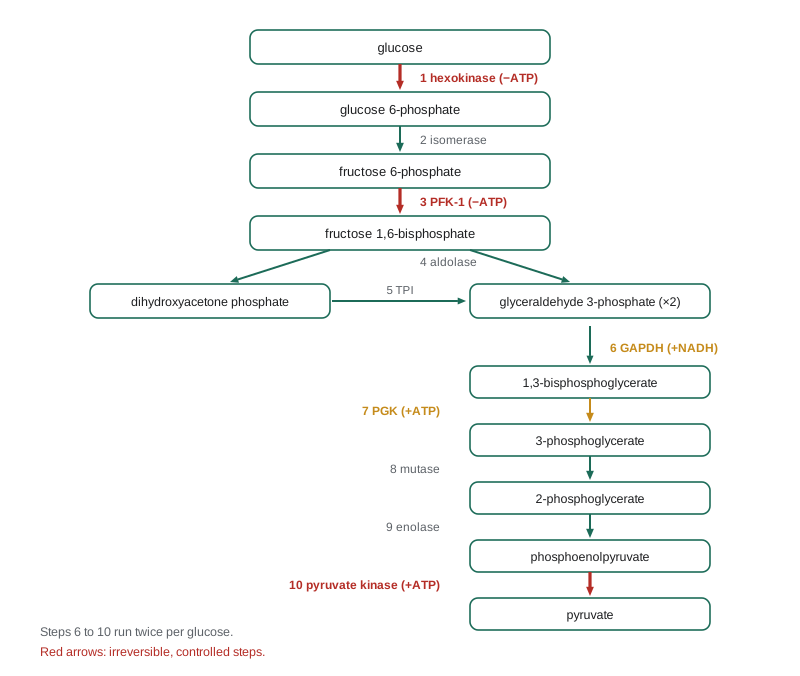
The preparatory phase
Step 1. Hexokinase transfers a phosphate from ATP to the hydroxyl group on carbon 6 of glucose, forming glucose 6-phosphate. The reaction is strongly favourable (ΔG°′ = −16.7 kJ/mol), as Lesson 9 showed, and in the cell it is effectively irreversible. Adding a charged phosphate traps glucose inside the cell, because the glucose transporters do not carry glucose 6-phosphate. In the liver a related enzyme, glucokinase, does the same job; it has a much higher KM for glucose, about 10 mM compared with less than 0.1 mM for hexokinase, so it works mainly when blood glucose is high after a meal, letting the liver take up and store the excess.
Step 2. Phosphoglucose isomerase converts glucose 6-phosphate, an aldose, into fructose 6-phosphate, a ketose. The reaction is readily reversible. Its purpose is to move the carbonyl group to carbon 2, which prepares the molecule to be split symmetrically two steps later.
Step 3. Phosphofructokinase-1 (PFK-1) transfers a second phosphate from ATP to carbon 1, forming fructose 1,6-bisphosphate. This is the committed step of glycolysis: once fructose 1,6-bisphosphate has been made, it has no other use than to continue down the pathway. The reaction is strongly favourable and irreversible in the cell, and PFK-1 is the main point at which the speed of glycolysis is controlled.
Step 4. Aldolase splits fructose 1,6-bisphosphate between carbons 3 and 4 into two three-carbon sugar phosphates: dihydroxyacetone phosphate (DHAP), from carbons 1 to 3, and glyceraldehyde 3-phosphate (GAP), from carbons 4 to 6. The reaction has a large positive ΔG°′ of +23.8 kJ/mol, so under standard conditions it would run backward. In the cell, the concentrations of the products are kept very low, and because one molecule becomes two, the low concentrations favour the forward direction strongly: the actual ΔG is close to zero.
Step 5. Triose phosphate isomerase converts DHAP into GAP. Only GAP can continue down the pathway, so this step ensures that both halves of glucose are used. Triose phosphate isomerase is one of the catalytically perfect enzymes mentioned in Lesson 5, working at the limit set by diffusion. At the end of the preparatory phase, one glucose has become two molecules of GAP, at a cost of two ATP.
The payoff phase
Every step of the payoff phase happens twice for each glucose, once for each GAP.
Step 6. Glyceraldehyde 3-phosphate dehydrogenase oxidizes the aldehyde group of GAP and, at the same time, attaches inorganic phosphate to it, forming 1,3-bisphosphoglycerate. The electrons removed reduce NAD⁺ to NADH. This is the only oxidation in glycolysis, and it is a beautiful example of energy coupling: the energy released by oxidizing the aldehyde is not lost as heat but captured in a new acyl-phosphate bond, which has a very high free energy of hydrolysis (−49.4 kJ/mol). The enzyme forms a covalent intermediate with the substrate through a cysteine in its active site, so that the oxidation and the phosphorylation are linked.
Step 7. Phosphoglycerate kinase transfers the high-energy phosphate of 1,3-bisphosphoglycerate to ADP, forming ATP and 3-phosphoglycerate. Making ATP by transferring phosphate directly from a substrate molecule like this is called substrate-level phosphorylation, to distinguish it from the oxidative phosphorylation of mitochondria. Since this step happens twice per glucose, the two ATP invested in the preparatory phase are now repaid.
Step 8. Phosphoglycerate mutase moves the phosphate from carbon 3 to carbon 2, forming 2-phosphoglycerate.
Step 9. Enolase removes a molecule of water, forming phosphoenolpyruvate (PEP). This small change has a large effect: the phosphate is now attached to an enol, a form that is unstable on its own. When the phosphate is removed, the enol rearranges into a ketone, and that rearrangement releases a great deal of energy. As a result, PEP has the highest free energy of hydrolysis of any common phosphate compound (−61.9 kJ/mol). Fluoride, once added to blood samples to stop glycolysis in the tube before glucose was measured, works by inhibiting enolase.
Step 10. Pyruvate kinase transfers the phosphate of PEP to ADP, forming ATP and pyruvate. The reaction is strongly favourable and irreversible, and it is the third point of control. It too happens twice per glucose, giving the net gain of two ATP.
The overall reaction of glycolysis is:
| Step | Enzyme | ATP or NADH per glucose | ΔG in the cell |
|---|---|---|---|
| 1 | Hexokinase | −1 ATP | Large and negative (irreversible) |
| 2 | Phosphoglucose isomerase | Near zero | |
| 3 | Phosphofructokinase-1 | −1 ATP | Large and negative (irreversible) |
| 4 | Aldolase | Near zero | |
| 5 | Triose phosphate isomerase | Near zero | |
| 6 | Glyceraldehyde 3-phosphate dehydrogenase | +2 NADH | Near zero |
| 7 | Phosphoglycerate kinase | +2 ATP | Near zero |
| 8 | Phosphoglycerate mutase | Near zero | |
| 9 | Enolase | Near zero | |
| 10 | Pyruvate kinase | +2 ATP | Large and negative (irreversible) |
Control of glycolysis
In a working cell, seven of the ten steps run close to equilibrium, with an actual ΔG near zero, so they can run in either direction depending on concentrations. The other three, catalysed by hexokinase, PFK-1 and pyruvate kinase, are far from equilibrium and essentially one-way. These are the steps the cell regulates, because controlling an irreversible step controls the flow through the whole pathway, much as a dam controls the flow of a river.
PFK-1 is the most important control point. It is an allosteric enzyme with four subunits and sigmoid kinetics, and it reads the energy state of the cell. High ATP inhibits it: ATP binds to a regulatory site as well as the active site, so when the cell has plenty of energy, glycolysis slows. AMP and ADP, which accumulate when ATP is being used up, relieve that inhibition. Citrate, an intermediate of the citric acid cycle, also inhibits PFK-1, signalling that the cell has enough fuel entering its mitochondria. The most powerful activator is fructose 2,6-bisphosphate, made by a separate enzyme under the control of hormones. In the liver, insulin, released after a meal, raises fructose 2,6-bisphosphate and speeds glycolysis, while glucagon, released when blood glucose is low, lowers it and slows glycolysis so that the liver can instead make glucose for the rest of the body.
Hexokinase is inhibited by its own product, glucose 6-phosphate, so if the later steps slow down and glucose 6-phosphate accumulates, glucose uptake slows too. Pyruvate kinase is activated by fructose 1,6-bisphosphate, an example of feed-forward activation, in which an early intermediate prepares a later step for the material on its way. It is inhibited by ATP and alanine, and in the liver it is switched off by phosphorylation when glucagon is present.
The fates of pyruvate
Glycolysis can continue only as long as there is NAD⁺ for step 6. A cell contains only a small amount of NAD⁺, so the NADH made in glycolysis must be reoxidized for the pathway to keep running. What happens next depends on whether oxygen is available.
With oxygen, in cells with mitochondria, pyruvate enters the mitochondria and is converted to acetyl-CoA, which is oxidized completely to carbon dioxide in the citric acid cycle. The NADH passes its electrons, indirectly, to the respiratory chain, which regenerates NAD⁺ and makes much more ATP. This aerobic route, described in Lesson 11, extracts about fifteen times as much ATP from glucose as glycolysis alone.
Without enough oxygen, cells regenerate NAD⁺ by fermentation. In lactic acid fermentation, lactate dehydrogenase uses NADH to reduce pyruvate to lactate. Muscles do this during intense exercise when oxygen supply cannot keep up with demand, and red blood cells do it all the time. The lactate passes into the blood, and the liver converts it back into glucose, a cycle described by Carl and Gerty Cori, who shared the 1947 Nobel Prize in Physiology or Medicine. Lactate also helps make yogurt and sauerkraut, through bacteria that produce it. In alcoholic fermentation, yeast and some bacteria first remove carbon dioxide from pyruvate to form acetaldehyde, then reduce acetaldehyde to ethanol with NADH. The carbon dioxide raises bread, and the ethanol is the alcohol of beer and wine.
For many years the burning sensation and fatigue of hard exercise were blamed on lactic acid. The current view is that lactate itself does no harm and is a valuable fuel; heart muscle and slower muscle fibres take it up and oxidize it. Fatigue has several causes, including the accumulation of phosphate and changes in the handling of calcium and protons within muscle cells.
Other sugars and a famous quirk
Other sugars enter glycolysis at various points. Fructose, from fruit and from sucrose, is phosphorylated in the liver and split into DHAP and glyceraldehyde, bypassing PFK-1, which is one reason large amounts of fructose are metabolized differently from glucose and can promote fat synthesis in the liver. Galactose, from lactose, is converted to glucose 6-phosphate through a short series of reactions; people who lack one of those enzymes have galactosemia and must avoid milk from infancy.
Cancer cells show a quirk first noticed by Otto Warburg in the 1920s: many of them take up glucose avidly and ferment much of it to lactate even when oxygen is plentiful. The Warburg effect is thought to help rapidly dividing cells by supplying building blocks for new molecules as well as energy. It also has a practical use. In PET scanning, patients receive a radioactive glucose analogue, fluorodeoxyglucose, which cells take up and phosphorylate with hexokinase but cannot process further. Tumours, which take up more of it, appear as bright spots on the scan.
A worked example: the energy captured by glycolysis
Worked problem
How efficient is glycolysis?
The conversion of glucose to two lactate has ΔG°′ = −196 kJ/mol. Glycolysis to lactate makes 2 ATP per glucose. Assuming ATP synthesis requires +30.5 kJ/mol under standard conditions, what fraction of the free energy is captured as ATP? Repeat using a cellular value of +50 kJ/mol for ATP synthesis. Then compare with the complete oxidation of glucose, ΔG°′ = −2,870 kJ/mol, which yields about 30 ATP.
Show solution
- Standard: 2 × 30.5 = 61 kJ captured. Efficiency = 61/196 = 31%.
- Cellular: 2 × 50 = 100 kJ captured; the free energy released by glucose to lactate in the cell is also somewhat larger than 196 kJ, so the efficiency is roughly 100/200 = 50%.
- Complete oxidation: 30 × 30.5 = 915 kJ captured out of 2,870, a standard efficiency of 32%; with cellular values, roughly 30 × 50 = 1,500 kJ, or about 50%.
- In absolute terms, glycolysis to lactate releases only 196/2,870 = 6.8% of the free energy available from glucose; most of the energy is still in the lactate.
Answer: Glycolysis captures roughly a third of its free energy release as ATP under standard conditions (about half in the cell), but it releases only about 7% of the energy in glucose.
A program: glycolysis by the numbers
The program tracks carbon atoms, ATP and NADH through the ten steps for one glucose, confirming the balance sheet, and then calculates the actual free energy of the aldolase step at typical concentrations in red blood cells, showing how a reaction with a large positive standard free energy can run forward in the cell.
import math

# step name, ATP change, NADH change (per glucose), copies per glucose
steps = [
    ("hexokinase", -1, 0, 1), ("phosphoglucose isomerase", 0, 0, 1),
    ("phosphofructokinase-1", -1, 0, 1), ("aldolase", 0, 0, 1),
    ("triose phosphate isomerase", 0, 0, 1),
    ("GAP dehydrogenase", 0, 1, 2), ("phosphoglycerate kinase", 1, 0, 2),
    ("phosphoglycerate mutase", 0, 0, 2), ("enolase", 0, 0, 2),
    ("pyruvate kinase", 1, 0, 2),
]
atp = nadh = 0
for name, d_atp, d_nadh, copies in steps:
    atp += d_atp * copies
    nadh += d_nadh * copies
    print(f"{name:28s} running totals: ATP {atp:+d}, NADH {nadh:+d}")
print(f"net per glucose: {atp} ATP, {nadh} NADH, 2 pyruvate (6 carbons in, 2 x 3 out)")

# Aldolase: FBP -> DHAP + GAP, dG0' = +23.8 kJ/mol; concentrations in red blood cells (M)
R, T = 8.314, 310.0
dg0 = 23.8
fbp, dhap, gap = 31e-6, 138e-6, 18.5e-6
q = dhap * gap / fbp
dg = dg0 + R * T * math.log(q) / 1000
print()
print(f"aldolase: Q = {q:.2e} M, dG = {dg0} + RT ln Q = {dg:.1f} kJ/mol")
# The same reaction if all three were at 1 mM
q1 = 1e-3 * 1e-3 / 1e-3
print(f"at 1 mM each: dG = {dg0 + R * T * math.log(q1) / 1000:.1f} kJ/mol")hexokinase running totals: ATP -1, NADH +0 phosphoglucose isomerase running totals: ATP -1, NADH +0 phosphofructokinase-1 running totals: ATP -2, NADH +0 aldolase running totals: ATP -2, NADH +0 triose phosphate isomerase running totals: ATP -2, NADH +0 GAP dehydrogenase running totals: ATP -2, NADH +2 phosphoglycerate kinase running totals: ATP +0, NADH +2 phosphoglycerate mutase running totals: ATP +0, NADH +2 enolase running totals: ATP +0, NADH +2 pyruvate kinase running totals: ATP +2, NADH +2 net per glucose: 2 ATP, 2 NADH, 2 pyruvate (6 carbons in, 2 x 3 out) aldolase: Q = 8.24e-05 M, dG = 23.8 + RT ln Q = -0.4 kJ/mol at 1 mM each: dG = 6.0 kJ/mol
The running totals show the cell in debt by two ATP until step 7, breaking even after step 7 and ending with a net gain of two ATP and two NADH. For aldolase, the low concentrations in red blood cells bring the actual ΔG down from +23.8 kJ/mol to a small negative value, so the reaction runs forward. If all three compounds were at 1 mM, the reaction would still be uphill, at about +6 kJ/mol; it is the very low concentrations of the products, kept low by the steps that follow, that pull it forward.
Common mistakes
MistakeGlycolysis produces four ATP per glucose.
InsteadIt produces four but spends two in the preparatory phase, for a net gain of two.
MistakeGlycolysis requires oxygen.
InsteadGlycolysis itself is anaerobic; oxygen is needed only to oxidize pyruvate and NADH in the mitochondria.
MistakeAll ten reactions of glycolysis are irreversible.
InsteadOnly the hexokinase, PFK-1 and pyruvate kinase steps are far from equilibrium; the other seven run close to equilibrium.
MistakeLactate is a waste product that causes muscle soreness.
InsteadLactate is recycled by the liver and used as fuel by heart and other muscles; fermentation to lactate regenerates NAD⁺ so glycolysis can continue.
MistakeA reaction with positive ΔG°′, like aldolase, cannot run forward in a cell.
InsteadIts actual ΔG depends on concentrations, and keeping the products low makes it slightly negative.
MistakeFermentation produces extra ATP from pyruvate.
InsteadFermentation makes no extra ATP; its purpose is to regenerate NAD⁺ from NADH.
Summary and key terms
- Glycolysis converts one glucose to two pyruvate in ten cytosolic steps, with a net yield of 2 ATP and 2 NADH.
- The preparatory phase spends 2 ATP and splits fructose 1,6-bisphosphate into two triose phosphates; the payoff phase oxidizes each and makes 2 ATP by substrate-level phosphorylation.
- Hexokinase, phosphofructokinase-1 and pyruvate kinase catalyse irreversible steps and are the points of control; PFK-1, the committed step, responds to ATP, AMP, citrate and fructose 2,6-bisphosphate.
- NAD⁺ must be regenerated: aerobically through the mitochondria, or anaerobically by fermentation to lactate or ethanol.
- Other sugars enter glycolysis at intermediate points, and many cancer cells rely heavily on glycolysis even with oxygen present.
- Glycolysis
- The ten-step pathway that breaks glucose into two pyruvate in the cytosol.
- Committed step
- The first irreversible step whose product has no other use than to continue in the pathway.
- Substrate-level phosphorylation
- Making ATP by direct transfer of a phosphate from a high-energy substrate to ADP.
- Phosphofructokinase-1
- The enzyme of the committed step of glycolysis and its main control point.
- Fermentation
- Anaerobic metabolism that regenerates NAD⁺ by reducing pyruvate or a product of it.
- Fructose 2,6-bisphosphate
- A regulator, controlled by hormones, that strongly activates phosphofructokinase-1.
- Warburg effect
- The tendency of many cancer cells to ferment glucose to lactate even when oxygen is available.
Practice problems
Work each problem on paper first, then reveal the answer to check.
Which steps of glycolysis use ATP and which make it?
Show answer
Steps 1 (hexokinase) and 3 (PFK-1) use ATP; steps 7 (phosphoglycerate kinase) and 10 (pyruvate kinase) make it, twice each per glucose.
Why would a muscle cell stop making ATP by glycolysis if it could not regenerate NAD⁺?
Show answer
Step 6 needs NAD⁺; without it GAP cannot be oxidized and the payoff phase stops.
How does a high level of ATP slow glycolysis?
Show answer
ATP binds an allosteric site on PFK-1 and inhibits it.
Glucokinase has a KM for glucose of about 10 mM. Why does this suit the liver?
Show answer
It works mainly when blood glucose is high, after a meal, so the liver takes up glucose only when there is a surplus.
What are the products of alcoholic fermentation?
Show answer
Ethanol and carbon dioxide, with NAD⁺ regenerated.
Fluorodeoxyglucose accumulates in tumours on a PET scan. Why does it stay in the cell?
Show answer
Hexokinase phosphorylates it, trapping it, but the next enzyme cannot process it further.
Lesson quiz · 5 questions
Score 60% or more to complete this lesson.
Create a free account to save your progress, take quizzes and earn a certificate.