
BAS-410 · Lesson 9 of 12 · 21 min
Training the building operators
▶ Video coming soon A video version of this lesson is on the way.
The last line of Marlow Lane's owner's project requirements asked for training for the operators before the warranty starts. The handover on November 5 came first, because the building had to keep running on the new controls, so the training is planned for Tuesday, November 24, with Ivo leading it and Philippa attending to check it against the commissioning plan. The training tab of the binder held a two-page training plan, an agenda, a draft exercise sheet and an empty sign-in sheet. "Everything we did in this binder is wasted if Rowena's people cannot run the building," Ivo said. "The new controls are better than the old ones only if somebody uses them properly on a cold Monday morning in January."
Why training is part of commissioning
A building's controls are operated for twenty or thirty years by people who were not there when they were installed. If the operators do not understand the sequences, they work around them: they override a valve to stop a complaint, leave a fan in hand, raise a setpoint for everyone because one room is cold. Each workaround is reasonable on its own, and together they slowly undo what commissioning proved. That is why every commissioning standard treats training as a commissioning task, planned from the start and checked by the commissioning provider, rather than an afterthought at the end of the job.
In Canada, training requirements usually come from the project specification, which often references CSA Z320 or ASHRAE Guideline 0 and asks for a training plan, attendance records and a sign-off.
Training is also the last chance to hand over knowledge that is not written anywhere: why the static pressure maximum is lower than the design value, why AHU-1 waits for an operator restart after a fire alarm, which corner office will complain first on a cold morning.
Who is trained, and who trains
Different people need different things from the training. Ivo's plan named four audiences.
| Audience | On Marlow Lane | What they need |
|---|---|---|
| Building operators | Halvern's two operators at Marlow Lane, Teodor Lisk and Maeve Corrigan | Daily operation, alarms, schedules, overrides, trends, first response to complaints, and the equipment itself |
| Property manager | Rowena Strand | What the system can do, reports, energy and comfort information, who to call, the warranty |
| On-call and service staff | Halvern's after-hours on-call operator and its mechanical service contractor | Remote access, alarm response, safe restarts, what not to change |
| Future staff | Whoever replaces any of the above | Recorded sessions and written materials that do not depend on a person |
The controls contractor gives most of the controls training, because it built the system. The design engineer should explain the intent of the sequences, at least for the major systems; on Marlow Lane the consulting engineer agreed to give the first half hour on the system design and why the sequences are written as they are. The commissioning provider reviews the training plan, attends, and records whether the training met the plan's objectives. Equipment suppliers sometimes train on their own equipment; the boiler supplier's service technician had already trained Teodor on the boilers at startup in the summer.
The training plan
A training plan is written before the training, reviewed by the commissioning provider, and agreed with the owner. It answers the same questions as a test script: what will be covered, for whom, by whom, how, how long, and how anyone will know it worked.
| Plan section | Marlow Lane |
|---|---|
| Objectives | After training, each operator can perform the tasks on the exercise sheet without help |
| Audiences and attendance | Both operators and Rowena for the full day; the on-call operator for the alarm and remote access sessions |
| Trainers | Ivo Bartek (Quillon); the consulting engineer for the design intent; Philippa attending |
| Content and agenda | Eight modules, in the classroom and at the equipment |
| Materials | Systems manual draft, plain-language sequence summaries, a one-page quick reference card, the exercise sheet |
| Recording | The classroom modules recorded on video with the operators' agreement; kept with the systems manual |
| Evaluation | Exercise sheet completed by each operator; Philippa records the result |
| Follow-up | A heating-season session in January 2027 and a cooling-season session in May 2027 (plans) |
The objectives line is the one that makes the plan testable. "Operators will be trained on the BAS" can be ticked off whether anyone learned anything. "Each operator can change a schedule, add a holiday, acknowledge and respond to an alarm, read a trend and release an override without help" can be checked.
The agenda
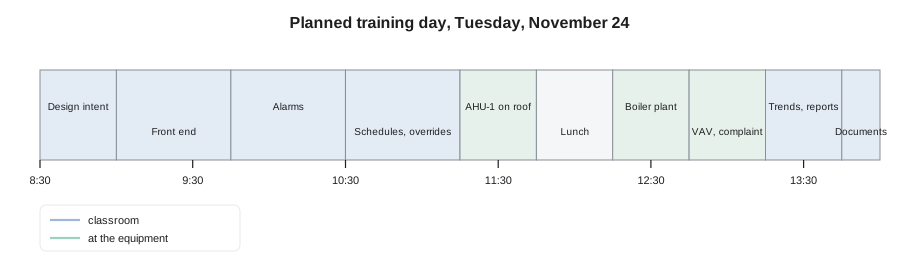
| Time | Module | Where | Hours |
|---|---|---|---|
| 8:30 | Design intent and system overview (consulting engineer) | Classroom | 0.5 |
| 9:00 | The front end: navigation, graphics, reading a system page | Classroom, at the operators' workstation | 0.75 |
| 9:45 | Alarms: priorities, acknowledgement, the on-call phone, first response | Classroom | 0.75 |
| 10:30 | Schedules, holidays, setpoints, overrides and releasing them | Classroom | 0.75 |
| 11:15 | Walk-through: AHU-1 on the roof (to 11:45); lunch; boiler plant (12:15 to 12:45) | At the equipment | 1.0 |
| 12:45 | VAV boxes and answering a comfort complaint | Third floor, at a box | 0.5 |
| 13:15 | Trends and reports | Classroom | 0.5 |
| 13:45 | Documents, warranty and who to call | Classroom | 0.25 |
Worked problem
Checking the agenda's hours
Add up the module hours. Quillon's estimate allowed 8 hours for training. If preparation (the exercise sheet, quick reference card and plain-language sequences) takes 3 hours, does the day fit the estimate?
Show solution
- Module hours: 0.5 + 0.75 + 0.75 + 0.75 + 1.0 + 0.5 + 0.5 + 0.25 = 5.0 hours.
- Delivery plus preparation: 5.0 + 3 = 8.0 hours.
Answer: Exactly 8 hours, which is the training line in Quillon's commissioning estimate. The two follow-up sessions in 2027 are in the warranty scope, not in this estimate.
The agenda alternates classroom and equipment. People remember a damper actuator they have put their hand on better than one in a slide, and an operator who has stood beside AHU-1 while Ivo explained the freeze protection device will know what to look at when it trips at 5:00 on a January morning.
Teaching the sequences in plain language
The sequences of operation in the specification are written for the people who programmed the system. Operators need the same information in a different form: what the system does in each situation, what they will see on the screen, and what they should and should not do. Ivo wrote a one-page plain-language summary for each system.
AHU-1 in plain language (extract from the training materials)
Morning start   About an hour before occupancy (earlier on cold days) the
                unit starts in warm-up: outdoor air damper closed, heating
                only, until the floors reach their heating setpoints.
Occupied        Supply air temperature is reset between its limits by the
                zone that needs the coolest air. Duct pressure is reset by
                the boxes that need the most air. Outdoor air never drops
                below the design minimum; the airflow station holds it.
Free cooling    When outdoor air is cool enough, the economizer opens the
                outdoor damper before any mechanical cooling runs.
Fire alarm      The fire alarm system stops the fans with its own wiring.
                After the fire alarm is reset, AHU-1 STAYS OFF until an
                operator restarts it from the front end. Look at the unit,
                then restart.
Freeze trip     The unit stops, the outdoor damper closes, the heating
                valve opens fully. Find out why before resetting.
Do not          Do not override the outdoor damper closed in winter to save
                heat; the building needs its outdoor air. Call Quillon
                instead if the coil area is cold.
The summary says what the operator will see and what to do, and it explains the two things most likely to surprise them: the restart after a fire alarm, and the freeze protection response. It also has a Do not line, because operators often learn their workarounds from the previous system, and Marlow Lane's old controls had let operators close the outdoor damper from the front end without any limit.
Hands-on exercises
The best evidence that training worked is an operator doing a task without help. Ivo's exercise sheet lists tasks that each operator will perform on the live system, with Philippa or Ivo watching, and the result recorded beside each name.
| Exercise | Done on | Checked by |
|---|---|---|
| Find AHU-1's supply air temperature, its setpoint and why it is at that value | Front end | Ivo |
| Acknowledge a test alarm, find its cause, and record the response | Front end and on-call phone | Ivo |
| Change the occupied hours of the third floor for one day, then restore them | Front end | Ivo |
| Add the first 2027 holiday to the holiday calendar | Front end | Ivo |
| Override a VAV box to maximum airflow, check the airflow, and release it | Front end and at the box | Philippa |
| Run the override report and confirm it is empty | Front end | Philippa |
| Show a 24-hour trend of a zone temperature with its setpoint | Front end | Philippa |
| Restart AHU-1 after a simulated fire alarm reset (the latch is set by a test command, not by the fire alarm system) | Front end | Philippa |
The last exercise needed care. A real fire alarm test needs the fire alarm contractor and the monitoring station, as BAS-340 described. The exercise instead sets the BAS latch from the front end with a test command that Sophie built for training and maintenance, so the operators can practise the restart without involving the fire alarm system at all. The commissioning plan records that the test command exists and that it is only an exercise of the BAS's own latch.
The holiday exercise connects to another plan: Rowena wants the 2027 holidays loaded before the end of December, and training is the natural time to show the operators how, so that they can load them themselves.
Answering a complaint
The module at a VAV box is built around the most common call an operator gets: a room is too hot or too cold. Ivo's method follows the one Callie learned at Tilden: start at the zone and work back toward the plant.
- Look at the zone on the front end: temperature, active setpoint, mode, airflow and airflow setpoint, valve position, discharge air temperature.
- Ask whether the box is doing what the sequence says. A box at maximum cooling airflow in a warm room is working; the problem is upstream or in the load.
- If the box is not doing what the sequence says, check overrides first, then the sensor, then the actuator and valve.
- Check upstream: is AHU-1's supply air at its setpoint, is the static pressure at its setpoint, is the plant supplying hot water?
- Record what you found and what you did, and release anything you overrode.
Ivo will use VAV-1-02, the corner office from the burn-in trends, as the example, because the operators will hear about it on the first cold mornings, and because its cause is still open in the issues log.
Recording the training
Training produces records, and the commissioning provider checks them. The Marlow Lane plan asks for a signed attendance sheet, the completed exercise sheet with a result for each operator, a copy of the materials, the video of the classroom modules, and Philippa's note of whether the objectives were met. These go into the systems manual (lesson 10). If an operator cannot do an exercise, the plan says the item is repeated in a short session before the January follow-up, not simply recorded as a failure.
Video recording is useful because staff change. It needs the agreement of the people in it, it should not show passwords or remote access details on screen, and it is no substitute for the hands-on exercises. Ivo planned to record only the classroom modules and to blur the login screen.
Worked problem
Planning the follow-up
Halvern's two operators and the on-call operator will attend the January and May follow-ups, each planned as 2 hours. Ivo and Philippa both attend each. How many person-hours of training time is that in total for the two follow-ups?
Show solution
- People per session: 3 operators + Ivo + Philippa = 5.
- Person-hours per session: 5 × 2 = 10.
- Two sessions: 10 × 2 = 20 person-hours.
Answer: 20 person-hours, of which 4 are Ivo's. The follow-ups are timed for the season each covers: January for heating, warm-up and freeze protection; May for cooling and the economizer, just before the deferred cooling tests in June.
Training on smaller jobs
Not every job has a training day. On the Ninefield rooftop units planned for December, the training will be an hour with Ilona's operator at the front end and on the roof after the checkout, covering the new RTU graphics, the economizer and what the units do on loss of communication, recorded on a one-page sign-off. The scale is different, but the principle is the same: the person who will run the equipment should be able to do the common tasks without calling the contractor.
Common mistakes
MistakeTreating a slide presentation as training.
InsteadCombine classroom explanation with time at the equipment and hands-on exercises on the live system.
MistakeWriting objectives that cannot be checked.
InsteadState tasks the operators will be able to do, and check them with an exercise sheet.
MistakeTraining only once, at handover.
InsteadPlan follow-up sessions for each season and record the classroom modules for future staff.
MistakeShowing passwords and remote access details in recorded sessions.
InsteadKeep credentials off screen and hand them over separately and securely.
Summary and key terms
- Training is a commissioning task: planned early, reviewed by the commissioning provider and recorded.
- Different audiences need different content: operators, managers, on-call and service staff, and future staff.
- A training plan sets objectives that can be checked, the agenda, trainers, materials, recording and evaluation.
- Plain-language sequence summaries and hands-on exercises on the live system make training stick.
- Seasonal follow-up sessions and recorded materials keep the knowledge in the building.
- Training plan
- The document setting out the objectives, audiences, agenda, trainers, materials and evaluation of operator training.
- Plain-language sequence
- A summary of a sequence of operation written for operators, describing what they will see and what to do.
- Exercise sheet
- A list of tasks that each trainee performs on the live system, with the result recorded.
- Follow-up session
- A later training session, often timed for a season, to reinforce and extend the first training.
- Training record
- Attendance, exercise results and materials kept as evidence that training was delivered.
Practice problems
Work each problem on paper first, then reveal the answer to check.
Why does the plain-language summary for AHU-1 include a Do not line?
Show answer
Operators often carry habits from the old system, such as closing the outdoor damper in winter, which would undo the design. Saying what not to do prevents the most likely workaround.
How can operators practise the restart after a fire alarm without involving the fire alarm system?
Show answer
Use the BAS test command that sets the BAS's own latch, so the restart is practised without operating any fire alarm device.
What makes a training objective checkable?
Show answer
It names tasks an operator can be seen doing, such as adding a holiday or releasing an override, without help.
Lesson quiz · 5 questions
Score 60% or more to complete this lesson.
Create a free account to save your progress, take quizzes and earn a certificate.