
BAS-410 · Lesson 3 of 12 · 22 min
Pre-functional checklists
▶ Video coming soon A video version of this lesson is on the way.
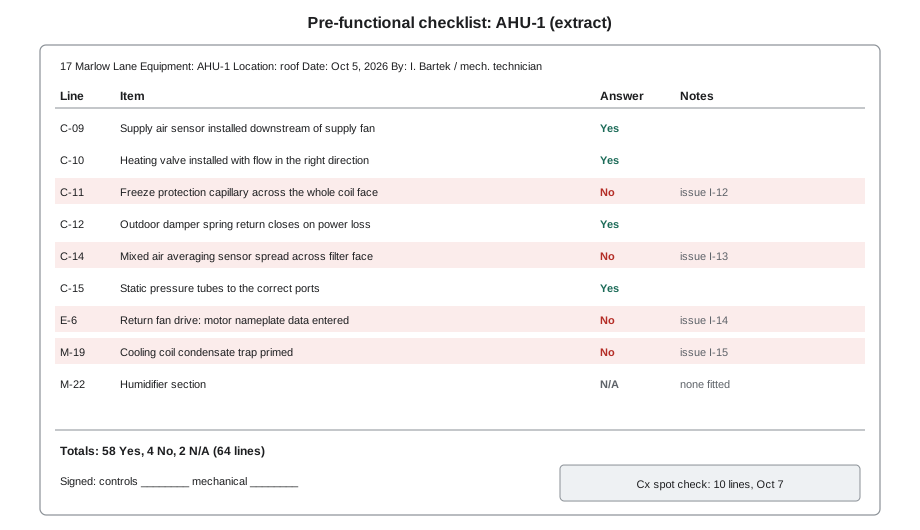
Behind the design review tab in the Marlow Lane binder was the thickest stack of paper in the file: 41 checklists, one for each piece of equipment the new controls touched. Most were a single page. AHU-1's ran to three, with 64 lines, and it had been filled in on the roof on Monday, October 5, by Ivo and the mechanical service contractor's technician, a week before balancing started. Four lines were marked No. "That page is the reason the AHU-1 functional test took two days instead of four," Ivo said. "Every No on it was fixed before anyone tried to test a sequence."
What a pre-functional checklist is
A pre-functional checklist is a list of items that must be true before a piece of equipment is started up and functionally tested: it is installed, connected, labelled, powered and ready. Guideline 0 calls these construction checklists, CSA Z320 calls them check sheets, and many specifications call them pre-functional or prefunctional checklists. The idea is the same: functional testing should test the sequences, not discover that a sensor was never connected.
The checklist asks simple, physical questions that someone can answer by looking, measuring or reading a nameplate. Is the mixed air sensor installed across the face of the filter? Is the freeze protection device's capillary installed across the whole face of the coil? Are the fan's motor data entered in the drive? Is the controller's panel labelled? Each answer is Yes, No or Not applicable, and a No becomes an issue to fix.
| Feature | Pre-functional checklist | Functional performance test (lesson 5) |
|---|---|---|
| Question | Is it installed and ready? | Does it work as the sequence requires? |
| When | Before startup and testing | After checklists, checkout and balancing |
| Who fills it in | The installing contractors | Contractors perform; commissioning provider directs and witnesses |
| How | Looking, measuring, reading nameplates | Operating the system through its modes and observing responses |
| Result | Yes, No or Not applicable per line | Pass or fail per step, against acceptance criteria |
Who writes them and who fills them in
The commissioning provider usually writes or adapts the checklists, often starting from the CSA Z320 check sheets, the templates in the ASHRAE commissioning guidelines, or a firm's own library, and edits them for the project's equipment. The contractors fill them in, because they installed the equipment and are responsible for it. The commissioning provider then checks a sample of the completed lines on site, to confirm that the answers are true.
On Marlow Lane, Philippa sent the checklist set with the commissioning plan. Each checklist had sections for different trades. AHU-1's had a mechanical section (filters, belts or fan wheels, coils, drain pans), an electrical section (disconnects, motor data, drive settings), a controls section (sensors, actuators, safeties, wiring, panel) and a documentation section (submittals approved, startup reports attached). Quillon filled in the controls lines; the mechanical service contractor filled in the mechanical lines; both signed.
The controls lines
Most of what a controls technician checks on a pre-functional checklist comes from BAS-120 (field devices) and BAS-210 (controllers and panels). The checklist simply makes those checks visible and signed. Ivo's AHU-1 controls section had 26 lines, grouped like this.
| Group | Typical lines |
|---|---|
| Sensors | Installed in the location on the drawings; correct type; averaging sensors spread across the duct or coil face; outdoor sensor shaded and away from exhausts; tubes for pressure sensors run to the right ports and not kinked |
| Actuators and valves | Valve installed with flow in the right direction; actuator matched to the valve or damper; linkage tight; spring return direction matches the fail-safe position in the sequence; manual override released |
| Safeties | Freeze protection device installed as the manufacturer requires; high and low static pressure switches piped and set; smoke detector interfaces present (tested with the fire alarm contractor) |
| Wiring and power | Terminations tight and labelled; cables labelled at both ends; shields grounded at one end; transformer sized and labelled with its load; Class 2 wiring separated from power wiring |
| Controller and network | Controller mounted and labelled; address and instance set to the plan; network terminated where required; program loaded and backed up |
| Documentation | Wiring diagram in the panel; points list matches the installation |
None of these lines needs the system to run. That is deliberate. A checklist line that says the economizer opens on a call for free cooling belongs in a functional test, because it depends on the program, the sensors and the actuator working together.
The four lines marked No
AHU-1's checklist came back with 58 lines marked Yes, 4 marked No and 2 marked Not applicable. Each No went straight into the issues log with a number, a description, the party responsible and a photograph.
| Line | Finding | Why it matters | Fixed by |
|---|---|---|---|
| C-11 | Freeze protection capillary did not cross the whole face of the heating coil; the last pass was missing on the bottom quarter | Cold air stratifies at the bottom of a coil; that part of the coil could freeze without the device tripping | Mechanical contractor, re-installed with an extra support |
| C-14 | Mixed air averaging sensor left coiled at one corner of the filter frame | It reads the air at one corner, not the average; the economizer and low-limit logic would act on a wrong value | Quillon, spread across the filter face on clips |
| E-6 | Return fan drive did not have the motor's nameplate data entered | Without motor data, the drive's overload protection and current readings are wrong | Mechanical contractor, with the drive supplier's settings sheet |
| M-19 | Cooling coil condensate trap not primed with water | An unprimed trap under suction lets the drain pan overflow and pulls air through the drain | Mechanical contractor |
Ivo had marked C-14 himself, on Quillon's own work. A labourer on the cutover night had hung the mixed air sensor temporarily and nobody had come back to it. "That one stung," he said, "but it is exactly what the checklist is for. If I had ticked it without looking, the economizer test would have failed two weeks later and we would have spent an hour suspecting the program."
The two lines marked Not applicable were the humidifier section, which AHU-1 does not have, and a variable speed drive bypass, which the drives were not fitted with. A line should only be marked Not applicable with a reason written beside it, so the reviewer can tell the difference between "does not exist" and "did not check".
Worked problem
Is AHU-1 ready to test?
AHU-1's checklist has 64 lines: 58 Yes, 4 No and 2 Not applicable. What share of the applicable lines passed, and is the unit ready for functional testing?
Show solution
- Applicable lines: 64 − 2 = 62.
- Share passed: 58 ÷ 62 = 0.935, about 94 in 100.
- The commissioning plan says equipment is ready for functional testing only when every applicable line is Yes or has an open issue that the commissioning provider has accepted as not affecting the tests.
Answer: Not yet. 94 in 100 sounds high, but two of the four No lines (the freeze protection capillary and the mixed air sensor) directly affect sequences that will be tested. All four were fixed by October 9 and the checklist was updated before balancing started.
Verifying the checklists
A completed checklist is only useful if its answers are true. Philippa spot-checked a sample of lines on each checklist on site, choosing items she could see and that mattered most: safeties, sensor locations, valve directions and labels. On AHU-1 she checked ten lines on October 7 and found all ten as recorded. On the VAV boxes she checked three boxes on each floor.
If a spot check finds a line marked Yes that is actually wrong, the commissioning provider does not just log the one item. It raises a question about the whole checklist, and often about every checklist that person completed, because one false Yes means the others cannot be trusted without looking. That is why Ivo was strict with Callie about ticking boxes: "Write No and fix it. Never write Yes for something you meant to check later."
VAV box checklists in an occupied building
The 36 VAV boxes had a shorter checklist, 18 lines each, mostly controls items: controller mounted and labelled, address set, airflow pickup tubes connected to the right ports, damper actuator rotation set, reheat valve flow direction, discharge air sensor installed downstream of the coil, zone sensor location, and wiring labels. Because the building was occupied, Ivo filled them in on the cutover nights, floor by floor, as each box was changed.
Worked problem
Planning the VAV checklists
Each VAV checklist took Ivo about 12 minutes once he had the ceiling tile out and a ladder in place, and each floor has 12 boxes. How long did one floor's checklists take, and how much of a four-hour cutover night was that?
Show solution
- One floor: 12 × 12 = 144 minutes, or 2.4 hours.
- Share of a four-hour night: 2.4 ÷ 4 = 0.6, or 60 in 100.
Answer: About 2.4 hours a floor, more than half of each cutover night. Ivo planned the cutovers so that the checklists and the point-to-point checkout of each box (lesson 4) were done the same night, while the ceiling was open.
The VAV checklists found seven problems across the building. The most common was airflow pickup tubes reversed at the box, with the high-pressure tube on the low port, which makes the flow reading go to zero or near it as the damper opens. That one is easy to find on a checklist by looking at the tube colours and labels, and very confusing to find later from the front end.
Making checklists work
Checklists can turn into a paperwork exercise, filled in at a desk the day before they are due. Ivo had a few rules for keeping them useful.
- Fill them in at the equipment, while you are looking at it. Use a tablet or a printed copy, not your memory.
- Answer only what you saw. If an item was not checked, leave it blank and come back.
- Write a short note for every No and every Not applicable.
- Take a photograph of anything that will be hidden: sensor locations above ceilings, capillaries inside units, panel wiring before covers go on.
- Log every No as an issue, and update the checklist when it is fixed, with the date and your initials.
- Hand in checklists as each piece of equipment is finished, not in a pile at the end.
Quillon now uses Philippa's Marlow Lane checklists as a starting point for its own jobs without a commissioning provider, including the Ninefield RTU-2 to RTU-4 replacements planned for December. Callie will fill those in before the checkout sheets, which is the order the next lesson follows.
Checklists for the controls themselves
Most checklists are written per piece of equipment, but a controls installation also needs checklists for the parts that are not attached to any one unit: the network, the supervisory controller and the front end. Marlow Lane's set had three of these, filled in by Quillon before the point-to-point checkout began.
| Checklist | Typical lines |
|---|---|
| Network | Each MS/TP trunk wired as a daisy chain; terminators only at the ends; shields continuous and grounded at one point; every device address and instance as on the numbering plan; baud rate the same on every device; trunk length and device count within the design limits |
| Supervisory controller | Mounted in a ventilated panel with its own labelled power supply; clock synchronized to the front end; backup battery or memory checked; all field controllers discovered |
| Front end | Server or workstation in its agreed location; licence for 50 devices installed; operator accounts created as agreed with Rowena; remote access set up through the owner's approved method; time zone and daylight saving settings correct |
These lines matter because a network fault shows up later as dozens of unrelated-looking problems. The burn-in week's 19 controller offline alarms came from one loose shield connection on the second-floor trunk, an item that the network checklist had marked Yes for the trunk as a whole. Ivo had checked continuity at each end but not every connection along the way. The finding changed Quillon's network checklist: it now asks for the shield to be checked at every controller, not just end to end.
Checklists also save time when the same equipment appears on many jobs. Quillon keeps its own library, started from Philippa's Marlow Lane set, and edits a copy for each project rather than writing one from scratch. The edit matters: a checklist for a unit with a humidifier, a heat wheel or a different freeze protection arrangement needs lines that Marlow Lane's did not, and a line that does not apply should be removed rather than ticked Not applicable on every unit.
Common mistakes
MistakeTicking a line as Yes intending to check it later.
InsteadLeave it blank or mark it No. A false Yes misleads everyone after you and makes the commissioning provider doubt the whole checklist.
MistakePutting functional checks on a pre-functional checklist.
InsteadChecklist lines should be answerable by looking or measuring. Anything that depends on the sequence running belongs in a functional test.
MistakeMarking lines Not applicable without a reason.
InsteadWrite why, so a reviewer can tell an item that does not exist from one that was not checked.
MistakeFixing a No without recording it.
InsteadEvery No goes into the issues log and is closed when fixed, so the record shows what was found and what was done.
Summary and key terms
- Pre-functional checklists confirm that equipment is installed, connected, labelled and ready before startup and functional testing.
- The commissioning provider writes or adapts them; the installing contractors fill them in; the commissioning provider spot-checks the answers.
- Controls lines cover sensors, actuators, safeties, wiring, controllers and documents, and need no sequence to be running.
- Every No becomes an issue; equipment is ready for testing only when the lines that affect testing are resolved.
- Checklists are useful only if filled in honestly at the equipment.
- Pre-functional checklist
- A list of installation and readiness items checked before equipment is started and functionally tested; also called a construction checklist or check sheet.
- Spot check
- The commissioning provider's on-site check of a sample of completed checklist lines.
- Not applicable (N/A)
- A checklist answer for an item that does not apply, which should always have a written reason.
- Freeze protection device
- A safety device on an air handler that trips on low air temperature leaving or crossing a coil; its sensing element must cover the coil face as the manufacturer requires.
- Averaging sensor
- A temperature sensor with a long sensing element spread across a duct or coil face to read the average temperature.
Practice problems
Work each problem on paper first, then reveal the answer to check.
Why was the coiled mixed air sensor marked No even though it was reading a temperature?
Show answer
It read the air at one corner instead of the average across the filter, so the economizer and low-limit logic would act on a wrong value.
What should happen when a commissioning provider's spot check finds a false Yes?
Show answer
The item is logged, and the commissioning provider questions the rest of that checklist and possibly every checklist by the same person, which often means re-checking them.
Why did Ivo do the VAV checklists on the cutover nights?
Show answer
The building was occupied, and the ceiling was already open while each box was changed, so the checklist and checkout could be done at the same time without disturbing tenants.
Lesson quiz · 5 questions
Score 60% or more to complete this lesson.
Create a free account to save your progress, take quizzes and earn a certificate.