
BAS-410 · Lesson 1 of 12 · 20 min
What commissioning is and who does it
▶ Video coming soon A video version of this lesson is on the way.
The 17 Marlow Lane job file had a second binder that Callie had not opened. Sophie had given her the front-end half of the file at the end of a Monday session, and Callie had read the graphics plans and the alarm review. The second binder was thicker and had a different name on the spine: Commissioning, with Philippa Quaid's name under it. Ivo Bartek, the Quillon project technician who had replaced Marlow Lane's controls over the summer and early fall, put it on the shop bench and opened it to the first tab. "Everything you have learned so far is about making controls work," he said. "This binder is about proving that they do, to someone who did not build them, against what the owner asked for in the first place. That is commissioning."
This course follows that binder from its first page to its last. Marlow Lane is a three-storey office owned by Halvern Properties, with one rooftop air handler (AHU-1), 36 VAV boxes with hot water reheat, two condensing boilers, two exhaust fans and 445 BAS points. The job was a controls replacement in an occupied building, not a new building, so it is a good example of how commissioning is scaled to fit a project rather than applied the same way everywhere. Other lessons draw on Ninefield Tower, where Callie has already done a rooftop unit checkout, and on Harcastle College's Tilden Hall, where an air handler replacement is planned for the summer of 2027.
What commissioning means
Commissioning is a quality process. It checks, step by step through a project, that the building and its systems are designed, installed, tested and handed over to meet the owner's documented requirements, and that the people who will run the building can operate and maintain them. Three parts of that definition matter more than the rest.
- It is measured against the owner's requirements. The test is not whether the controls contractor is happy with the work, or even whether the design was followed, but whether the result does what the owner needs. If the design itself misses the owner's needs, commissioning is meant to catch that too.
- It runs through the whole project. Commissioning starts before design and finishes after handover. Most of its value comes from the early parts, when problems are cheap to fix on paper, not from the final tests.
- It is documented. Every requirement, review, test and issue is written down, so that the owner ends up with a record of what was proven, what was not, and what is still open.
Commissioning is not the same as startup, checkout or balancing, although it relies on all three. Startup is the manufacturer's or installer's work to get a piece of equipment running safely. Checkout, which BAS-210 covered for a rooftop unit, is the controls contractor's work to prove that each point is wired, scaled and working. Testing, adjusting and balancing (TAB) sets airflows and water flows. Commissioning sits over all of these: it plans them, checks that they were done properly, and then tests that the systems work together under real operating conditions.
| Activity | Done by | Question it answers |
|---|---|---|
| Startup | Manufacturer or installing contractor | Is this piece of equipment running safely and as the manufacturer intended? |
| Point-to-point checkout | Controls contractor (Quillon) | Is every point wired, addressed, scaled and responding correctly? |
| Testing, adjusting and balancing | TAB firm | Are the air and water flows set to the design values? |
| Functional performance testing | Contractors perform; commissioning provider directs and witnesses | Do the systems work as a whole, in every mode, as the sequences and the owner require? |
| Commissioning | Commissioning provider leads; whole team takes part | Does the finished building meet the owner's requirements, and can the operators run it? |
Why owners pay for it
Buildings that are not commissioned often have problems that nobody notices for years: an economizer that never opens, a valve installed backwards, a sequence that heats and cools at the same time, a sensor in the wrong duct. The building still feels mostly comfortable because other equipment works harder to cover the fault. The owner pays for it in energy, in complaints, and in equipment that wears out early. Commissioning finds those problems while the contractors are still on site and still responsible for fixing them.
Studies of commissioned buildings, in Canada and the US, have repeatedly found energy savings and quick paybacks, though the numbers vary widely by building and by how thorough the process was. A fairer way to think about it, Ivo said, is the cost of finding the same problem at different times. A wrong sensor range found in a submittal review costs a few minutes of a reviewer's time. Found at point-to-point checkout, it costs a site visit. Found two years after occupancy, after tenants have complained all winter, it costs a service call, a trend investigation, perhaps a damaged coil, and some of the owner's trust.
Worked problem
The cost of finding a problem late
Marlow Lane's issues log recorded a VAV box reheat valve wired to open on a falling signal instead of a rising one. Ivo estimated the time to fix it at each stage: 0.25 hours if caught in the shop when the controller was configured, 1 hour at point-to-point checkout, and 6 hours after occupancy (a complaint call, travel, finding the fault in trends, the fix, and a follow-up). If all 36 boxes had shared that fault from a template error, how many hours would each stage have cost?
Show solution
- In the shop: 36 × 0.25 = 9 hours, but a template error is fixed once in the template, so in practice about 0.25 hours plus a reload of 36 boxes.
- At checkout: 36 × 1 = 36 hours.
- After occupancy: 36 × 6 = 216 hours, spread over many complaint calls.
Answer: Roughly 36 hours at checkout against 216 hours after occupancy, six times as much, before counting tenant complaints or energy. That ratio, not any one number, is why commissioning puts so much effort into the early stages.
The standards
Commissioning is described in a small family of standards and guidelines. They do not tell anyone how to wire a sensor. They describe the process: who does what, in what order, with what documents.
| Document | What it covers |
|---|---|
| ASHRAE Guideline 0-2019, The Commissioning Process | The process in detail for any building system: owner's requirements, design review, construction checks, testing, training, documentation and the warranty period |
| ANSI/ASHRAE/IES Standard 202-2024, Commissioning Process for Buildings and Systems | The minimum process that must be followed, written in mandatory language so that it can be cited in a contract or a code |
| ASHRAE Guideline 1.1-2025, HVAC&R technical requirements for the commissioning process | How Guideline 0 is applied to heating, ventilating, air conditioning and refrigeration systems, including the controls |
| ASHRAE Guideline 1.2-2019, commissioning existing HVAC&R systems | The process for buildings already in use, including retro-commissioning (lesson 11) |
| CSA Z320-11 (reaffirmed 2021), Building commissioning | The standard for the commissioning process used in Canada, with a large set of companion check sheets for systems and equipment |
In Canada, CSA Z320 is often named in specifications, sometimes together with ASHRAE Guideline 0, and its check sheets are widely used as a starting point for pre-functional checklists (lesson 3). In Ontario, most commissioning on commercial work is required by the owner's contract and specification rather than by the building code alone. The code does require integrated testing of fire protection and life safety systems for new construction, which BAS-340 covered, and the energy compliance path chosen under SB-10 can bring verification and testing requirements of its own. On every project, the specification says which documents apply.
Marlow Lane was a controls replacement in an existing building, so the energy code commissioning requirements written for new construction did not drive the job. Halvern's contract did: it required a commissioning process following the referenced standards, scaled to the controls work, with a named commissioning provider. That is common for renovations and replacements, and it is why a controls technician needs to understand the process even on jobs where no code asks for it.
Who does what
Commissioning is a team effort with one person responsible for running it. The names vary: commissioning provider (CxP), commissioning authority (CxA) or commissioning agent are all in use, and Guideline 0 uses commissioning provider. The abbreviation Cx, short for commissioning, appears on nearly every document.
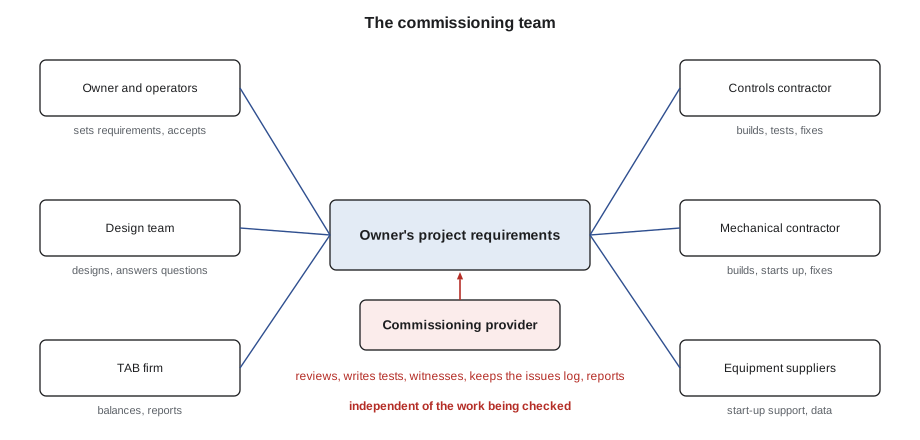
| Role | On Marlow Lane | Main commissioning duties |
|---|---|---|
| Owner | Halvern Properties; property manager Rowena Strand | Writes or approves the owner's project requirements, appoints the commissioning provider, accepts the finished work |
| Commissioning provider | Philippa Quaid, from the commissioning group in Halvern's consulting engineer's office | Writes the commissioning plan, reviews design and submittals, writes test scripts, directs and witnesses tests, keeps the issues log, writes the reports |
| Design team | Halvern's consulting engineer (mechanical and controls design) | Writes the basis of design and the sequences, answers questions, accepts or rejects proposed changes |
| Controls contractor | Quillon Building Controls: Ivo Bartek, with Sophie Aubertin for programming | Submittals, installation, pre-functional checklists, point-to-point checkout, performs functional tests, fixes deficiencies, training, as-builts |
| Other contractors | Halvern's mechanical service contractor; Signalpoint Fire Systems for the fire alarm interfaces | Their own equipment's checklists, startup and repairs |
| TAB firm | Stelmark Balancing, technician Brenna Fairweather | Balances air and water flows, calibrates airflow readings with the controls contractor, writes the TAB report |
| Operators | Rowena's building operators | Take part in tests where they can, receive training, inherit the building |
Ivo pointed out the line about Philippa's employer. The best commissioning provider is independent of the people whose work is being checked. On large new buildings, owners often hire a separate commissioning firm. On Marlow Lane, Halvern accepted a commissioning provider from its own consulting engineer's office, because the job was small and because she worked in a separate group from the engineers who wrote the design. Guideline 0 allows that arrangement as long as the independence is real and the owner agrees to it in writing. What the process does not allow is for the contractor to commission its own work: Quillon performed tests, but Philippa decided what the tests were and whether they passed.
Commissioning providers often hold a certification. Several exist, from ASHRAE, the Association of Energy Engineers, the AABC Commissioning Group and others, and owners sometimes name one in the contract. A controls technician does not need one to take part in commissioning, but should know who on the team has the authority to say a test has passed.
The controls technician's part
On most projects the controls contractor does more commissioning work than anyone except the commissioning provider. The BAS is the tool that every other system's tests depend on: it starts the fans, opens the valves, records the trends and shows the results. A test cannot start until the controls are ready, and the controls technician is usually in the room, or on the roof, for every test.
| Stage | Quillon's hours on Marlow Lane (estimate) |
|---|---|
| Pre-functional checklists for the controls | 14 |
| Point-to-point checkout of 232 physical points | 19 |
| Support for TAB (overrides, airflow calibration) | 10 |
| Functional performance tests | 16 |
| Fire alarm interface test (BAS side) | 6 |
| Burn-in trend review and fixes | 8 |
| Operator training (preparation and delivery) | 8 |
| Closeout documents and as-builts | 12 |
| Total | 93 |
Ninety-three hours was a little under a fifth of Quillon's labour on the job, and Ivo said that was typical for a controls replacement of this size. On a new building with a full commissioning process, the share can be higher. The hours are not overhead; they are the part of the job that proves the rest of it was done.
The controls technician's responsibilities in commissioning come down to a few habits that the rest of this course builds on:
- Read the owner's requirements and the sequences before starting, not after a test fails.
- Complete checklists honestly. A box ticked without looking is worse than a blank, because it tells the next person the item was checked.
- Do the point-to-point checkout properly before functional testing begins, so that the functional tests test the sequences and not the wiring.
- Report problems through the issues log, including your own mistakes, and do not quietly fix something the commissioning provider has already recorded without telling them.
- Never change a setting during a witnessed test without saying so, and record every change you make.
- Leave the operators able to run the building: training, clear documents, and a system that matches its as-built drawings.
Kinds of commissioning
The word commissioning is used for several related processes, and it helps to keep them apart.
| Kind | When | Example in this course |
|---|---|---|
| New building commissioning | Through design and construction of a new building or major renovation | The process in lessons 2 to 10, scaled down on Marlow Lane |
| Commissioning of a system replacement | When one system is replaced in an existing building | Marlow Lane's controls; Tilden Hall's AHU-2 replacement planned for the summer of 2027 |
| Retro-commissioning | An existing building that was never commissioned, or not for many years | Ninefield Tower, planned for the spring of 2027 (lesson 11) |
| Re-commissioning | A building that was commissioned before, repeated at intervals or after a change of use | A possible future step for Marlow Lane |
| Ongoing or monitoring-based commissioning | Continuously, using trends and fault detection to keep performance from drifting | The analytics in BAS-330, applied after handover |
Common mistakes
MistakeTreating commissioning as the final tests at the end of the job.
InsteadCommissioning runs from before design to after handover. The tests at the end are only one stage, and most problems are cheapest to fix in the earlier ones.
MistakeThinking a passed checkout means the system is commissioned.
InsteadCheckout proves the points work. Functional testing proves the sequences work together, and commissioning checks the whole result against the owner's requirements.
MistakeLetting the contractor decide whether its own tests passed.
InsteadThe contractor performs the tests; the commissioning provider writes the acceptance criteria and decides whether each test passed.
MistakeAssuming the energy code always requires commissioning.
InsteadCode requirements depend on the jurisdiction, the code edition, the building and the scope of work. Many projects, such as Marlow Lane, are commissioned because the owner's contract requires it.
Summary and key terms
- Commissioning is a documented quality process that checks a building's systems against the owner's requirements from before design to after handover.
- It relies on startup, checkout and balancing but is not the same as any of them.
- The main references are ASHRAE Guideline 0-2019, Standard 202-2024, Guideline 1.1 for HVAC&R, Guideline 1.2 for existing buildings, and CSA Z320 in Canada; the project specification names which apply.
- The commissioning provider leads the process and should be independent of the work being checked; contractors perform tests and fix deficiencies.
- The controls contractor does a large share of the commissioning work, because every test depends on the BAS.
- Commissioning (Cx)
- A documented quality process that verifies a building's systems are designed, installed, tested and handed over to meet the owner's requirements.
- Commissioning provider (CxP)
- The person who leads the commissioning process, also called the commissioning authority or agent.
- Owner's project requirements (OPR)
- The owner's written statement of what the project must achieve, used as the measure for commissioning.
- Startup
- Getting a piece of equipment running safely for the first time, usually by the installer or manufacturer.
- Retro-commissioning
- Commissioning an existing building that was never commissioned or not for a long time.
Practice problems
Work each problem on paper first, then reveal the answer to check.
What makes commissioning different from point-to-point checkout?
Show answer
Checkout proves each point is wired, scaled and responding. Commissioning is the overall process that checks the whole result, including how systems work together in every mode, against the owner's requirements, from design to after handover.
Why did Philippa, rather than Ivo, decide whether Marlow Lane's tests passed?
Show answer
The person deciding should be independent of the work being checked. Quillon performed the tests, but the commissioning provider wrote the acceptance criteria and judged the results.
Name two commissioning duties of a controls contractor.
Show answer
Any two of: pre-functional checklists for the controls, point-to-point checkout, supporting TAB, performing functional tests, fixing deficiencies, training operators, as-built documents.
Lesson quiz · 5 questions
Score 60% or more to complete this lesson.
Create a free account to save your progress, take quizzes and earn a certificate.