
BAS-410 · Lesson 11 of 12 · 21 min
Retro-commissioning existing buildings
▶ Video coming soon A video version of this lesson is on the way.
Marlow Lane was commissioned because its controls were being replaced. Ninefield Tower has had no commissioning of any kind since it was built in 1979, apart from the work each contractor did on its own equipment as it was replaced. Through the fall, Callie had seen its problems one at a time: a night and weekend base load of about 150 kW, every piece of equipment starting at 6:00, fixed duct static setpoints, a chilled water plant running at a delta-T of 3.5 K (6.3 °F) against a design of 5.5 K (9.9 °F), a chilled water meter reading about 28 in 100 low, an air handler whose fire alarm status had been listed as a spare. Declan's answer, in the proposal going to Ilona Vescovi in early December, is retro-commissioning, with the work planned for the spring of 2027. Ivo put the draft beside the Marlow Lane binder. "Same process," he said, "run backwards. On a new job you start with the owner's requirements and build to them. In an old building you start with what is there, find out what the owner needs now, and close the gap."
What retro-commissioning is
Retro-commissioning (RCx) applies the commissioning process to an existing building that was never commissioned, or not for many years. Its aim is to make the building's existing systems work as well as they can for its current use, mostly by finding and fixing operating problems rather than replacing equipment. Typical findings are schedules that no longer match occupancy, setpoints and resets left fixed, sequences that fight each other, sensors out of calibration, overrides nobody remembers, and equipment that has failed quietly while other equipment covers for it.
The process for existing buildings is described in ASHRAE Guideline 1.2-2019 for HVAC&R systems, alongside the general process in Guideline 0. CSA Z320 includes guidance on re-commissioning and retro-commissioning in its annexes. Many utilities and governments have run retro-commissioning programs with their own procedures, and owners often meet the process first through one of them.
| New building commissioning | Retro-commissioning | |
|---|---|---|
| Starting point | Owner's project requirements, written before design | Current facility requirements, written for the building as it is used now |
| Main source of findings | Design review, checklists, checkout, tests | Investigation: documents, interviews, trends, tests of existing systems |
| Typical fixes | Contractor corrects installation and programming | Owner pays for adjustments, repairs, programming and some small upgrades |
| Who pays for problems | The contractor responsible, under the contract | The owner, so measures are chosen by cost and benefit |
| Measure of success | Systems meet the OPR at handover | Measured savings and comfort, and whether they last |
The last two rows explain why retro-commissioning looks different. Nobody is under contract to fix Ninefield's 6:00 starts or its fixed static setpoints. Every fix costs Ilona money, so each one has to be justified by savings, comfort or reliability, and the savings have to be measured afterwards to show that they were real.
The phases
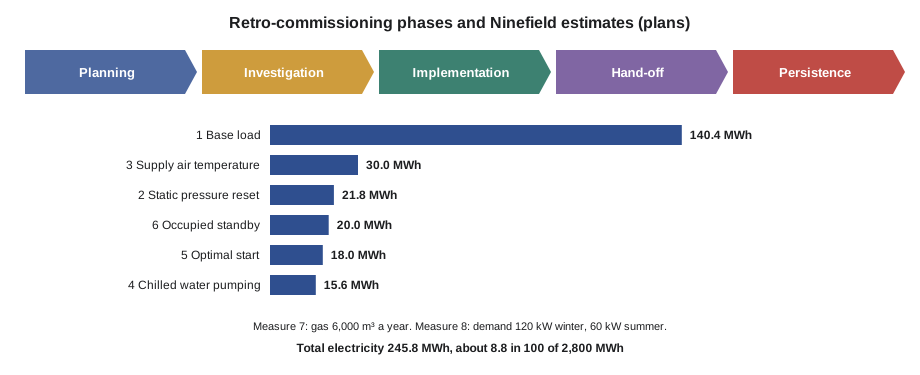
| Phase | Main tasks | Ninefield |
|---|---|---|
| Planning | Current facility requirements; scope; team; budget | Requirements drafted with Ilona: tenant hours, comfort, after-hours billing, energy and reliability goals |
| Investigation | Review documents; interview operators and tenants; trend and test the existing systems; list findings; estimate measures | Most of the fall's findings; the energy analysis and proposal (BAS-330) |
| Implementation | Make the fixes; retest each one | Spring 2027 (a plan) |
| Hand-off | Update documents and sequences; train operators; final report | After the spring work (a plan) |
| Persistence | Monitor; measure savings; keep fixes from being undone | Twelve-month measurement and verification period (a plan) |
Planning: current facility requirements
The existing-building equivalent of the owner's project requirements is often called the current facility requirements (CFR). They describe how the building is used now and what the owner needs from it, which may be quite different from what it was designed for. Ninefield was designed in 1979 for office tenants on fixed hours with no after-hours use. In 2026 it has tenants with different hours, a podium with retail, a fourth floor being fitted out for a data analysis firm with a server room, and an owner who bills tenants for after-hours HVAC.
Ninefield Tower - Current facility requirements (draft extract, for Ilona)
1  Occupied hours by tenant and floor, from the leases; after-hours use
   by request, logged for billing.
2  Space conditions in occupied hours: heating 21 C (70 F), cooling 24 C (75 F),
   held within 1 K (2 F); no complaints traceable to setback or standby.
3  Outdoor air at design minimums whenever spaces are occupied.
4  Lower energy use and peak demand, with savings measured, not estimated.
5  Equipment protected: no simultaneous starts after power or fire alarm
   events; fire alarm statuses mapped for every air handler.
6  Operators able to see why each system is doing what it is doing.
7  Documents that match the building.
Callie noticed that line 5 came straight from two of the fall's events: the AHU-2 fire alarm status found on October 19, and every fan restarting in the same minute after the annual fire alarm test. Retro-commissioning picks up findings like those and turns them into requirements, so that the fix is tested against something written down.
Investigation
Investigation is the largest phase of retro-commissioning and the one where controls technicians spend most of their time. It is diagnosis, and every skill from the earlier BAS courses is used.
- Documents. Find the drawings, sequences, points lists, TAB reports and service records. At Ninefield many were missing or out of date; the 2022 points list still showed AHU-2's fire alarm contact as a spare.
- Interviews. Ask operators and tenants what goes wrong, when, and what they do about it. Operators know where the workarounds are.
- Trends. Trend the systems over weeks, as BAS-220 and BAS-330 described, to see schedules, resets, simultaneous heating and cooling, loops that hunt, and base loads.
- Functional tests of existing systems. Test the sequences as they are, with the same kind of scripts used in new building commissioning, to find what does not work.
- Measurements. Spot-check sensors against references, measure airflows and pump flows where the readings are doubtful.
The investigation at Ninefield used Quillon's normal work there through the fall as much as any dedicated survey. Callie's own visits produced findings: the 7th-floor trunk fault, the static tube cut during a roofing repair, the turbine meter reading low. Declan's energy analysis put numbers on the operating problems, and the trend data gave the baseline. The findings were then grouped into measures.
The measures
A retro-commissioning measure is one fix or a group of related fixes with an estimated cost and benefit. Declan's proposal has eight, the same list Callie studied in BAS-330.
| Measure | What it fixes | Estimated saving |
|---|---|---|
| 1. Night and weekend base load | Schedules, unoccupied modes, overrides | 140,400 kWh |
| 2. Duct static pressure reset | Fixed static setpoints on the penthouse air handlers | 21,800 kWh |
| 3. Supply air temperature | Setpoint left at 10 °C (50 °F) on one air handler; add trim and respond reset | 30,000 kWh |
| 4. Chilled water pumping | Two-way valves, remote differential pressure sensor, reset | 15,600 kWh |
| 5. Optimal start | Fixed 6:00 starts replaced by adaptive, staggered starts | 18,000 kWh |
| 6. Occupied standby | Lighting occupancy sensors used for HVAC setback by zone | 20,000 kWh |
| 7. Outdoor air in warm-up | Dampers closed until occupancy; actuator repaired | Gas 6,000 m³ (2,120 therms) (Gas 2,120 therms) |
| 8. Demand control | Staggered starts and a predictive demand limit | Demand: 120 kW winter, 60 kW summer |
Worked problem
How big is measure 1?
Measure 1 lowers the night and weekend base load by about 25 kW. Ninefield is occupied 60 hours a week, so the rest of the 168-hour week is unoccupied. Using 52 weeks, check the measure's estimated saving.
Show solution
- Unoccupied hours per week: 168 − 60 = 108.
- Unoccupied hours per year: 108 × 52 = 5,616.
- Saving: 25 × 5,616 = 140,400 kWh.
Answer: 140,400 kWh, the figure in the proposal. It is the largest measure because the base load runs for most of the hours in the year, which is typical: in many retro-commissioned office buildings, the biggest savings come from what runs when nobody is there.
Worked problem
What is the whole proposal worth?
The measures together save 245,800 kWh of Ninefield's 2,800,000 kWh a year. At the sample rates in BAS-330, the annual saving including gas and demand was 43,624 dollars, and the proposal is priced at 124,000 dollars. What share of the electricity is saved, and what is the simple payback?
Show solution
- Share: 245,800 ÷ 2,800,000 = 0.088, about 8.8 in 100.
- Payback: 124,000 ÷ 43,624 = 2.8 years.
Answer: About 8.8 in 100 of the electricity, with a simple payback of about 2.8 years at the sample rates. The estimates are conservative and allow for measures that interact.
Two items in the proposal have no savings attached: the magnetic flow meter for the chilled water plant, which will let the plant's efficiency be measured properly, and tagging the tower's 1998 points for fault detection. The fire alarm restart inhibit is in the proposal for equipment protection, not energy. Retro-commissioning often includes items like these, because the requirements are not only about energy.
Implementation and verification
In new building commissioning the contractor fixes deficiencies; in retro-commissioning the fixes are the work itself, and each is verified the same way: a functional test of the changed sequence, then trends to show it works in operation. For Ninefield, each measure will have a short test script in the spring (a plan). The static pressure reset, for example, will be tested with the same steps Philippa used on Marlow Lane's AHU-1, and its trends reviewed against criteria before it is accepted.
Implementation in an occupied building needs the same care as Marlow Lane's cutovers. Tenants are told in advance about changes that might be noticed, such as earlier setback or occupied standby. Each change is made on one floor or one system first and watched before it is rolled out. Operators are involved from the start, because they will be the ones who keep the changes in place or undo them.
Persistence and measured savings
The weakest part of many retro-commissioning projects is what happens a year later. Studies of retro-commissioned buildings have found that savings often decline over a few years as overrides return, schedules are extended for one tenant and never shortened, and failed sensors are bypassed. The defence is to measure, to monitor, and to make the reasons for each change visible.
- Measurement and verification. Ninefield's proposal uses IPMVP Option C on the whole-building utility data, with Option B on the fan and pump drives for the reset measures, a baseline from September 2025 to August 2026 and a twelve-month reporting period (BAS-330).
- Monitoring. Fault detection rules and dashboards, as BAS-330 described, flag when a fix has been undone: a static setpoint fixed again, a schedule extended, an override left in place.
- Documents and training. Updated sequences and a short training session explain why each change was made, so operators do not reverse it when a tenant complains.
- Ongoing commissioning. A regular review, monthly at first, of the measures' trends and the savings report.
Ivo said this was what separated retro-commissioning that paid from retro-commissioning that was forgotten. "Marlow Lane has a warranty review and a contractor responsible for a year. Ninefield has whatever monitoring we leave behind. Plan the persistence before you start the work."
Retro-commissioning, re-commissioning and ongoing commissioning
Marlow Lane will not need retro-commissioning, because it has just been commissioned, but its performance will drift too. The systems manual recommends re-commissioning at intervals: repeating the key functional tests and a trend review every few years, or after a major change of use. Between those, ongoing or monitoring-based commissioning uses the trends and alarms the building already has. All three are the same process at different points in a building's life.
Functional tests of existing systems
Investigation in retro-commissioning uses the same kind of functional test scripts as new building commissioning, but with a different purpose: to find out what the existing systems actually do, not to prove that they meet a requirement. A test that fails is a finding, not a deficiency to be charged to a contractor. At Ninefield, the most useful tests were short and targeted.
| Test | What it showed |
|---|---|
| Lower one floor's zone setpoint after hours and watch the penthouse air handler | Whether after-hours requests start only the floors needed or the whole tower |
| Step the duct static setpoint on one air handler | Whether the static loop is stable enough to accept a reset |
| Command the chilled water secondary pumps through their speed range | How much differential pressure the plant really needs, and how far the valves are from closed |
| Watch the morning start on a mild day | That every unit started at 6:00 whatever the weather |
Each test was done with Ilona's operator, on one system at a time, and each was recorded in the same format as a commissioning test so that the spring 2027 retests can be compared with it. Retro-commissioning without these records tends to end with savings estimates nobody can check; with them, the before and after of each measure is on paper.
The investigation also has a limit worth stating. Some findings at Ninefield, such as the turbine chilled water meter reading low, can only be fixed with new equipment. Retro-commissioning lists them, estimates their value where it can, and leaves the decision to the owner, separately from the low-cost operating measures that make up most of the proposal.
Common mistakes
MistakeStarting retro-commissioning with fixes instead of requirements.
InsteadWrite the current facility requirements first, so that each measure is tested against something the owner agreed.
MistakeEstimating savings by adding every measure's best case.
InsteadEstimate each measure conservatively and allow for interactions; then measure the real savings.
MistakeChanging an occupied building's operation without telling tenants or operators.
InsteadTell tenants in advance, change one floor or system first, and involve the operators.
MistakeLeaving without a plan for persistence.
InsteadMeasure the savings, monitor for reversed changes, document why each change was made, and review regularly.
Summary and key terms
- Retro-commissioning applies the commissioning process to existing buildings, mainly to find and fix operating problems.
- It starts from current facility requirements and an investigation of documents, interviews, trends and tests of the existing systems.
- Measures are chosen by cost and benefit because the owner pays for every fix.
- Ninefield's proposal has eight measures saving about 8.8 in 100 of its electricity, plus gas and demand, with the work planned for spring 2027.
- Persistence needs measurement, monitoring, documents and regular review.
- Retro-commissioning (RCx)
- Commissioning an existing building that was never commissioned, or not for many years.
- Current facility requirements (CFR)
- The owner's requirements for an existing building as it is used now.
- Measure
- A fix or group of fixes in a retro-commissioning project, with estimated costs and benefits.
- Persistence
- Whether the improvements and savings from commissioning last over time.
- Re-commissioning
- Repeating commissioning tests and reviews on a building that was commissioned before.
Practice problems
Work each problem on paper first, then reveal the answer to check.
Why does retro-commissioning start with current facility requirements instead of the original design?
Show answer
The building's use has changed since it was designed; the fixes must serve how it is used now.
Why is measure 1 the largest at Ninefield?
Show answer
The base load runs for 5,616 unoccupied hours a year, so even 25 kW adds up to 140,400 kWh.
Name two ways to make retro-commissioning savings last.
Show answer
Any two of: measurement and verification, fault detection and monitoring, updated documents and training, regular ongoing review.
Lesson quiz · 5 questions
Score 60% or more to complete this lesson.
Create a free account to save your progress, take quizzes and earn a certificate.