
BAS-310 · Lesson 7 of 12 · 21 min
Priority arrays and commanding points
▶ Video coming soon A video version of this lesson is on the way.
Prakash's folder for the network nights had a page headed simply "Who is in charge?". It held two printouts. One was the integration sheet for Ninefield's chillers from August, listing which chiller values the building system was allowed to write and at what priority. The other was a copy of the override report Callie would run at Tilden Hall on November 14, which in BAS-220 found 14 points still held at priority 8, some of them since the summer. "Two answers to the same question," he said. "One planned, one accidental. BACnet decides who is in charge of an output with sixteen slots and one rule."
Why outputs need more than one writer
A single output in a building is often commanded by several things. A program sets a damper to hold a temperature. A safety routine closes it when the freezestat trips. An operator overrides it from the front end to test it. A supervisory controller sends it a demand-limiting command. If each simply wrote its value over the last, the output would end up wherever the most recent writer left it, and when the operator's test was over nobody would know what to put it back to.
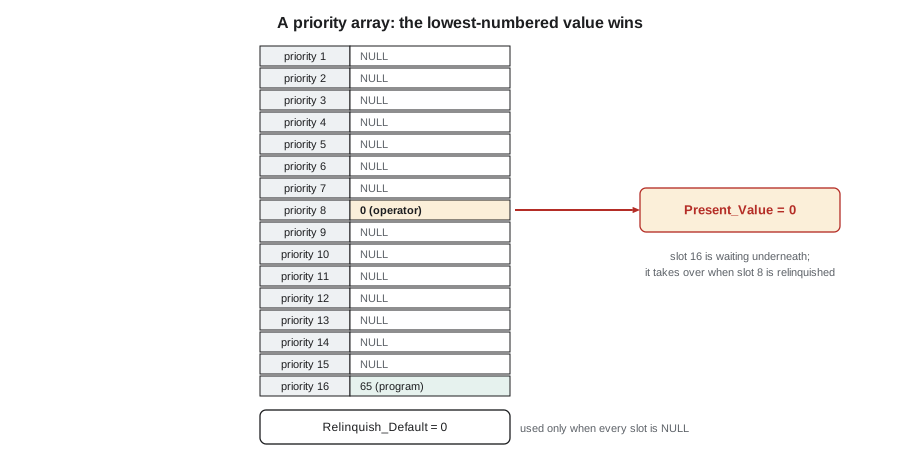
BACnet's answer is the priority array. A commandable object keeps not one commanded value but sixteen, one for each priority level from 1, the most important, to 16, the least. Each writer writes into its own slot. The object's Present_Value is the value in the most important slot that is in use. When that writer is finished, it relinquishes its slot by writing NULL, and control passes automatically to the next most important writer still holding a slot.
Which objects are commandable
Analog Output, Binary Output and Multi-state Output objects are always commandable, because they drive physical equipment. Analog Value, Binary Value and Multi-state Value objects may be commandable or not; the device's documentation and PICS say which. A commandable object has two extra properties: Priority_Array, the sixteen slots, and Relinquish_Default, the value Present_Value takes when every slot is NULL. Newer devices also have a Current_Command_Priority property that reports which slot is in control, which makes troubleshooting much easier.
Writing to a commandable object without giving a priority, as lesson 3 said, uses priority 16. Writing to a value object that is not commandable simply replaces its Present_Value: there is no array, and the last writer wins. Setpoints are often non-commandable Analog Values, which is why two people adjusting the same setpoint from two places can undo each other without either knowing.
The standard priority assignments
The standard reserves some levels for particular uses and leaves the rest for sites to assign. Quillon's site standards filled in the open levels the same way on every job, so that a technician arriving at any Quillon building could read an output's array and know who wrote what.
| Priority | Standard use | Quillon convention |
|---|---|---|
| 1 | Manual life safety | Fire fighter or life safety panel override; never used by Quillon programs |
| 2 | Automatic life safety | Smoke control commands from the fire alarm interface |
| 3 and 4 | Available | Not used |
| 5 | Critical equipment control | Equipment protection, such as freeze protection closing outdoor dampers |
| 6 | Minimum on and off | Reserved for the device's own minimum on and off timing |
| 7 | Available | Not used |
| 8 | Manual operator | Operator overrides from the front end |
| 9 to 15 | Available | 10: supervisory commands such as demand limiting; others not used |
| 16 | Available (lowest) | Normal program control |
Priority 6 is special. On binary outputs that support minimum on and off times, the device itself writes to priority 6 whenever the output changes state and holds it there for the minimum time, so that a lower-priority writer cannot short-cycle the equipment. Anything at priorities 1 to 5, such as a safety, still overrides it. The rooftop unit compressors in BAS-220, with their three-minute minimum on and five-minute minimum off, were protected this way in the new RTU-1 controller.
Worked problem
Resolving a priority array
RTU-1's compressor stage 1 output is a Binary Output with Relinquish_Default inactive. Its array holds: priority 6 active (minimum on time, 2 minutes left), priority 8 inactive (an operator stopped it), priority 16 active (the program wants cooling). What is the Present_Value now? What will it be when the minimum on time ends? What if the operator then writes NULL at priority 8? And if the program finally writes NULL at 16?
Show solution
- Now: the most important non-NULL slot is 6, active, so the compressor stays on for its last 2 minutes, despite the operator.
- Minimum time over: the device clears slot 6. The most important non-NULL slot is now 8, inactive, so the compressor stops, and the device starts its minimum off time at priority 6.
- Operator writes NULL at 8: the most important non-NULL slot is 16, active, so the compressor restarts (after its minimum off time, which the device enforces at priority 6).
- Program writes NULL at 16: every slot is NULL, so Present_Value takes the Relinquish_Default, inactive.
Answer: Each step follows one rule: the most important slot in use wins, and the Relinquish_Default applies only when every slot is empty. Minimum on and off protects the compressor even from the operator, but not from a safety at priority 5 or above.
Relinquishing, and the overrides nobody released
The weakness of the priority array is that a slot stays in use until something writes NULL to it. An operator who overrides a valve at priority 8 to check it and forgets to release it has, in effect, disconnected that valve from its program indefinitely. The program keeps writing at 16, its trends look normal, and the output does not move. That is exactly what BAS-220's Tilden override report found: 14 points at priority 8, a few of them left from a summer cooling complaint.
Good front ends help. Some give every operator override an automatic release time, writing NULL after an hour or a shift unless renewed. Some colour overridden points on every graphic. Some, like Quillon's, produce a daily report of every output with a slot in use at priority 8. None of these features is required by the standard, and on a site without them the only protection is discipline: every override written on the work order, and every override released before the technician leaves.
Releasing is a write of NULL, not a write of the program's value. An operator who "puts the valve back to 40" by writing 40 at priority 8 has not released anything; the valve will sit at 40 forever, whatever the program asks for. Generic BACnet tools show a Relinquish or Release button for this reason, and the integration sheet should say that releases are done that way.
Device 101001  binary-output,1  NF.RTU1.CMP1-CMD   Present_Value: inactive
  Priority_Array:
    1  NULL     5  NULL     9  NULL    13  NULL
    2  NULL     6  NULL    10  NULL    14  NULL
    3  NULL     7  NULL    11  NULL    15  NULL
    4  NULL     8  inactive 12  NULL    16  active
  Relinquish_Default: inactive     Current_Command_Priority: 8
Commanding from supervisory controllers and integrations
Supervisory controllers and integrations write to other devices constantly: schedules sent to VAV controllers, setpoints sent to chillers, demand limits sent to air handlers. Each of these writes needs a priority chosen deliberately, written into the integration sheet, and understood by everyone who might write to the same object.
At Ninefield, the chillers' own controls run the compressors, and the building system only enables each chiller and sends it a chilled water supply setpoint. The integration sheet that Sophie wrote in August set both writes at priority 16 to the chillers' commandable objects, with a note that the chiller service technician's own local overrides at the chiller panel take precedence whatever the building system writes. The front end's demand-limit command to the air handlers used priority 10, so that an operator at priority 8 could still override it for testing.
Some equipment, particularly older gateways and some chiller interfaces, does not implement a priority array at all, even on objects it calls outputs. A write then simply replaces the value, and the building system and an operator can fight without any record of who is winning. The PICS and a test write during commissioning show which kind of object you have.
Out of service, overridden and the priority array
Three different mechanisms can stop an output following its program, and a technician should check all three: the priority array, with a slot above the program in use; Out_Of_Service, from lesson 2, which disconnects the physical output from Present_Value; and a hardware override, such as a hand-off-auto switch on an output card, which BACnet reports by setting the OVERRIDDEN flag in Status_Flags. Callie wrote them in her notebook as one line: array, out of service, hand switch.
| What you see | Most likely cause | How to clear |
|---|---|---|
| Present_Value differs from the program's value; a slot above 16 is in use | Override in the priority array | Write NULL at the overriding priority, after checking why it was set |
| Present_Value follows the program but the device does not move; OUT_OF_SERVICE set | Output out of service | Set Out_Of_Service false |
| Device position differs from Present_Value; OVERRIDDEN set | Hand switch or local override at the device | Return the switch to auto, on site |
| Present_Value equals Relinquish_Default although the program is running | Program writing to the wrong object or not at all | Check the program's output block and its target |
Prakash closed his folder. "Sixteen slots and one rule," he said. "The rule never breaks. What breaks is people forgetting which slot they used."
Minimum on and off times
Some equipment must not be started and stopped rapidly. A compressor, for example, needs a minimum run time to return oil and a minimum off time to let pressures equalize. BACnet binary outputs and binary values can enforce this through their Minimum_On_Time and Minimum_Off_Time properties. When the output changes state, the device itself writes the new state into priority 6 of the array and holds it there for the minimum time, then relinquishes it.
The effect is that any command at priority 7 to 16 is held off until the minimum time has passed, while commands at priorities 1 to 5, such as life safety or critical equipment protection, still take effect at once. For a technician this explains a puzzle that appears on many sites: an operator stops a unit at priority 8 and nothing happens for several minutes. The priority array, read at that moment, shows a value at priority 6 that nobody wrote. It is the minimum on time, doing its job.
Auditing overrides
Earlier sections showed how quickly forgotten overrides accumulate, and Callie's report on Tilden's points still at priority 8 showed the same thing in BAS-220. A regular audit is the only reliable cure. Most front ends can produce a report of every commandable point with a value at a manual priority; where they cannot, a tool can read the Priority_Array of each point and list those with a non-NULL manual slot.
| Step | What to do |
|---|---|
| Run the report | List every point with a value at priority 8, or at any priority reserved for operators |
| Sort by age | Where the front end records when the command was written, oldest first |
| Ask why | Check work orders and the operator log for a reason that still applies |
| Release or record | Relinquish overrides with no current reason; record the reason and an end date for the rest |
| Repeat | Monthly on most sites, and after every major service visit |
The audit is quick once it becomes routine. The first one on a building is usually the slow one, because it finds overrides that nobody can explain, and each of those needs a careful look at what the point controls before it is released.
Common mistakes
MistakeReleasing an override by writing the program's value at priority 8.
InsteadWrite NULL at priority 8; the program then takes over.
MistakeWriting integration commands without choosing a priority.
InsteadAssign each integration write a priority in the integration sheet.
MistakeAssuming every object called an output has a priority array.
InsteadCheck the PICS and test a write during commissioning.
MistakeUsing priorities 1 or 2 for ordinary program commands.
InsteadReserve them for life safety; use 16 for programs and 8 for operators.
MistakeChecking only the priority array when an output will not move.
InsteadCheck the array, Out_Of_Service and the OVERRIDDEN flag.
Summary and key terms
- Commandable objects keep sixteen commanded values, priority 1 (most important) to 16 (least).
- Present_Value is the value in the most important slot that is not NULL; Relinquish_Default applies when all are NULL.
- A writer relinquishes its slot by writing NULL.
- Priorities 1 and 2 are for life safety, 5 for critical equipment, 6 for minimum on and off, and 8 for operators.
- Outputs are always commandable; value objects may or may not be.
- Forgotten overrides at priority 8 disconnect outputs from their programs indefinitely.
- Integrations should state the priority of every write and be tested during commissioning.
- Commandable object
- An object with a priority array that resolves commands from several writers.
- Priority array
- The sixteen command slots of a commandable object.
- Priority
- A level from 1 (most important) to 16 (least) at which a command is written.
- NULL
- An empty slot in the priority array; writing NULL relinquishes a command.
- Relinquish_Default
- The value a commandable object takes when every priority slot is empty.
- Relinquish
- To release a command by writing NULL at its priority.
- Minimum on and off
- Timing that protects equipment from short cycling, enforced at priority 6.
- Current_Command_Priority
- A property showing which priority slot is in control.
Practice problems
Work each problem on paper first, then reveal the answer to check.
An array holds 30 at 10, 55 at 16 and nothing else. What is Present_Value?
Show answer
30, from priority 10.
An operator writes NULL at 8 on a damper that also has 20 at 5 and 40 at 16. What is Present_Value after the write?
Show answer
20, from priority 5.
Every slot is NULL and Relinquish_Default is 0. What does the output do?
Show answer
It goes to 0.
A chiller interface's output has no priority array. What happens when two writers write to it?
Show answer
The last write wins, with no record of which writer is in control.
A fan output follows its program in BACnet but the fan never starts; OVERRIDDEN is set. What do you check?
Show answer
The hand-off-auto switch or local override at the starter or output card.
Lesson quiz · 5 questions
Score 60% or more to complete this lesson.
Create a free account to save your progress, take quizzes and earn a certificate.