
BAS-110 · Lesson 7 of 12 · 24 min
Terminal units: VAV boxes, fan coils and radiation
▶ Video coming soon A video version of this lesson is on the way.
Tuesday, October 13, was the day after Thanksgiving, and Ninefield Tower's offices were quiet. Prakash used the quiet to show Callie the warm north offices on the ninth floor that Ilona had complained about. Above the ceiling tiles, every office had a VAV box: a sheet metal box with a damper, an airflow sensor and a small controller, fed by a round duct from the main trunk. "The air handler sends everyone the same cold air," Prakash said, standing on a ladder with his head in the ceiling. "These boxes decide how much each room gets. When a room is too warm, the first question is always what its box is doing."
Later that afternoon they drove across town to Tilden Hall, where the terminal units were a mix of VAV boxes with hot water reheat, fan coils in the stair halls and fin-tube radiation along the perimeter walls. This lesson explains these terminal units: the devices at the end of the duct or pipe that control conditions in each room or zone. It covers VAV boxes with and without reheat, fan-powered boxes, fan coil units, radiation and other terminal heating, and how their controls interact with the air handlers and plants upstream.
Zones
A zone is an area of a building whose temperature is controlled by one sensor and one set of terminal equipment. A zone might be a single office, a classroom, a group of open-plan desks or a whole floor of a warehouse. The more zones a building has, the better it can match different loads, but the more equipment and controls it needs. Perimeter zones, with outside walls and windows, have loads that change with the weather and the sun. Interior zones have steady internal loads that, as lesson 2 explained, often need cooling all year. A typical office floor has interior zones and a ring of perimeter zones, with separate zones on each side of the building because the sun reaches them at different times.
The VAV box
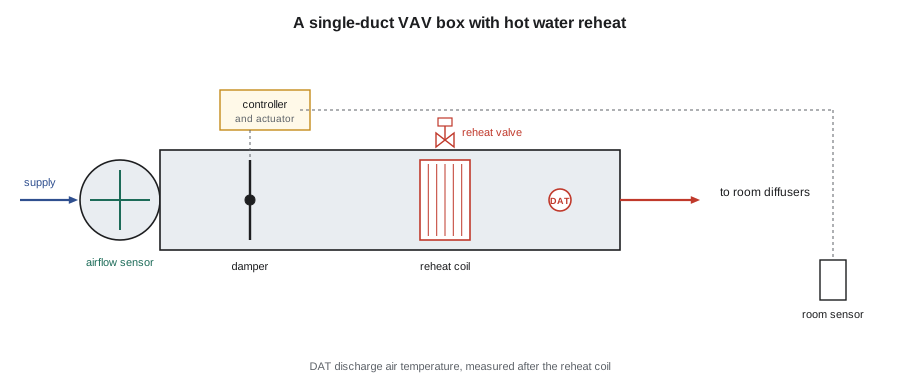
A variable air volume box, or VAV terminal, is a damper in a box with an airflow sensor and a controller. The air handler supplies cool air at a roughly constant temperature, about 13 °C, and the VAV box varies how much of it reaches the room. When the room is warm, the box opens to deliver more cool air, up to its maximum airflow. When the room is cool, the box closes down to its minimum airflow. The minimum is not zero, because the room still needs ventilation air and because diffusers do not spread very small airflows well.
Modern VAV boxes are pressure-independent. An airflow sensor at the inlet, usually a cross-shaped or ring-shaped pickup that measures velocity pressure, tells the controller how much air is actually flowing. The room temperature loop decides how much air the room needs, and a second, faster loop positions the damper to deliver exactly that flow whatever the pressure in the duct. Older pressure-dependent boxes simply positioned the damper, so the airflow changed whenever other boxes opened or closed and the duct pressure changed. Pressure independence is one reason the supply fan's static pressure control, covered in lesson 3, matters so much: if the duct pressure is too low, boxes at the far end cannot reach their maximum airflow no matter how far they open.
Reheat
A VAV box alone can only cool. When a perimeter room needs heat, or an interior room is overcooled even at its minimum airflow, something has to add heat. In many buildings, the VAV box has a reheat coil, hot water or electric, at its outlet. As the room cools, the box closes to its minimum airflow; if the room is still too cool, the reheat valve or electric heater opens to warm the air. Some sequences then raise the airflow again to a heating maximum, so that enough warm air reaches the room to heat it without blowing very hot air from the ceiling, where it tends to stay.
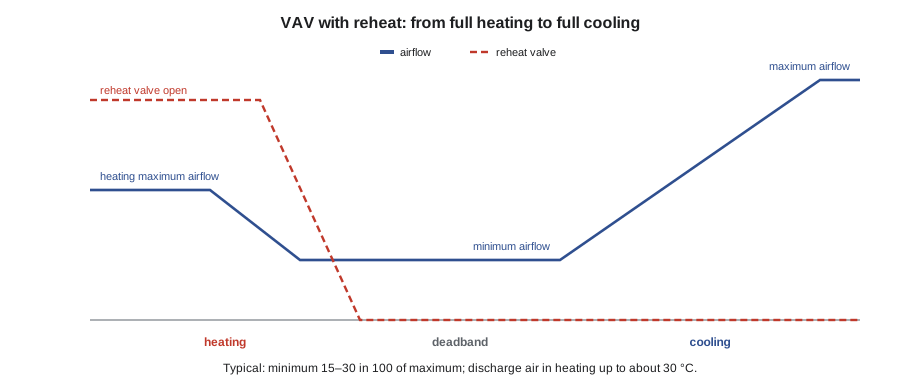
Reheat costs energy twice. The air handler spends energy cooling the air, and the reheat coil spends energy warming it again. That is why the minimum airflow setting is so important, and why ASHRAE Guideline 36 and current energy codes push VAV minimums as low as ventilation and good air distribution allow. A box with a minimum set at 40 in 100 of its maximum, common in older buildings, may reheat far more air than one set at 15 or 20 in 100. Lowering minimums is one of the most effective energy measures in an existing VAV building, but it must be done with the ventilation requirements covered in lesson 8 in mind.
Worked problem
Reheat energy at minimum airflow
A Tilden Hall classroom VAV box has a minimum airflow of 150 L/s. On a cold morning the AHU supplies air at 13 °C, and the reheat coil warms it to 30 °C. How much heat is the reheat coil adding?
Show solution
- Temperature rise: 30 − 13 = 17 K.
- Q = 1.2 × 150 × 17 ÷ 1,000 = 3.06 kW.
Answer: About 3.1 kW for one box. A building with three hundred such boxes reheating at once can be using hundreds of kilowatts to undo its own cooling.
The north offices at Ninefield illustrated the opposite problem. Their VAV boxes were sized for the original 1979 office layout, with fewer computers and people, and at maximum airflow they could no longer remove the afternoon heat. Lowering the air handler's supply air temperature, which someone had done, sent colder air to every box on the system, overcooling the interior zones and causing low delta-T at the plant, as lesson 6 described, while giving the north offices only a little more cooling. The real fixes were to check whether the north boxes were reaching their maximum airflow, which several were not because the duct static pressure setpoint was too low for the far end of the floor, and to raise the maximums on the boxes that could take more air.
Fan-powered VAV boxes
A fan-powered box adds a small fan to the VAV box. In a series fan-powered box, the fan runs continuously whenever the zone is occupied, mixing primary air from the air handler with warm air drawn from the ceiling plenum, so the room always gets a steady airflow. In a parallel fan-powered box, the fan runs only when the zone needs heat, drawing warm plenum air to supplement or replace the primary air. Fan-powered boxes recover heat from lights and the plenum before using reheat, give steadier air movement in the room and are common in perimeter zones. Their fans need their own start command and proof, and series boxes must have their fans running before primary air arrives, or the primary air can blow backward out of the plenum inlet.
Dual-duct and other air terminals
Older buildings may have dual-duct systems, in which the air handler sends separate hot and cold ducts to every zone and a mixing box blends them. Dual-duct systems control well but use a lot of energy and are rarely installed today. Constant-volume reheat systems, in which every zone receives a fixed airflow of cold air reheated as needed, are even more wasteful and are no longer allowed by energy codes for most new work, though many remain in older buildings. Induction units, chilled beams and displacement ventilation are other terminal types a controls technician may meet in particular buildings. Chilled beams, for example, use chilled water coils in the ceiling to cool the room air directly, with a small amount of ventilation air from the air handler, and their controls must keep the water above the room's dew point so that the beams do not drip.
Fan coil units
A fan coil unit, or FCU, is a small air handler in a cabinet: a fan, a filter and one or two coils, heating, cooling or both. Fan coils sit under windows, in ceilings, in stairwells and in hotel rooms, and they recirculate room air through their coils. Two-pipe fan coils have one coil fed by a single supply and return pipe that carries either hot or chilled water depending on the season, so the whole building switches over in spring and fall. Four-pipe fan coils have separate hot and chilled water pipes and coils, so each unit can heat or cool at any time. Fan coils usually get their ventilation air separately, from a dedicated outdoor air system or a central air handler.
A fan coil's controller runs the fan, often at several fixed speeds or a variable speed, and modulates or cycles its valves. On a two-pipe system it must know whether the water is hot or cold, which it usually learns from a pipe temperature sensor or a changeover signal from the BAS. Common fan coil faults are clogged filters, failed fan motors, stuck valves and condensate trays that overflow onto ceilings. At Tilden Hall, the stair hall fan coils were four-pipe units, heating only in winter, and two of them had filters so clogged that their fans moved almost no air.
Radiation and other terminal heating
Perimeter radiation, usually fin-tube convectors running along the base of outside walls, heats the room by warming air that rises along the cold glass and walls. It counters the downdraft and radiant chill from windows that lesson 2 described, which is why it is placed under them. Fin-tube radiation is typically fed by hot water, controlled by a zone valve or by modulating the water temperature to a whole exposure, such as all the west-facing radiation, on an outdoor reset. Cast-iron radiators in older buildings may be fed by steam, controlled by thermostatic radiator valves or by cycling the steam supply. Radiant panels in ceilings and radiant floors heat mainly by radiation and respond slowly, so they suit steady loads.
In rooms with both radiation and a VAV box, the two must work together. The usual sequence uses the radiation as the first stage of heat and the VAV reheat as a second stage, or uses the radiation for the perimeter and the VAV box only for cooling and ventilation. Problems arise when they fight: the radiation heats while the VAV box cools, both under control, both wasting energy. A shared deadband between heating and cooling setpoints, typically a couple of degrees, stops that. Room 214 at Tilden, from lesson 2, had exactly this arrangement, which is why Sophie adjusted the radiation and the VAV box together.
| Terminal type | Heats | Cools | Ventilation air | Common controls |
|---|---|---|---|---|
| Single-duct VAV, cooling only | No | Yes | Yes, from the AHU | Airflow to room temperature |
| VAV with reheat | Yes | Yes | Yes | Airflow, then reheat valve or electric heat |
| Series fan-powered VAV | Yes | Yes | Yes | Constant fan, primary airflow, reheat |
| Parallel fan-powered VAV | Yes | Yes | Yes | Primary airflow; fan and reheat in heating |
| Four-pipe fan coil | Yes | Yes | Usually separate | Fan speed, heating and cooling valves |
| Two-pipe fan coil | One at a time | One at a time | Usually separate | Fan speed, one valve, changeover |
| Fin-tube radiation | Yes | No | No | Zone valve or reset water temperature |
How terminal units talk to the plant
Terminal units are where the building's loads are felt, so they are the best source of information for the systems upstream. Good sequences collect requests from the zones: a VAV box that cannot reach its airflow setpoint with its damper nearly wide open sends a pressure request to the air handler; a box that needs colder air sends a cooling request; a reheat valve that is wide open sends a hot water request. The air handler raises its static pressure or lowers its supply temperature only as far as the zones that need it require, and the plants reset in turn. ASHRAE Guideline 36 calls this trim-and-respond logic. It saves a great deal of energy and finds problem zones, because a zone that requests constantly is either a design problem or a fault.
The same idea gives a technician a quick way to find the zone driving a whole system. On Ninefield's ninth floor, Callie sorted the VAV boxes on the front end by damper position and found six of the north boxes at 100 in 100 open but well below their maximum airflow. That pattern meant the supply duct pressure at the end of the floor was too low. Prakash raised the static pressure setpoint a little as a temporary measure and asked Sophie to program a trim-and-respond reset so that the pressure would rise only when those boxes asked for it.
Worked problem
Can the box cool the room?
A ninth-floor north office at Ninefield has a VAV box with a maximum of 600 L/s, supplied at 13 °C. The room setpoint is 24 °C. What is the most sensible cooling the box can deliver at maximum airflow?
Show solution
- Temperature difference: 24 − 13 = 11 K.
- Q = 1.2 × 600 × 11 ÷ 1,000 = 7.92 kW.
Answer: About 7.9 kW, but only if the box actually reaches 600 L/s. If the duct pressure lets it reach only two-thirds of that, it delivers only two-thirds of the cooling.
Common mistakes
MistakeLowering the AHU supply air temperature to fix one warm zone.
InsteadFind out whether that zone's box reaches its maximum airflow; a lower supply temperature overcools every other zone.
MistakeSetting VAV minimum airflows high to be safe.
InsteadSet minimums from the ventilation requirement and good air distribution; high minimums waste reheat.
MistakeLetting radiation heat while the VAV box cools the same room.
InsteadUse a shared deadband and a single sequence for both.
MistakeStarting primary air before the fan in a series fan-powered box.
InsteadStart the box fan first so primary air cannot blow back into the plenum.
MistakeForgetting two-pipe changeover.
InsteadMake sure the fan coil controller knows whether the water is hot or cold.
MistakeIgnoring a zone that requests constantly.
InsteadTreat it as a fault or design problem and investigate it.
Summary and key terms
- A zone is an area controlled by one sensor and one set of terminal equipment.
- A VAV box varies cool air between a minimum and a maximum airflow to meet the room load.
- Pressure-independent boxes measure airflow and deliver the flow the room loop calls for.
- Reheat adds heat at minimum airflow; high minimums waste energy twice.
- Fan-powered boxes recover plenum heat; series boxes run their fans continuously.
- Fan coils recirculate room air through their own coils; two-pipe units need changeover.
- Perimeter radiation counters cold windows and must be coordinated with VAV cooling.
- Zone requests let air handlers and plants reset only as far as the zones that need it require.
- Zone
- An area whose conditions are controlled by one sensor and one set of terminal equipment.
- VAV box
- A terminal unit that varies the amount of supply air delivered to a zone.
- Pressure-independent
- A VAV box that measures airflow and controls it regardless of duct pressure.
- Minimum airflow
- The least air a VAV box delivers, set for ventilation and air distribution.
- Reheat
- Heating air after it has been cooled, at a terminal unit.
- Fan-powered box
- A VAV box with its own fan that can mix warm plenum air with primary air.
- Fan coil unit (FCU)
- A small cabinet unit with a fan, filter and coils that conditions room air.
- Trim and respond
- A reset strategy in which upstream setpoints change in response to requests from the zones.
Practice problems
Work each problem on paper first, then reveal the answer to check.
A VAV box delivers 200 L/s of 13 °C air to a room at 23 °C. How much sensible cooling does it provide?
Show answer
1.2 × 200 × 10 ÷ 1,000 = 2.4 kW.
Why must a VAV box have a minimum airflow?
Show answer
To deliver the ventilation air the room needs and keep air distribution acceptable.
What is the difference between two-pipe and four-pipe fan coils?
Show answer
Two-pipe units have one coil that heats or cools depending on the water season; four-pipe units can heat or cool at any time.
A box is 100 in 100 open but below its maximum airflow. What does that suggest?
Show answer
The duct static pressure at that box is too low.
Why do radiation and VAV cooling need a shared deadband?
Show answer
So they cannot heat and cool the same room at the same time.
Lesson quiz · 5 questions
Score 60% or more to complete this lesson.
Create a free account to save your progress, take quizzes and earn a certificate.