
BAS-110 · Lesson 2 of 12 · 24 min
Heat, comfort and the building envelope
▶ Video coming soon A video version of this lesson is on the way.
Two days after Callie started, on Thursday, September 10, a professor in Tilden Hall room 214 called the college's work order desk for the third time that week. Her office was too cold in the morning and too warm by mid-afternoon. The thermostat on the wall read 22 °C all day. Gus Thibodeaux, Harcastle's facilities manager, sent the call to Quillon. Prakash and Callie found a narrow corner office on the west side of the building with one large single-glazed window from 1988, a fin-tube radiator under it and a VAV box above the ceiling. "The controls are doing exactly what they were told," Prakash said after ten minutes with the trend logs. "The air at the thermostat is 22 degrees. The problem is that the professor is not a thermostat. She sits a metre from that window."
This lesson covers the physics a controls technician needs to understand comfort complaints and the loads that heating and cooling systems have to meet. It explains how heat moves, what makes people feel comfortable, how a building's envelope gains and loses heat, and how heating and cooling loads change through the day and the year. None of it requires an engineer's calculations, but all of it explains why controls behave as they do.
Heat and temperature
Temperature is how hot or cold something is; heat is energy moving because of a temperature difference. Heat always flows from warmer to cooler. Heat is measured in joules, and the rate of heat flow in watts, where one watt is one joule per second. Heating and cooling equipment in Canada is rated in kilowatts, though many manufacturers also print British thermal units per hour (Btu/h) and refrigeration tons on their nameplates, because so much equipment is made for the North American market. One kilowatt is about 3,412 Btu/h, and one ton of refrigeration, the cooling needed to melt a short ton of ice in a day, is 12,000 Btu/h or about 3.517 kW. A controls technician has to be comfortable in both sets of units.
Sensible heat is heat that changes a temperature you can measure with a thermometer. Latent heat is heat that changes the state of a substance without changing its temperature, such as the heat that evaporates water or the heat released when water vapour condenses. In buildings, latent heat matters mostly because of moisture: people breathe and sweat moisture into the air, outdoor air brings humidity in with it, and a cooling coil has to remove that moisture by condensing it, which takes energy. A cooling load therefore has a sensible part and a latent part, and lesson 6 shows why the split matters.
How heat moves
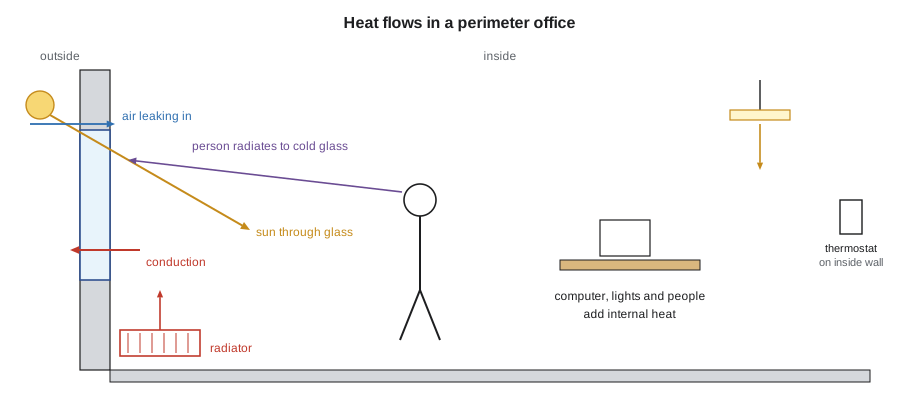
Heat moves in three ways. Conduction is heat flowing through a solid material, such as through a wall, a window frame or a pipe. Convection is heat carried by a moving fluid, such as air rising off a warm radiator or air blown across a coil. Radiation is heat travelling as infrared energy between surfaces that can see each other, such as from a person's skin to a cold window or from the sun through the glass. All three happen in every room, and a comfort complaint is often about one of them.
Radiation is the one most often forgotten. A person sitting beside a cold window loses heat by radiation to the glass even if the air around them is at a comfortable temperature, in the same way that a campfire warms the side of you that faces it on a cold night. A thermostat on an inside wall, out of sight of the window, does not feel that loss at all. That is what was happening in room 214 on cold mornings. On sunny afternoons the opposite happened: sun shining through the west window warmed the professor directly, while the thermostat, in the shade, still read a comfortable air temperature.
What makes people comfortable
Thermal comfort is the condition of mind in which a person is satisfied with the thermal environment. That definition, from ASHRAE Standard 55, makes the point that comfort is about people, not thermometers. Six factors affect it. Four belong to the environment: air temperature, mean radiant temperature, air speed and humidity. Two belong to the person: their activity level, called metabolic rate, and their clothing. A person walking quickly in a heavy coat and a person sitting still in a summer shirt want very different conditions in the same room.
Mean radiant temperature is the average temperature of the surfaces a person can see, weighted by how much of their view each surface fills. A room with cold windows and an outside wall has a mean radiant temperature well below the air temperature in winter. Operative temperature combines the two. In still air it is close to the average of the air temperature and the mean radiant temperature, and it is a better measure of how warm a person feels than the air temperature alone.
Worked problem
Operative temperature beside a cold window
On a cold morning in room 214, the air temperature at the professor's desk is 22 °C, and the mean radiant temperature, dragged down by the single-glazed window, is 17 °C. The air is nearly still. About what operative temperature does she feel?
Show solution
- In still air, operative temperature ≈ (air temperature + mean radiant temperature) ÷ 2.
- (22 + 17) ÷ 2 = 19.5 °C.
- That is two and a half degrees below what the thermostat shows.
Answer: About 19.5 °C. She is right that she is cold, even though the thermostat is right about the air.
Humidity matters less to comfort at normal room temperatures than people expect, but it matters for other reasons. Very dry winter air irritates eyes and skin and causes static shocks; very humid summer air feels muggy and encourages mould on cold surfaces. Many commercial buildings aim to keep relative humidity between about 30 and 60 in 100, though few control it closely in winter. Air speed matters in summer, when a gentle breeze lets people feel comfortable at a higher temperature, and in winter, when a draft from a leaky window or a badly placed diffuser makes people feel cold even in warm air.
ASHRAE 55 describes comfort in terms of the share of people likely to be dissatisfied, because no single condition satisfies everyone. Even in a well-designed office, a few people will always be too warm or too cool. A controls technician cannot make every occupant happy, but they can make sure that the system is delivering what it was designed to deliver, and they can recognize when a complaint is really about radiation, drafts or sun rather than air temperature.
The building envelope
The envelope is everything that separates the inside of a building from the outside: walls, roof, floors over unheated spaces, windows and doors. It controls four things: heat, air, water and vapour. For a controls technician, the envelope matters because it sets how much heating and cooling the building needs and how fast conditions change when the weather does.
Heat flows through the envelope by conduction at a rate set by the U-value of each component, its area and the temperature difference across it. The U-value, or thermal transmittance, is the heat flow through one square metre for each degree of temperature difference, in watts per square metre per kelvin (W/m²·K). The lower the U-value, the better the insulation. Insulation is also described by its thermal resistance, RSI, which for a layer is the inverse of its U-value. A single-glazed window like the one in room 214 has a U-value of roughly 5 to 6 W/m²·K; a modern double-glazed, low-emissivity window with an insulated frame may be 1.6 or less; a well-insulated wall may be well under 0.3.
Worked problem
Heat loss through a window
Room 214's window was partly upgraded in 2005 with a storm pane, giving it a U-value of about 2.8 W/m²·K. It is 6 m² in area. How much heat does it lose when the room is at 22 °C and it is −18 °C outside?
Show solution
- Temperature difference: 22 − (−18) = 40 K.
- Heat loss: Q = U × A × ΔT = 2.8 × 6 × 40 = 672 W.
- The radiator under the window has to replace that heat, and more for air leakage, just to keep the room where it is.
Answer: About 670 W through one window. Halving the U-value halves the loss.
Air leakage, or infiltration, is outdoor air entering through cracks around windows and doors, joints in the walls and openings around pipes and ducts, with indoor air leaving somewhere else. It brings cold, dry air in winter and hot, humid air in summer. Infiltration depends on wind, on the difference between indoor and outdoor temperature, which drives the stack effect in tall buildings, and on how the ventilation system pressurizes the building. Lesson 8 explains how air handlers keep a building slightly positive so that outdoor air does not leak in.
Solar gain is the heat from sunlight entering through windows and, to a lesser extent, heating the outside of walls and roofs. It can be large: on a clear afternoon, sunlight on a west-facing window can deliver several hundred watts for each square metre of glass. Solar gain is welcome in winter on the south side and a major cooling load in summer on the east, west and south sides. Blinds, shading and window coatings change it a great deal, which is why a comfort complaint sometimes ends with a recommendation to close the blinds.
Heating and cooling loads
The heating load is the rate at which the heating system must add heat to keep a space at its setpoint, and the cooling load is the rate at which the cooling system must remove heat. Engineers calculate peak loads to size equipment: the heating load on the coldest design day, and the cooling load on a hot, humid, sunny design day. But equipment runs at peak for only a few hours a year. Most of the time it runs at part load, and controls have to work well at every load, not only at the design point.
Heat gains inside the building, called internal gains, come from people, lights, computers and other equipment. A seated person gives off roughly 100 W of heat, part sensible and part latent; a laptop and monitor add another 50 to 100 W; lighting adds several watts for each square metre of floor. In a large modern office, internal gains are so large that interior zones, with no outside walls, need cooling all year, even in January. Perimeter zones, beside the windows, may need heating in the morning and cooling in the afternoon. This is why a building can call for heating and cooling at the same time, and why the controls must manage both without fighting.
| Load | Source | Heating season | Cooling season |
|---|---|---|---|
| Conduction through envelope | Walls, roof, windows | Large loss | Moderate gain |
| Infiltration | Air leakage | Loss, and dry air | Gain, and humid air |
| Solar | Sunlight through glass | Useful gain on the south | Large gain, east, south and west |
| People | Body heat and moisture | Gain | Gain, sensible and latent |
| Lights and equipment | Electrical use | Gain | Gain |
| Outdoor air for ventilation | Air brought in on purpose | Large loss | Large gain, sensible and latent |
Outdoor air brought in for ventilation is often the largest load of all. In winter, every litre of outdoor air at −20 °C has to be heated to room temperature; in summer, outdoor air at 30 °C and humid has to be cooled and dehumidified. That is why air handlers bring in only as much outdoor air as is needed for health, and why demand-controlled ventilation, covered in lesson 8, saves so much energy.
How buildings respond: thermal mass and time lag
A building does not respond instantly to the weather or to its heating and cooling. Heavy materials such as concrete, masonry and furniture store heat and release it slowly. That thermal mass smooths out swings in temperature, but it also means that a building cooled down overnight takes time to warm up in the morning, and one that has been heated by the sun all afternoon stays warm into the evening. Controls deal with this through morning warm-up and cool-down sequences that start equipment early enough to reach setpoint by the time people arrive, and optimal start programs that learn how long the building takes on different days. BAS-230 covers those sequences.
Time lag also explains many complaints. The professor in room 214 was cold at nine in the morning because the room had been at its unoccupied setback overnight, and although the air reached 22 degrees quickly once the VAV box and radiator started, the window and the outside wall took much longer. She was warm at three in the afternoon because the sun on the west window was a load the radiator control could not see coming.
What Prakash and Callie did
They could not change the window, which was on Harcastle's list for replacement in a future year. But they could change the controls. Sophie Aubertin added the room's existing outdoor air temperature reset to the radiator valve so that it gave more heat on colder mornings, and moved the start of the room's occupied mode half an hour earlier on weekdays. Prakash recommended that Gus have the facilities staff adjust the blinds to close on sunny afternoons, and he wrote a note in the service report that the window's radiant effect, not the controls, was the main cause of the complaint. The professor called once more, in October, to say the room was better.
Common mistakes
MistakeAssuming a thermostat reading tells you how comfortable a person is.
InsteadConsider radiation, drafts, sun and activity, and measure where the person sits.
MistakeTreating every comfort complaint as a controls fault.
InsteadCheck the envelope, the sun and the occupant's position before changing setpoints.
MistakeForgetting that interior zones need cooling in winter.
InsteadExpect simultaneous heating and cooling in large buildings, and make sure the controls do not fight.
MistakeExpecting a cold building to warm up instantly.
InsteadAllow for thermal mass with warm-up and optimal start.
MistakeMixing up kilowatts, Btu/h and tons.
InsteadConvert carefully: 1 kW ≈ 3,412 Btu/h and 1 ton = 12,000 Btu/h ≈ 3.517 kW.
Summary and key terms
- Heat flows from warm to cool by conduction, convection and radiation.
- Sensible heat changes temperature; latent heat changes moisture content.
- Comfort depends on air temperature, radiant temperature, air speed, humidity, activity and clothing.
- Operative temperature combines air and radiant temperature and is a better measure of how warm a person feels.
- Envelope heat flow depends on U-value, area and temperature difference; air leakage and sun add to it.
- Internal gains from people, lights and equipment can make interior zones need cooling all year.
- Outdoor air for ventilation is often the largest single load.
- Thermal mass delays a building's response, which controls handle with warm-up and optimal start.
- Sensible heat
- Heat that changes the temperature of a substance.
- Latent heat
- Heat that changes the state of a substance, such as evaporating or condensing water, without changing its temperature.
- Mean radiant temperature
- The average temperature of the surfaces a person can see, weighted by how much of the view each fills.
- Operative temperature
- A combination of air temperature and mean radiant temperature that reflects how warm a person feels.
- U-value
- The rate of heat flow through one square metre of a building component for each degree of temperature difference.
- Infiltration
- Outdoor air leaking into a building through cracks and openings.
- Internal gains
- Heat added to a space by people, lights and equipment.
- Thermal mass
- The ability of heavy materials to store heat and release it slowly.
Practice problems
Work each problem on paper first, then reveal the answer to check.
What are the three ways heat moves?
Show answer
Conduction, convection and radiation.
Why can a person feel cold in a room where the air is at setpoint?
Show answer
They may be losing heat by radiation to cold surfaces such as windows, or feeling a draft.
Air is at 21 °C and mean radiant temperature is 15 °C in still air. About what is the operative temperature?
Show answer
About 18 °C.
Why do interior zones of a large office need cooling in winter?
Show answer
Internal gains from people, lights and equipment exceed any heat loss, because they have no outside walls.
What is usually the largest single load in an air handler?
Show answer
Conditioning the outdoor air brought in for ventilation.
Lesson quiz · 5 questions
Score 60% or more to complete this lesson.
Create a free account to save your progress, take quizzes and earn a certificate.