
BAS-110 · Lesson 4 of 12 · 24 min
Rooftop units and packaged equipment
▶ Video coming soon A video version of this lesson is on the way.
On Tuesday, September 22, Prakash drove Callie to Ninefield Tower, a ten-storey office building from 1979 with a two-storey podium of shops and a food court along the street. The tower floors were served by a central chilled water plant and large air handlers in the penthouse, which lessons 6 and 9 return to. The podium had its own system: four packaged rooftop units, RTU-1 to RTU-4, standing on curbs on the podium roof, each rated at 10 tons of cooling. Ilona Vescovi, the property manager, had asked Quillon to find out why the food court was warm on hot afternoons while the shops beside it were cold. Prakash climbed the ladder, signed in with the building's roof access log and clipped his harness lanyard to the anchor by the hatch before stepping out. Callie did the same.
This lesson explains packaged rooftop units and other packaged HVAC equipment, which serve a large share of low-rise commercial buildings across North America. It covers what a rooftop unit contains, how its refrigeration, heating and economizer sections are controlled, how factory controls and a BAS share the work, and the common faults a controls technician finds on a roof.
What a rooftop unit is
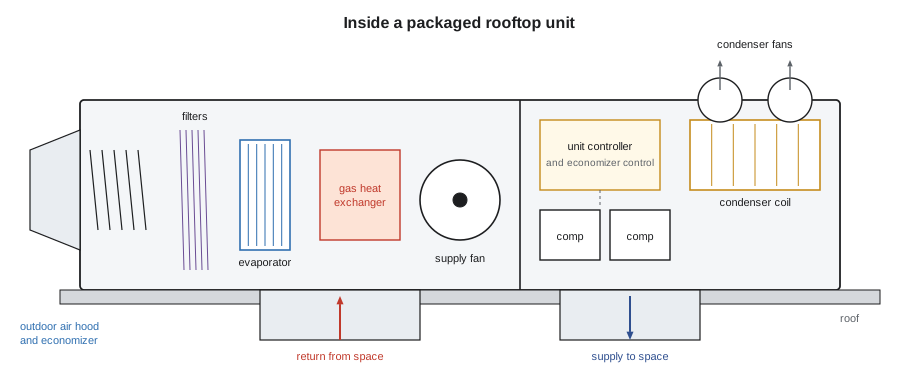
A packaged rooftop unit, or RTU, is an air handler, a refrigeration system and usually a heating section built into one weatherproof cabinet. It sits on a curb on the roof, with its supply and return openings connected straight down into the ductwork of the space below. Because everything is in one box, made and tested in a factory, an RTU is much cheaper to buy and install than a central plant with separate air handlers, and it can be replaced in a day with a crane. Strip malls, schools, low-rise offices, retail stores and the podiums of larger buildings are full of them.
Inside the cabinet, an RTU has the same air path as the air handler in lesson 3: outdoor and return dampers, filters, an evaporator coil for cooling, a heating section and a supply fan. The difference is that the cooling comes from a refrigeration circuit inside the unit itself, with one or more compressors, a condenser coil and condenser fans in a separate section of the cabinet open to the outdoors. This is called direct expansion, or DX, cooling, because refrigerant evaporates directly in the coil the air passes through. RAC-110 and RAC-120 cover the refrigeration cycle itself; this lesson looks at it from the controls side.
Cooling capacity and efficiency
RTUs are rated in tons of cooling. Ninefield's podium units were each 10 tons, which is about 35 kW. Small units start at 3 tons; large ones reach 100 tons or more. Their efficiency is rated by the energy efficiency ratio, or EER, which is the cooling output in Btu/h divided by the electrical input in watts at a standard rating condition, and for part-load performance by the integrated energy efficiency ratio, IEER, which weights performance at several part loads. Engineers outside North America use the coefficient of performance, or COP, which is cooling output divided by electrical input in the same units.
Worked problem
EER and COP for a rooftop unit
RTU-3 at Ninefield is rated at 10 tons and draws 11.3 kW of electricity at the rating condition. What are its EER and COP?
Show solution
- Cooling output: 10 tons × 12,000 = 120,000 Btu/h, or 10 × 3.517 = 35.17 kW.
- EER = 120,000 Btu/h ÷ 11,300 W = 10.6.
- COP = 35.17 kW ÷ 11.3 kW = 3.1.
- The two describe the same thing in different units: COP is about EER ÷ 3.412.
Answer: EER about 10.6 and COP about 3.1. A unit installed in 1995 might have an EER near 9; a new high-efficiency unit may exceed 12, with a much higher IEER.
Most RTUs have more than one stage of cooling, so that they can match part loads. A 10-ton unit might have two compressors that run one or both, or a single variable-speed compressor that modulates. Each stage of compressor operation is a step change in cooling, and a unit with only two stages on a mild day often cycles on and off, which wastes energy, wears the compressors and gives poor humidity control. New units increasingly use variable-speed compressors and variable-speed supply fans to run longer at lower capacity.
Heating in a rooftop unit
Most RTUs in Canada and the northern United States have gas heat: a gas-fired heat exchanger in the air stream, with an inducer fan, an igniter, a flame sensor and a gas valve, much like a large furnace. The unit's control board runs the ignition sequence and the safeties; the BAS or thermostat calls for one or two stages of heat. Some units have electric heat, staged in steps, and some are heat pumps that reverse the refrigeration cycle to heat the building and use electric or gas heat as backup in the coldest weather. Heat pump RTUs are becoming much more common as buildings move away from burning gas.
A controls technician does not service the gas train or the burner, which belongs to a certified gas technician, but needs to understand the sequence well enough to tell whether a no-heat call is a controls fault or a heating fault. If the BAS sends a call for heat and the unit's board shows the inducer starting, the igniter glowing and the flame proving, the controls have done their job. If the call never reaches the unit, the problem is on the controls side. GAS-220 covers the ignition sequence from the gas technician's side.
Factory controls and the BAS
Every RTU comes with a factory control board that runs its internal sequences: compressor timing, minimum on and off times, condenser fan cycling, defrost on heat pumps, gas ignition, and its own safeties such as high and low refrigerant pressure switches and limit switches. Older units took simple commands from a thermostat: G for the fan, Y1 and Y2 for cooling stages, W1 and W2 for heating stages. Many still do, with a BAS controller standing in for the thermostat and closing the same contacts. Newer units have a full unit controller with its own programming that can talk to the BAS directly over BACnet, giving the front end access to dozens of internal points such as compressor status, refrigerant pressures and fault codes.
| Thermostat terminal | Function | BAS equivalent |
|---|---|---|
| R | 24 V power from the unit transformer | Common source for the BAS relay outputs |
| G | Supply fan on | Binary output: fan enable |
| Y1 / Y2 | First and second stage cooling | Binary outputs: cooling stage 1 and 2 |
| W1 / W2 | First and second stage heating | Binary outputs: heating stage 1 and 2 |
| O or B | Reversing valve on a heat pump | Binary output: heat pump mode |
| C | 24 V common | Common for the controller power or relays |
Where the BAS and the factory controls meet, the technician has to know who is responsible for what. The BAS usually decides when the unit should be occupied, what the space setpoint is and whether to call for heating, cooling or economizer; the factory board decides how to run its compressors and burner safely. Problems come when both try to do the same job, for example when the BAS runs its own economizer logic while the factory economizer controller runs another. The sequence of operations should say which one is in charge.
Economizers on rooftop units
Most RTUs above a few tons have an airside economizer, as described in lesson 3, often with a separate economizer controller on the unit. RTU economizers have a poor reputation. Studies by utilities and research laboratories in the United States and Canada have found that a large share of RTU economizers in the field are not working: actuators failed, linkages slipped, dampers rusted shut, outdoor air sensors broken or high-limit settings wrong. Energy codes now require economizer fault detection and diagnostics on new RTUs above a certain size, so that the unit can report when its economizer is not doing what it should. Ontario's energy efficiency supplementary standard, SB-10, allows compliance through ASHRAE Standard 90.1, which includes requirements of this kind.
On the podium roof at Ninefield, Callie watched Prakash test each economizer by forcing the unit into economizer mode from his laptop and watching the dampers. RTU-1 and RTU-4 opened smoothly. RTU-2's damper did not move at all; its actuator had failed and the damper was stuck at about 20 in 100 open. RTU-3's actuator moved, but its shaft coupling had slipped on the damper shaft, so the actuator showed 100 in 100 while the blades barely moved. Both units had been running with almost no economizer cooling for years.
Worked problem
How much outdoor air can an economizer use?
On a mild day the return air from the food court is 23 °C and the outdoor air is 8 °C. RTU-3 needs supply air at 13 °C. If mechanical cooling stays off, what fraction of outdoor air must the economizer bring in?
Show solution
- Fraction outdoor = (return − mixed) ÷ (return − outdoor).
- (23 − 13) ÷ (23 − 8) = 10 ÷ 15 = 0.67.
Answer: About two-thirds outdoor air, with no compressor running. With its damper stuck at 20 in 100, RTU-3 had to run a compressor to get the same result.
Zoning and the food court problem
A single-zone RTU controls the conditions at one thermostat or zone sensor, and it delivers the same supply air to every diffuser it serves. If it serves spaces with different loads, some will be too warm and some too cool. At Ninefield, RTU-2 served both the food court, with its cooking equipment, crowds at lunch and big south windows, and two quiet shops facing north. The thermostat for RTU-2 was in one of the shops. When the shop was satisfied, the unit stopped cooling, and the food court overheated. When the food court was crowded and sunny, nothing told the unit.
There are several ways to fix that kind of problem. One is to move the sensor, or average several sensors, which is cheap but only partly helps. Another is to rezone, so that spaces with similar loads share a unit. A third is to convert the unit to serve VAV boxes with their own controls, which works for larger units but needs a variable-speed fan and more controls. In Ninefield's case Prakash recommended moving RTU-2's sensor to the food court, rebalancing the airflows to send less air to the north shops, and repairing the economizer actuators on RTU-2 and RTU-3. Declan Kilbride turned the recommendation into a quote that Ilona approved in October; the work is booked for early December.
Other packaged equipment
Not all packaged equipment sits on a roof. Split systems put the compressor and condenser outdoors and the air handler or fan coil indoors, connected by refrigerant piping. Ductless mini-split and multi-split heat pumps serve individual rooms with wall- or ceiling-mounted indoor units. Variable refrigerant flow, or VRF, systems connect many indoor units to one outdoor unit and can move heat between zones. Packaged terminal air conditioners and heat pumps, the through-the-wall units found in hotels and apartments, serve single rooms. Dedicated outdoor air systems, or DOAS, are packaged units that only condition and supply outdoor air, often with energy recovery wheels or plates, and leave room heating and cooling to other equipment.
Most of these come with their own manufacturer's controls, which may connect to a BAS through a gateway that translates between the manufacturer's protocol and BACnet. A controls technician integrating them needs to know which points the gateway makes available, which it does not, and what happens if the BAS and the manufacturer's controls disagree. Lesson 7 returns to terminal equipment and BAS-310 covers integration.
Working on the roof
Rooftop work brings hazards that indoor controls work does not. Falls from roof edges, through skylights and down open hatches are the most serious. Ontario's construction regulation and the guarding and fall protection rules for industrial establishments require guardrails, travel restraint or fall arrest where a worker could fall more than a set height, and roofs with permanent anchors usually have a rooftop safety plan. Prakash and Callie used the building's anchors and stayed inside the marked safe zone near the units. Other hazards include rotating condenser fans that can start at any time, sharp coil fins, hot gas flues, refrigerant at high pressure, heat and sun in summer and ice in winter. A unit must be locked out at its disconnect before any panel is opened, and both the BAS command and the unit's own controls must be unable to restart it.
Common mistakes
MistakeAssuming an RTU's economizer works because the actuator shows open.
InsteadWatch the damper blades, and check the shaft coupling and the outdoor air sensor.
MistakeLetting the BAS and the factory controller both run the economizer.
InsteadDecide which one is in charge and disable the other's logic.
MistakeTreating a no-heat call as a gas fault without checking the call.
InsteadConfirm the BAS sends the call and the unit receives it before calling the gas technician.
MistakePutting the only zone sensor in the space with the smallest load.
InsteadLocate or average sensors to represent the zone, or rezone.
MistakeOpening a unit panel without locking out the disconnect.
InsteadLock out the unit so neither the BAS nor its own controls can start it.
MistakeForgetting fall protection on a low roof.
InsteadFollow the roof safety plan and use the anchors.
Summary and key terms
- A rooftop unit packages an air handler, a DX refrigeration system and usually a heating section in one cabinet.
- Capacity is rated in tons; efficiency in EER, IEER or COP.
- Multi-stage or variable-speed compressors let units match part loads; two-stage units cycle on mild days.
- Gas heat sections have their own ignition controls and safeties, which belong to the gas technician.
- Factory boards run internal sequences; the BAS decides occupancy, setpoints and calls, through thermostat terminals or BACnet.
- RTU economizers often fail; test them by watching the dampers move.
- A single-zone unit serving spaces with different loads will leave some too warm and some too cool.
- Rooftop work needs fall protection and lockout of the unit at its disconnect.
- Rooftop unit (RTU)
- A packaged unit on a roof containing an air handler, refrigeration system and usually heating.
- Direct expansion (DX)
- Cooling in which refrigerant evaporates directly in the coil the air passes through.
- Energy efficiency ratio (EER)
- Cooling output in Btu/h divided by electrical input in watts at a rating condition.
- Coefficient of performance (COP)
- Cooling or heating output divided by energy input in the same units.
- Stage
- A step of heating or cooling capacity that turns on or off as a unit.
- Unit controller
- A packaged unit's own control board, which runs its internal sequences and safeties.
- Gateway
- A device that translates between a manufacturer's protocol and the BAS protocol.
- Dedicated outdoor air system (DOAS)
- A unit that conditions and supplies only outdoor air for ventilation.
Practice problems
Work each problem on paper first, then reveal the answer to check.
A 7.5-ton RTU draws 8.0 kW at its rating condition. What is its EER?
Show answer
90,000 Btu/h ÷ 8,000 W = 11.25.
What do the G, Y1 and W1 terminals call for?
Show answer
The supply fan, first-stage cooling and first-stage heating.
An economizer actuator reports 100 in 100 open but the space is warm on a cool day. What should you check?
Show answer
Whether the damper blades are moving: the shaft coupling, the linkage and the damper itself.
Why is a single-zone RTU a poor fit for a food court and a north-facing shop?
Show answer
The two spaces have very different loads, but the unit can respond to only one sensor.
Who services an RTU's burner and gas valve?
Show answer
A certified gas technician; the controls technician confirms the heating call reaches the unit.
Lesson quiz · 5 questions
Score 60% or more to complete this lesson.
Create a free account to save your progress, take quizzes and earn a certificate.