
AWS-129 · Lesson 9 of 12 · 32 min
Common traps in scenario questions
▶ Video coming soon A video version of this lesson is on the way.
By the ninth session Andre could recite the domains. Noor went back through the wrong answers on his diagnostic set and the practice questions they had tried together, and found that most fell into a handful of patterns, the same patterns that catch most candidates on business exams. "You're not missing knowledge," she said. "You're walking into traps. Let's name them so you can see them coming." This lesson collects the traps that appear most often in AIB-C01-style questions, each with a worked practice item.
Trap 1: technology before the problem
The scenario describes an organization excited about a technology, and the options include several ways to deploy it. The trap is choosing the best deployment when the correct answer is to step back and confirm the business problem, the objective or the measure. Watch for stems where nobody has said what the AI is for.
Worked problem
Practice: the eager executive
A retailer's CEO has seen a demonstration of an AI agent that negotiates with suppliers and wants one deployed this quarter. No business case exists. What should the AI strategist do first? Options: (A) choose the most capable agent platform; (B) define the business objective, the expected value and how success will be measured; (C) train procurement staff on prompt engineering; (D) pilot the agent with the largest supplier.
Show solution
- Spot the trap: three options assume the agent is the answer.
- Apply the sequence from Domain 2: objective and value before solution.
- Option (D) also adds risk by testing on the most important relationship first.
Answer: The answer is (B). The strategist must establish why and how value will be measured before choosing or piloting a tool.
Trap 2: the engineer's answer
An option describes a technically sensible action, such as retraining the model, tuning parameters or changing the architecture, when the question asks what a business strategist should do. The exam's out-of-scope list is the clue. The business answer usually involves deciding, measuring, governing or involving the right people; the technical team then does the technical work.
Worked problem
Practice: falling accuracy
Six months after launch, a claims-triage model's accuracy has fallen and complaints are rising. What should the AI strategist do? Options: (A) adjust the model's hyperparameters; (B) ensure monitoring is in place, confirm the cause with the technical owner, and decide whether to add human review or a fallback until performance recovers; (C) switch to a different algorithm; (D) remove the complaints channel.
Show solution
- Options (A) and (C) are engineering choices the strategist would not make directly.
- Option (D) hides the problem and breaks the transparency principle.
- Option (B) uses the strategist's levers: monitoring, accountability, risk mitigation and a business decision about service continuity.
Answer: The answer is (B). Performance drift is a governance and continuity issue for the strategist; the fix itself belongs to the technical team.
Trap 3: the right step at the wrong time
All the options are good ideas, but only one belongs at this point in the sequence. Rolling out to every site before a pilot, buying licences before choosing use cases, or setting KPIs after launch are classic examples. Ask yourself what must be true before each option makes sense.
Trap 4: absolute promises
Options that say AI will eliminate, guarantee, always or never something are almost always wrong. AI systems are probabilistic: they reduce errors, they do not remove them. Responsible AI controls lower risk; they do not make it zero. An option claiming that guardrails "ensure the assistant never produces incorrect information" is wrong however good the guardrails are.
Trap 5: the big-bang answer
The scenario describes a limited budget, a cautious culture or an early stage of maturity, and one option proposes an enterprise-wide transformation. The exam consistently rewards iterative approaches: pilots with measures, quick wins that build foundations, staged rollouts and decision gates. Choose the big option only when the scenario describes an organization that is ready for it.
Trap 6: forgetting the human
A scenario involves a decision with significant consequences for people, such as hiring, credit, health or safety, and an option offers full automation for speed or cost. The trap is choosing efficiency over oversight. When errors would seriously harm people, the expected answer keeps a human in the decision or adds strong review and escalation.
Worked problem
Practice: automated screening
A staffing agency wants to use AI to screen thousands of job applications and automatically reject the bottom half to save recruiter time. Which approach is most appropriate? Options: (A) automate rejections to maximize savings; (B) use AI to rank and summarize applications, with recruiters making decisions, fairness testing before launch and monitoring of outcomes by group; (C) avoid AI because hiring is sensitive; (D) let applicants appeal only if they suspect bias.
Show solution
- Hiring is a consequential decision with fairness and legal risks, so full automation in (A) is the human-free trap.
- Option (C) is the opposite mistake: it ignores a legitimate business need that can be met responsibly.
- Option (D) is reactive and puts the burden on applicants.
- Option (B) keeps people accountable, builds fairness in from the start and monitors over time.
Answer: The answer is (B), the balanced option that serves the business goal and the responsible AI principles together.
Trap 7: the overcautious answer
The mirror image of trap 6. An option says to avoid AI altogether, wait for regulation to settle or stop all experimentation because something might go wrong. Unless the scenario shows that AI is genuinely the wrong tool or that the risk cannot be controlled, the exam prefers managing risk to avoiding value. Look for the option that proceeds with proportionate controls.
Trap 8: counting benefits wrongly
Business case scenarios often hide a measurement error in an attractive option. Typical errors are counting hours saved as money when the time is not redeployed, using full price instead of margin, crediting the AI with changes that also happened at sites without it, ignoring running costs or reporting only the best case. If an option's figure looks very large, check how it was counted.
Worked problem
Practice: the vendor's savings claim
A vendor claims its assistant will save a firm 1.2 million dollars a year: 24,000 staff hours at 50 dollars an hour. Staff hours will be freed, but the firm plans no change in staffing or workload. How should the strategist treat the claim?
Show solution
- Check the arithmetic: 24,000 × 50 = 1,200,000, so the multiplication is right.
- Check the logic: freed hours become money only if a cost is avoided (less overtime, fewer temporary staff, slower hiring) or the time produces measurable value.
- With no plan for the time, the realizable financial benefit could be close to zero, though staff experience may improve.
- The sound response is to ask the vendor and the business what the time will be used for, count only realizable savings, and report the rest as an intangible benefit.
Answer: Treat the 1.2 million dollars as capacity, not cash. Count only what will be realized, with a plan to capture it.
Trap 9: answering for your own workplace
Covered in lesson 2 but worth repeating, because it is the trap experienced professionals fall into most. The scenario's organization is not yours. If the question says the data is clean, it is clean. If it says nothing about regulation, do not assume a regulator is watching. Answer for the case as written.
| Trap | Warning sign | Question to ask yourself |
|---|---|---|
| Technology before problem | Nobody has stated the objective | What is this AI for, and how will we know? |
| Engineer's answer | Options about tuning, architecture or configuration | What would the business leader decide? |
| Wrong time | Good actions in the wrong order | What must happen before this? |
| Absolute promise | Eliminate, guarantee, always, never | Can AI really promise this? |
| Big bang | Enterprise-wide option for an early-stage organization | Is there a smaller step that proves value first? |
| Forgetting the human | Full automation of a consequential decision | Who is accountable if it goes wrong? |
| Overcaution | Avoid, stop or wait for regulation | Can the risk be managed instead? |
| Wrong benefit counting | Large savings figures | Is this margin, net of costs, and actually realizable? |
| Own workplace | Your instinct uses facts not in the question | Is this in the scenario? |
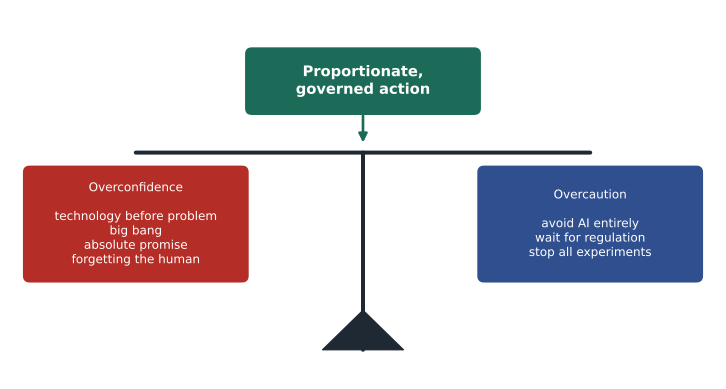
Andre noticed a pattern in the patterns. Most traps were either too much (the big bang, the absolute promise, full automation) or too little (avoiding AI, waiting, doing nothing). The correct answer usually sat in the middle: a measured, governed step that delivered value while managing risk. That was, he realized, exactly what he had been trying to do for Cascade Ridge all autumn.
A mixed practice round
Noor finished with a quick round of short items, each hiding one of the traps, and asked Andre to name the trap before choosing. Naming the trap first turned out to be faster than weighing every option from scratch.
Worked problem
Item 1: the guarantee
A vendor says its document-processing service "eliminates manual data entry errors entirely". A board member asks whether to include that claim in the business case. What should the strategist advise?
Show solution
- Trap: absolute promise.
- AI reduces error rates; it does not remove them. Extracted fields still need validation rules and sampling.
- The business case should use a measured error rate from a pilot on the organization's own documents.
Answer: Do not use the claim. Measure the error rate in a pilot and plan validation for the remaining errors.
Worked problem
Item 2: the regulation wait
A regional hospital network's legal team suggests pausing all AI work until national AI regulation is settled, which could take years. The network has a low-risk scheduling use case ready to pilot. What should the strategist recommend?
Show solution
- Trap: overcaution.
- Low-risk uses can proceed under existing law with proportionate governance: privacy review, a named owner and monitoring.
- Keeping track of regulatory developments is sensible; stopping all work is not.
Answer: Proceed with the low-risk pilot under proportionate governance while monitoring regulatory developments.
Worked problem
Item 3: the order of steps
A school district wants an AI tutoring tool. The options are: (A) negotiate the contract; (B) define learning objectives and how success will be measured; (C) train all teachers; (D) roll out to every school. Which comes first?
Show solution
- Trap: right step at the wrong time.
- All four are reasonable eventually, but objectives and measures must come before choosing, buying or training.
Answer: The answer is (B).
Worked problem
Item 4: the hidden assumption
An option claims a chatbot will save 900,000 dollars a year by deflecting 60,000 calls at 15 dollars each. The contact centre plans to keep the same number of staff and has no backlog. How should the strategist treat the figure?
Show solution
- Trap: wrong benefit counting.
- The arithmetic is right: 60,000 × 15 = 900,000.
- With unchanged staffing and no backlog, little cost is actually avoided; the benefit is capacity, shorter waits and possibly better experience.
- Realizable savings depend on a plan, such as not filling vacancies or reducing overtime and outsourcing.
Answer: Treat the 900,000 dollars as capacity, not savings, unless there is a concrete plan to capture it.
When two traps compete
Some items set two traps against each other, offering both an overconfident option and an overcautious one, so that rejecting one makes the other look right. The resolution is almost always a third option that is neither: a pilot with controls, a phased approach, or a decision with conditions. If you find yourself choosing between "automate everything now" and "do nothing", re-read the options for the measured middle path. It is usually there, and it is usually the answer.
Andre added a final line to his trap list: "If two options are extremes, look for the middle." Noor said that line alone was worth a few points on exam day.
The trap list is also a useful tool outside the exam. Andre is running each item in the draft roadmap through it before the roadmap goes to the board, and two proposals have already failed: one counted hours saved as cash, and one proposed a clinic-wide rollout with no pilot.
Common mistakes
MistakeChoose the option that delivers the most value fastest.
InsteadChoose the option that delivers value with proportionate controls and respects every constraint.
MistakeAvoiding AI is always the safe answer.
InsteadOvercaution is a trap; the exam prefers managed risk to lost value unless AI is the wrong tool.
MistakeLarge savings figures are a sign of a strong option.
InsteadCheck how benefits were counted before trusting a large figure.
Summary and key terms
- Common traps include technology before the problem, engineering answers to business questions, right steps at the wrong time, absolute promises, big-bang programmes for early-stage organizations, full automation of consequential decisions, overcaution, wrongly counted benefits and answering from your own workplace.
- Most traps are too much or too little; the correct answer is usually a proportionate, governed step.
- Name the trap, ask the matching question and re-read the constraints.
- Big-bang rollout
- Deploying everywhere at once rather than in stages.
- Overcaution
- Avoiding or delaying AI when the risk could be managed.
- Realizable benefit
- A benefit that will actually be captured, with a plan and an owner.
- Proportionate control
- A safeguard matched in strength to the size of the risk.
Practice problems
Work each problem on paper first, then reveal the answer to check.
An option says guardrails will ensure an assistant never gives wrong answers. Which trap is it?
Show answer
An absolute promise; no control can guarantee that.
A cautious organization at an early stage is offered an enterprise-wide AI programme. What is the trap and the better answer?
Show answer
The big bang; a pilot or quick win with clear measures fits better.
Why are 10,000 hours saved not automatically worth 10,000 times the hourly wage?
Show answer
Time becomes money only if a cost is avoided or the time is used for measurable value.
Lesson quiz · 5 questions
Score 60% or more to complete this lesson.
Create a free account to save your progress, take quizzes and earn a certificate.