
AWS-129 · Lesson 10 of 12 · 22 min
Building a study plan
▶ Video coming soon A video version of this lesson is on the way.
"A plan you won't follow is worse than no plan," Noor said, "because it makes you feel prepared." Andre had a full-time job, a board roadmap due at the end of March and two children with hockey schedules. His study plan had to fit that life. This lesson builds it with him: choosing an exam date, counting the hours honestly, allocating them by domain weight and confidence, and planning the practice and review that turn knowledge into points.
Step 1: choose the date and the version
Lesson 1 showed that the AIB-C01 beta ran into early 2027, with an early adopter badge for anyone certified by February 15, 2027. Andre's first decision was whether to aim for the beta or for a later date.
| Factor | Sit the beta by mid-February 2027 | Sit in May 2027 |
|---|---|---|
| Fee | 50 US dollars (beta price) | Probably 100 US dollars (standard price) |
| Badge | Early adopter badge in addition to the certification | Certification badge only |
| Result | Delayed until after the beta closes and the passing standard is set | Usually within a few business days |
| Length | 85 questions in 170 minutes | Standard version; the exam guide gives 130 minutes, question count to be confirmed |
| Preparation time | About 13 weeks, including the holidays | About 26 weeks |
| Fit with work | Overlaps the most intense roadmap weeks in January and February | After the roadmap goes to the board |
The fee is charged in US dollars, so a Canadian card will be billed the converted amount plus any applicable tax; at either price the cost is small next to the study time. The real difference between the options is preparation time and the clash with the roadmap.
Andre chose May. The badge was attractive, but he would rather pass with time to prepare than rush the exam during the roadmap's busiest weeks. Noor agreed, with one adjustment: he would book a specific date as soon as the standard version's details were published, because a booked date makes a plan real. Until then, his working target was Saturday, May 15, 2027.
Step 2: count the hours honestly
Andre counted the weeks from Monday, November 16, 2026 to his target date and was honest about the gaps. He planned six hours a week on average: two evenings of about an hour and a half and three hours on Sunday morning.
Worked problem
Counting available study hours
From mid-November to mid-May there are 25 full study weeks. Andre plans no study for 2 weeks over the holidays, and only 2 hours a week for 2 weeks in March while the roadmap is finalized. In the other weeks he plans 6 hours. How many hours does he have?
Show solution
- Normal weeks: 25 − 2 − 2 = 21 weeks.
- \[21 \times 6 = 126 \text{ hours}\]
- Reduced weeks:
- \[2 \times 2 = 4 \text{ hours}\]
- Holiday weeks contribute nothing.
- \[126 + 4 = 130 \text{ hours}\]
Answer: Andre has about 130 hours of study time. Planning from the real figure stops the plan quietly assuming time that does not exist.
Step 3: allocate time by weight and confidence
Noor suggested reserving about 40 hours for practice and final review: the six weeks from late March to early May (36 hours) plus the light card review in the two roadmap weeks (4 hours). That left 90 hours, the 15 normal weeks before the roadmap crunch, to allocate across the domains. A sensible allocation reflects two things: how much the domain is worth on the exam, and how much work Andre needs in it. Andre rated his confidence in each domain from 1 (weak) to 5 (strong), and Noor turned confidence into a need factor of 6 minus the rating, so weaker domains get more time.
| Domain | Weight | Confidence (1 to 5) | Need factor (6 − confidence) | Weight × need |
|---|---|---|---|---|
| 1. Fundamentals and literacy | 24 | 4 | 2 | 48 |
| 2. Strategy and business value | 28 | 4 | 2 | 56 |
| 3. Governance and responsible AI | 24 | 2 | 4 | 96 |
| 4. Readiness and transformation | 24 | 3 | 3 | 72 |
| Total | 100 | 272 |
Worked problem
Turning scores into hours
Allocate 90 hours across the domains in proportion to weight × need.
Show solution
- Domain 1:
- \[\frac{48}{272} \times 90 \approx 15.9 \text{ hours}\]
- Domain 2:
- \[\frac{56}{272} \times 90 \approx 18.5 \text{ hours}\]
- Domain 3:
- \[\frac{96}{272} \times 90 \approx 31.8 \text{ hours}\]
- Domain 4:
- \[\frac{72}{272} \times 90 \approx 23.8 \text{ hours}\]
- Check: 15.9 + 18.5 + 31.8 + 23.8 = 90.0 hours.
Answer: About 16 hours for Domain 1, 18.5 for Domain 2, 32 for Domain 3 and 24 for Domain 4. Governance, Andre's weakest area, gets the most time even though Domain 2 carries the most weight.
Andre was surprised that Domain 2, the largest, got less time than Domain 3. Noor explained that time should go where it will gain the most points. Andre already scored well on strategy questions; another twenty hours there would add little. Governance, where he was weak, had the same weight as two other domains and much more room for improvement. The confidence ratings would be replaced by real practice results after his diagnostic set, which is the subject of lesson 11.
Step 4: build the calendar
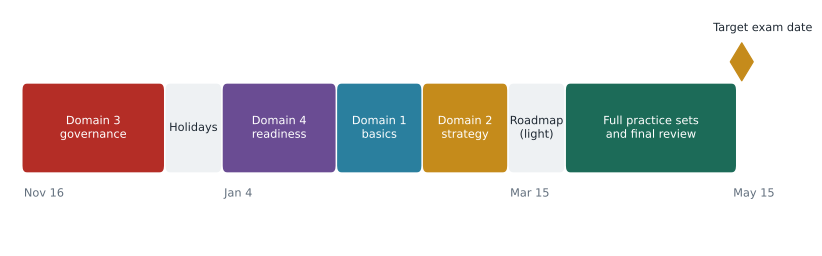
Andre put the weakest domain first, while his energy and motivation were highest, and the strongest domains later. Each domain block followed the same weekly rhythm: one session reading the relevant course material and exam guide skills, one session making short review cards, and a Sunday session answering a timed set of practice questions on that domain and reviewing every answer, right or wrong.
The six-week final block was different. Each week included one full-length practice set taken under timed conditions, a careful analysis of the results, and targeted review of the weakest skills. The last week was deliberately lighter: a final review of cards and traps, logistics, and rest.
Study methods that work
Not all study time is equal. Methods that make you retrieve and apply information beat methods that only expose you to it.
| Method | Why it works | How Andre used it |
|---|---|---|
| Retrieval practice | Recalling information strengthens memory more than rereading | Answering review cards from memory before checking |
| Spaced review | Revisiting material over increasing gaps reduces forgetting | Cards from earlier domains reviewed again every two weeks |
| Explaining in your own words | Exposes gaps that recognition hides | Explaining one exam skill a week to Lorraine in two minutes |
| Timed question practice | Builds speed and exam reading habits | Sunday sets of 20 questions at 2 minutes each |
| Error analysis | Turns wrong answers into targeted study | A log of every mistake, with its cause (lesson 11) |
Two methods were deliberately left out. Rereading notes many times feels productive but builds recognition rather than recall. And memorizing answers to a single practice set measures memory of that set, not readiness; the questions on the real exam will be different.
Practice materials
AWS Skill Builder offers official preparation material for its certifications, which may include an exam prep course and official practice questions; check what is available for AIB-C01 when you plan. Third-party practice tests can add volume, but their quality varies, and some are written before the exam's details are settled. Treat any question whose explanation contradicts the official exam guide as wrong, whoever wrote it.
A typical study week
Plans fail at the level of the week, not the month. Andre wrote out a typical week in the governance block so he could see whether it was realistic.
| Day | Session | Activity |
|---|---|---|
| Tuesday evening | 90 minutes | Read the course material for two Domain 3 skills and the matching exam guide lines; write review cards in his own words |
| Thursday morning | 45 minutes, with Noor before work | Discuss one scenario from Cascade Ridge that uses the week's skills; Noor asks questions in exam style |
| Thursday evening | 45 minutes | Answer review cards from memory, including cards from earlier weeks |
| Sunday morning | 3 hours | 20 timed practice questions, then a full review of every answer, updating the error log; then a two-minute explanation of each skill to Lorraine or to himself aloud |
He will keep the sessions fixed in his calendar like meetings, and he has decided in advance what will happen when life interrupts. A missed Tuesday moved to Wednesday; a missed Sunday was not made up by doubling the next one but by trimming the review cards to the weakest topics. Noor's view was that consistency mattered more than heroics: six hours every week beats twelve hours one week and none the next.
Review cards that work
Andre's review cards follow three rules. Each card asked one question and was answered in one or two sentences. Each was written in his own words, not copied from the course. And each was tied to an exam guide skill number, so he could see which skills had cards and which did not. Examples from the governance block:
- Skill 3.1.3: When should responsible AI practices be built into a project? At planning and design, not as a final review.
- Skill 3.2.4: Why classify AI uses by risk? So governance effort is proportional, with the most review for the highest-risk uses.
- Skill 3.3.2: Name three stages where bias can enter. Problem choice, data collection and labelling, and use after deployment, among others.
- Skill 3.1.4: What are escalation criteria? Rules that say when an AI system must hand a case to a person.
He expects to have about 140 cards by March. Cards he answers correctly three times in a row move to a monthly pile; cards he misses stay in the weekly pile. This simple spacing kept his review time short while protecting the material he was most likely to forget.
Keeping the plan honest
Every plan drifts. Andre's plan includes a short check at the end of each month: hours actually studied against hours planned, practice results by domain, and whether the error log causes were changing. If he fell more than six hours behind, he would cut the least valuable activity, usually extra reading in a strong domain, rather than push the exam date. If practice results showed a domain improving faster than expected, its remaining hours would move to the weakest area.
Worked problem
Adjusting after a slow month
Suppose that by the end of January Andre has studied 30 hours against a plan of 42 because of a busy period at work, while his governance practice results have improved from 50 to about 70 out of 100, while Domain 4 is still near 65. What adjustment fits his rules?
Show solution
- Shortfall: 42 − 30 = 12 hours, more than his six-hour trigger.
- Cut the least valuable remaining activity: extra reading planned for Domain 1, his strongest area, saving about 4 hours.
- Shift emphasis: governance has improved, so some of its remaining review time can move to Domain 4.
- Accept a slightly smaller final block or add one extra Sunday session in February, rather than moving the exam date.
Answer: Trim low-value work in strong areas, move time from the improving governance block to Domain 4, and keep the exam date.
Rest and the final week
Sleep is part of the plan. Memory for what was studied consolidates during sleep, and a tired candidate misreads questions. Andre's plan avoids late-night study in the final two weeks, keeps the last week light, and leaves the day before the exam for a short review, logistics and rest. He also plans one complete rehearsal of exam day three weeks before the real one: the same start time, a full practice set in one sitting, and the same breakfast, so nothing about the day itself is new.
Andre also told the people around him about the plan: his family, so Sunday mornings would stay protected; Lorraine, so a crisis at work would not quietly swallow a month of study; and Noor, so their Thursday sessions had a clear purpose each week. A plan that others know about is harder to abandon.
Common mistakes
MistakePlan the hours you would like to have.
InsteadCount the hours you actually have, including holidays and busy periods.
MistakeGive the most time to the most heavily weighted domain.
InsteadAllocate by weight and need; weak domains with equal weight often deserve more time.
MistakeRereading notes is good preparation.
InsteadRetrieval practice, spaced review and timed questions build more durable recall.
MistakeLeave practice exams until the last week.
InsteadTake a diagnostic early and full practice sets across the final month, with time to act on the results.
Summary and key terms
- Choose the exam date and version deliberately: the beta offered a lower fee and an early adopter badge but a delayed result and less preparation time.
- Count real study hours, including gaps.
- Reserve the final weeks for practice and review, and allocate the rest by domain weight multiplied by need.
- Put the weakest domain early.
- Use retrieval practice, spaced review, explanation, timed questions and error analysis rather than rereading.
- Use official preparation material first and treat third-party answers that contradict the exam guide as wrong.
- Need factor
- A number that gives weaker domains more study time, such as 6 minus a confidence rating.
- Retrieval practice
- Recalling information from memory to strengthen learning.
- Spaced review
- Revisiting material at increasing intervals to reduce forgetting.
- Diagnostic set
- An early practice set used to measure strengths and weaknesses before planning in detail.
Practice problems
Work each problem on paper first, then reveal the answer to check.
Why did Domain 3 receive more hours than Domain 2 in Andre's plan?
Show answer
His confidence in governance was much lower, so extra time there would gain more points despite the equal or lower weight.
What are the trade-offs of taking a beta exam?
Show answer
A lower fee and an early adopter badge, but a delayed result, a longer exam and possibly less preparation time.
Why not memorize the answers to one practice set?
Show answer
It measures memory of that set, not readiness for different questions on the real exam.
Lesson quiz · 5 questions
Score 60% or more to complete this lesson.
Create a free account to save your progress, take quizzes and earn a certificate.