
AWS-129 · Lesson 3 of 12 · 27 min
Domain 1 review: AI fundamentals and literacy
▶ Video coming soon A video version of this lesson is on the way.
Domain 1 carries 24 of every 100 scored points, and Andre had studied its material months earlier in the AI Practitioner courses. That was the danger. "It's the domain you think you know," Noor said. "People skim it and lose easy points." This lesson reviews the three tasks in Domain 1 at the depth a business strategist needs: core concepts and vocabulary, choosing the right type of solution, and applying generative AI techniques.
Task 1.1: core concepts and vocabulary
The exam expects you to explain basic AI ideas in business terms, not mathematical ones. The table gives the definitions Andre wrote on his review cards.
| Term | Plain business meaning | A Cascade Ridge example |
|---|---|---|
| Algorithm | A procedure for learning from data or making a decision | The method used to learn which bookings tend to be missed |
| Model | The result of training: a learned pattern that turns inputs into outputs | The no-show model that scores each booking |
| Training | Fitting a model to historical examples with known outcomes | Learning from two years of bookings marked kept or missed |
| Inference | Using a trained model on new inputs | Scoring tomorrow's bookings each evening |
| Prediction | The output of inference, often with a probability | "This booking has a 0.31 chance of being missed" |
| Artificial intelligence | The broad field of systems that perform tasks that normally need human judgment | All of the above, plus rules and assistants |
| Machine learning | A subset of AI where systems learn patterns from data rather than following written rules | The no-show model |
| Generative AI | A subset of machine learning that creates new content such as text, images or code | Drafting call notes from a transcript |
The relationship between the last three terms is a favourite exam topic: generative AI is a kind of machine learning, and machine learning is a kind of AI. Not all AI is machine learning (a rules engine is AI in the broad sense but learns nothing), and not all machine learning is generative (the no-show model predicts a probability; it creates no content).
Data types matter because they decide which tools fit. Structured data sits in rows and columns with defined fields: appointment records, invoices, lab values. Unstructured data has no fixed fields: call recordings, free-text notes, radiograph images, emails. Traditional machine learning works most easily on structured data. Generative AI and other deep learning models made unstructured data useful at scale, which is why so many new use cases involve documents, conversations and images.
Data quality decides outcomes. A model trained on incomplete, inaccurate or unrepresentative history will reproduce those flaws. If Cascade Ridge's booking records marked some kept appointments as missed because of a reception software fault, the no-show model would learn the fault. The business lesson the exam looks for is that data quality is a business problem with business owners, not just a technical detail.
The guide also mentions shared frameworks for AI vocabulary and management. ISO/IEC 23053 describes a framework for AI systems that use machine learning, giving a common language for their components. ISO/IEC 42001 is a management system standard for AI: it sets out how an organization establishes policies, roles, risk processes and continual improvement for its AI use, and organizations can be certified against it. You need to recognize these, not recite them.
Task 1.2: choosing the right solution type
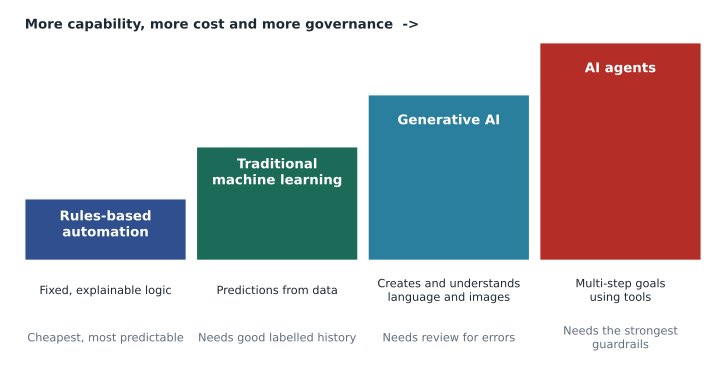
This task appears in many scenario questions because it is a business decision with real costs. The guiding principle is to use the simplest approach that meets the need.
| Approach | Use it when | Avoid it when |
|---|---|---|
| Rules-based automation | The logic is clear, stable and can be written down by experts | The patterns are too many or too subtle to write as rules |
| Traditional machine learning | There is a prediction or classification to make and good labelled history | There is little relevant data or the decision must be fully explainable by rule |
| Generative AI | The task involves understanding or producing language, images or code | A single exact answer is required with no tolerance for errors and no review step |
| AI agents | A goal requires several steps, decisions and actions using tools or systems | The task is simple, high risk without oversight, or the tools cannot be safely limited |
AI agents have their own skill in the guide. An agent is a system that pursues a goal with some autonomy, deciding its own next step; uses tools, such as searching a knowledge base, calling an application or updating a record; may communicate with other agents; and works under orchestration, which coordinates the steps and agents involved. An agent that can rebook an appointment, check the vet's calendar and send the client a confirmation does more than a chatbot that only answers questions, and needs tighter controls because it acts in real systems.
Two more skills in Task 1.2 are about operations rather than choice. AI systems need ongoing monitoring because their performance can change after deployment. Model drift happens when the world changes so that patterns learned in training no longer hold: a new online booking channel might change who misses appointments. And organizations should classify AI tools transparently, for example as approved, blocked or under evaluation, so staff know what they may use. Without such a list, staff use unapproved tools anyway, a problem called shadow AI, and client data may end up in services nobody has reviewed.
Worked problem
Choosing the approach
Three proposals reach Andre. (1) Automatically apply a standard discount to seniors' vaccinations, using the client's recorded age. (2) Predict which pets are due for dental work and likely to book, from appointment and treatment history. (3) Let clients ask questions about the clinic's policies in plain language at any hour. Recommend an approach for each.
Show solution
- Proposal 1 is a fixed rule: if the client is a senior and the service is a vaccination, apply the discount. Rules-based automation is enough; machine learning would add cost and nothing else.
- Proposal 2 is a prediction from structured history, with outcomes to learn from. Traditional machine learning fits.
- Proposal 3 requires understanding free-form questions and answering in natural language from approved policy documents. Generative AI with retrieval from those documents fits, with limits on what it can answer.
Answer: Rules for 1, traditional machine learning for 2, generative AI with retrieval for 3. Each choice uses the simplest approach that meets the need.
Task 1.3: generative AI techniques
The third task covers how business users get good results from generative AI. You will not write code, but you must recognize the techniques and when each is the right lever.
Prompt engineering is designing the instructions given to a model. Good prompts state the task clearly, give the model a role and context, specify the format of the answer, include examples where useful, and set limits such as "answer only from the policy text provided". The exam treats prompt engineering as the first and cheapest lever: before paying to customize a model, see whether better instructions solve the problem.
Tokens are the units a model reads and writes, roughly pieces of words. Every model has a context window, the maximum number of tokens it can consider at once, covering the instructions, any documents supplied and the answer. If a task exceeds it, the model cannot see everything: a summary of a very long medical history may silently leave out early events. Token limits also drive cost, because many services charge per token. The business signals to watch for in a scenario are very long documents, long conversations and high volumes.
Two model adaptation techniques appear by name. Retrieval augmented generation (RAG) gives the model relevant passages from the organization's own documents at the moment of the question, so its answer is grounded in current, approved information. It is the right choice when the problem is that the model does not know the organization's facts, or when those facts change often. Fine-tuning trains an existing model further on the organization's examples, changing its behaviour: its style, its format, its skill at a specialized task. It costs more, needs good example data and must be repeated when needs change.
| Problem in the scenario | Most appropriate lever | Why |
|---|---|---|
| Answers are vague or in the wrong format | Prompt engineering | Cheapest; clear instructions and examples often fix it |
| The model does not know company policies or current prices | Retrieval augmented generation | Supplies current facts at question time without retraining |
| The model must consistently write in a specialized style or perform a narrow task | Fine-tuning | Changes the model's behaviour using labelled examples |
| A document is too long for the model to process at once | Split the document, summarize in stages or use a model with a larger context window | The context window limits what the model can consider |
Practice scenarios for Domain 1
Domain 1 questions are usually short, but they hide traps in vocabulary. Noor wrote three practice items in the exam's style and had Andre talk through each one.
Worked problem
Practice: the rules question
An insurance company wants to route incoming claims to one of four teams. The rule is written in the claims manual: claims under 5,000 dollars go to the fast team, property claims over that amount go to property, vehicle claims go to motor, and everything else goes to general. A vendor proposes a machine learning classifier. What should the AI strategist recommend?
Show solution
- Ask: a recommendation about the solution type.
- Key fact: the routing logic is fully written down and simple.
- Apply skill 1.2.1: when rules are clear and stable, rules-based automation is sufficient and cheaper, more predictable and easier to explain.
- Check the distractor: a classifier might work, but it adds training, monitoring and cost for no gain.
Answer: Recommend rules-based automation. Machine learning would be the "technology before the problem" trap.
Worked problem
Practice: the long document
A legal team asks a generative AI assistant to summarize 900-page contracts. Summaries of long contracts often leave out clauses from the first chapters. What is the most likely cause, and what should the strategist suggest?
Show solution
- The symptom (early material missing from summaries of very long documents) points to the context window: the model cannot consider the whole document at once.
- Options that address it: split the contract into sections, summarize each, then combine the section summaries; or choose a model with a larger context window if cost allows.
- Human review of summaries remains important for legal documents.
Answer: The context window is too small for the document. Summarize in stages or use a larger-context model, with lawyers reviewing the result.
Worked problem
Practice: unapproved tools
Staff at a consulting firm are pasting client data into a free public chatbot. Leadership wants to stop the risk without halting productivity. Which approach fits skill 1.2.4?
Show solution
- The problem is shadow AI: staff use unapproved tools because they find them useful.
- A ban alone tends to drive use underground.
- Skill 1.2.4 recommends transparent classification: publish a list of approved, blocked and under-evaluation tools, provide an approved alternative with proper data terms, and explain why.
Answer: Classify tools transparently and provide an approved option with suitable data protections, alongside clear guidance on client data.
None of the three items needed technical depth. Each needed one Domain 1 idea applied carefully to a business situation, which is exactly what the domain tests.
Common mistakes
MistakeGenerative AI and machine learning are separate fields.
InsteadGenerative AI is a subset of machine learning, which is a subset of AI.
MistakeFine-tuning is the best way to give a model up-to-date company facts.
InsteadRetrieval augmented generation is usually better for facts that change; fine-tuning changes behaviour.
MistakeOnce a model is deployed and accurate, it can be left alone.
InsteadPerformance can drift as the world changes; AI systems need monitoring and updates.
MistakeBanning all unapproved AI tools without offering approved ones solves shadow AI.
InsteadTransparent classification of tools as approved, blocked or under evaluation, with approved options, reduces shadow AI.
Worked problem
Diagnosing a generative AI problem
Cascade Ridge's draft client assistant gives correct general pet-care advice but quotes last year's vaccination prices and an old weekend schedule. Staff suggest fine-tuning the model on the current price list. What should Andre recommend?
Show solution
- Identify the problem: the model lacks current facts that change during the year. It is a knowledge problem, not a behaviour problem.
- Compare levers: fine-tuning would bake in this year's prices, which would then go out of date, and would need repeating after every change.
- Retrieval augmented generation lets the assistant look up the current price list and schedule each time it answers, so updating the document updates the answers.
Answer: Recommend retrieval augmented generation from the current price list and schedule, with a rule that prices are quoted only from retrieved documents.
Summary and key terms
- Domain 1 tests core vocabulary in business terms: algorithm, model, training, inference and prediction.
- Generative AI is a subset of machine learning, which is a subset of AI.
- Structured and unstructured data suit different tools, and data quality decides outcomes.
- Choose the simplest approach that works: rules, then traditional machine learning, then generative AI, then agents.
- Agents act with autonomy, tools and orchestration, so they need the strongest controls.
- Monitor deployed systems for drift and classify tools to reduce shadow AI.
- Use prompt engineering first, retrieval augmented generation for current facts, and fine-tuning to change behaviour; watch token limits and context windows.
- Inference
- Using a trained model to make predictions on new data.
- Model drift
- A fall in model performance because real-world patterns have changed since training.
- Shadow AI
- Use of AI tools that the organization has not approved or reviewed.
- Context window
- The maximum amount of text, in tokens, a model can consider at once.
- Retrieval augmented generation
- Supplying relevant passages from an organization's documents to a model at question time.
- Fine-tuning
- Further training of an existing model on an organization's examples to change its behaviour.
- ISO/IEC 42001
- A management system standard for how an organization governs its use of AI.
Practice problems
Work each problem on paper first, then reveal the answer to check.
A decision follows a short written protocol that never changes. Which approach fits?
Show answer
Rules-based automation, because the logic is clear and stable.
What makes an AI agent different from a question-answering assistant?
Show answer
It pursues a goal with some autonomy, uses tools and can take actions in systems, coordinated by orchestration.
Why does a context window matter to a business user?
Show answer
Long documents or conversations may exceed it, so the model cannot consider everything, and larger inputs cost more.
Lesson quiz · 5 questions
Score 60% or more to complete this lesson.
Create a free account to save your progress, take quizzes and earn a certificate.