
AWS-129 · Lesson 12 of 12 · 28 min
Final review and exam-day strategy
▶ Video coming soon A video version of this lesson is on the way.
The last session of the course was short and practical. Noor brought a single page: the ideas Andre should be able to state without hesitation, and the plan for the day itself. "By the final week you aren't learning much new," she said. "You're protecting what you know from nerves, fatigue and the clock." This lesson gives that page in full, then the exam-day strategy: pacing, flagging, reviewing, and what to do before, during and after the exam.
The one-page review
| Domain | Ideas to state without hesitation |
|---|---|
| 1. Fundamentals and literacy | AI contains machine learning, which contains generative AI. Structured and unstructured data suit different tools; data quality decides outcomes. Use the simplest approach that works: rules, then machine learning, then generative AI, then agents. Agents have autonomy, tools and orchestration. Monitor for drift; classify tools to prevent shadow AI. Prompt engineering first; retrieval for current facts; fine-tuning to change behaviour; watch context windows and tokens. |
| 2. Strategy and business value | Start from objectives, not technology. Prioritize by value, feasibility, sustainability and alignment; scale, pause, terminate or pivot on evidence. Recognize when AI is the wrong tool. Build, buy or partner on budget, timelines, capabilities, vendor proposals and compliance. Plan transitions for continuity, cost, data and performance. Tangible, intangible and guardrail KPIs; baselines before launch; comparison groups; honest ROI; leading indicators; cost controls. Parity versus sustainable advantage; investment by maturity and pressure. |
| 3. Governance and responsible AI | Fairness, explainability, privacy, safety, transparency and robustness, applied with balanced tradeoffs. Build responsibility in from the start. Oversight in proportion to impact and likelihood of error; guardrails, hallucination detection, escalation. Cross-functional governance with named owners. Compliance risks recognized early; risk classification for proportional effort; access and data security. Monitor bias, harmful content, intellectual property, hallucinations, data degradation and drift. |
| 4. Readiness and transformation | Readiness across leadership, data, culture, infrastructure and governance; fix the blocking gap. Match investment to maturity. Data readiness for a specific use; owners and sharing frameworks for silos. Sponsors, champions, cross-functional teams. Honest communication on roles; interventions for risk aversion, resistance and fear of failure. Literacy through proofs of concept, hackathons and training. Envision, experiment, launch, scale; quick wins that build foundations; a centre of excellence; production-grade requirements. |
Andre plans to read the page aloud once a day in the final week and to test himself by covering the right-hand column and explaining each domain in his own words. He will also reread the nine traps from lesson 9 and the five causes in his error log, and he will not start any new material.
Pacing
Pacing turns the time limit into a plan. The simplest approach is to divide the exam into a first pass at a steady target pace, leaving a reserve of time for flagged questions and a final check.
Worked problem
Setting checkpoints
Suppose an exam has 85 questions in 170 minutes, as the beta did. Andre wants to finish his first pass with about 25 minutes in reserve. Set a target pace and checkpoints at questions 20, 40, 60 and 85.
Show solution
- Time for the first pass: 170 − 25 = 145 minutes, so roughly 1.7 minutes per question.
- \[\frac{145}{85} \approx 1.7 \text{ minutes per question}\]
- Checkpoints at 1.7 minutes per question:
- \[20 \times 1.7 = 34; \quad 40 \times 1.7 = 68; \quad 60 \times 1.7 = 102; \quad 85 \times 1.7 = 144.5\]
- Reserve:
- \[170 - 144.5 = 25.5 \text{ minutes}\]
Answer: Checkpoints at about 34, 68, 102 and 145 minutes leave about 25 minutes to review flagged questions. Andre will recalculate from the real question count and time when he books the standard exam.
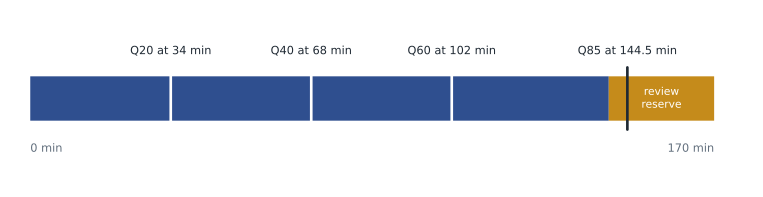
The checkpoints are signals, not rules to panic over. If Andre reaches question 40 at minute 75 instead of 68, he is seven minutes behind: he should speed up slightly by flagging hard questions sooner, not abandon careful reading. Being well ahead is also a signal, often of reading too fast.
Flagging and the two-minute rule
The exam interface lets you flag questions to return to later. Noor's rule was simple: if a question is not resolved after about two minutes, choose your best answer now, flag it and move on. Always choose an answer before moving on, because a flagged blank is still a blank if time runs out. Long business case questions are the usual time traps; one stubborn question should not cost three easier ones at the end.
When returning to flagged questions, read the ask again with fresh eyes. Change an answer only if you can name a specific fact in the scenario that you missed or misread the first time. Andre's error log showed one point lost by switching a correct answer on a vague feeling; research on test-taking suggests that changes based on a clear reason are more often right than wrong, while changes based on unease are not.
Managing attention
An exam of two hours or more is long enough for fatigue to matter. Andre's diagnostic set had shown him rushing the last few questions, so he planned a few habits: a slow breath and a stretch at each checkpoint, a sip of water if allowed, and re-reading the ask of any question that felt confusing, because fatigue shows first as misreading. If a run of questions feels hard, remember that some questions are unscored and difficulty varies; one hard section says nothing about the result.
Before the exam
| When | What to do |
|---|---|
| When booking | Check the current exam length, question count, fee and policies on the official pages; choose a testing centre or online proctoring; request any accommodation before booking |
| A week before | Confirm the appointment and the identification Pearson VUE requires, which is listed in the confirmation; for online delivery, run the system test on the computer and network you will use |
| The day before | Light review of the one-page sheet and trap list only; plan the route or prepare the room; sleep |
| On the day | Eat beforehand; arrive early at a testing centre or start online check-in early; bring the required identification; leave phones and notes as instructed |
For online proctoring, the rules are strict: a private room, a clear desk, no other people entering, and no reading questions aloud. A proctor watches through the webcam and can end the exam if the rules are broken. Andre plans to choose a testing centre in Calgary to avoid worrying about his home internet connection and a household with two children on a Saturday.
During the exam: the routine for each question
- Read the last sentence and identify what is asked.
- Read the scenario, marking constraints and signal words.
- Predict the shape of the answer.
- Eliminate options that break a constraint or match a trap.
- Choose the option with the fewest assumptions; for multiple response, judge each option separately and check the count.
- If unresolved after about two minutes, answer, flag and move on.
After the exam
For the standard version, candidates normally receive a pass or fail result and a score report within a few business days; beta candidates wait until after the beta closes. The score report shows the scaled score and performance by domain. If you pass, you receive a digital badge and the certification, which for AWS certifications is valid for three years. If you do not pass, AWS requires a wait of 14 days before a retake and charges the full fee again. The domain feedback, read with the usual caution about small sections, and a new error log from memory of the hard questions are the starting point for the next attempt.
Andre had one more task for after the exam, whatever the result: a short note to Lorraine about what preparing had changed in the roadmap. He had already started it. The prioritization was sharper, the business cases had comparison groups and stop conditions, and the governance section had named owners for every system. The exam was in May; the value had begun in November.
A final practice round across the domains
In the last session Noor gave Andre one question from each domain, mixed together as they will be on the exam, and asked him to use the full per-question routine on each.
Worked problem
Final round, question 1 (Domain 1)
A travel company wants its booking assistant to answer questions using its current cancellation policies, which change several times a year. Which approach is most appropriate?
Show solution
- Ask: the most appropriate approach for answers based on frequently changing documents.
- Constraint: policies change several times a year.
- Predict: retrieval from the current policy documents.
- Eliminate: fine-tuning would need repeating after every change; a larger model would not know the policies either.
Answer: Retrieval augmented generation from the current policy documents.
Worked problem
Final round, question 2 (Domain 2)
A wholesaler's AI pilot reduced order errors at pilot warehouses from 4.0 to 2.9 per 100 orders, while comparison warehouses went from 4.1 to 3.8. Leadership asks for the effect to report. What should the strategist report?
Show solution
- Pilot change: 2.9 − 4.0 = −1.1.
- Comparison change: 3.8 − 4.1 = −0.3.
- Effect: −1.1 − (−0.3) = −0.8.
Answer: A reduction of about 0.8 errors per 100 orders attributable to the pilot, not the full 1.1.
Worked problem
Final round, question 3 (Domain 3)
A lender wants to use AI to decide small business loan applications automatically, without human review, to cut processing time. What should the strategist recommend?
Show solution
- Ask: a recommendation for a consequential decision affecting people and businesses.
- Principles: fairness, explainability, regulatory compliance and human oversight.
- Trap check: full automation forgets the human; refusing AI altogether is overcautious.
- Balanced answer: use AI to assess and summarize applications, with loan officers making decisions, explanations for declines, fairness testing before launch and monitoring afterwards.
Answer: AI-assisted decisions with human accountability, explanations, fairness testing and monitoring.
Worked problem
Final round, question 4 (Domain 4)
A government agency piloted an AI tool successfully in one office. A central team built it, but now twenty offices want their own versions and the central team cannot keep up. What should the strategist recommend?
Show solution
- Ask: how to scale beyond a central bottleneck.
- Skill 4.4.3: centre of excellence and collaboration models.
- Predict: move toward hub-and-spoke, with central standards and shared components, and local teams building with support.
Answer: Shift to a hub-and-spoke model, keep standards and shared platforms central, and build capability in the offices, scaling in stages with metrics.
The point of the round was not only to reach four right answers but to explain why each wrong option was wrong. Noor considered that the real sign of readiness: not just knowing the right answer, but knowing exactly what was wrong with the others.
If things go wrong on the day
Most exam days go to plan, but it helps to know in advance what to do if they do not. If an online session loses its connection, follow the proctor's instructions and contact Pearson VUE support rather than starting again on your own. If a question seems to have no correct answer or a technical fault, choose the best available option, flag it, and use the comment or reporting option if one is offered; dwelling on it costs time for other questions. If anxiety rises, pause for a few slow breaths at the next checkpoint; a few seconds of calm costs far less than a run of misread questions. And if you are unwell on the day, check the rescheduling and cancellation rules in your booking, which usually allow changes up to a set time before the appointment.
Andre added one personal rule: no checking of answers with anyone in the hours after the exam. Whatever the result, the time to review would be when the score report arrived, using the domain feedback and his own notes.
Common mistakes
MistakeSpend as long as needed on each question to get it right.
InsteadAnswer and flag after about two minutes; protect time for the questions at the end.
MistakeLeave hard questions blank and come back to them.
InsteadAlways choose an answer before moving on; a flagged blank still scores zero if time runs out.
MistakeChange answers whenever you feel unsure on review.
InsteadChange only when you can name a specific fact you missed.
MistakeCram new material the night before.
InsteadReview the one-page sheet and trap list lightly, then rest.
Worked problem
Recovering from a slow start
Andre reaches question 20 at minute 42 instead of 34. With his plan of 85 questions in 170 minutes, how much time per question does he have for the remaining questions if he still wants 25 minutes in reserve?
Show solution
- Questions remaining: 85 − 20 = 65.
- Time remaining for the first pass: 170 − 42 − 25 = 103 minutes.
- \[\frac{103}{65} \approx 1.58 \text{ minutes per question}\]
- That is about 0.1 minutes, or 7 seconds, faster per question than planned, which is achievable by flagging the hardest questions sooner.
Answer: About 1.6 minutes per question. A small, steady adjustment recovers the time; there is no need to rush.
Summary and key terms
- In the final week, review the one-page summary of each domain, the trap list and the error log, and add no new material.
- Pace with checkpoints and a review reserve, recalculated from the real exam length.
- Answer and flag after about two minutes; never leave a question blank.
- Change answers only for a specific reason.
- Manage fatigue at checkpoints.
- Confirm the booking, identification and room or route in advance.
- Standard results arrive within a few business days; beta results come later.
- AWS certifications are valid for three years; retakes need a 14-day wait and a new fee.
- Checkpoint
- A planned question number and time used to check pacing during the exam.
- Review reserve
- Time set aside at the end of the exam for flagged questions.
- Flag
- Marking a question in the exam interface to return to later.
- Online proctoring
- Taking the exam remotely while a proctor watches through a webcam.
Practice problems
Work each problem on paper first, then reveal the answer to check.
An exam has 60 questions in 130 minutes, and you want a 20-minute reserve. What is the target pace?
Show answer
110 minutes for 60 questions, about 1.8 minutes per question.
When should you change an answer on review?
Show answer
Only when you can name a specific fact in the scenario that you missed or misread.
How long must a candidate wait before retaking an AWS exam after a fail?
Show answer
14 days, and the full fee is charged again.
Lesson quiz · 5 questions
Score 60% or more to complete this lesson.
Create a free account to save your progress, take quizzes and earn a certificate.