
AWS-129 · Lesson 7 of 12 · 26 min
Domain 4 review: readiness and transformation
▶ Video coming soon A video version of this lesson is on the way.
Domain 4, Business Readiness, Leadership, and AI Transformation, carries 24 of every 100 scored points and has the most skills of any domain: four tasks and nineteen skills. Andre found it the most familiar in spirit, because operations managers spend their lives on readiness: whether the staff, systems and procedures are in place before something new starts. This lesson reviews the first two tasks, assessing readiness and maturity and establishing data and infrastructure foundations. Lesson 8 covers leading change, building workforce capability and scaling.
Task 4.1: readiness across dimensions
Skill 4.1.1 asks you to assess readiness across dimensions the guide names as examples: leadership alignment, data quality, culture, technical infrastructure and governance. A readiness assessment is the honest answer to a simple question: if we approved this AI programme tomorrow, what would stop it succeeding?
| Dimension | Signs of readiness | Signs of a gap |
|---|---|---|
| Leadership alignment | Executives agree on priorities, sponsor initiatives and commit budget | Leaders disagree on goals, or support AI in speeches but not in budgets |
| Data quality | Key data is complete, accurate, timely, accessible and owned | Data is scattered, inconsistent, out of date or nobody owns it |
| Culture | Staff are curious, willing to experiment and trust that change will be handled fairly | Fear of job loss, risk aversion, punishment of failed experiments |
| Technical infrastructure | Systems can share data securely; cloud services and integration tools are in place | Old systems with no interfaces, manual exports, no secure environment for AI |
| Governance | Policies, risk processes and accountable owners exist for AI | No policy on AI tools, no risk review, unclear decision rights |
In the autumn, Andre and Noor had scored Cascade Ridge on these dimensions. Leadership alignment was strong after the board's request; data quality was mixed, because appointment records were good but pharmacy product codes differed between three systems; culture was cautious, especially among technicians who had heard rumours that AI would replace them; technical infrastructure was improving with the move to AWS; and governance was new, with an AI policy drafted but not yet approved. The exam often gives a scenario like this and asks which gap to address first. The answer is usually the gap that blocks the specific initiative being discussed, not the one that sounds most impressive to fix.
Maturity models
Skill 4.1.2 asks you to use AI maturity models to place an organization on its AI journey, from experimentation to enterprise-scale deployment. Maturity models differ in their names and number of stages, but they share a common shape.
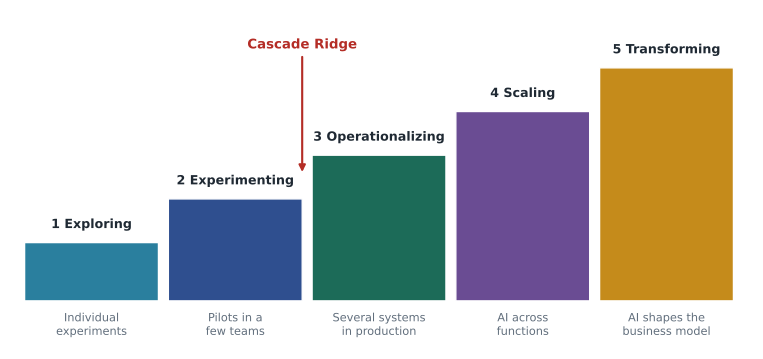
| Stage | Typical characteristics | Sensible next investment |
|---|---|---|
| Exploring | Individual experiments; no strategy or policy | Literacy training, an approved-tools list, a first use-case inventory |
| Experimenting | Pilots in a few teams; early governance | Prioritization, business cases, data foundations for the leading use cases |
| Operationalizing | Several systems in production; governance and shared platforms forming | Monitoring, model operations, a centre of excellence, reuse of components |
| Scaling | AI across functions; value measured and reported | Portfolio management, workforce redesign, deeper integration |
| Transforming | AI reshapes products, services and the business model | New offerings, ecosystem partnerships, continuous reinvention |
The exam point in skills 4.1.3 and 4.1.4 is that investments should match maturity. An organization at the exploring stage gains little from an enterprise-wide agent platform; it needs literacy, policy and a few well-chosen pilots. An organization already running several systems needs monitoring and operating discipline more than another pilot. A good answer identifies capability gaps in people, process, technology and governance that block progress, then prioritizes investments that close the gaps on the path to the organization's strategic goals.
Worked problem
Matching investment to maturity
A regional credit union has staff using public chatbots informally, no AI policy and no production AI systems. The CEO proposes buying an enterprise agent platform for every department. What should the strategist recommend?
Show solution
- Place the organization: informal individual use, no policy, no production systems. This is the exploring stage.
- Identify the gaps: governance (no policy, shadow AI risk), people (no structured literacy) and process (no use-case selection).
- Match the investment: approve a policy and an approved-tools list, run literacy training, gather and prioritize use cases, and select one or two pilots with clear measures.
- Explain why: an enterprise platform before these foundations would likely be underused and could increase risk.
Answer: Recommend foundations first: policy and approved tools, literacy, a prioritized use-case list and a small number of pilots. Revisit the platform once pilots prove value.
Task 4.2: data foundations
Skill 4.2.1 asks you to evaluate data readiness, including quality, accessibility and the effect of data silos. Data readiness is always judged for a specific use: data that is perfectly good for monthly reporting may be useless for a daily prediction because it arrives too late. The dimensions Andre used were completeness, accuracy, timeliness, accessibility, ownership and lawful use.
Data silos, where data sits in separate systems owned by different teams with different definitions, are among the most common blockers in exam scenarios. Cascade Ridge's three pharmacy systems used different product codes for the same medicines, so a demand forecast could not combine their history until someone built and maintained a mapping between them. The business fix is as important as the technical one: an owner for the master product list and a rule that new products get one code everywhere.
Skill 4.2.2 covers data strategy, data ownership and data sharing frameworks. A data strategy states which data matters most to the organization's goals and how it will be managed. Ownership assigns a named business owner, often called a data owner or data steward, who is accountable for each important dataset's quality and use. Sharing frameworks set the rules for using data across teams or with partners: purposes allowed, consent and privacy conditions, security, and who may approve new uses. Proprietary data governed this way is also a source of competitive advantage, which links back to Domain 2.
Infrastructure foundations
Skill 4.2.3 asks you to assess the foundational technology and infrastructure AI needs. At a business level, that means a secure environment where data can be stored and processed, ways to connect AI services to existing systems, the ability to monitor and control use and cost, and enough capacity for expected demand. Cloud platforms reduce the upfront investment: instead of buying hardware, an organization can use managed AI services and pay for use.
| Foundation | Business question | AWS examples a strategist should recognize |
|---|---|---|
| Secure data storage and access | Can we store and protect the data AI needs? | Amazon S3 for storage, AWS Identity and Access Management for permissions |
| Data integration | Can data move between systems reliably? | AWS Glue for data integration, managed databases |
| AI services and platforms | Can we use or build AI without managing hardware? | Amazon Bedrock, Amazon SageMaker AI, managed AI services such as Amazon Textract |
| Monitoring and control | Can we see usage, performance and cost? | Amazon CloudWatch, AWS Cost Explorer, AWS Budgets |
| Governance and compliance | Can we show who did what and meet obligations? | AWS CloudTrail for activity logs, AWS Artifact for compliance reports |
Remember the out-of-scope list from lesson 1: you will not be asked to configure any of these services. You may be asked which kind of capability is missing, or which service category fits a business need.
Practice scenarios for readiness and foundations
Readiness questions usually describe an organization in a few sentences and ask what to assess, what is missing or what to invest in next. The skill is to read the description as a readiness profile.
Worked problem
Practice: the eager but unready retailer
A clothing retailer's executives are united behind AI and have approved a budget. Its sales data is spread across an online store platform, a separate point-of-sale system in each region and spreadsheets kept by buyers, with different product codes in each. Staff are enthusiastic. What is the main readiness gap for a demand forecasting initiative, and what should be done first?
Show solution
- Leadership alignment: strong. Culture: positive. Budget: approved.
- Data quality and accessibility: weak, because sales data sits in silos with inconsistent product codes.
- For demand forecasting, combined and consistent sales history is essential, so data is the blocking gap.
- First steps: name an owner for product master data, agree a single product code scheme, bring the sales sources together with a mapping, and check the history for gaps before any model work.
Answer: Data readiness is the blocking gap. Fix ownership, definitions and integration of sales data before building the forecast.
Worked problem
Practice: the right next investment
A logistics firm has three AI systems in production, built by different teams in different ways. Each team monitors its own system informally, and two teams recently paid separately for overlapping tools. Leaders ask what to invest in next. What fits its maturity?
Show solution
- Place the firm: several systems in production with inconsistent practices, which fits the operationalizing stage.
- Gaps: shared standards, monitoring, reuse and cost coordination.
- Next investment: a small centre of excellence or platform team to set standards, provide shared monitoring and components, coordinate purchasing and support governance.
Answer: Invest in shared standards, monitoring and a central enabling team rather than another standalone pilot.
Worked problem
Practice: infrastructure at a business level
A health insurer wants to use generative AI on scanned claim forms. Its forms are stored as paper in a warehouse and as unindexed images on an old file server. Which foundational gap must be addressed first?
Show solution
- The AI needs digital, accessible, organized inputs; paper and unindexed images are neither.
- Infrastructure and data foundations come first: digitize and store the forms securely in a managed location with appropriate access controls, and organize them so they can be found and processed.
- Only then can document extraction or generative AI be tested on representative forms.
Answer: Digitize and securely organize the claim forms with access controls before choosing or testing AI tools.
Data sharing frameworks in practice
Exam scenarios sometimes involve sharing data with a partner, such as a supplier, a research institution or another company in a joint venture. A sound data sharing framework answers a short list of questions before any data moves: what the data will be used for and what uses are forbidden; what legal basis or consent covers the sharing; what form the data takes, such as aggregated, de-identified or full records; how it will be secured in transit and at rest; who may approve new uses; how long it will be kept; and what happens to it when the arrangement ends. Andre found it helpful to picture Cascade Ridge sharing appointment trends with a pet food supplier. Aggregated, de-identified trends by region might be acceptable under a written agreement. Individual client records would not be.
Data ownership questions follow a similar pattern. The expected answer usually assigns a named business owner for each important dataset, because quality problems persist when everyone uses the data and no one is accountable for it. Technical teams maintain the systems; business owners decide definitions, quality standards and who may use the data for what.
Finally, remember that readiness is not a one-time verdict. An organization can be ready for a low-risk document extraction pilot and unready for a customer-facing agent at the same moment. Good answers judge readiness for the specific initiative in the question.
Common mistakes
MistakeData is ready if the organization has a lot of it.
InsteadReadiness depends on quality, timeliness, access, ownership and lawful use for the specific purpose.
MistakeData silos are purely a technical problem.
InsteadSilos need business fixes too: owners, shared definitions and sharing rules.
MistakeThe most advanced platform is the best first investment.
InsteadInvestments should match maturity; early-stage organizations need foundations first.
MistakeA readiness assessment should fix the biggest gap first.
InsteadFix first the gap that blocks the initiative in question.
Worked problem
Choosing the blocking gap
A hospital wants to pilot an AI tool that summarizes discharge notes. Leadership supports it and the cloud environment is ready. Clinicians fear they will be blamed for AI errors, and there is no policy on who is accountable for an AI-drafted note. Which gap should be addressed first?
Show solution
- List the strong dimensions: leadership alignment and technical infrastructure.
- List the gaps: culture (fear of blame) and governance (no accountability rule).
- Find the blocker: clinicians will not use the tool without clarity on accountability, so governance and culture are linked.
- Choose: agree and communicate an accountability policy, for example that the reviewing clinician signs and owns the final note and that errors are treated as learning, not blame.
Answer: Address governance first by setting clear accountability for AI-drafted notes, communicated in a way that also answers the cultural fear.
Summary and key terms
- Assess readiness across leadership alignment, data quality, culture, technical infrastructure and governance, and fix the gap that blocks the initiative at hand.
- Maturity models run from exploring to transforming; match investment to the current stage.
- Identify capability gaps in people, process, technology and governance.
- Judge data readiness for a specific use, and fix silos with owners, shared definitions and sharing frameworks.
- Infrastructure foundations include secure storage, integration, AI services, monitoring and governance tools, recognized at a business level.
- Readiness assessment
- An evaluation of whether an organization can succeed with AI across several dimensions.
- Maturity model
- A staged description of an organization's progress from AI experiments to enterprise use.
- Data silo
- Data held in a separate system or team, hard to combine with other data.
- Data owner
- The person accountable for a dataset's quality and appropriate use.
- Data sharing framework
- Rules for using data across teams or with partners, covering purposes, privacy and approvals.
Practice problems
Work each problem on paper first, then reveal the answer to check.
An organization has several AI systems in production and a forming governance group. Which maturity stage fits best?
Show answer
Operationalizing.
Why must data readiness be judged for a specific use?
Show answer
Data adequate for one purpose, such as monthly reporting, may be too slow, incomplete or restricted for another.
Name the five readiness dimensions given as examples in skill 4.1.1.
Show answer
Leadership alignment, data quality, culture, technical infrastructure and governance.
Lesson quiz · 5 questions
Score 60% or more to complete this lesson.
Create a free account to save your progress, take quizzes and earn a certificate.