
AWS-129 · Lesson 11 of 12 · 26 min
Practice set analysis
▶ Video coming soon A video version of this lesson is on the way.
On Tuesday, November 10, 2026, before his study plan was finished, Andre sat a 40-question diagnostic practice set in 80 minutes at his kitchen table, with his phone in another room. He scored 27 out of 40. His first reaction was to look up the answers to the 13 he got wrong and move on. Noor stopped him. "The score is the least useful thing on that sheet," she said. "What matters is why you lost each point." This lesson shows how to analyse practice results so that every set changes what you study next.
What a practice score does and does not tell you
A raw practice score, 27 out of 40 or about 68 in 100, is not a prediction of an exam result. The real exam reports a scaled score from 100 to 1,000, and the relationship between the share of questions answered correctly and the scaled score is not published and may differ between versions. Practice questions also vary in difficulty and quality. A practice score is best treated as a rough reading on a trend: useful when compared with your own later scores on similar material, misleading when compared with the passing score.
Small samples need particular care. With about ten questions per domain, a single extra right or wrong answer moves a domain result by ten points out of 100. AWS gives the same caution for the section feedback on real score reports. Treat domain results from one set as a hint, and look for patterns that persist across several sets.
Step 1: results by domain
| Domain | Questions | Correct | Score (in 100) |
|---|---|---|---|
| 1. Fundamentals and literacy | 10 | 8 | 80 |
| 2. Strategy and business value | 11 | 8 | about 73 |
| 3. Governance and responsible AI | 10 | 5 | 50 |
| 4. Readiness and transformation | 9 | 6 | about 67 |
| Total | 40 | 27 | about 68 |
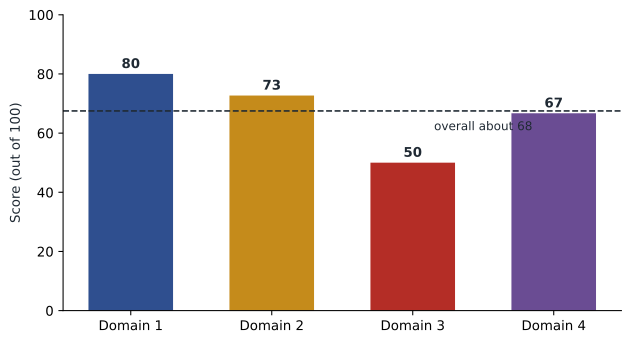
The domain pattern confirmed what Andre had guessed: governance was his weakest area. But it also showed that Domain 2, his supposed strength, was only middling. Three of the strategy questions he missed were business case questions he was sure he knew. That was the first clue that the problem was not always knowledge.
Step 2: an error log
For every wrong answer, and for every right answer that was a lucky guess, Andre recorded the question's topic, the option he chose, the correct option and, most importantly, the cause of the error. Noor suggested five causes.
| Cause | What it means | Andre's count | The fix |
|---|---|---|---|
| Misread the ask | Knew the material but answered a different question, such as a later step when "first" was asked | 4 | Apply the reading method: last sentence first, mark signal words |
| Did not know | The concept or fact was genuinely missing | 4 | Targeted study of the specific exam guide skill |
| Fell for a trap | Chose a distractor pattern such as an absolute promise or the engineer's answer | 3 | Review lesson 9; name the trap before choosing |
| Changed a correct answer | Picked the right option, then switched without a clear reason | 1 | Change only when you find a specific fact you missed |
| Ran out of time | Guessed at the end without reading | 1 | Pacing checkpoints (lesson 12) |
Only 4 of the 13 lost points came from missing knowledge. The other 9, more than two thirds, came from reading, traps, second-guessing and time. That changed the plan. Extra reading alone would have fixed at most four points; practising the reading method and the trap list could fix more.
Worked problem
Revising the time allocation
Andre's study plan allocated 90 hours using confidence ratings. Replace the ratings with diagnostic results, using a need of 100 minus the domain score, multiplied by the domain weight. How do the hours change?
Show solution
- Need: Domain 1, 100 − 80 = 20; Domain 2, 100 − 72.7 = 27.3; Domain 3, 100 − 50 = 50; Domain 4, 100 − 66.7 = 33.3.
- Weight × need: 24 × 20 = 480; 28 × 27.3 ≈ 764; 24 × 50 = 1,200; 24 × 33.3 ≈ 800. Total ≈ 3,244.
- Domain 1:
- \[\frac{480}{3{,}244} \times 90 \approx 13.3 \text{ hours}\]
- Domain 2:
- \[\frac{764}{3{,}244} \times 90 \approx 21.2 \text{ hours}\]
- Domain 3:
- \[\frac{1{,}200}{3{,}244} \times 90 \approx 33.3 \text{ hours}\]
- Domain 4:
- \[\frac{800}{3{,}244} \times 90 \approx 22.2 \text{ hours}\]
Answer: Domain 2 rises from about 18.5 to about 21 hours and Domain 1 falls from about 16 to about 13, while governance stays the largest block at about 33. Because the domain samples were small, Andre adjusted by these amounts rather than rebuilding the plan.
Step 3: look at the questions you got right
Analysis is not only about mistakes. Andre marked each correct answer as sure or unsure. Seven of his 27 correct answers were unsure: he had narrowed to two options and guessed. Those seven are fragile points that could easily be lost on exam day, so their topics went onto his review list alongside the errors. A candidate who scores 68 with many lucky guesses is less ready than one who scores 68 with confident answers.
Step 4: time
Andre finished in 74 of the 80 minutes, an average of 1.85 minutes per question. But his time was uneven. He spent more than four minutes on two long business case questions and then rushed the last five questions, guessing one without reading it properly. Timing data matters as much as accuracy: the fix is a checkpoint plan and a rule for when to flag a question and move on, which lesson 12 sets out.
Step 5: plan the next practice sets
Noor's rule for practice sets was "never the same set twice, and never without analysis". A repeated set measures memory. A set taken without analysis wastes the questions. Andre's plan for the remaining practice was:
| When (planned) | What | What he will look for |
|---|---|---|
| End of each domain block | 20 timed questions on that domain | Errors by cause; unsure correct answers |
| Mid-March | A second full mixed set | Whether reading and trap errors have fallen |
| Late March to early May, weekly | Full-length timed sets in exam conditions | Domain trend over several sets, pacing, fatigue in the last third |
| The week before the exam | No new full set; review the error log and trap list | Confidence, rest and logistics |
The goal for the full sets was not a particular raw score. It was a stable pattern: errors mostly from genuinely hard questions, few from misreading or traps, consistent pacing with time to review flagged items, and no domain far behind the others.
Working through the error log
Noor asked Andre to take three entries from his error log and explain each one fully: what the question asked, why he chose what he chose, and what would have led him to the right answer. The aim was not to memorize those three questions, which would never appear again, but to see the thinking that went wrong.
Worked problem
Error log entry: misread the ask
A diagnostic question asked what a hospital should do first before piloting an AI scheduling assistant. Andre chose "train all schedulers on the new tool". The correct answer was "measure current scheduling time and errors". Analyse the error.
Show solution
- What was asked: the first step, before the pilot.
- Why Andre chose training: it is a genuinely important step, and he had seen training neglected at Cascade Ridge.
- What went wrong: training belongs just before or during the pilot; the baseline must come before anything else, or the pilot's effect cannot be shown. He also let his own experience shape the answer.
- The fix: read the signal word "first", predict "objective or baseline" before reading the options, and check whether his answer used facts not in the question.
Answer: Cause: misread the ask, helped along by answering from his own workplace. Fix: the reading method and the one-sentence check from lesson 2.
Worked problem
Error log entry: did not know
A question asked which ISO standard sets out a management system for an organization's AI use. Andre chose ISO/IEC 23053. The correct answer was ISO/IEC 42001. Analyse the error.
Show solution
- What was asked: a factual recognition question from skill 1.1.6.
- Why Andre chose 23053: he remembered that it related to AI but not what it covered.
- What went wrong: a genuine knowledge gap in a small, memorizable fact.
- The fix: a review card for skill 1.1.6 contrasting the two: 23053 describes a framework for machine learning systems; 42001 is the AI management system standard.
Answer: Cause: did not know. Fix: one targeted review card and spaced review.
Worked problem
Error log entry: fell for a trap
A question described a retailer whose AI pricing tool had produced a few unfair prices for customers in some postal codes, and asked for the best response. Andre chose "retrain the model with more data". The correct answer was "pause automatic price changes in the affected areas, investigate the cause with the model owner and add fairness monitoring". Analyse the error.
Show solution
- What was asked: the best response to harm already occurring.
- Why Andre chose retraining: it sounded like fixing the root cause.
- What went wrong: it was the engineer's answer, and it left customers exposed while retraining happened. The strategist's levers are containment, accountability, investigation and monitoring.
- The fix: name the trap before choosing; ask what the business leader would decide first.
Answer: Cause: fell for a trap, the engineer's answer combined with missing containment. Fix: review lesson 9 and the governance pattern of contain, investigate and report.
Tracking progress across sets
One set is a snapshot. Several sets make a trend. Andre's plan is to keep a simple tracking table after each full set: the overall raw score, the score by domain, the number of errors by cause, the number of unsure correct answers, and minutes used. The numbers he cares most about are not the overall score but the error causes. If misreading and trap errors fall from 7 of 13 to 2 or 3 of a similar number of misses, the reading habits are working, even if the overall score moves only a little because the later sets are harder.
| Measure | Diagnostic (November 10) | Target for the final full sets |
|---|---|---|
| Overall raw score | 27 of 40 (about 68 in 100) | Consistently higher across several different sets |
| Misreading and trap errors | 7 of 13 lost points | A small share of lost points |
| Unsure correct answers | 7 of 27 | Fewer than half as many |
| Lowest domain | Governance, 50 in 100 | No domain far behind the others |
| Minutes per question | 1.85, uneven | Steady pace with time left to review flagged items |
The targets are deliberately described as patterns rather than precise numbers, because practice sets differ in difficulty and the relationship to the scaled score is unknown. What matters is that the kinds of mistakes change.
When results stall
Sometimes scores stop improving despite steady study. Noor's checklist for a stall has four questions. Is the study aimed at the causes in the error log, or at comfortable topics? Are practice questions being reviewed fully, including the right answers? Is fatigue affecting the later questions in a set? And are the practice questions themselves good, or do their explanations contradict the official guide? A stall usually has one of these causes, and each has a different fix: redirect study, slow the review down, practise in shorter timed blocks before building up to full sets, or change practice material.
Andre wrote the checklist on the inside cover of his notebook. He hoped not to need it, but it was there if he did.
Common mistakes
MistakeA practice score of 68 out of 100 predicts a scaled score of about 680.
InsteadThe link between practice results and scaled scores is not published; use practice scores to track trends, not to predict results.
MistakeA low domain score on one set proves that domain is the weakest.
InsteadWith about ten questions per domain, look for patterns across several sets.
MistakeLook up the right answers and move on.
InsteadRecord the cause of each error; the fix depends on the cause.
MistakeCorrect answers need no review.
InsteadUnsure correct answers are fragile points and belong on the review list.
Worked problem
Diagnosing from an error log
A colleague's error log for 15 lost points shows: misread the ask 2, did not know 10, traps 2, ran out of time 1. What should she prioritize?
Show solution
- Most errors (10 of 15) are knowledge gaps, unlike Andre's pattern.
- She should map each "did not know" error to its exam guide skill and study those skills specifically, using the official guide as the checklist.
- Reading and traps are minor for her; a short review of the trap list is enough.
Answer: Targeted content study of the specific skills behind her knowledge gaps, not more question drills.
Summary and key terms
- A practice score is a trend reading, not a prediction of a scaled score.
- Domain results from one set are small samples.
- Keep an error log that records the cause of every lost point: misreading, missing knowledge, traps, second-guessing or time.
- Fix each cause with the matching remedy.
- Review unsure correct answers too.
- Analyse timing as well as accuracy.
- Never repeat a set, never skip the analysis, and look for a stable pattern across several full sets.
- Error log
- A record of each wrong or lucky answer with its topic and cause.
- Unsure correct answer
- A question answered correctly by narrowing and guessing, a fragile point.
- Raw score
- The number of practice questions answered correctly, not converted to the exam's scale.
- Diagnostic set
- An early practice set used to find strengths, weaknesses and error patterns.
Practice problems
Work each problem on paper first, then reveal the answer to check.
Why did Andre's error log change his plan more than his domain scores did?
Show answer
It showed that 9 of 13 lost points came from reading, traps, second-guessing and time, which content study alone would not fix.
Why treat domain results from a 40-question set with caution?
Show answer
Each domain has only about ten questions, so one answer moves the result by about ten points.
Why should a candidate not retake the same practice set?
Show answer
It measures memory of that set rather than readiness for new questions.
Lesson quiz · 5 questions
Score 60% or more to complete this lesson.
Create a free account to save your progress, take quizzes and earn a certificate.