
AWS-121 · Lesson 7 of 12 · 18 min
Data readiness as a strategic asset
▶ Video coming soon A video version of this lesson is on the way.
The pharmacy demand forecast had scored well on value but poorly on feasibility, and Andre wanted to understand why. He asked Noor to show him. She opened three exports on her laptop: the product list from VetLedger, the order history from the purchasing system, and the stock counts that each clinic kept in its own spreadsheet. "Find me amoxicillin 250 milligram capsules in all three," she said. It took Andre twenty minutes. The same product appeared under six different names and four different codes, and two clinics counted it in bottles while the others counted capsules.
"That's the forecast problem," Noor said. "Not the model. The data." This lesson is about treating data as something an organization deliberately builds, protects and invests in, because almost every AI ambition depends on it. The exam guide places data readiness among the key considerations for moving to AI-based solutions, and it treats proprietary data as one of the main sources of lasting competitive advantage.
Why data decides what AI can do
A model learns from data, and a generative AI application answers from data. Both inherit the strengths and the flaws of what they are given. A prediction model trained on incomplete records learns the gaps. An assistant that retrieves from an out-of-date manual gives out-of-date answers, confidently. The phrase "garbage in, garbage out" is old, but AI makes it more serious, because AI outputs look authoritative and arrive at scale.
Data also decides how quickly an organization can act on new ideas. Cascade Ridge could move fast on the no-show model because three years of booking history already existed in one system, with a clear outcome field. It could not move fast on the pharmacy forecast, because the data was scattered, inconsistent and owned by nobody in particular. The difference was not the sophistication of the model. It was the state of the data.
Dimensions of data readiness
Noor used six dimensions to assess whether data was ready for a particular use. A dataset can be ready for one use and not for another, so the assessment is always made against a specific use case.
| Dimension | Question | What poor readiness looks like |
|---|---|---|
| Completeness | Are the records and fields the use case needs actually present? | Outcome missing for many appointments; whole clinics absent for some months |
| Accuracy and consistency | Are values correct and recorded the same way everywhere? | Six names for one product; bottles counted at some clinics and capsules at others |
| Timeliness | Is the data current enough, and available when the use case needs it? | Stock counts updated monthly when the forecast needs weekly data |
| Accessibility | Can the data be reached and combined, technically and organizationally? | Clinic spreadsheets on local drives; no shared identifier linking systems |
| Ownership and governance | Does someone own the data, decide how it is used and fix problems? | Nobody responsible for the product list; changes made by whoever needs them |
| Lawful and appropriate use | Is using this data for this purpose consistent with law, consent and what people were told? | Client phone numbers collected for reminders now proposed for marketing |
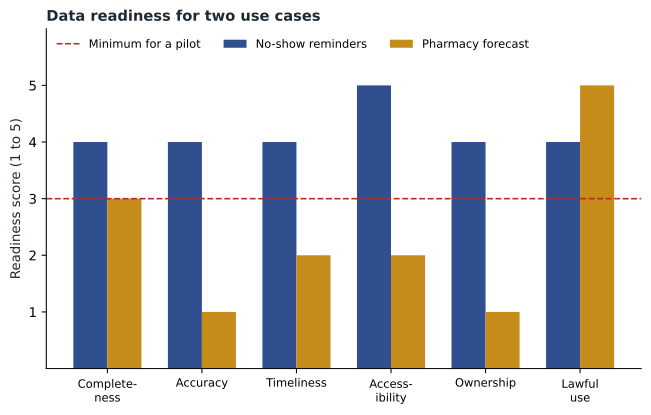
The chart made the board's decision easy to explain. The no-show data was ready. The pharmacy data was below the pilot threshold on accuracy, timeliness, accessibility and ownership. The forecast was not a bad idea; it was an idea whose first step was a data project.
Measuring data quality
Readiness scores are judgments, but they should rest on measurements wherever possible. Noor sampled the appointment data before the no-show model was trained, and the same simple checks apply to most datasets.
Worked problem
Checking a sample of appointment records
In a random sample of 2,000 appointment records, 46 have no recorded outcome (attended, cancelled or no-show), 31 are exact duplicates, and 18 have an appointment date after the record's creation date by more than two years, which is impossible under the booking rules. Calculate the share of records with each problem and the share that are usable.
Show solution
- Missing outcome: 46 ÷ 2,000 = 0.023, or 23 in every 1,000 records.
- Duplicates: 31 ÷ 2,000 = 0.0155, or about 16 in every 1,000.
- Impossible dates: 18 ÷ 2,000 = 0.009, or 9 in every 1,000.
- Records with at least one problem: 46 + 31 + 18 = 95, assuming no record has two problems.
- Usable records: (2,000 − 95) ÷ 2,000 = 0.9525, or about 95 in every 100.
Answer: About 95 out of every 100 records were usable as they stood. The duplicates and impossible dates could be removed by rule, and the missing outcomes were concentrated in one clinic during a system outage, which explained them. The data was ready for a pilot after a short cleanup.
The pattern in the problems mattered as much as their number. Missing outcomes concentrated in one clinic and one month pointed to a specific event, not a general failure. If they had been spread unevenly across clinics with different client mixes, they could have biased the model, which lesson 2 of the responsible AI course treats in depth. A data quality check always asks where the problems are, not only how many.
Silos and shared identifiers
A data silo is data held in one system or team that cannot easily be combined with data elsewhere. Silos form naturally: each department chooses the tools that suit it, and each clinic builds its own spreadsheet. They become a problem when an AI use case needs data from several of them at once, as the pharmacy forecast did.
The usual cure is not one giant system but shared identifiers and definitions: a single product code used everywhere, a single client identifier, and agreed definitions of terms such as "no-show" or "unit of stock". Once those exist, data can stay in different systems and still be joined reliably. At Cascade Ridge, the first step for the pharmacy forecast was a master product list with one code and one unit per product, owned by the pharmacy lead and used by all three systems.
Ownership and stewardship
Data without an owner decays. Fields are added without definitions, codes multiply, and nobody notices until a project depends on them. Two roles help:
- A data owner is the business leader accountable for a dataset: who may use it, for what purposes, and to what quality standard. For booking data, that was Andre. For the product list, it became the pharmacy lead.
- A data steward looks after the dataset day to day: maintaining definitions, checking quality, handling requests and fixing problems. Stewardship is often part of someone's existing job rather than a new position.
Hannah added a third responsibility that overlaps both: deciding whether a proposed use is lawful and appropriate. Client phone numbers collected to send appointment reminders were fine for reminders. Using the same numbers for marketing texts needed separate consent. Data readiness includes this question, because data that is technically perfect but cannot lawfully be used for a purpose is not ready for it.
Data as a source of advantage
The exam guide asks how AI creates sustainable competitive advantage, and data is the clearest answer. Foundation models are available to everyone; so are most AI services. What competitors cannot buy is an organization's own history: its customers, its operations, its outcomes. Cascade Ridge's three years of appointments, 95,000 pet records and the call notes of its emergency hospital were unique. Used well, they could make its models more accurate and its assistants more useful than anything a competitor could assemble from public tools.
This advantage is real only if the data is ready, governed and used lawfully. Unready data is a liability rather than an asset, because projects built on it fail or mislead. Andre summarized it for the board in a phrase Lorraine liked: "Our data is an asset on the balance sheet we don't show, and like any asset it needs maintenance."
There is also a compounding effect. Each AI system that is used well tends to produce more good data: the no-show pilot would record which reminders worked; the call-note summarizer would produce clean, structured notes that could feed later analysis. Organizations that invest early in data foundations often find that each later initiative is cheaper and faster than the last.
Investing in data foundations
Data work is unglamorous and often underfunded. Noor warned Andre that in many AI projects she had seen, preparing data took more time than building the model, sometimes far more. A roadmap that funds models but not data foundations is planning to be disappointed.
| Foundation | What it involves | Cascade Ridge plan |
|---|---|---|
| Shared definitions | A short glossary of key business terms and how each is recorded | No-show, cancellation, unit of stock and active client defined by March 2027 |
| Master data | One authoritative list each for products, clients and locations, with codes used everywhere | Master product list owned by the pharmacy lead |
| Central storage for analysis | A place where data from several systems can be combined securely | An Amazon S3 data lake in the group's AWS account, with access controlled by role |
| Quality monitoring | Regular automated checks on completeness, duplicates and impossible values | Weekly checks on booking and pharmacy data |
| Governance | Owners, stewards and rules for lawful and appropriate use | Owners named for six key datasets; Hannah reviews new uses |
These foundations serve every future use case, not just the pharmacy forecast. That is why Andre placed them in their own row of the roadmap budget instead of hiding them inside individual projects, where they tend to be cut when budgets are tight.
Data readiness when switching platforms
Lesson 3 named data readiness as one of the considerations when moving a process to AI or between platforms. In practice this means asking: can the data the new system needs be exported from the old one, in a usable format, with its history? Are identifiers and definitions the same? Will the new platform store data where residency commitments require? A transition plan should include a data migration test on a real sample before the switch, not after.
Readiness for generative AI
Data readiness looks slightly different for generative AI applications that answer from documents, such as the planned client-support assistant and the staff procedure manual tool. The data is not rows and columns but documents: policies, procedures, aftercare sheets, fee schedules. The same six dimensions apply, translated. Completeness asks whether every topic the assistant must answer is covered by an approved document. Accuracy asks whether the documents are correct and consistent with each other. Timeliness asks whether they are current, and whether someone updates them when a fee or an opening hour changes.
Accessibility asks whether documents are stored where the application can reach them, in readable formats rather than scanned images. Ownership asks who approves each document and who retires old versions. Lawful use asks whether any document contains personal information that should not be exposed. When Hannah reviewed the first set of aftercare sheets for the assistant, she found two that still named the clinic staff member who wrote them, with a direct phone number. They were corrected before they went anywhere near a knowledge base. For document-based AI, a content owner who keeps the approved set accurate and current is as important as any data steward.
Andre took one practical habit from the session: before any new initiative was scored for feasibility, its sponsor had to name the datasets it needed, their owners, and the date of the last quality check. Ideas that could not answer were not rejected, but their first milestone became a data assessment. The first time he applied it, the habit surfaced two more datasets with no owner at all, both of which were added to the foundations plan.
Common mistakes
MistakeAssuming a dataset is ready because it is large.
InsteadAssess completeness, accuracy, timeliness, accessibility, ownership and lawful use against the specific use case.
MistakeCounting data problems without asking where they are.
InsteadLook at the pattern; concentrated problems may have a simple explanation, while uneven ones can bias models.
MistakeBuilding one giant system to cure silos.
InsteadAgree shared identifiers and definitions so data in different systems can be joined reliably.
MistakeHiding data work inside individual projects.
InsteadFund data foundations visibly, because they serve every later initiative and are often cut first.
Summary and key terms
- Data readiness decides what AI can do and how quickly.
- Readiness is judged against a specific use across completeness, accuracy and consistency, timeliness, accessibility, ownership and governance, and lawful and appropriate use.
- Quality checks measure problems and look at where they occur.
- Silos are best addressed with shared identifiers and definitions.
- Data owners are accountable and data stewards maintain quality.
- Proprietary data that is ready and governed is a major source of lasting competitive advantage, and investment in data foundations makes each later AI initiative cheaper and faster.
- Data readiness
- Whether data is complete, accurate, timely, accessible, governed and lawful to use for a particular purpose.
- Data silo
- Data held in one system or team that cannot easily be combined with other data.
- Master data
- The authoritative list of key items, such as products or clients, used across systems.
- Data owner
- The business leader accountable for a dataset and its use.
- Data steward
- The person who maintains a dataset's definitions and quality day to day.
- Data lake
- Central storage where data from many sources can be kept and analysed together.
Practice problems
Work each problem on paper first, then reveal the answer to check.
In a sample of 1,000 records, 30 are missing a key field and 20 are duplicates. If no record has both problems, how many in every 100 are usable?
Show answer
(1,000 − 50) ÷ 1,000 = 0.95, so 95 in every 100.
Why is lawful use part of data readiness?
Show answer
Data that cannot lawfully or appropriately be used for a purpose is not ready for that purpose, however clean it is.
How can proprietary data create lasting advantage?
Show answer
Competitors cannot buy an organization's own history; ready, governed data makes its AI more accurate and useful.
Lesson quiz · 5 questions
Score 60% or more to complete this lesson.
Create a free account to save your progress, take quizzes and earn a certificate.