
AWS-121 · Lesson 12 of 12 · 18 min
Case study: an AI roadmap for a mid-sized company
▶ Video coming soon A video version of this lesson is on the way.
Andre had promised the board an AI roadmap by the end of the first quarter of 2027. By late November 2026 he had a draft, built from every session of the autumn: the value trees, the prioritized shortlist, the fit screens, the business cases, the sourcing decision, the data readiness assessment, the cost estimates, the pilot gates and the communication plan. This final lesson walks through that draft as a case study, showing how the pieces of AI strategy fit together into a plan a board can approve, fund and hold people to.
Cascade Ridge Veterinary Partners is a typical mid-sized organization for this kind of exercise: about 420 staff, twelve sites, revenue of about 48 million dollars a year, a small IT team, one contract data scientist and a newly built AWS environment. It has enough data and scale for AI to matter, and few enough people that every initiative competes for the same handful of experts.
1. Objectives and principles
The roadmap opens with the board's objectives for 2027, from lesson 1, and the principles that govern every AI initiative. The principles were short and specific:
- Every initiative serves a named business objective and has an owner, KPIs, a baseline and a decision gate.
- Choose the simplest solution that works; AI only where it fits better than rules, existing features or process changes.
- AI may assist, but every clinical decision stays with a veterinarian or a credentialed veterinary technician.
- AI outputs are never used to refuse or delay care or bookings.
Client data stays in Canada, in line with PIPEDA and the Alberta and British Columbia private-sector privacy laws.
- Results are reported honestly, in a consistent structure, including when an initiative is paused or stopped.
2. The portfolio
The prioritization in lesson 2 and the fit screens in lesson 3 produced a portfolio with a place for every idea, including the ones that were not AI projects at all.
| Initiative | Decision | Why |
|---|---|---|
| No-show reminders | Pilot February 2027, scale in waves from May | Highest priority score; data ready; strong business case |
| Lab-report extraction | Pilot in spring 2027 at three clinics | Clear time and error savings; managed document extraction fits |
| Call-note summaries for the emergency hospital | Pilot in summer 2027 at the emergency hospital only | High value; strict clinical guardrails and audits required |
| Client-support assistant (administrative questions only) | Partner-led build; pilot in the second quarter of 2027 | Parity with competitors; partner option chosen in lesson 6 |
| Review-comment themes | Quick win in 2027 | Cheap with a managed language service; supports client trust measures |
| Pharmacy demand forecast | Data foundations in 2027; model in 2028 | High value, but data not ready |
| Radiograph image-quality check | Watch list; revisit in 2028 | Low feasibility now; diagnosis always stays with veterinarians |
| Preventive wellness reminders | Explore in 2028 | Possible business model change; needs the no-show learning first |
| Marketing image generation | Stopped | Low value; stock photography and a designer meet the need |
| Vaccine due dates | Not AI: rules from the clinical protocol | Clear, stable rule |
| Invoice checking | Not AI: switch on matching in the accounting system | Existing feature solves it |
Including the decisions not to use AI was deliberate. They showed the board that the roadmap was not a wish list, and they freed budget and attention for the initiatives that mattered. The two "not AI" items were also the cheapest wins on the list.
3. The timeline
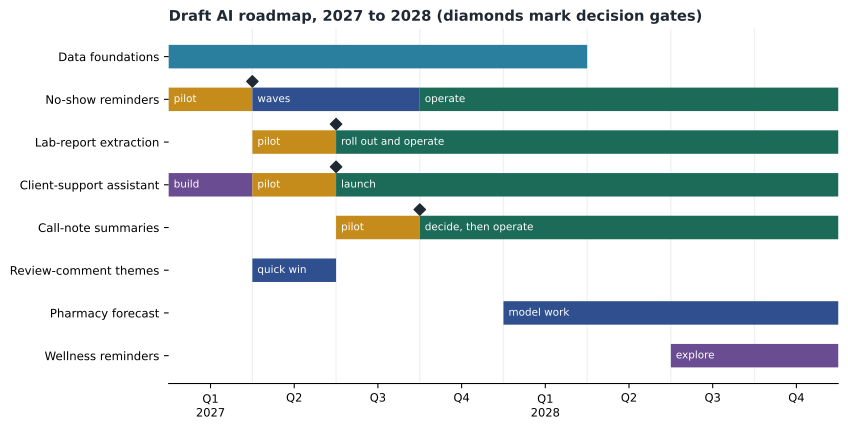
The timeline sequenced initiatives so that the same people were not needed for everything at once. Noor's time went first to the no-show pilot, then to the summarizer evaluation. Kwame's time went to integration for the no-show model and to working alongside the partner on the assistant. Data foundations ran throughout, because every later initiative depended on them.
4. The budget
The first-year budget of 450,000 dollars was built up from the business cases and checked against the investment guide in lesson 11, where it came to about 9.4 dollars per 1,000 dollars of revenue.
| Budget line, 2027 | Dollars | Notes |
|---|---|---|
| Data foundations | 90,000 | Master product list, shared definitions, data lake in Amazon S3, quality checks |
| No-show reminders | 90,000 | 70,000 to build and launch, plus about 20,000 of running costs as clinics join |
| Lab-report extraction | 51,000 | Integration and testing, plus usage at an illustrative price per page |
| Call-note summaries | 78,000 | Design, integration, clinical evaluation and a half year of running costs |
| Client-support assistant | 52,000 | Partner build in stages and a half year of running costs |
| Review-comment themes | 12,000 | Managed language service and a monthly report |
| Program management, governance and AI literacy training | 50,000 | Share of Andre's time, the governance group, training for managers and staff |
| Contingency | 27,000 | About 6 in every 100 dollars of the budget, released only with the CFO's approval |
| Total | 450,000 |
Worked problem
Checking the budget
Confirm that the budget lines add up to 450,000 dollars, and find the share going to foundations, governance and contingency together.
Show solution
- Add the initiative lines: 90,000 + 51,000 + 78,000 + 52,000 + 12,000 = 283,000.
- Add foundations, governance and contingency: 90,000 + 50,000 + 27,000 = 167,000.
- Total: 283,000 + 167,000 = 450,000 dollars.
- Share for foundations, governance and contingency: 167,000 ÷ 450,000 ≈ 0.37, or about 37 dollars in every 100.
Answer: The lines add up to 450,000 dollars. About 37 dollars in every 100 go to foundations, governance and contingency rather than to specific initiatives, which is typical of a first year in which the organization is building its capacity to do AI well.
Lorraine questioned the size of the non-initiative share and then accepted it. "If we don't fund the foundations, every project pays for them separately and badly," she said. She added one condition: each initiative's running costs had to be tagged and tracked against its own line from the first day, using cost allocation tags and AWS Budgets alerts as lesson 8 described.
5. Expected value
Andre presented the value of the portfolio at full run rate, counting only realized value that had an owner and a measure. Each figure was an expected case with a lower conservative case beside it, and the intangible benefits were listed separately.
| Initiative | Expected realized value each year at full scale (dollars) | Main KPI | Guardrail |
|---|---|---|---|
| No-show reminders | 133,200 | No-shows per 100 appointments | Recall by clinic; any access complaint |
| Lab-report extraction | 26,000 | Minutes per report; transcription errors | Values accepted without review |
| Call-note summaries | 19,500 | Overtime hours; minutes per note | Clinically important details missed in audits |
| Client-support assistant | 12,000 | Routine calls handled without staff | Hand-off rate for clinical and urgent questions must stay complete |
| Review-comment themes | Not counted in money | Time to act on recurring complaints | None |
| Total counted | 190,700 |
The total of about 190,700 dollars a year at full scale was well below the first-year budget, and Andre said so plainly. Only two initiatives paid back on counted cash value alone: the no-show reminders, in about 8.5 months, and the lab-report extraction, with about 45,000 dollars of one-time cost and about 20,000 dollars a year of net benefit, in a little over two years. The call-note summaries roughly covered their own running costs in overtime savings, and the client-support assistant cost slightly more to run than the call time it saved. Those two were justified mainly by benefits that were listed but not counted in money: safer, less exhausting overnight shifts and lower technician turnover for the summaries, and parity with rising client expectations for the assistant. The data foundations and governance were justified by the 2028 pipeline they made possible. Lorraine preferred this honest picture to a portfolio that claimed to pay for itself in year one.
6. Governance and decision gates
Each initiative had a decision gate at the end of its pilot, with criteria agreed in advance, as lesson 9 described. Above them sat a portfolio review every quarter by a small AI steering group: Andre, Lorraine, Dr. Kaur, Hannah and Noor. At each review the group looked at every initiative's KPIs, leading indicators, guardrails and costs, and made one of four decisions: scale, continue, pause or stop. Any initiative touching clinical work needed Dr. Kaur's approval; any new use of personal information needed Hannah's.
The governance detail, including risk reviews, model documentation and incident handling, belonged to the responsible AI course, and the people and change side belonged to the transformation course. The roadmap referred to both rather than repeating them, but it made clear that no initiative would move from pilot to scale without passing both the value gate and the governance review.
7. Communication plan
The roadmap ended with a communication plan built on lesson 10: a one-page summary for the board each quarter, a monthly value dashboard for managers built in Amazon Quick from aggregated figures, briefings for staff at each clinic before any pilot reached them, and client-facing notices for anything that changed how clients were contacted. Reception leads and emergency technicians were named as champions, with time set aside for them to collect feedback.
8. Risks to the roadmap itself
Finally, Andre listed the risks to the plan as a whole, not just to individual initiatives:
| Risk | Effect | Response |
|---|---|---|
| Key-person dependence on Noor and Kwame | Delays across several initiatives | Partner support for the assistant; documentation and shared knowledge; plan to hire a data analyst in 2027 |
| Data foundations slip | Pharmacy forecast and later work delayed | Foundations funded as their own line with a named owner and quarterly milestones |
| No-show pilot below break-even | Largest value source fails | Stop condition in the gate; budget released to other initiatives |
| Vendor or model changes | Re-testing and possible cost changes | Keep evaluation sets and guardrail rules portable; review provider changes each quarter |
| Staff resistance or low adoption | Value not realized | Early involvement, champions, adoption tracked as a leading indicator |
The recommendation
The board will meet in December to consider the draft. Andre's recommendation was to approve the 2027 budget in tranches: release funding for data foundations, the no-show pilot and the partner build of the client-support assistant at once, and release the rest after the first gate in May 2027, depending on its results. Tranche funding tied money to evidence, which was exactly what the roadmap promised.
"It's not a technology plan," Lorraine said when she read the final draft. "It's a business plan that happens to use technology." Noor considered that the best review the roadmap could get, and Andre added it, unattributed, to his exam notes as a summary of Domain 2.
Lessons for any mid-sized organization
Andre's roadmap was specific to Cascade Ridge, but Noor pointed out that its shape would fit most mid-sized organizations starting their AI programs. Start with the business objectives and a few well-chosen initiatives that can show measured value within a year. Fund data foundations and governance visibly from the start. Prefer buying or partnering for parity uses and building, or co-building, where the organization's own data offers an advantage. Tie money to evidence through decision gates and tranche funding. Communicate honestly and often, including when things go wrong.
She also warned against two opposite failures she had seen elsewhere. One was the organization that launched dozens of small AI experiments with no portfolio view, no measures and no owners, and two years later could not say what any of them had achieved. The other was the organization that waited for a perfect strategy before trying anything, and found that its competitors and its own staff had moved on without it. A roadmap like Andre's avoids both: it is focused enough to measure and flexible enough to change at every quarterly review.
Common mistakes
MistakePresenting a roadmap as a list of AI projects.
InsteadStart from objectives and principles, include decisions not to use AI, and give every initiative an owner, measures and a gate.
MistakeHiding foundation and governance costs inside projects.
InsteadFund them visibly; they serve every initiative and are the first to be cut when hidden.
MistakeClaiming the portfolio pays for itself in year one.
InsteadShow realized value honestly, with one-time costs and the payback period stated plainly.
MistakeApproving the whole budget at once.
InsteadRelease funding in tranches tied to decision gates and evidence.
Summary and key terms
- An AI roadmap brings together objectives and principles, a prioritized portfolio that includes decisions not to use AI, a timeline that respects scarce people, a budget built from business cases and checked against investment posture, expected realized value with guardrails, governance with decision gates and quarterly portfolio reviews, a communication plan and the risks to the plan itself.
- Funding in tranches tied to evidence keeps the plan honest.
- For a mid-sized organization, a first year typically spends a substantial share on data foundations, governance and training, which make later initiatives faster and cheaper.
- AI roadmap
- A time-bound plan for which AI initiatives to pursue, in what order, with what budget and how success will be judged.
- Portfolio review
- A regular review of all initiatives to decide whether each should scale, continue, pause or stop.
- Tranche funding
- Releasing a budget in stages, each tied to evidence from a decision gate.
- Contingency
- A reserve in a budget for unexpected costs, released only with approval.
- Key-person dependence
- Reliance on a few individuals whose absence would delay work.
- Steering group
- A small group of leaders who oversee a program and make portfolio decisions.
Practice problems
Work each problem on paper first, then reveal the answer to check.
Why include "not AI" decisions in an AI roadmap?
Show answer
They show the plan is disciplined, often deliver cheap wins, and free budget and attention for initiatives where AI fits.
A 300,000-dollar budget spends 105,000 on foundations, governance and contingency. What share is that?
Show answer
105,000 ÷ 300,000 = 0.35, or 35 in every 100 dollars.
What is the benefit of tranche funding?
Show answer
Money is released as evidence arrives, so poor results stop spending early and good results unlock the next stage.
Lesson quiz · 5 questions
Score 60% or more to complete this lesson.
Create a free account to save your progress, take quizzes and earn a certificate.