
AWS-121 · Lesson 11 of 12 · 18 min
Industry patterns and examples
▶ Video coming soon A video version of this lesson is on the way.
In late November, ahead of its December meeting, the board asked a question Andre had expected: "What are our competitors doing?" Two large corporate veterinary chains had opened clinics in the region over the past three years, and one advertised "AI-powered appointment booking" on billboards. Some board members worried Cascade Ridge was falling behind. Others thought the billboard was mostly marketing. Andre needed a way to answer that was neither panic nor complacency.
This lesson covers the third task of Domain 2: positioning AI for competitive advantage. It looks at how to assess a competitive landscape, how AI can transform business models, which advantages last, and how to set the level of AI investment to suit an industry's maturity and competitive dynamics. It also surveys common AI patterns across industries, because many good ideas travel from one sector to another.
Assessing the competitive landscape
Noor suggested a structured look rather than reacting to advertising. A competitive landscape assessment for AI asks what competitors, new entrants and suppliers are doing with AI, and what that means for customers' expectations. Andre gathered information from public sources: competitors' websites and apps, job postings, trade press, vendor case studies, conference talks, and conversations with clients who had used other clinics.
| Question | What Andre found (illustrative) | What it suggests |
|---|---|---|
| What AI-enabled services do competitors offer clients? | Both chains offer online booking with automatic reminders; one has a chat assistant for opening hours and prescription refills | Clients increasingly expect self-service for routine tasks |
| What are they doing behind the scenes? | Job postings for data analysts and a vendor case study about AI note-taking in consultations | Competitors are reducing clinical documentation time, which helps staff retention |
| What are suppliers building into their products? | The VetLedger vendor plans an AI note-drafting feature in its next release | Some capabilities will soon be available to everyone at low cost |
| Are new kinds of competitor appearing? | An online pet-health service offers video consultations and remote triage advice | Convenience is becoming a basis of competition for routine questions |
| What do clients say they want? | Faster appointments for sick animals; easier refills; clear after-hours guidance | Value lies in access and convenience more than in novelty |
The assessment changed the board's framing. The billboard was not a reason to copy the competitor's chatbot. It was evidence that client expectations for convenient self-service were rising, and that capabilities such as note drafting were about to become standard features of practice software. That second point mattered: there was little advantage in building something the group's own software vendor was about to provide.
Parity, advantage and differentiation
Strategists separate AI uses into three kinds, because each calls for a different approach:
- Parity uses keep the organization level with competitors and with customer expectations. Online booking with reminders, and answers to routine questions, were becoming parity at Cascade Ridge. The goal is to meet the standard at reasonable cost, usually by buying.
- Advantage uses make the organization measurably better than competitors at something customers value. Filling more appointment slots for sick animals, using the group's own booking history, could be one: it combines proprietary data with a redesigned process.
- Differentiation through trust is less visible but powerful. A group known for using AI carefully, explaining it honestly and keeping clinical decisions with veterinarians may win clients who are wary of impersonal, automated care.
Andre's recommendation followed from this split: meet parity cheaply, invest properly in the few advantage uses, and protect the group's reputation for trustworthy care in everything.
Which advantages last
The exam guide asks how AI creates sustainable competitive advantages and operational improvements. An advantage is sustainable if competitors cannot easily copy it. Noor summarized the main sources:
| Source | Why it is hard to copy | Cascade Ridge example |
|---|---|---|
| Proprietary data | Competitors cannot buy your history with your customers and operations | Three years of appointments and 95,000 pet records |
| Redesigned processes | Changing how work is done takes time, leadership and practice | Reception workflow built around daily flags and a waitlist |
| Learning loops | Each use generates data that improves the next version | Pilot results showing which reminders work, feeding the next model |
| Skills and culture | Experience with evaluating and improving AI builds up slowly | Staff who know how to judge a model's output and give useful feedback |
| Trust and reputation | Built through consistent behaviour over years | A record of careful, transparent AI use |
By contrast, an advantage based only on having access to a particular model or tool rarely lasts, because competitors can buy the same thing. Operational improvements can still be very valuable even when they are not unique: lower costs and less staff burnout matter whether or not a competitor achieves the same.
Transforming business models
Most AI initiatives improve existing operations. A few change the business model itself: how the organization creates, delivers and captures value. The exam guide asks you to identify such opportunities. Examples across industries include:
- From product to service. Equipment makers selling uptime guarantees instead of machines, using AI to predict failures before they happen.
- From one-off transactions to continuous relationships. Retailers using personalization to turn occasional buyers into subscribers.
- From reactive to preventive. Insurers and health providers using risk prediction to offer prevention programs rather than only paying for problems.
- New products from existing data. Organizations offering anonymized benchmarks or insights to partners, where law and consent allow.
- Self-service at scale. Professional services firms packaging expertise into AI-assisted tools that serve smaller clients economically.
At Cascade Ridge, the board discussed one transformation idea: expanding its wellness plans, which clients pay for monthly, with AI-assisted reminders for preventive care tailored to each pet's age, breed and history. It would move part of the business from treating problems toward preventing them, with steadier revenue. Dr. Kaur supported it on one condition: care recommendations would follow the group's clinical protocols, with the AI only deciding when and how to remind, not what care a pet needed. The board put it on the roadmap as an exploration for 2028.
Industry patterns
Many AI patterns appear across industries in slightly different forms. Knowing them helps a strategist recognize opportunities and avoid reinventing solutions.
| Industry | Common AI patterns | Typical caution |
|---|---|---|
| Healthcare and veterinary care | Documentation and note drafting, scheduling and no-show prediction, image quality checks, patient communication | Clinical decisions stay with professionals; privacy and safety standards are high |
| Retail | Demand forecasting, personalization and recommendations, customer service assistants, pricing analysis | Personalization must respect privacy and avoid unfair pricing |
| Financial services | Fraud detection, document processing, customer service, risk assessment | Strict regulation; explainability needed for credit and similar decisions |
| Manufacturing | Predictive maintenance, visual quality inspection, supply chain optimization | Data from equipment must be reliable; safety-critical uses need careful testing |
| Public sector | Document processing, citizen enquiries, translation, case triage | Fairness, transparency and accountability to the public are central |
| Professional services | Drafting, research summaries, knowledge search, proposal writing | Confidentiality and accuracy; outputs need expert review |
Several patterns recur in every row: document processing, customer communication, forecasting and knowledge search. These are often good first initiatives for a mid-sized organization, because they are well understood, supported by managed services, and measurable.
How much to invest
The exam guide asks you to determine appropriate AI investment levels based on industry maturity and competitive dynamics. There is no universal right amount. Noor offered a simple way to think about it, using two questions: how mature is AI use in this industry, and how strongly does it affect competition?
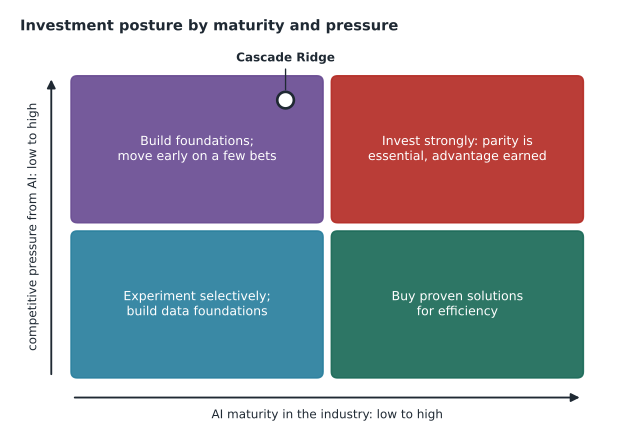
| Posture | When it fits | What it means for investment |
|---|---|---|
| Leader | AI shapes competition strongly and the organization has unusual data or skills to exploit | Significant, sustained investment in advantage uses and foundations; tolerance for some failed bets |
| Fast follower | Pressure is rising but practices are not settled; the organization can learn from early movers | Steady investment in foundations and a few targeted initiatives; buy for parity |
| Selective adopter | AI matters but mainly for efficiency, and proven products exist | Modest investment, mostly buying proven solutions with clear returns |
| Watch and prepare | AI has little effect on competition yet | Small experiments and data foundations, so the organization can move when the time comes |
Veterinary care in 2026 was moving: client-facing convenience and documentation tools were spreading quickly, but few groups had redesigned their operations around AI. Cascade Ridge's assessment placed it as a fast follower: invest in data foundations, buy for parity, and back two or three advantage uses with proper measurement. Being a fast follower is not timid. It means learning from others' mistakes and spending where the group's own data gives it a real edge.
Worked problem
Sizing the first-year AI budget
The board wants a first-year AI budget proportionate to the group's size and posture. Group revenue is about 48 million dollars a year. Noor's rough guide for a fast follower of this size was between 6 and 12 dollars of AI spending per 1,000 dollars of revenue in the first year, including data foundations. What range does this give, and where did Andre's draft roadmap of 450,000 dollars fall?
Show solution
- Lower end: 48,000,000 × 6 ÷ 1,000 = 288,000 dollars.
- Upper end: 48,000,000 × 12 ÷ 1,000 = 576,000 dollars.
- Andre's draft: 450,000 ÷ 48,000,000 × 1,000 ≈ 9.4 dollars per 1,000 dollars of revenue.
Answer: The guide gives a range of about 288,000 to 576,000 dollars. Andre's draft of 450,000 dollars, about 9.4 dollars per 1,000 of revenue, sits in the middle of the range. The guide is only a sense check; the real justification is the business case for each initiative.
Ratios like this are rough sense checks, not targets. An organization that spends the "right" share of revenue on poorly chosen initiatives creates no value. The investment level should follow from the portfolio of business cases, then be checked against posture and size to make sure it is neither reckless nor so small that nothing meaningful can be done.
The cost of waiting
Lorraine pressed the other side of the question: what does it cost to wait? Noor named three costs. First, client expectations rise whether or not the group acts, so parity gaps grow. Second, the data and skills needed for advantage uses take years to build; starting late means starting behind. Third, staff notice when competitors' tools make work easier, which matters in a market where technicians can choose where to work. None of these costs appears in a single year's accounts, which is why they are easy to ignore.
Learning from other industries
Some of the most useful ideas for Cascade Ridge came from outside veterinary care. Airlines and hotels had long used no-show prediction and overbooking; the group would never overbook appointments, but the airline practice of offering waitlisted customers a seat when a cancellation is likely translated directly into its waitlist design. Retailers' demand forecasting suggested how to forecast pharmacy stock by product and location. Banks' experience with document processing showed the value of a human check on extracted values before they enter a record.
Borrowing ideas works best when the strategist asks what is different about the new setting. Airlines can accept occasional overbooked passengers with compensation; a clinic cannot turn away a sick animal. Retailers can tolerate a stock-out of a sweater; a clinic cannot run out of an emergency drug. Each borrowed pattern was adapted with these differences in mind, which is the real skill behind learning from other industries.
For Andre, the main lesson of the session was proportion. The board did not need to match every competitor's AI feature, and it did not need to ignore them. It needed to know which uses were becoming parity, buy those sensibly, and put its real effort where its own data and processes could make it better than the competition.
Common mistakes
MistakeCopying a competitor's AI feature because it is advertised.
InsteadAssess the landscape systematically and ask what it reveals about customer expectations and coming parity.
MistakeTrying to build an advantage on a tool anyone can buy.
InsteadLook for advantage in proprietary data, redesigned processes, learning loops, skills and trust.
MistakeSetting the AI budget as a share of revenue first.
InsteadBuild the budget from business cases, then sense-check it against posture and size.
MistakeAssuming waiting is free.
InsteadCount the rising parity gap, the time needed to build data and skills, and the effect on staff.
Summary and key terms
- Positioning AI for competitive advantage starts with a structured competitive landscape assessment of competitors, suppliers, new entrants and customer expectations.
- AI uses can be separated into parity, advantage and trust-based differentiation.
- Sustainable advantage comes from proprietary data, redesigned processes, learning loops, skills and culture, and trust; tools anyone can buy rarely give lasting advantage.
- Some AI uses transform business models, for example from reactive to preventive services.
- Common patterns recur across industries, including document processing, customer communication, forecasting and knowledge search.
- Investment posture, from leader to watch and prepare, depends on industry maturity and competitive dynamics, and budgets should follow business cases.
- Competitive landscape assessment
- A structured review of what competitors, suppliers and new entrants are doing and what customers expect.
- Parity use
- An AI use that keeps an organization level with competitors and customer expectations.
- Sustainable advantage
- An advantage competitors cannot easily copy.
- Business model transformation
- A change in how an organization creates, delivers and captures value.
- Learning loop
- A cycle in which using a system produces data that improves the next version.
- Fast follower
- An organization that invests steadily after early movers, learning from their experience.
Practice problems
Work each problem on paper first, then reveal the answer to check.
Why is building an advantage on a widely available tool risky?
Show answer
Competitors can buy the same tool, so the advantage disappears quickly.
A company has revenue of 20 million dollars and a guide of 5 to 10 dollars per 1,000 dollars of revenue. What budget range results?
Show answer
100,000 to 200,000 dollars.
Give an example of a business model transformation enabled by AI.
Show answer
For example moving from selling equipment to selling uptime using predictive maintenance, or from treating problems to preventive wellness plans.
Lesson quiz · 5 questions
Score 60% or more to complete this lesson.
Create a free account to save your progress, take quizzes and earn a certificate.