
AWS-121 · Lesson 10 of 12 · 18 min
Communicating AI value to stakeholders
▶ Video coming soon A video version of this lesson is on the way.
Andre's first draft of the board paper for the no-show pilot was eleven pages long. It explained gradient-boosted trees, showed a confusion matrix, defined precision and recall, and reached the recommendation on page nine. Lorraine read it and handed it back. "Every word of this is right," she said, "and the board will not read past page two. Tell them what you want, why, what it costs, what could go wrong and how they'll know. Then put the rest in an appendix."
Communicating value is part of creating it. An AI initiative that nobody understands will not get funded, will not be adopted, and will not survive its first problem. This lesson covers how to explain AI initiatives to the different people who decide on them, use them and are affected by them, honestly and without either hype or jargon.
Different audiences, different questions
Each stakeholder group cares about different things, and the same initiative has to be explained to each in its own terms. Noor and Andre drew a simple map for the no-show initiative.
| Stakeholder | What they care about | What to tell them | Format |
|---|---|---|---|
| Board | Strategy, value, risk, reputation, whether to approve | The decision needed, the expected value range, cost, key risks and how success will be judged | A one-page summary with an appendix |
| CFO and finance | Cash flow, assumptions, cost control, accountability | Full business case, sensitivity, cost per outcome, budget tracking | The business case and a monthly cost report |
| Medical director and clinical leads | Patient safety, clinical workload, professional standards | What the tool does and does not do, how it affects clinical work, guardrails | A short briefing and a standing review slot |
| Reception staff | Their daily work, whether it helps or adds effort, job security | What changes in their day, why, how to use the flags, who to ask | A demonstration, a one-page guide and a feedback channel |
| Clients | Convenience, privacy, fair treatment | That they may get an extra reminder; that bookings are never refused by the system | A line in the reminder text and a page on the website |
| Privacy and security lead | Lawful use, data protection, incidents | Data flows, retention, access, monitoring | Design documents and the review checklist |
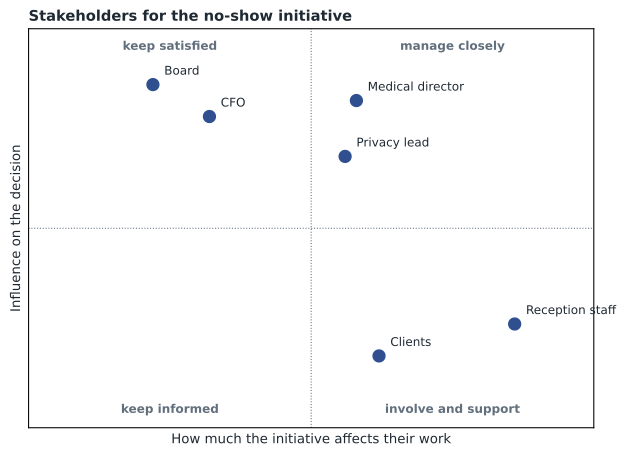
Reception staff sat low on influence over the decision but high on how much the initiative changed their work. They were also the people whose adoption the pilot depended on. Andre made sure they heard about the pilot from their own reception leads before any announcement, and that each pilot clinic had a reception lead in the planning meetings. Ignoring the people who must use a tool is one of the most common reasons AI initiatives fail.
The one-page summary
Lorraine's structure for the board summary became Andre's template for every AI proposal after that:
- The ask. One sentence: what decision the board is being asked to make.
- Why it matters. The business problem in numbers, and the objective it serves.
- What we will do. The solution in plain words, including what it will not do.
- Value and cost. Expected value as a range, the cost, and the payback period.
- Risks and controls. The two or three most important risks and how each is limited.
- How we will know. The KPIs, the baseline, the decision gate and its date.
Worked problem
Writing the ask and the value line
Turn the no-show business case into the first and fourth lines of the board summary.
Show solution
- The ask: approve a twelve-week pilot of extra reminders for bookings that a model predicts may be missed, at four clinics from February 2027, with a pilot budget and a decision gate in May 2027.
- Expected value range: the conservative case recovers about 740 appointments a year (about 66,600 dollars of margin) and the expected case about 1,480 (about 133,200 dollars).
- Cost: about 70,000 dollars to build and launch across all sites, and about 34,000 dollars a year to run at full scale.
- Payback: about 8.5 months in the expected case and about 26 months in the conservative case.
Answer: The ask names the decision, the scope, the date and the gate. The value line gives a range rather than a single figure, with the cost and payback beside it, so the board sees both the opportunity and the uncertainty.
Giving a range is not a sign of weakness. A single precise figure, such as "133,200 dollars a year", invites the board to treat it as a promise. A range, with the reason for its width, shows that the team understands what is uncertain and has a plan for finding out. Boards tend to trust ranges more, not less, once they see the pilot will narrow them.
Explaining AI without jargon
Technical terms are precise for specialists and opaque for everyone else. The skill is to translate them into what they mean for the business, without distorting them.
| Technical statement | Plain-language version |
|---|---|
| Recall is 0.62 | Of every 10 bookings that will end up missed, the model spots about 6 |
| Precision is 0.41 | Of every 10 bookings it flags, about 4 would really have been missed; the other 6 would have come anyway, so they just get one extra friendly reminder |
| The model was trained on three years of booking history | It learned patterns from about 410,000 past appointments |
| Retrieval-augmented generation over approved documents | The assistant answers only from documents we have approved, and shows which one it used |
| Contextual grounding check | An automatic check that blocks answers that are not supported by the approved documents |
| Data drift | Client behaviour changes over time, so we check monthly that the model still works and retrain it when it does not |
Plain language must stay accurate. "The model predicts no-shows" is plain but misleading if it implies certainty. "The model spots about 6 in 10 bookings that will be missed, and flags some that won't" is plain and honest. When in doubt, say what the output means for the person hearing it and what they should do with it.
Avoiding hype and avoiding fear
AI is surrounded by exaggeration in both directions. Some people expect it to solve everything; others fear it will replace them or harm clients. A strategist's credibility depends on refusing both. Noor's guidelines for Andre were:
- Describe what the system does, not what AI in general might do.
- Say clearly what it will not do: the no-show model never refuses or delays a booking; the call-note summarizer never sets triage priority; every clinical decision stays with a veterinarian or credentialed technician.
- Report bad news as promptly and plainly as good news. If the rural recall gap persists, say so, and say what is being done.
- Do not claim savings that have not been captured, or credit the AI with changes the comparison group also showed.
- Address job concerns directly. For reception, the honest message was that the flags would replace some phone calls with targeted ones, freeing time for clients at the desk, and that no positions were being cut because of the pilot.
Dashboards that inform decisions
For ongoing reporting, a dashboard can show the state of each initiative at a glance. A useful AI value dashboard is small and stable. It shows each KPI against its baseline and target, the leading indicators, the guardrail metrics, the cost against budget, and a short note on what changed and why. It does not show every number the system can produce. Each figure on it should answer a question someone actually asks.
Andre asked Noor to build the dashboard in Amazon Quick, which the clinic managers were already planning to use for shift reports, so that the same people could see the pilot's progress without a separate tool. The dashboard drew only on aggregated figures, never on individual client records, which kept Hannah's review simple.
Telling the story
Numbers persuade analysts; stories persuade most other people. The best AI communication combines both: a specific, true example that makes the numbers real. In the board summary, Andre included one short paragraph about a real pattern from the booking data: Monday-morning appointments for older dogs, booked more than three weeks ahead, were missed far more often than average, and those were exactly the slots that waitlisted clients with sick animals wanted. It took four sentences and made the value of the pilot obvious to people who would never read a confusion matrix.
Stories must be true and representative. An unusually dramatic example that does not reflect the typical case is a form of hype, and it will be found out.
Communicating to clients
Clients deserve to know when AI affects them, in terms that matter to them. Hannah wrote the client-facing wording for the pilot, and Dr. Kaur checked it for tone:
"Some clients may receive an extra reminder before their appointment. We use our booking records to decide who might find one helpful. Your booking is never changed or cancelled because of this, and you can ask us not to send extra reminders at any time." The page also explained how booking records are used under the group's privacy notice and how to contact the privacy lead, in line with PIPEDA and Alberta's and British Columbia's private-sector privacy laws.
Transparency of this kind is part of responsible AI, which the governance course covers in depth, but it is also good business. Clients who understand why they receive a message are less likely to be annoyed by it.
Reporting results
When results arrive, they should be reported in the same structure the proposal promised: the KPIs against the baseline, the effect against the comparison group, the gate decision and the reasons. Reporting in a consistent structure lets the board compare initiatives and see whether proposals tend to deliver what they promise. Over time, that track record is the most persuasive communication an AI program has.
Delivering bad news
Sooner or later, every AI program has bad news to report: a pilot below its targets, a cost overrun, a fairness gap, a complaint, or a mistake that reached a client. How it is reported shapes trust more than any success. Noor's advice to Andre was to report bad news early, before rumours did it for him; to state plainly what happened and what it means for the business; to explain what is being done and by when; and to say what the organization has learned. Burying the problem in the eighth page of a report, or describing it in technical language that hides its meaning, is noticed and remembered.
Andre practised with an imaginary case: suppose the rural recall gap persisted at the end of the pilot. His draft board paragraph read: "The model works well at city clinics but misses more likely no-shows at our rural clinic. We are scaling to city clinics now, retraining the model with more rural data, and will report on the rural clinics at the August gate. Rural clients still receive the standard reminder, so nobody is worse off than before." Four sentences: what happened, what we are doing, when we will know, and why nobody is harmed. Lorraine said it was the most reassuring paragraph in the paper.
The same discipline applies to communicating with staff. When something goes wrong with a tool they use, they should hear about it from their own leaders, with a clear explanation and a fix, rather than discovering it themselves. Trust that survives a problem is stronger than trust that has never been tested.
Communication is two-way. Andre planned a simple feedback form for pilot staff and a monthly fifteen-minute call with each reception lead. Noor expected some of the most useful changes to come from these channels, such as moving the daily list earlier or adding a short reason code to each flag so staff could see why a booking had been flagged. Listening, and showing that feedback leads to changes, is the most persuasive communication of all.
Common mistakes
MistakeLeading with technical detail.
InsteadLead with the decision, the value, the cost, the risks and how success will be judged; put detail in an appendix.
MistakeGiving a single precise value figure.
InsteadGive a range with the reason for its width and the plan for narrowing it.
MistakeTelling users last.
InsteadInvolve the people who will use the tool early, through their own leads, and give them a feedback channel.
MistakeOverstating results or hiding problems.
InsteadReport good and bad news promptly, plainly and in the structure promised.
Summary and key terms
- Communicating AI value means explaining initiatives to boards, finance, clinical leaders, front-line staff, clients and specialists, each in terms of what they care about.
- A one-page summary covers the ask, why it matters, what will be done, value and cost as a range, risks and controls, and how success will be judged.
- Technical terms should be translated accurately into plain language.
- Credible communication avoids hype and fear, states what the system will not do, reports bad news promptly and addresses job concerns directly.
- Dashboards should be small and stable, stories should be true and representative, and clients should be told when AI affects them.
- Stakeholder
- A person or group that decides on, uses or is affected by an initiative.
- Stakeholder map
- A chart placing stakeholders by influence and by how much an initiative affects them.
- Value range
- A low-to-high estimate of benefit that shows uncertainty honestly.
- Plain language
- Wording that a non-specialist understands without losing accuracy.
- Dashboard
- A small, stable display of key measures against baselines and targets.
- Hype
- Exaggerated claims about what a technology will do.
Practice problems
Work each problem on paper first, then reveal the answer to check.
Translate "precision is 0.5" for a reception team.
Show answer
Of every 10 bookings the model flags, about 5 would really have been missed; the others would have come anyway.
What are the six parts of the one-page summary in this lesson?
Show answer
The ask, why it matters, what we will do, value and cost, risks and controls, and how we will know.
Why give the board a value range instead of one figure?
Show answer
A range shows the uncertainty honestly and avoids a figure being treated as a promise; the pilot will narrow it.
Lesson quiz · 5 questions
Score 60% or more to complete this lesson.
Create a free account to save your progress, take quizzes and earn a certificate.