
AWS-121 · Lesson 4 of 12 · 20 min
Building the business case
▶ Video coming soon A video version of this lesson is on the way.
The no-show reminder idea had come out on top of the ranking, and the board wanted to see a business case at its December meeting before it would approve the pilot planned for February 2027. Lorraine set the bar plainly at the start of the session. "I don't need the case to be certain," she said. "I need it to be honest about what it assumes, and I need to be able to check it in a year."
A business case is the document that justifies an investment: what problem it solves, what it will cost, what it will deliver, what could go wrong, and how success will be measured. For AI initiatives it has a few extra demands. Benefits often depend on how well a model performs in real use, which is uncertain until a pilot runs. Costs continue after launch, because models need monitoring and retraining. And some benefits are intangible, such as staff wellbeing or client trust, which still matter to the decision. This lesson builds the no-show case step by step.
The parts of an AI business case
| Section | What it contains |
|---|---|
| Problem and objective | The business problem in measurable terms, and the objective it serves |
| Options | The alternatives considered, including doing nothing and non-AI options |
| Proposed solution | What the AI does, who uses it, and what changes in the workflow |
| Benefits | Tangible benefits with amounts, and intangible benefits described with how they will be tracked |
| Costs | One-time and ongoing costs over the whole life of the solution |
| Financial summary | Net benefit, payback period, net present value and return on investment |
| Assumptions and sensitivity | What the numbers depend on, and how results change if assumptions are wrong |
| Risks and controls | What could go wrong, how likely and serious it is, and what limits it |
| KPIs and baseline | The measures of success, their current values and targets |
| Plan and decision points | Pilot, milestones and the conditions for scaling, pausing or stopping |
"Doing nothing" deserves a real entry under options. It is never free: at Cascade Ridge it meant continuing to lose roughly 9,570 appointments a year to no-shows. Comparing the AI option against an improved non-AI option is just as important. Andre included one: sending a second reminder text to every client, not just those the model flagged. That option would cost little and might capture some of the benefit, so the AI option had to beat it, not just beat doing nothing.
Stating the problem in numbers
The case started with the baseline facts, taken from three years of booking data:
- About 410,000 appointments over three years, or roughly 136,700 a year across the eleven clinics and the hospital's scheduled services.
- About 7 in every 100 appointments ended as no-shows, so roughly 9,570 missed appointments a year.
- Reception could refill a missed slot only when it learned of the cancellation early; true no-shows were almost never refilled.
- The average contribution margin of a kept appointment, meaning revenue minus the direct cost of the visit, was about 90 dollars. This, not the full price, is the right figure for value lost, because a missed appointment also avoids some costs.
Using contribution margin rather than revenue is a detail that sinks many business cases when the finance team reviews them. Lorraine was pleased to see it.
Estimating the benefit
The benefit depended on a chain of assumptions, each of which Andre wrote down. The model from the autumn assessment had a recall of 0.62 and a precision of 0.41 on its test set. Recall means it caught 62 out of every 100 bookings that turned out to be no-shows. Precision means that 41 out of every 100 bookings it flagged were real no-shows; the other 59 would have attended anyway.
Worked problem
From model performance to recovered appointments
Estimate the yearly number of appointments recovered, using the baseline facts and an assumption that one in four flagged would-be no-shows is recovered by an extra reminder or a waitlist refill.
Show solution
- No-shows a year: 136,700 × 0.07 ≈ 9,570.
- No-shows the model flags (recall 0.62): 9,570 × 0.62 ≈ 5,930.
- Total bookings flagged, including those who would have come anyway (precision 0.41): 5,930 ÷ 0.41 ≈ 14,470.
- Recovered appointments, at one in four of the flagged would-be no-shows: 5,930 × 0.25 ≈ 1,480.
- Yearly benefit at 90 dollars of contribution margin each: 1,480 × 90 = 133,200 dollars.
Answer: About 1,480 recovered appointments, worth about 133,200 dollars a year in contribution margin. The total flagged count, about 14,470 bookings, drives some of the running costs.
The weakest link in that chain is the recovery rate of one in four. The model's accuracy can be measured on historical data, but nobody yet knows how many clients will respond to an extra reminder, or how often reception can refill a slot at short notice. That is precisely what the pilot is for. A good business case says so openly and shows what happens if the assumption is wrong.
Counting the costs
Costs fall into one-time costs, paid to build and launch, and ongoing costs, paid every year the system runs. Lesson 8 covers life-cycle costs in depth; here are the figures Andre used, all illustrative and rounded.
| Cost item | One-time (dollars) | Each year (dollars) |
|---|---|---|
| Data preparation: cleaning three years of booking history | 12,000 | |
| Model development and testing (share of Noor's contract) | 30,000 | |
| Integration with BookVet and the reminder system (Kwame) | 20,000 | |
| Staff training and process change | 8,000 | |
| Cloud costs: training, scoring pipeline, storage | 9,000 | |
| Extra text messages for flagged bookings | 500 | |
| Reception follow-up calls: 14,470 flagged × 2 minutes at 30 dollars an hour | 14,470 | |
| Monitoring, retraining and support | 10,000 | |
| Total | 70,000 | 33,970, rounded to 34,000 |
Two things stand out. First, the largest running cost is people, not cloud services: the reception time spent following up on flagged bookings. This is common, and it means a model with better precision, which flags fewer bookings that would have come anyway, saves real money even if its recall is the same. Second, the cloud costs are modest because the model scores bookings in a daily batch rather than running an always-on service.
The financial summary
Lorraine asked for four numbers, each of which answers a different question.
- Net annual benefit: benefit minus ongoing cost. Here 133,200 − 34,000 = 99,200 dollars a year.
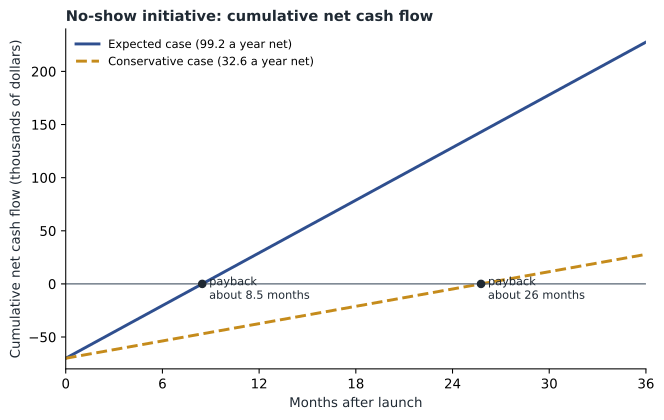
- Payback period: how long until the one-time cost is recovered. Here 70,000 ÷ 99,200 ≈ 0.71 years, or about 8.5 months.
- Net present value (NPV): the value today of all future net benefits, minus the investment, using a discount rate that reflects the cost of money and risk. Lorraine used 8 in 100 a year (a rate of 0.08).
- Return on investment (ROI): net benefit per dollar of total cost over a chosen period.
Worked problem
Net present value over three years
Calculate the three-year NPV of the no-show initiative with a one-time cost of 70,000 dollars, a net benefit of 99,200 dollars a year, and a discount rate of 0.08.
Show solution
- \[\mathrm{NPV} = -C_0 + \sum_{t=1}^{3} \frac{N}{(1+r)^t}\]
- Year 1: 99,200 ÷ 1.08 ≈ 91,852.
- Year 2: 99,200 ÷ 1.08² = 99,200 ÷ 1.1664 ≈ 85,048.
- Year 3: 99,200 ÷ 1.08³ = 99,200 ÷ 1.2597 ≈ 78,748.
- Sum of discounted benefits: 91,852 + 85,048 + 78,748 = 255,648.
- Subtract the investment: 255,648 − 70,000 = 185,648.
Answer: The three-year NPV is about 185,600 dollars. A positive NPV means the initiative is expected to create more value than it costs, after allowing for the cost of money.
For ROI over three years, total benefit is 3 × 133,200 = 399,600 dollars and total cost is 70,000 + 3 × 34,000 = 172,000 dollars. ROI is (399,600 − 172,000) ÷ 172,000 ≈ 1.32: each dollar spent returns its own cost plus about 1.32 dollars of net benefit. ROI is easy to explain but ignores timing; NPV accounts for timing but is harder to explain. Presenting both, with payback, gives the board a rounded picture.
Assumptions and sensitivity
Andre listed every assumption with its source and how confident he was. Then he did what turns a hopeful spreadsheet into a business case: he changed the most uncertain assumption to see what happened.
| Case | Recovery rate | Recovered a year | Net annual benefit (dollars) | Payback | Three-year NPV (dollars) |
|---|---|---|---|---|---|
| Expected | 1 in 4 | about 1,480 | 99,200 | about 8.5 months | about 185,600 |
| Conservative | 1 in 8 | about 740 | 32,600 | about 26 months | about 14,000 |
| Break-even | about 1 in 9 | about 680 | about 27,200 | about 31 months | about 0 |
The conservative case still breaks even within three years, which reassured Lorraine. The break-even line was even more useful: if fewer than about one in nine flagged would-be no-shows are recovered, the initiative does not pay for itself. That number became a stop condition for the pilot. Lesson 9 shows how such thresholds become decision gates.
Intangible benefits and risks
Not everything fits in the cash flow. Andre listed intangible benefits separately, each with a way to track it: fewer frustrated clients who could not get an appointment (measured by the waitlist size and time to next available slot), and less stress for reception staff who previously phoned every booking (measured in the staff survey). He did not add a dollar value to them, but he explained why they mattered.
He also listed risks and their controls. The most important came from Hannah: the model must never be used to refuse or deprioritize a booking, only to send an extra reminder or offer a waitlist slot, because limiting access to care based on a prediction would be unfair to clients and damaging to trust. A second came from the autumn assessment, where Noor had found the model's recall was lower at two rural clinics; the pilot would track recall by clinic. These went into the case as conditions, not footnotes.
What makes a business case credible
Noor summarized the session with a short checklist that applies to any AI business case:
- It compares the AI option against doing nothing and against the best non-AI option.
- It uses margin, not revenue, for lost or gained sales, and counts time savings only where they are captured.
- It counts all costs over the full life of the solution, especially people and ongoing operations.
- It states every key assumption and shows what happens when the shakiest one is wrong.
- It names the KPIs, their baselines and targets, and who owns each one.
- It sets out decision points, including the conditions for stopping.
Where AI business cases go wrong
Lorraine had reviewed many technology business cases in her career, and she told Andre the four mistakes she saw most often in AI proposals. The first was benefits taken from a vendor's brochure rather than the organization's own data. A vendor's figure for "time saved" reflects its best customers, not an average clinic. The second was costs that stopped at launch, with nothing for monitoring, retraining, support or the people who act on outputs. The third was a single number presented as certain, with no conservative case. The fourth was no plan for measuring results, so nobody could tell a year later whether the case had come true.
Each of these mistakes has the same cure: use your own baseline data, count costs across the whole life of the solution, show a range of outcomes, and name the KPIs and the date they will be checked. A business case built this way may look less exciting than a vendor's pitch, but it survives scrutiny, and it can be checked against reality after the pilot. That second quality matters most to a board that will be asked to approve many more AI proposals over the coming years.
A business case is also a commitment. Once approved, its KPIs, baseline and gate dates become the yardstick the initiative is judged by, and the person who wrote it is expected to report against it. Andre found that knowing this made him more careful with every assumption, which was exactly Lorraine's intention.
Common mistakes
MistakeUsing full revenue as the value of a recovered appointment.
InsteadUse contribution margin, because a kept appointment also brings direct costs.
MistakeComparing the AI option only with doing nothing.
InsteadInclude the best non-AI alternative; the AI option must beat it.
MistakePresenting a single number as certain.
InsteadState assumptions and show expected, conservative and break-even cases.
MistakeForgetting the people costs of acting on AI outputs.
InsteadInclude the staff time needed to use and review outputs; it is often the largest running cost.
Summary and key terms
- A business case for AI states the problem in numbers, compares options including doing nothing and non-AI alternatives, and sets out benefits, costs, risks, KPIs and decision points.
- Benefits rest on chains of assumptions, such as model recall, precision and how often a prediction leads to a useful action.
- Costs include one-time and ongoing items, with people often the largest.
- The financial summary uses net annual benefit, payback, net present value and ROI.
- Sensitivity analysis shows how results change when the most uncertain assumption is wrong, and the break-even point can become a stop condition.
- Business case
- A document that justifies an investment by setting out its problem, options, costs, benefits, risks and measures.
- Contribution margin
- Revenue minus the direct costs of providing the service.
- Payback period
- The time until cumulative net benefit equals the initial investment.
- Net present value
- The present value of future net benefits minus the initial investment, using a discount rate.
- Discount rate
- The yearly rate used to convert future money into today's value.
- Sensitivity analysis
- Changing an assumption to see how much the result depends on it.
Practice problems
Work each problem on paper first, then reveal the answer to check.
A tool costs 50,000 dollars to build and returns 20,000 dollars a year net. What is the payback period?
Show answer
50,000 ÷ 20,000 = 2.5 years.
What is the present value of 10,000 dollars received in one year at a discount rate of 0.08?
Show answer
10,000 ÷ 1.08 ≈ 9,259 dollars.
Why include the best non-AI option in a business case?
Show answer
Because the AI option must show value beyond what a cheaper, simpler change would achieve.
Lesson quiz · 5 questions
Score 60% or more to complete this lesson.
Create a free account to save your progress, take quizzes and earn a certificate.