
AWS-109 · Lesson 9 of 12 · 22 min
Building a study plan
▶ Video coming soon A video version of this lesson is on the way.
Knowing what is on the exam is not the same as being ready for it. In the second week of November 2026, Gwen asks Mateo and Kwame to each take a short diagnostic: twenty original practice questions spread across the four domains, untimed, with a note beside each answer saying how sure they were. Mateo scores well on Domains 1 and 3 but misses several security questions about shared responsibility and IAM. Kwame does well on Domain 3, poorly on Domain 4, and gets three questions wrong that he marked as "sure". "Good," Gwen says. "Now we know where the time should go." This lesson turns a diagnostic like theirs into a study plan you can actually follow.
Start from the exam guide and a diagnostic
A good plan has two inputs: what the exam covers and what you already know. The first comes from the exam guide's domains and task statements, reviewed in lessons 3 to 7. The second comes from a diagnostic. Use a short set of practice questions, ideally twenty to thirty, covering all four domains roughly in proportion to their weights. Do it before you study more, so it shows your real starting point. For each question, record your answer, whether it was right, and how confident you were: sure, unsure or guessing.
Confidence matters as much as correctness. A wrong answer you marked as sure is the most dangerous kind, because it means you hold a mistaken belief you will not think to check. A right answer you marked as a guess is fragile, because it might go the other way on exam day. Kwame's three confident errors, all about pricing options and support plans, became the top of his study list.
| Result | What it tells you | Action |
|---|---|---|
| Right and sure | Solid knowledge | Light review only |
| Right but guessing | Fragile knowledge | Review and practise until sure |
| Wrong and unsure | A known gap | Study the topic, then retest |
| Wrong but sure | A mistaken belief | Top priority: find and fix the misconception |
Weighting your time
Spread study time using two things together: the domain weights and your gaps. A simple method is to start from the weights, 24, 30, 34 and 12, and then adjust for what the diagnostic shows. If you are strong in a domain, reduce its share; if you are weak, increase it. Never drop a domain to zero, because scoring is compensatory across the whole exam and every domain carries marks.
# Share study hours by exam weight, adjusted for diagnostic gaps
weights = {"Concepts": 24, "Security": 30, "Technology": 34, "Billing": 12}
# Gap factor from the diagnostic: 1.0 = average, higher = weaker
kwame = {"Concepts": 1.0, "Security": 1.0, "Technology": 0.7, "Billing": 1.8}
hours = 30
raw = {d: weights[d] * kwame[d] for d in weights}
total = sum(raw.values())
for d, r in raw.items():
print(d, round(hours * r / total, 1), "hours")Concepts 7.2 hours Security 9.1 hours Technology 7.2 hours Billing 6.5 hours
What this code does
It splits 30 study hours across the four exam domains by multiplying each domain's exam weight by a gap factor from a diagnostic test, where a higher factor means a weaker area. Each domain's share of the total gives its hours. Billing gets more time than its small exam weight suggests because the learner is weakest there, while strong areas get less.
The calculation gives Kwame a plan for thirty hours of study. Technology drops a little because he is strong there; billing rises sharply because it was his weakest area, even though its exam weight is the smallest. The numbers are a guide, not a rule, but they stop the common mistake of spending most of your time on the topics you already enjoy.
A plan in phases
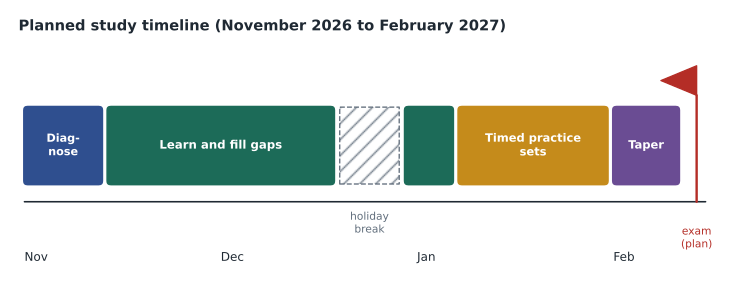
Gwen suggests four phases. In the diagnose phase, which takes a week or less, you take the diagnostic, read the exam guide, and list your gaps. In the learn phase, which takes most of the time, you work through each domain, filling gaps with the relevant course lessons, AWS's own free materials such as AWS Skill Builder and the exam guide, and the AWS documentation and whitepapers for topics you need in more depth. In the practise phase, you take timed practice sets under exam conditions, review every mistake, and keep a mistakes log. In the taper phase, the last few days, you stop learning new material and review your log, the confused pairs from lesson 8 and your signpost list.
Mateo's plan runs from mid-November 2026 to his planned exam in early February 2027. He plans to study four evenings a week for about an hour, with a longer session on Saturdays, and to take two weeks off over the holidays, when the emergency hospital is at its busiest. Kwame plans a shorter, more intense schedule toward his planned online exam in late January: five short sessions a week, with billing first and the confused-pairs list every Friday.
| Week (plan) | Mateo's focus | Kwame's focus |
|---|---|---|
| 1: mid-November | Diagnostic, exam guide, gap list | Diagnostic, exam guide, gap list |
| 2 to 3 | Domain 2: shared responsibility, IAM | Domain 4: pricing options, billing tools |
| 4 to 5 | Domain 3: databases, networking, AI | Domain 4: support plans; Domain 1 review |
| 6 to 7 | Domains 1 and 4 | Domain 2: security services |
| Holiday break | Rest; light flashcards only | Practice set 1 |
| 8 to 10 | Timed practice sets and mistakes log | Practice sets 2 and 3; taper |
| 11: early February | Taper and exam | Exam already planned for late January |
Choosing study material
Use legitimate material. AWS's own resources are the most reliable: the exam guide, the official practice question set and other free courses on AWS Skill Builder, the AWS documentation, and AWS whitepapers such as the overview of AWS and the Well-Architected Framework. Reputable training providers publish courses and practice tests written by their own authors. Avoid exam dumps: collections claiming to contain real exam questions. Using them breaks the AWS Certification Program Agreement, which can lead to a ban and the loss of certifications, and they are often wrong anyway. More importantly, they teach you to recognize questions rather than understand services, which fails the moment the wording changes.
Active study beats passive study. Reading a page twice feels productive, but explaining it aloud, writing a one-line summary from memory, or answering practice questions builds the recall you need on exam day. Mateo uses three techniques. Flashcards with a service name on one side and its one-line job on the other. Teach-back, where he explains a topic to Andre, the operations manager, who knows nothing about AWS. And spaced repetition, where he revisits each topic after a day, a week and a month, which suits a plan that spans the holidays.
Keeping a mistakes log
From the first practice question onward, keep a mistakes log. For every wrong answer, and every right answer you guessed, record four things: the topic, the right answer, why your answer was wrong, and the kind of mistake. Gwen uses four kinds. A knowledge gap means you did not know the fact. A confusion means you mixed up two similar services. A reading error means you knew the answer but misread the question or missed a constraint. A timing error means you rushed. Each kind has a different fix: study for gaps, the confused-pairs method for confusions, the reading routine from lesson 2 for reading errors, and the timing plan from lesson 10 for rushing.
Fitting study into a working life
Most Cloud Practitioner candidates study around a job, and Mateo is no exception. The emergency hospital runs around the clock, and some evenings he is called in to fix a printer or a network switch. Gwen's advice is to plan for interruptions rather than pretend they will not happen. Choose short, regular sessions over long, rare ones: four hours spread across a week stick far better than one four-hour block on a Sunday. Decide at the start of each week which topics you will cover, so that when a session is lost you know exactly what to move, rather than drifting. Keep a few minutes' worth of flashcards on your phone for waiting rooms and lunch breaks. And protect one longer session a week for practice questions and review, because that is where learning turns into readiness.
Use your own work as study material. Every AWS task in the migration is a chance to connect a service to a real need. When Mateo sets up the AWS Backup plan for the pilot, he writes a line in his log: "AWS Backup: central backup policies across EBS, RDS, EFS and S3; replaces tapes; Domain 3, storage." When Lorraine asks why the bill rose in November, he looks it up in Cost Explorer and writes the answer as a Domain 4 note. Studying this way makes the exam feel like a description of work he has already done.
Set a date and work back from it. A booked exam gives a plan its shape, and a plan without a date tends to stretch. Gwen suggests booking once the diagnostic is done and the plan is drawn, with enough weeks for every phase and a margin for illness or work emergencies. If the date turns out to be too early, the rescheduling policy usually allows a change if you act before the deadline; check the current rules when you book. Kwame books his online slot for late January the same week he finishes his plan. Mateo books his testing centre seat for early February, after the holiday rush at the hospital, and writes the date at the top of every page of his study log.
Finally, measure progress, not hours. A plan that says "study ten hours a week" can be met without learning much. A plan that says "by the end of week 3, explain the shared responsibility line for EC2, RDS and Lambda from memory and get eight of ten Domain 2 questions right" can be checked. Gwen asks both candidates to write one such goal for each week of their plan, and to note on Sunday evening whether they met it.
Kwame adds one more line to his plan after hearing this: a single sentence at the top of the page that says why he is doing it. "So that I can explain AWS costs to Lorraine and design BookVet's next version properly." On evenings when motivation is low, Gwen says, the reason matters more than the schedule.
Worked problem
Turning a diagnostic into week 2
Mateo's diagnostic shows four wrong answers in Domain 2: two on who patches what under the shared responsibility model, one where he chose IAM users with access keys instead of a role for an application, and one where he chose CloudWatch for an audit question. What should week 2 of his plan contain?
Show solution
- Classify the mistakes: the two shared responsibility errors and the access key error are knowledge gaps; the CloudWatch error is a confusion.
- For the knowledge gaps, review the AWS-102 lessons on shared responsibility and IAM, then write a table of who does what for EC2, RDS and Lambda from memory.
- For the confusion, add CloudWatch versus CloudTrail to his confused-pairs page with a deciding difference and a signpost.
- End the week with ten new practice questions on Domain 2 and check that the same mistakes do not recur.
Answer: Week 2 targets the specific gaps and confusion the diagnostic revealed and ends with a retest.
Common mistakes
MistakeStudying without a diagnostic.
InsteadStart by measuring what you know, so time goes to real gaps.
MistakeSpending most time on favourite topics.
InsteadWeight time by exam weight and diagnostic gaps.
MistakeIgnoring confident wrong answers.
InsteadTreat them as the top priority; they reveal mistaken beliefs.
MistakeUsing exam dumps.
InsteadUse AWS materials and reputable practice questions; dumps break the agreement and teach recognition, not understanding.
MistakeRereading instead of testing yourself.
InsteadUse flashcards, teach-back and practice questions to build recall.
Summary and key terms
- Base a study plan on the exam guide and a diagnostic that records correctness and confidence.
- Weight time by domain weights adjusted for your gaps; never drop a domain.
- Plan four phases: diagnose, learn, practise under exam conditions, and taper.
- Use AWS materials such as the exam guide, Skill Builder and whitepapers, and reputable practice questions; avoid dumps.
- Study actively with flashcards, teach-back and spaced repetition.
- Keep a mistakes log that classifies errors as gaps, confusions, reading errors or timing errors.
- Diagnostic
- A short practice set taken at the start to measure what you already know.
- Confidence rating
- A note of how sure you were of each answer, used to spot mistaken beliefs.
- Mistakes log
- A record of every wrong or guessed answer with its topic, cause and fix.
- Taper
- The final days before the exam, spent reviewing rather than learning new material.
- Spaced repetition
- Revisiting material at growing intervals to strengthen memory.
- Exam dump
- A collection claiming to contain real exam questions; using one breaks the certification agreement.
Practice problems
Work each problem on paper first, then reveal the answer to check.
What two inputs does a good study plan need?
Show answer
The exam guide and a diagnostic of what you know.
Which diagnostic result is the top priority?
Show answer
A wrong answer you were sure of.
Should you ever drop a domain from your plan?
Show answer
No; every domain carries marks.
What are the four phases of Gwen's plan?
Show answer
Diagnose, learn, practise, taper.
Why avoid exam dumps?
Show answer
They break the certification agreement, are often wrong, and teach recognition rather than understanding.
What are the four kinds of mistake in the log?
Show answer
Knowledge gap, confusion, reading error and timing error.
Which technique fits a plan spread over the holidays?
Show answer
Spaced repetition.
Lesson quiz · 5 questions
Score 60% or more to complete this lesson.
Create a free account to save your progress, take quizzes and earn a certificate.