
AWS-109 · Lesson 12 of 12 · 22 min
Final review and next steps
▶ Video coming soon A video version of this lesson is on the way.
The last session of Gwen's review is planned for the third week of January 2027, a week before Kwame's online exam and about two weeks before Mateo's testing centre appointment. Gwen has already told them what it will cover, and they have the plan on paper now, in November. "The final week is not for learning," she says. "It is for consolidating, resting and arriving calm. And after the exam, whatever the result, there is a plan for that too." This lesson covers the final review, the last week, exam day itself, and what to do with your result.
The final review sheet
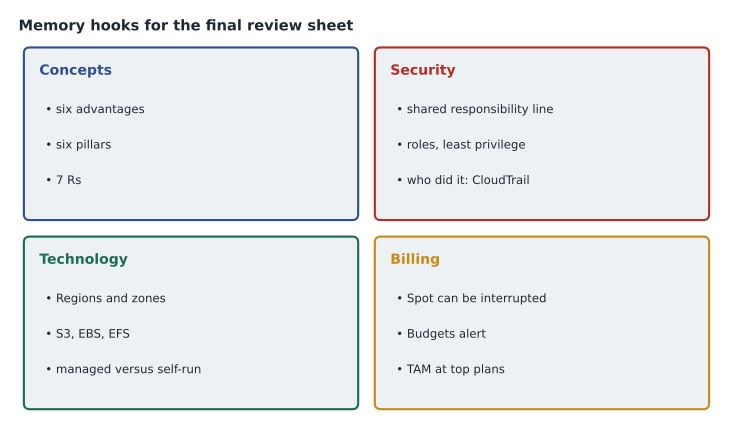
In the taper phase, replace broad study with a one-page final review sheet. Gwen asks each candidate to build their own, because writing it is itself a review. It has five parts: the four domains and their weights; a short list of the services in each domain with their one-line jobs; the confused pairs from lesson 8 with deciding differences; the signpost phrases from lesson 2; and the candidate's own top ten mistakes from the mistakes log. Mateo's sheet leads with shared responsibility for EC2, RDS and Lambda, the security pairs he used to confuse, and the Cloud Adoption Framework perspectives. Kwame's leads with the EC2 purchase options, the billing tools and the support plan pattern.
| Part of the sheet | What goes in it |
|---|---|
| Domains and weights | Concepts 24, security 30, technology 34, billing 12 |
| Services by domain | One-line job for each service you might see |
| Confused pairs | Each pair with its deciding difference |
| Signposts | Phrases such as least effort, can be interrupted, who made the call |
| Personal top ten | Your most frequent mistakes from the log, with the fix |
Domain highlights
For Domain 1, be ready to name the six advantages of the cloud, the six Well-Architected pillars, the six AWS CAF perspectives and the 7 Rs, and to explain fixed versus variable cost. For Domain 2, be ready to draw the shared responsibility line for any service, describe IAM users, groups, roles and policies, explain least privilege and root user protection, and give the one-line job of each security service. For Domain 3, be ready to describe Regions, Availability Zones and edge locations and how to choose a Region, and to match needs to compute, storage, database, networking, analytics, AI and integration services. For Domain 4, be ready to match workloads to EC2 purchase options, name the billing tools by their jobs, explain consolidated billing, and describe the pattern of support plans.
The final week
The last week before the exam follows a simple shape. Early in the week, take one last unseen practice set under exam conditions, then review it with the four-step method from lesson 11. In the middle of the week, work through your final review sheet and your mistakes log, and drill the confused pairs. In the last two days, stop practice sets entirely. Read the sheet once a day, sleep well, and prepare the logistics: identification, the route to the testing centre and the time to leave, or for an online exam, the room and the system test. On the day before, do something unrelated to AWS in the evening. Cramming at that point adds stress and very little knowledge.
Logistics deserve a checklist. For a testing centre: your identification, matching your account name exactly; the confirmation email; the address and travel time, with a margin for traffic or snow; and arrival well before the appointment. For online proctoring: the system test passed on the same computer and network; a clear desk and private room; identification ready; other programs closed; and logging in at the start of the check-in window. Mateo plans to drive to the testing centre the weekend before to check parking. Kwame plans to tell his housemates exactly when the exam runs and put a sign on the door.
Exam day
On the day, eat normally, arrive or log in early, and begin with the pacing plan from lesson 10. Read each question with the four-part routine, look for the signpost, eliminate in three passes, and for multiple response mark each option true or false. Answer every question before moving on, flag anything you want to revisit, and keep an eye on the checkpoints. When you finish the first pass, use the review reserve for flagged questions, change answers only for a reason, and confirm none are blank before you submit. When you submit, you may see a pass or fail result on screen; AWS's policies say final results are posted to your AWS Certification account within five business days, and sometimes longer if a result is under review.
After a pass
A pass earns the AWS Certified Cloud Practitioner certification, valid for three years. AWS issues a digital badge you can share on professional networks and add to your résumé, and your certification account lists your benefits, which have included discounts on future exams; check the current benefits page. Keep the certification current before it expires. In November 2026, AWS's recertification options for Cloud Practitioner included completing the AWS Cloud Quest: Recertify Cloud Practitioner course, passing the latest version of the Cloud Practitioner exam, or passing an associate or professional exam, which also recertifies the foundational level. AWS's retake policy also says that once you pass an exam you cannot retake it for two years, so recertification by exam happens near the end of the three-year term.
| Next step | Suits | Why |
|---|---|---|
| AWS Certified AI Practitioner | Anyone working with AI and generative AI projects | Another foundational exam focused on AI concepts and AWS AI services |
| AWS Certified Solutions Architect – Associate | Mateo, and anyone designing systems | Builds directly on Domain 3 and the Well-Architected Framework |
| AWS Certified Developer – Associate | Kwame, and anyone building applications | Covers Lambda, DynamoDB, APIs and deployment in depth |
| AWS Certified SysOps Administrator – Associate | Operations staff | Focuses on monitoring, operations and automation |
| Hands-on work | Everyone | A small real project fixes knowledge better than another exam |
Gwen's advice on next steps is practical. Mateo plans to aim for the Solutions Architect – Associate exam after the spring cutover, because he will have built the VetLedger and imaging environments by then. Kwame plans to go for the Developer – Associate exam while he refactors BookVet into serverless services. Both plan to keep their study logs: the habits from this course, reading for constraints, separating confused services and reviewing mistakes by type, carry straight into associate-level exams.
After a fail
A fail is information, not a verdict. AWS's policies, checked in November 2026, require a wait of 14 calendar days after a failed attempt before you can retake the exam, place no limit on the number of attempts, and charge the full fee for each attempt. Your score report shows your performance in each domain, which is the starting point for a short, focused plan. Treat the report like a practice-set review: find the weakest domains, return to the mistakes log, and look honestly at whether the problem was knowledge, confusion, reading or timing. Many candidates pass comfortably on a second attempt after two or three weeks of targeted study.
# Earliest retake date after a failed attempt (14 calendar days)
from datetime import date, timedelta
exam_day = date(2027, 2, 6)          # an example date only
retake = exam_day + timedelta(days=14)
print("Earliest retake:", retake.isoformat())Earliest retake: 2027-02-20
What this code does
It adds 14 calendar days to an example exam date to find the earliest date a retake can be booked after a failed attempt. It prints that date. Knowing the waiting period helps plan the study time between attempts.
Turning the certification into value at work
A certification is most useful when other people can see what it means in practice. Gwen suggests three things to do in the first month after a pass. First, explain one AWS idea to a colleague who does not work in IT: Mateo plans to walk Andre through why the clinics' booking site stays up when one data centre fails, using the multi-zone design from lesson 5. Second, take on one small piece of real AWS work that uses something from the course, such as setting up a budget alert or reviewing who has access to the production account. Third, write down what you would do differently if you were starting the migration again, now that you know the vocabulary. Each of these turns exam knowledge into working knowledge.
For a team, a group of certified people creates a shared language. Before the move to AWS, the clinic group's conversations about technology tended to happen between Mateo and whoever had a problem. With Lorraine, Hannah and Dr. Kaur all aware of terms such as Availability Zones, shared responsibility and Savings Plans, discussions about cost, risk and uptime can happen in the same room, with the same words. Gwen has seen this in other organizations: a handful of foundational certifications across finance, security and operations often does more for a migration than one more architect.
Keep learning between exams. AWS releases new services and features constantly, and some of today's details will change before the certification needs renewing. A small habit, such as reading the AWS What's New feed once a week or following the AWS blog for the services you use, keeps knowledge fresh without needing a study plan. When recertification comes around, much of the material will already be familiar.
Mateo and Kwame also agree to compare notes after their exams, whatever happens. Kwame's exam comes first, so he plans to tell Mateo how the online check-in went, how the pacing plan held up and which domains felt hardest, without sharing any question content, which the certification agreement forbids. That kind of honest debrief, Gwen says, is the best preparation a colleague can give.
Worked problem
Planning a retake from a score report
Suppose a candidate's report shows "meets competencies" in Domains 1 and 3 and "needs improvement" in Domains 2 and 4. Their mistakes log from practice showed many security confusions and several billing knowledge gaps. What should the retake plan look like?
Show solution
- Book the retake for at least 14 days after the attempt, leaving enough time to study; three weeks is a reasonable target.
- Spend most of the time on Domains 2 and 4, starting with the confused security pairs and the billing tools and purchase options.
- Keep Domains 1 and 3 alive with short reviews, because scoring is compensatory and they still carry most of the marks.
- Take one or two unseen practice sets under exam conditions and confirm that the security and billing mistake counts have fallen before the retake.
Answer: Wait the required 14 days, target the two weak domains with the mistakes log, keep the strong domains fresh, and confirm progress with unseen practice before retaking.
Gwen closes the planning session by giving Mateo and Kwame the same sentence she wrote on the whiteboard in November: concepts, security, technology, billing. "You know what each word means now," she says, "and you know how to read a question about it. Go and show the exam." Their exams are in January and February 2027. Whatever the result, they have a plan for the day after.
Common mistakes
MistakeLearning new topics in the last two days.
InsteadTaper: review the sheet and the log, rest, and prepare logistics.
MistakeLeaving logistics to the morning of the exam.
InsteadCheck ID, route, room and system test in advance.
MistakeTreating a fail as the end.
InsteadUse the domain report and mistakes log for a focused retake after 14 days.
MistakeLetting the certification lapse.
InsteadRecertify within three years by the recertification course or a qualifying exam.
MistakeStopping the study habits after passing.
InsteadReading for constraints and reviewing mistakes carry into associate exams.
Summary and key terms
- Build a one-page final review sheet with domains, services, pairs, signposts and your top mistakes.
- In the final week, take one last unseen set early, then taper with review and rest.
- Prepare logistics in advance: matching ID, route or room, and the system test for online exams.
- Final results are posted to your certification account within five business days.
- A pass is valid for three years; recertify by the recertification course, the latest exam or a higher-level exam.
- After a fail, wait 14 days, study the weak domains from the report and the log, and confirm progress before retaking.
- Final review sheet
- A one-page summary of domains, services, pairs, signposts and personal mistakes.
- Recertification
- Renewing a certification before it expires, by a course or a qualifying exam.
- Digital badge
- An online credential AWS issues to show a certification.
- Score report
- The report showing pass or fail and performance by domain.
- Retake waiting period
- The 14 calendar days required after a failed attempt before retaking.
- Associate certification
- The AWS level above foundational, focused on a role such as architect or developer.
Practice problems
Work each problem on paper first, then reveal the answer to check.
What five parts make up the final review sheet?
Show answer
Domains and weights, services by domain, confused pairs, signposts and personal top mistakes.
Should you take a practice set the day before the exam?
Show answer
No; stop practice sets in the last two days.
How soon are final results posted?
Show answer
Within five business days, sometimes longer if under review.
How long is the certification valid?
Show answer
Three years.
How long must you wait after a failed attempt?
Show answer
14 calendar days.
Name one way to recertify Cloud Practitioner.
Show answer
Complete the recertification course, pass the latest Cloud Practitioner exam, or pass an associate or professional exam.
Which associate exam suits a developer like Kwame?
Show answer
AWS Certified Developer – Associate.
Lesson quiz · 5 questions
Score 60% or more to complete this lesson.
Create a free account to save your progress, take quizzes and earn a certificate.