
AWS-109 · Lesson 3 of 12 · 22 min
Domain 1 review: cloud concepts
▶ Video coming soon A video version of this lesson is on the way.
Domain 1 is where the exam checks that you understand why organizations use the cloud at all. It carries a weight of 24 in the exam guide, so roughly a quarter of the scored questions come from it. Gwen starts the review with a question for Mateo: "If Lorraine asked you tomorrow why the board approved the move to AWS, what would you say in two minutes?" Mateo thinks about the summer. "The server room overheated twice, and VetLedger was down for three hours on July 18. The imaging storage array goes out of support next June, and we would have had to buy a new one sized for five years of growth. On AWS we pay for what we use, we can add storage as the images grow, and we can keep a copy in a second Region if the first has a problem." Gwen nods. "That answer touches four of the benefits on the exam. Let us name them properly."
This lesson reviews the four task statements in Domain 1: the benefits of the AWS Cloud, the design principles of the Well-Architected Framework, the benefits and strategies of migration, and cloud economics. Each section ends with the kind of reasoning the exam asks for, and the lesson closes with original practice items. AWS-101 covered these ideas in full; this is a review, so if any section feels unfamiliar, go back to the matching AWS-101 lesson before moving on.
Benefits of the AWS Cloud
AWS lists six advantages of cloud computing, and exam questions often describe one of them without using its name. Trade fixed expense for variable expense: instead of buying servers and storage up front, you pay for what you consume. Benefit from massive economies of scale: because AWS serves so many customers, its costs per unit are lower and it passes savings on through lower prices over time. Stop guessing capacity: you can scale up or down as demand changes instead of buying for a forecast peak. Increase speed and agility: new resources are a few clicks or one command away, so teams can experiment and deliver faster. Stop spending money running and maintaining data centres: staff time moves from racking servers to work that serves the business. Go global in minutes: you can deploy in Regions around the world close to your users.
Other benefits appear in exam questions as qualities of the cloud. High availability means a system keeps working when parts fail, usually by running across several Availability Zones. Elasticity means resources grow and shrink automatically with demand. Agility means the speed of change. Reliability and durability refer to recovering from failure and not losing data. A question might describe the clinic group adding storage each month as new images arrive without buying hardware: that is elasticity and stopping guessing capacity. A question about the July outage being avoided by running in two Availability Zones is about high availability.
| Advantage | How it appears in a scenario |
|---|---|
| Fixed expense to variable expense | No up-front hardware purchase; pay monthly for use |
| Economies of scale | Lower per-unit prices because AWS buys at huge scale |
| Stop guessing capacity | Scale with demand instead of buying for a forecast peak |
| Speed and agility | New environments in minutes; faster experiments |
| Stop running data centres | Staff time moves from hardware to the business |
| Go global in minutes | Deploy close to users in many Regions |
The Well-Architected Framework
The AWS Well-Architected Framework describes good practice for designing and running workloads in the cloud. It is organized into six pillars, and the exam expects you to recognize each by its focus. Operational excellence is about running and monitoring systems and improving processes, for example by making changes small and reversible and by learning from operational events. Security is about protecting data, systems and assets, for example by applying least privilege and enabling traceability. Reliability is about a workload performing its function correctly and recovering from failure, for example by testing recovery and scaling horizontally. Performance efficiency is about using resources efficiently as demand changes, for example by choosing the right resource types and experimenting. Cost optimization is about avoiding unnecessary cost, for example by measuring efficiency and paying only for what you use. Sustainability is about reducing the environmental impact of running workloads, for example by maximizing utilization and choosing efficient services.
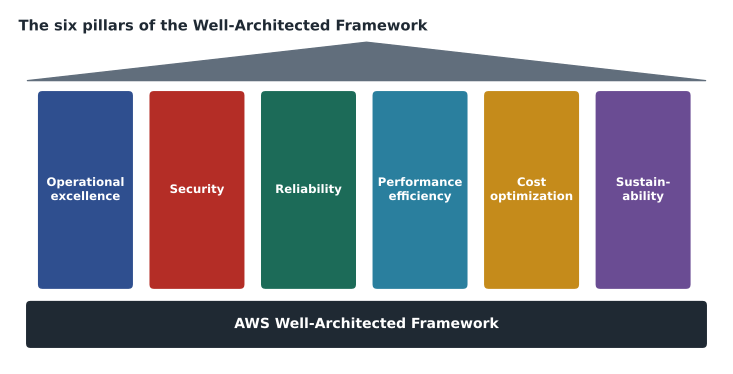
Exam questions usually give you a design decision and ask which pillar it supports. Gwen walks through the Cascade Ridge plan. Running VetLedger's database with Amazon RDS in a Multi-AZ deployment supports reliability. Requiring multi-factor authentication for every administrator supports security. Tagging every resource with a clinic name so Lorraine can see costs by clinic supports cost optimization. Writing runbooks for the cutover and reviewing what went wrong after the pilot supports operational excellence. Choosing an instance size that matches VetLedger's real usage rather than the old servers' size supports performance efficiency and cost optimization together. Turning off the development environment at night supports cost optimization and sustainability. The Well-Architected Tool in the console lets teams review a workload against the pillars; for the exam, remember that the tool exists and that the review is free.
Migration benefits and strategies
Task statement 1.3 asks you to understand why and how organizations migrate. The AWS Cloud Adoption Framework, or AWS CAF, organizes the work of moving to the cloud into six perspectives. The business, people and governance perspectives focus on business capabilities: strategy and outcomes, culture and skills, and portfolio and risk management. The platform, security and operations perspectives focus on technical capabilities: architecture and infrastructure, security controls, and running services day to day. The exam may ask which perspective a concern belongs to. Training the clinic staff on new tools is the people perspective. Making sure client data is protected is the security perspective. Tracking whether the migration delivers its cost savings is the governance perspective.
The migration strategies, often called the 7 Rs, describe what to do with each application. Rehost moves it as it is, sometimes called lift and shift. Replatform makes a few changes to gain a benefit, such as moving a database to a managed service. Refactor, or re-architect, rewrites it to use cloud-native features. Repurchase replaces it with a different product, often software as a service. Retain keeps it where it is for now. Retire turns it off. Relocate moves it to the cloud without changing it at the hypervisor level, for example moving a VMware environment. Cascade Ridge used five of them: VetLedger is replatformed with its database on Amazon RDS; the imaging archive is relocated into Amazon S3; BookVet is rehosted on EC2 first and refactored later; the old intranet wiki is retired; the tape backup is replaced with AWS Backup, a repurchase; and the pharmacy label-printer PC is retained on site.
| Strategy | In one line | Cascade Ridge example |
|---|---|---|
| Rehost | Move as is | BookVet on EC2 in phase 1 |
| Replatform | Small changes for a benefit | VetLedger database to Amazon RDS |
| Refactor | Rebuild with cloud-native features | BookVet serverless in phase 2 |
| Repurchase | Switch to a different product | Tape backup replaced with AWS Backup |
| Retain | Keep where it is for now | Pharmacy label-printer PC |
| Retire | Turn it off | Old intranet wiki |
| Relocate | Move a virtualized environment without changes | Not used by Cascade Ridge |
Migration questions also mention tools. AWS Database Migration Service moves databases with minimal downtime, and the Schema Conversion Tool helps when changing database engines. AWS Application Migration Service helps rehost servers. For very large amounts of data where the network would be too slow, AWS offers physical data transfer devices in the AWS Snow Family. AWS has reduced the range of Snow devices in recent years, so check which devices are currently offered; for the exam, remember the idea that shipping a device can be faster than sending tens of terabytes over a limited connection.
# How long would 38 TB of images take over the clinic's connection?
tb = 38
bits = tb * 8 * 10**12
for mbps in (100, 500, 1000):
    seconds = bits / (mbps * 10**6)
    days = seconds / 86400
print(mbps, "Mbps:", round(days, 1), "days at full speed")100 Mbps: 35.2 days at full speed 500 Mbps: 7.0 days at full speed 1000 Mbps: 3.5 days at full speed
What this code does
It converts 38 terabytes into bits and divides by three connection speeds to find how many days the copy would take at full speed. The results are about a month at 100 megabits per second and a few days at 1 gigabit per second. Numbers like these explain why exam questions about very large transfers often point to offline or dedicated transfer options.
The calculation above shows why the physical transfer option exists. At 100 megabits per second, moving the imaging archive would take over a month even at full speed, and real connections rarely run at full speed while clinics are also using them. At a gigabit it is a few days, which may be acceptable. A question that mentions a large data set and a slow or shared connection is pointing toward a physical transfer device.
Cloud economics
Task statement 1.4 covers the economics of the cloud. Fixed costs are paid whether you use the capacity or not, like the storage array bought for five years of growth. Variable costs rise and fall with use. On-premises costs include more than hardware: power, cooling, space, maintenance contracts, staff time and the cost of idle capacity. Licensing matters too: some software can be brought to AWS under your existing licence, known as bring your own licence, while other services include the licence in the price. Rightsizing means choosing the resource size that matches actual use. Automation reduces cost by removing manual work, for example by starting and stopping resources on a schedule. And economies of scale lower AWS's prices over time.
How Domain 1 questions are usually framed
Domain 1 questions rarely ask for a definition directly. More often they describe a company's situation and ask which benefit, pillar, perspective or strategy it shows. That means the review is really about recognition: hearing a description and naming the idea. Gwen suggests a drill for the bus ride home. Take each of the six advantages, six pillars, six perspectives and seven migration strategies, and invent a one-sentence scenario for each from Cascade Ridge's own move. "The clinics can open a new booking region for a spring promotion in an afternoon" is speed and agility. "Lorraine can see the imaging cost rise by a small amount each month instead of a big purchase every five years" is trading fixed for variable expense. "Dr. Kaur's emergency hospital keeps running when one Availability Zone has a problem" is high availability and the reliability pillar.
Doing the drill from your own context makes the ideas stick, and it prepares you for the way the exam disguises them. If you can generate the scenario, you can recognize it. Mateo writes his twenty-five sentences on index cards and shuffles them each evening for a week. By the end, he can name the idea behind each card before he finishes reading it.
Worked problem
Naming the economic benefit
A practice question reads: "Before moving to AWS, a company bought enough storage for its expected peak five years ahead. Most of that capacity sat unused for the first three years. Which benefit of the AWS Cloud addresses this problem most directly?"
Show solution
- Find the need: the company paid for capacity it did not use.
- Check the candidates: economies of scale is about AWS's buying power; go global in minutes is about Regions; stop guessing capacity is about matching capacity to demand; trading fixed for variable expense is about paying for use.
- Two fit partly. The question stresses buying for a forecast peak and leaving capacity idle, which is exactly the phrase "stop guessing capacity".
Answer: Stop guessing capacity. Trading fixed expense for variable expense is related, but the scenario's emphasis on forecasting a peak points to stop guessing capacity.
Common mistakes
MistakeTreating every benefit as "cost savings".
InsteadLearn the six advantages by name and the scenario cues for each.
MistakeMixing up reliability and performance efficiency.
InsteadReliability is recovering from failure; performance efficiency is using resources well as demand changes.
MistakeForgetting the sustainability pillar.
InsteadThe framework has six pillars, including sustainability.
MistakeConfusing replatform with refactor.
InsteadReplatform makes small changes; refactor rebuilds with cloud-native features.
MistakeCounting only hardware in on-premises cost.
InsteadInclude power, cooling, space, staff time, maintenance and idle capacity.
Summary and key terms
- Domain 1 carries a weight of 24 and covers benefits, Well-Architected, migration and economics.
- AWS's six advantages include trading fixed for variable expense, economies of scale, stop guessing capacity and go global in minutes.
- The Well-Architected Framework has six pillars: operational excellence, security, reliability, performance efficiency, cost optimization and sustainability.
- AWS CAF has six perspectives: business, people, governance, platform, security and operations.
- The 7 Rs are rehost, replatform, refactor, repurchase, retain, retire and relocate.
- Cloud economics compares fixed and variable cost, includes hidden on-premises costs, and uses rightsizing and automation.
- Elasticity
- The ability to grow and shrink resources automatically with demand.
- High availability
- Designing a system to keep working when components fail, often across Availability Zones.
- Well-Architected Framework
- AWS's set of design principles and best practices organized into six pillars.
- AWS CAF
- The AWS Cloud Adoption Framework, organizing cloud adoption into six perspectives.
- Rehost
- Moving an application to the cloud without changes; lift and shift.
- Rightsizing
- Matching resource types and sizes to actual workload needs.
Practice problems
Work each problem on paper first, then reveal the answer to check.
Name the six Well-Architected pillars.
Show answer
Operational excellence, security, reliability, performance efficiency, cost optimization and sustainability.
Which pillar does a Multi-AZ database support?
Show answer
Reliability.
Which AWS CAF perspective covers staff training?
Show answer
People.
Which migration strategy did Cascade Ridge choose for the old wiki?
Show answer
Retire.
What is replatforming?
Show answer
Moving with small changes to gain a benefit, such as a managed database.
Which advantage describes paying monthly instead of buying hardware?
Show answer
Trade fixed expense for variable expense.
Why might a physical transfer device beat the network?
Show answer
Very large data sets over slow or shared connections can take weeks to send.
Lesson quiz · 5 questions
Score 60% or more to complete this lesson.
Create a free account to save your progress, take quizzes and earn a certificate.