
AWS-109 · Lesson 2 of 12 · 25 min
Reading multiple-choice and multiple-response questions
▶ Video coming soon A video version of this lesson is on the way.
A week after the first session, Gwen hands Mateo and Kwame a single printed page with one practice question on it and asks them to answer it in silence. Kwame circles an answer in fifteen seconds. Mateo takes a minute and a half and circles a different one. Gwen asks each of them to explain. Kwame had seen the word "database" and picked the first database service he recognized. Mateo had noticed the phrase "without managing servers" and the phrase "key-value lookups in single-digit milliseconds", and chosen the service that fits both. "Most wrong answers on this exam are not about knowledge," Gwen says. "They come from reading too fast. Today is about reading."
The CLF-C02 exam uses two question types. A multiple-choice question has one correct answer and three incorrect ones, which AWS calls distractors. A multiple-response question has two or more correct answers among five or more options, and the question tells you how many to choose. To get a multiple-response question right you must choose every correct option and no incorrect ones; there is no partial credit for getting one of two. Both types are usually built around a short scenario: a company, a need, a constraint and a question.
The four parts of a scenario
Gwen teaches a simple habit: before you look at the options, find the four parts of the question. The context is who is asking and what situation they are in. The need is what they want to achieve. The constraint is the condition that rules options out, such as cost, speed, effort, location or compliance. The ask is the exact thing the question wants you to choose: a service, a pricing model, a responsibility, a benefit. Read the last sentence first if it helps, because that is where the ask usually lives.
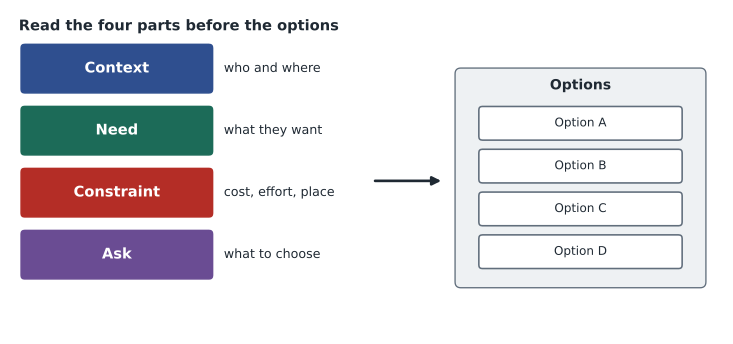
Here is an example in the style of the exam. "A veterinary clinic group stores radiograph images that are viewed often for 30 days and then rarely, but must be kept for years. The group wants to reduce storage cost with the least ongoing effort. Which solution meets these requirements?" The context is a clinic group with medical images. The need is long-term storage. The constraints are cost and least effort. The ask is a solution. That combination points toward Amazon S3 with life cycle rules or S3 Intelligent-Tiering, rather than a manual process of copying files or a block storage volume that must be resized by hand.
| Part | Question words to look for | Example from the question above |
|---|---|---|
| Context | A company, a team, a workload | A veterinary clinic group with radiograph images |
| Need | Wants to, needs to, must | Keep images for years |
| Constraint | Most cost-effective, least effort, fastest, in one Region, without managing | Reduce cost with the least ongoing effort |
| Ask | Which service, which model, which responsibility | Which solution meets the requirements |
Signpost phrases
Many questions hinge on one phrase that points toward a family of answers. Gwen calls these signposts, and she asks Mateo to start a list in his study log. "Least operational overhead" and "without managing servers" point toward managed or serverless services. "Unpredictable traffic" and "scale automatically" point toward Auto Scaling, Lambda or other elastic services. "Steady usage for one or three years" points toward Savings Plans or Reserved Instances. "Can be interrupted" points toward Spot Instances. "Audit who did what" points toward AWS CloudTrail. "Compliance reports from AWS" points toward AWS Artifact. "Low latency for users around the world" points toward Amazon CloudFront or edge locations.
Signposts are not magic words; they narrow the field. You still need to check that the option fits every part of the scenario. But reading for signposts slows you down in the right way, because you stop matching on topic words such as "database" and start matching on the requirement.
| Signpost | Usually points toward |
|---|---|
| Least operational overhead; fully managed | Managed and serverless services such as Lambda, Fargate, DynamoDB, RDS |
| Scale automatically with demand | Auto Scaling, Lambda, elastic services |
| Steady use for one or three years | Savings Plans or Reserved Instances |
| Workload can be interrupted | Spot Instances |
| Who made this API call | AWS CloudTrail |
| Metrics, alarms and logs | Amazon CloudWatch |
| AWS compliance reports and agreements | AWS Artifact |
| Recommendations on cost, security and limits | AWS Trusted Advisor |
| Global users, low latency for content | Amazon CloudFront |
Eliminating distractors
AWS writes distractors to be plausible. They are usually real AWS services or real cloud ideas, so you cannot pass by spotting invented names. The skill is elimination. Gwen's routine has three passes. First, cross out any option that does not meet the need at all, such as a networking service when the question asks about storage. Second, cross out any option that breaks a constraint, such as a service that requires managing servers when the question says "without managing servers". Third, among what remains, choose the option that fits best, not just one that would work. Many questions have two options that could technically work; the exam asks for the one that matches the stated priority.
Absolute words in options deserve a second look. An option that says a service "always" does something or "never" needs configuration is often wrong, because cloud services usually depend on how they are set up. An option that solves a bigger problem than the one asked is also suspicious: if the question asks for the most cost-effective way to store backups, a multi-Region active-active database is probably not the answer, however impressive it sounds.
Reading the options as carefully as the question
Gwen points out that candidates often read the question slowly and then skim the options. That is backwards. Options are where the distractors live, and they are written to look right at a glance. Read every option to the end before deciding, even if the first one seems perfect. Watch for options that are almost right but wrong in one detail: a correct service paired with the wrong feature, a correct idea attached to the wrong responsibility, or a correct pricing model applied to the wrong kind of workload. An option that says "Amazon S3 to run a relational database" names a real service and a real need, but the pairing is wrong.
It also helps to notice the level each option works at. Some options name a single service, some name a combination, and some describe a practice such as "enable multi-factor authentication on the root user". If the question asks for a service, an option that describes a practice is less likely to be the answer, and the reverse. When two options look equally good, ask which one answers exactly what was asked, at the level it was asked. Kwame tries this on three practice questions that afternoon and finds that it settles two of them that he would otherwise have guessed.
Finally, beware of bringing in facts that are not in the scenario. If the question does not mention a compliance requirement, do not choose an option because it would satisfy one. If it does not say the workload is critical, do not pay for the most resilient design. The exam rewards answering the question that was written, not the one you imagine behind it.
Worked problem
Eliminating to the best fit
Kwame tries Gwen's three passes on this question: "A company wants to run a short data-processing job each night. The job can be restarted if it stops, and the company wants the lowest possible compute cost. Which EC2 purchasing option should it use?" The options are On-Demand Instances, Reserved Instances, Spot Instances and Dedicated Hosts.
Show solution
- Pass one, the need: all four are ways to buy EC2 capacity, so none is removed on topic.
- Pass two, the constraints: the job runs for a short time each night, so a one-year or three-year commitment (Reserved Instances) does not match a short, variable workload. Dedicated Hosts are for licensing or compliance needs that are not mentioned and cost more.
- Pass three, best fit: On-Demand would work, but the question asks for the lowest cost and says the job can be restarted if interrupted. That is the signpost for Spot Instances, which use spare capacity at a large discount but can be reclaimed.
Answer: Spot Instances. The phrase "can be restarted if it stops" plus "lowest possible cost" is the deciding pair.
Multiple-response questions
Multiple-response questions deserve their own routine because they are scored all-or-nothing. Read the instruction for how many to choose, and choose exactly that many. Then treat each option as a true-or-false statement against the scenario: does this option, on its own, meet the need and respect the constraints? Mark each option true or false before choosing. If you find more true options than you are asked for, reread the constraint; one of them usually fails a detail. If you find fewer, reread the options; one may be phrased differently from how you expect, such as a service described by what it does rather than by name.
Kwame admits that he usually picks the first two options that look right and moves on. Gwen shows him why that is risky. In a "choose two" question with five options, a candidate who is sure of one correct option and guesses the second at random among the remaining four has about one chance in four of getting the question right. A candidate who eliminates two wrong options first has one chance in two. Elimination doubles the odds.
# Chance of getting a "choose two of five" question right
# when one correct option is already known
from fractions import Fraction
remaining = 4          # options left after the known correct one
print("Random second pick:", Fraction(1, remaining))
after_eliminating = remaining - 2   # two wrong options crossed out
print("After eliminating two:", Fraction(1, after_eliminating))Random second pick: 1/4 After eliminating two: 1/2
What this code does
It works out the chance of getting a "choose two of five" question right when you already know one correct answer. Guessing the second from the four remaining options gives a 1 in 4 chance; crossing out two wrong options first raises it to 1 in 2. The fractions show why eliminating wrong answers pays off on multiple-response questions.
Wording traps
A few wording patterns catch candidates every year. Negative questions ask which option is not true, or which is not a benefit; they are easy to misread under time pressure, so slow down when you see "not" or "except". Comparative questions ask for the most cost-effective, the most secure or the least effort; several options may work, and only one is the best by the stated measure. Responsibility questions ask what the customer is responsible for under the shared responsibility model; read carefully whether the question is about AWS's side or the customer's. And scope questions ask about a specific level, such as a Region, an Availability Zone or an edge location; mixing these up is a common source of wrong answers.
Gwen adds one more habit: notice when a question describes a service by what it does rather than by its name. "A service that records API calls made in an account" is CloudTrail even if the option list uses the name and the question does not. Lesson 8 collects the pairs of services that are most often confused, which is where many of these descriptive questions catch people.
Worked problem
Reading a responsibility question
Mateo reads: "Under the AWS shared responsibility model, which of the following is a responsibility of the customer when using Amazon EC2? Choose two." The options are physical security of data centres, patching the guest operating system, configuring security groups, maintaining the hypervisor, and replacing failed disks.
Show solution
- Find the ask: customer responsibilities, for EC2 specifically, choose two.
- Treat each option as true or false for the customer. Physical security of data centres: AWS, so false. Patching the guest operating system: on EC2 the customer manages the operating system, so true. Configuring security groups: the customer controls network access rules, so true. Maintaining the hypervisor: AWS, so false. Replacing failed disks in the data centre: AWS, so false.
- Exactly two options are true, which matches the instruction.
Answer: Patching the guest operating system and configuring security groups.
At the end of the session, Gwen gives each of them a short checklist to tape inside a notebook: find the four parts; underline the constraint; look for signposts; eliminate in three passes; for multiple response, mark each option true or false; slow down for "not" and "except". Kwame grumbles that it will make him slower. Gwen agrees, and points out that he has 90 minutes for 65 questions. Spending ten more seconds on each question costs about eleven minutes, and those are minutes well spent if they turn three wrong answers into right ones.
Common mistakes
MistakeMatching on a topic word such as "database".
InsteadMatch on the requirement and constraint, then check the whole scenario.
MistakeChoosing an option that would work but is not the best fit.
InsteadAsk which option best meets the stated priority, such as cost or effort.
MistakeChoosing the first two plausible options in a multiple-response question.
InsteadMark every option true or false, then choose exactly the number asked.
MistakeMisreading "not" or "except".
InsteadSlow down and restate negative questions in your own words before answering.
MistakeIgnoring which side of shared responsibility is asked.
InsteadCheck whether the question asks about AWS or the customer, and for which service.
Summary and key terms
- CLF-C02 uses multiple-choice (one correct of four) and multiple-response (two or more correct of five or more) questions.
- Multiple-response questions are all-or-nothing; choose exactly the number asked.
- Find the context, need, constraint and ask before reading the options.
- Signpost phrases such as least effort, can be interrupted or audit API calls narrow the field.
- Eliminate in three passes: off-topic, breaks a constraint, then best fit.
- Slow down for negative, comparative, responsibility and scope wording.
- Distractor
- An incorrect option written to look plausible.
- Multiple response
- A question type with two or more correct answers that must all be chosen.
- Signpost
- A phrase in a scenario that points toward a particular kind of answer.
- Constraint
- A condition in a question, such as cost or effort, that rules options out.
- Elimination
- Crossing out options that fail the need or a constraint before choosing.
- Best fit
- The option that meets every requirement and the stated priority, not merely one that works.
Practice problems
Work each problem on paper first, then reveal the answer to check.
How many correct answers does a multiple-choice question have?
Show answer
One.
Is there partial credit on multiple-response questions?
Show answer
No; all correct options and no wrong ones must be chosen.
What are the four parts of a scenario?
Show answer
Context, need, constraint and ask.
Which signpost suggests Spot Instances?
Show answer
The workload can be interrupted or restarted.
Which signpost suggests AWS CloudTrail?
Show answer
A need to record or audit who made API calls.
What are Gwen's three elimination passes?
Show answer
Remove off-topic options, remove options that break a constraint, then choose the best fit.
Why slow down for the word except?
Show answer
Negative questions are easy to misread and invert the answer.
Lesson quiz · 5 questions
Score 60% or more to complete this lesson.
Create a free account to save your progress, take quizzes and earn a certificate.