
AWS-103 · Lesson 4 of 12 · 19 min
Relational and NoSQL databases
▶ Video coming soon A video version of this lesson is on the way.
Every appointment, vaccination, prescription and invoice at Cascade Ridge lives in one Microsoft SQL Server database behind VetLedger. It is about 400 GB, and it is the thing Mateo worries about most. He patches it at night, checks the backup logs every morning, and once spent a whole weekend restoring it after a disk failed. The migration plan says the database will be replatformed to Amazon RDS for SQL Server. This session is about what that means, and about the other kinds of databases AWS offers, because BookVet's phase 2 design in lesson 2 already mentioned one of them.
Gwen frames the session around two decisions. First: should a database run on an EC2 instance that you manage, or as an AWS managed service? Second: what kind of database does the data actually need? The exam tests both.
Self-managed on EC2 or managed by AWS
A database can be installed on an EC2 instance like any other software. That gives full control: any engine, any version, any setting, any operating system tool. It also keeps all of the work Mateo does today: installing and patching the database software and operating system, configuring backups and testing restores, setting up replication or failover, monitoring storage and scaling the server.
An AWS managed database service takes most of that work. AWS provisions the database, patches the engine and operating system in a maintenance window you choose, takes automated backups, can maintain a standby copy in another Availability Zone, and scales storage. The customer still designs the schema, writes queries, controls who can connect and manages the data. In the language of the earlier course, the customer gives up some control in return for less undifferentiated heavy lifting.
| Choose self-managed on EC2 when | Choose a managed service when |
|---|---|
| You need an engine, version or feature the managed service does not support | A supported engine meets the need |
| You need operating system access for agents or custom tools | You want AWS to handle patching, backups and failover |
| A vendor certifies its product only on self-managed installs | The team is small and its time is better spent elsewhere |
VetLedger's vendor certifies Amazon RDS for SQL Server, which settles it. Mateo will no longer patch SQL Server at night.
Relational databases: Amazon RDS and Amazon Aurora
A relational database stores data in tables of rows and columns, with relationships between tables, and is queried with SQL. It enforces structure (each row in a table has the same columns), supports transactions that either complete fully or not at all, and is good at queries that join data across tables, such as all unpaid invoices for clients whose pets were seen at the Red Deer clinic this month. Most business systems, VetLedger included, are relational.
Amazon Relational Database Service (Amazon RDS) runs relational databases as a managed service. It supports several engines: MySQL, PostgreSQL, MariaDB, Oracle, Microsoft SQL Server and IBM Db2, as well as Amazon Aurora. Key features appear on the exam again and again.
- Multi-AZ deployments keep a synchronized standby copy in a second Availability Zone. If the primary fails, or during maintenance, RDS fails over to the standby automatically, usually within a minute or two, and the database endpoint name stays the same. Multi-AZ is about availability.
- Read replicas are copies kept up to date asynchronously, used to spread read-heavy traffic such as reports, and they can be in other Regions. Read replicas are mainly about performance and scale, though a cross-Region replica can also help disaster recovery.
- Automated backups with point-in-time recovery to any second within a retention period, plus manual snapshots kept until you delete them.
- Encryption at rest and in transit, network isolation inside a VPC and access control through security groups.
Amazon Aurora is a relational database built by AWS for the cloud and compatible with MySQL and PostgreSQL, so applications written for those engines usually work with little change. Aurora separates compute from a shared storage layer that keeps six copies of the data across three Availability Zones, grows automatically and recovers quickly. It supports up to 15 low-latency read replicas, global databases across Regions, and Aurora Serverless, which adjusts capacity automatically with demand. AWS positions Aurora as giving the performance and availability of commercial databases at lower cost.
Kwame asks whether VetLedger could use Aurora instead. Not today, Gwen says: VetLedger needs SQL Server, and Aurora is compatible with MySQL and PostgreSQL. If the vendor ever supports PostgreSQL, the question can be reopened.
NoSQL databases
Not all data fits neatly into tables. NoSQL (often read as not only SQL) databases use other data models and trade some relational features, such as joins across many tables, for flexibility, scale or speed. AWS offers purpose-built databases for each model, and the exam expects you to match a description to the service.
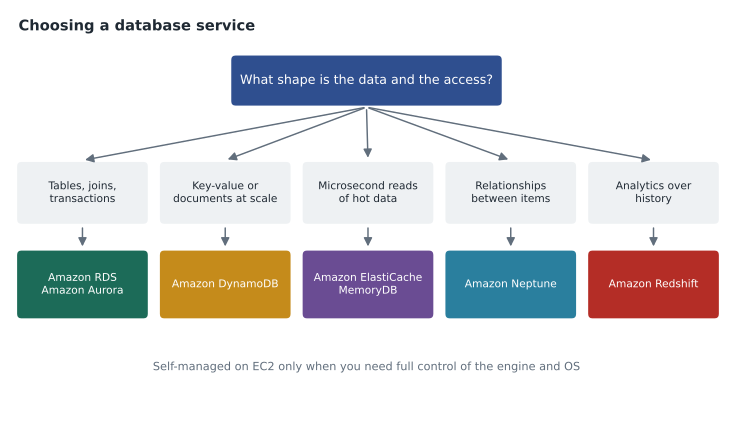
Amazon DynamoDB is a serverless key-value and document database. Data is stored in tables of items, each found by a primary key; items in the same table can have different attributes. DynamoDB delivers consistent single-digit millisecond performance at virtually any scale, with no servers, patching or storage to manage. Capacity can be on-demand, paying per request, or provisioned, with optional auto scaling. Global tables replicate a table across Regions, and DynamoDB Accelerator (DAX) adds an in-memory cache for microsecond reads. DynamoDB suits applications with known access patterns at large or unpredictable scale: shopping carts, user profiles, session state, game data and device data.
For BookVet phase 2, DynamoDB fits the booking sessions and the reminder schedule: each item is found by a client or appointment key, traffic is bursty, and there is no server to maintain. The authoritative appointment records stay in VetLedger's relational database.
# The same appointment seen two ways: relational rows versus a key-value item.
import sqlite3, json

db = sqlite3.connect(":memory:")
db.executescript("""
CREATE TABLE client(id INTEGER PRIMARY KEY, name TEXT);
CREATE TABLE pet(id INTEGER PRIMARY KEY, client_id INTEGER, name TEXT, species TEXT);
CREATE TABLE appt(id INTEGER PRIMARY KEY, pet_id INTEGER, clinic TEXT, slot TEXT);
INSERT INTO client VALUES (1, 'R. Okafor');
INSERT INTO pet VALUES (10, 1, 'Biscuit', 'dog');
INSERT INTO appt VALUES (4471, 10, 'Lethbridge', '2026-12-03 09:30');
""")
row = db.execute("""SELECT a.id, c.name, p.name, a.clinic, a.slot
                    FROM appt a JOIN pet p ON p.id = a.pet_id JOIN client c ON c.id = p.client_id""").fetchone()
print("Relational join:", row)

# Key-value: one item, fetched by its key, holding everything the booking page needs.
table = {"APPT#4471": {"client": "R. Okafor", "pet": "Biscuit", "clinic": "Lethbridge",
                       "slot": "2026-12-03 09:30", "reminder": "SMS"}}
print("Key-value get:", json.dumps(table["APPT#4471"]))Relational join: (4471, 'R. Okafor', 'Biscuit', 'Lethbridge', '2026-12-03 09:30')
Key-value get: {"client": "R. Okafor", "pet": "Biscuit", "clinic": "Lethbridge", "slot": "2026-12-03 09:30", "reminder": "SMS"}What this code does
It stores one vet appointment two ways. In the relational version the client, pet and appointment sit in three linked tables, and a query joins them back together. In the key-value version the whole appointment is saved as one item under a single key and fetched in one step, which is how a key-value database such as DynamoDB is used.
The relational version can answer almost any question by joining tables. The key-value version answers one question, show me appointment 4471, in a single fast lookup, which is exactly what the booking page asks thousands of times a morning.
Other purpose-built databases are worth recognizing by description.
| Service | Data model | Recognize it by |
|---|---|---|
| Amazon ElastiCache | In-memory cache (Valkey, Redis OSS or Memcached engines) | Microsecond reads, caching database query results, session stores |
| Amazon MemoryDB | Durable in-memory database compatible with Valkey and Redis OSS | In-memory speed with data that must not be lost |
| Amazon DocumentDB | Document database compatible with MongoDB | JSON documents, existing MongoDB applications |
| Amazon Neptune | Graph database | Relationships: social networks, fraud rings, recommendations |
| Amazon Keyspaces | Wide-column, compatible with Apache Cassandra | Existing Cassandra workloads |
| Amazon Timestream | Time series | Sensor readings and metrics over time |
| Amazon Redshift | Data warehouse (columnar, relational) | Analytics and reporting over large historical data (lesson 9) |
The exam phrase memory-based database points to ElastiCache. A typical scenario: a relational database is overloaded by the same read queries again and again; placing ElastiCache in front of it to serve the repeated reads from memory reduces the load and speeds up responses. Kwame notes that the BookVet clinic-hours page, which reads the same few rows constantly, is a candidate.
Moving databases: AWS DMS and schema conversion
Moving a database is often the hardest part of a migration, because the business cannot stop while it happens. AWS Database Migration Service (AWS DMS) copies data from a source database to a target with the source still running, then keeps the target in step by replicating ongoing changes until cutover. It supports homogeneous migrations, where source and target use the same engine (SQL Server to RDS for SQL Server), and heterogeneous ones, where they differ (Oracle to Aurora PostgreSQL).
Heterogeneous migrations also need the schema, stored procedures and other code converted to the new engine. The AWS Schema Conversion Tool (AWS SCT), and the schema conversion feature built into DMS, analyse the source, convert what they can automatically and report what needs manual work.
Cascade Ridge's move is homogeneous, so Gwen's plan is a native SQL Server backup restored into RDS for the initial copy, with DMS available to replicate changes if the cutover window must be very short. The cutover itself is planned for a Sunday night in spring 2027, when the emergency hospital is quietest.
Backups, recovery and the numbers that matter
Two numbers shape every database recovery plan, and Dr. Kaur learns them in this session. The recovery point objective (RPO) is how much data the business can afford to lose, measured in time: if the database failed now, how far back is acceptable? The recovery time objective (RTO) is how long the business can afford to be without the system. For the emergency hospital, Dr. Kaur says, losing an hour of records would be serious and being without the system for more than an hour would be dangerous.
Managed databases make good RPO and RTO values easier to reach. RDS automated backups allow point-in-time recovery to within about five minutes of the present. A Multi-AZ standby handles the failure of an Availability Zone in minutes, without restoring anything. A cross-Region snapshot copy, or a cross-Region read replica for engines that support it, protects against the loss of a whole Region, with a longer recovery time. AWS Backup can manage these copies alongside the archive and file share backups, so Hannah sees one report instead of five.
Gwen adds a warning she gives every client: a backup that has never been restored is a hope, not a plan. The design includes a quarterly test in which Mateo restores last night's VetLedger backup into the development account and checks that the clinics' records open correctly. The first test is scheduled for the month after cutover.
Worked problem
Matching database needs to services
Choose a service for each Cascade Ridge need: (1) VetLedger's SQL Server database, with automatic failover if an Availability Zone fails; (2) BookVet booking sessions, looked up by key, with heavy morning bursts; (3) the clinic-hours page, which reads the same data hundreds of times a minute; (4) moving VetLedger's data with minimal downtime.
Show solution
- (1) Amazon RDS for SQL Server with a Multi-AZ deployment: managed, relational, supported by the vendor, with a standby in a second zone.
- (2) Amazon DynamoDB in on-demand capacity mode: key-value access at any scale, paying per request.
- (3) Amazon ElastiCache in front of the database, serving repeated reads from memory.
- (4) AWS DMS to copy and then continuously replicate changes until cutover.
Answer: RDS Multi-AZ, DynamoDB, ElastiCache and DMS.
Who does what for a managed database
Hannah, the security lead, asks for the responsibility split in writing. For RDS, AWS manages the hardware, the host operating system, the database engine installation and patching, automated backups and the failover mechanism. Cascade Ridge manages the database settings it chooses, user accounts and permissions inside the database, the security groups that decide who can connect, encryption choices, the schema and queries, and of course the data. For DynamoDB, which is serverless, AWS also manages capacity and partitioning, and Cascade Ridge manages tables, keys, IAM permissions and data.
Common mistakes
MistakeRunning a database on EC2 by habit when a managed service supports the engine.
InsteadUse RDS, Aurora or DynamoDB unless you need control the managed service cannot give.
MistakeUsing read replicas to provide automatic failover.
InsteadMulti-AZ is the availability feature; read replicas mainly spread read traffic.
MistakeChoosing DynamoDB for complex reports joining many tables.
InsteadRelational databases or a data warehouse suit ad hoc joins; DynamoDB suits known key-based access.
MistakeCalling ElastiCache a durable primary database.
InsteadElastiCache is mainly a cache; MemoryDB is the durable in-memory option.
MistakeForgetting schema conversion when changing database engines.
InsteadHeterogeneous migrations need AWS SCT or DMS schema conversion as well as data replication.
Summary and key terms
- Databases can be self-managed on EC2 for full control or run as managed services that handle provisioning, patching, backups and failover.
- Amazon RDS runs MySQL, PostgreSQL, MariaDB, Oracle, SQL Server and Db2, with Multi-AZ deployments for availability and read replicas for read scaling.
- Amazon Aurora is a MySQL- and PostgreSQL-compatible database built for the cloud.
- Amazon DynamoDB is a serverless key-value and document database with single-digit millisecond performance.
- ElastiCache provides in-memory caching; DocumentDB, Neptune, Keyspaces, Timestream and MemoryDB serve other data models.
- AWS DMS migrates and replicates databases, and AWS SCT converts schemas between engines.
- Relational database
- A database of related tables with a fixed structure, queried with SQL.
- Amazon RDS
- The managed relational database service.
- Multi-AZ deployment
- An RDS configuration with a standby copy in another Availability Zone for automatic failover.
- Read replica
- An asynchronously updated copy of a database used to serve read traffic.
- Amazon Aurora
- An AWS-built relational database compatible with MySQL and PostgreSQL.
- Amazon DynamoDB
- A serverless key-value and document database.
- Amazon ElastiCache
- A managed in-memory cache.
- AWS DMS
- A service that migrates databases with minimal downtime.
- AWS SCT
- A tool that converts database schemas and code between engines.
Practice problems
Work each problem on paper first, then reveal the answer to check.
Which RDS feature provides automatic failover to another Availability Zone?
Show answer
A Multi-AZ deployment.
Which database engines is Aurora compatible with?
Show answer
MySQL and PostgreSQL.
Which service would you use for a graph of relationships between people and accounts?
Show answer
Amazon Neptune.
Lesson quiz · 5 questions
Score 60% or more to complete this lesson.
Create a free account to save your progress, take quizzes and earn a certificate.