
AWS-102 · Lesson 1 of 12 · 19 min
The shared responsibility model
▶ Video coming soon A video version of this lesson is on the way.
On the Monday after the board meeting, Gwen Halvorsen drew two boxes on the whiteboard in the Calgary head office: a large one labelled AWS and a smaller one labelled Cascade Ridge. Mateo Ruiz, who had looked after the clinics' computers for six years, expected a lecture about firewalls. Instead Gwen asked a simpler question. "When the server room overheated in July, whose problem was it?"
"Mine," Mateo said. "The air conditioner, the server, the operating system, the backups, the practice software. All of it."
"After we move, some of that becomes Amazon's problem and some of it stays yours," Gwen said. "Security on AWS starts with knowing exactly where that line is. Most cloud breaches you read about are not someone breaking into Amazon's data centres. They are customers leaving their own side of the line open."
That line has a name: the shared responsibility model. It is the first idea in the security domain of the AWS Certified Cloud Practitioner exam, and it shapes every other lesson in this course. This lesson explains what AWS is responsible for, what the customer is responsible for, what the two share, and why the line moves depending on which service you use.
Security of the cloud and security in the cloud
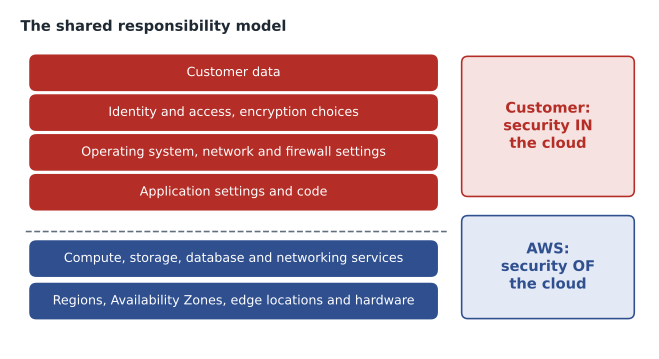
AWS describes the split in two short phrases. AWS is responsible for security of the cloud: the infrastructure that runs every AWS service. The customer is responsible for security in the cloud: everything the customer puts on that infrastructure and every setting the customer chooses.
Security of the cloud covers the physical world and the software that runs the services. AWS guards the data centre buildings, controls who can walk into them, and destroys old disks so data cannot be recovered. It maintains power, cooling and fire suppression, the very things that failed in the Cascade Ridge server room. It runs the network that links Availability Zones and Regions, and it operates the virtualization layer that keeps one customer's virtual machines separated from another's. When a flaw is found in the hypervisor or in the hardware of a managed service, AWS patches it.
Security in the cloud covers the customer's choices. The customer decides who can sign in to its AWS accounts and what each person may do. The customer decides whether a storage bucket is private or public, whether a database is encrypted, which network ports are open, and whether logs are kept. The customer owns its data and chooses where it lives. AWS never decides any of these on the customer's behalf, although it provides tools and safe defaults that make good choices easier.
A useful test is to ask who can change the thing in question. Mateo cannot change the locks on an AWS data centre, so that is AWS's responsibility. He can change a security group rule, an IAM policy or the encryption setting on a disk, so those are his. If you can configure it, you are responsible for configuring it well.
What AWS is responsible for
AWS's side of the model includes several layers, and exam questions often name one of them and ask whose job it is.
- Physical security of facilities. Guards, cameras, access badges, visitor logs and controlled destruction of storage media.
- Environmental controls. Power, backup generators, cooling and fire detection and suppression.
- Hardware. Servers, storage devices and network equipment, including replacing failed parts.
- The global network. The links between Availability Zones, Regions and edge locations.
- The virtualization layer. The hypervisor that isolates customer virtual machines from each other and from the host.
- The software of managed services. For services such as Amazon RDS or AWS Lambda, the operating systems and platforms underneath that AWS runs on the customer's behalf.
AWS proves that it does these things through independent audits. Lesson 11 shows where to download the audit reports. For now, the important point is that a customer inherits these controls. Cascade Ridge does not need to hire security guards for its data, because the AWS facilities already have them, and an auditor can read AWS's reports to confirm it.
What the customer is responsible for
The customer's side is larger than many newcomers expect. Gwen wrote this list on the whiteboard, and Mateo copied it into the project plan.
- Customer data. What is stored, how it is classified, who may read it, how long it is kept, and whether it is backed up.
- Identity and access. Who has accounts, which permissions they hold, whether multi-factor authentication is on, and how the root user is protected.
- Encryption choices. Whether data is encrypted at rest and in transit, and who controls the keys.
- Network settings. Security groups, network access control lists and which resources are reachable from the internet.
- Operating systems on virtual machines. Patching the operating system and installed software on Amazon EC2 instances.
- Applications. The security of the customer's own code, such as the BookVet booking app, and its settings.
- Logging and monitoring choices. Turning on the services that record activity and reading what they find.
Kwame Asante, who wrote BookVet, asked whether AWS would at least fix bugs in his code. Gwen laughed kindly. "AWS will keep the server under BookVet patched if we let a managed service run it. AWS will never review your Python. If your login page has a flaw, that stays your flaw, in the cloud or anywhere else."
Shared controls
Some controls belong to both parties, each in its own layer. AWS calls these shared controls, and three examples come up often.
| Control | AWS does | The customer does |
|---|---|---|
| Patch management | Patches the infrastructure and the platforms of managed services | Patches guest operating systems and applications it runs |
| Configuration management | Configures its infrastructure devices | Configures its own operating systems, databases and applications |
| Awareness and training | Trains AWS employees | Trains its own staff |
Shared controls catch people out because the same word, such as patching, appears on both sides. The question to ask is always: patching what? AWS patches the host and the platforms it manages. The customer patches anything it installed or manages itself.
How the line moves between services
The model is not one fixed line. It moves depending on how much of the stack the customer manages, and the exam guide names three services to illustrate it: Amazon EC2, Amazon RDS and AWS Lambda.
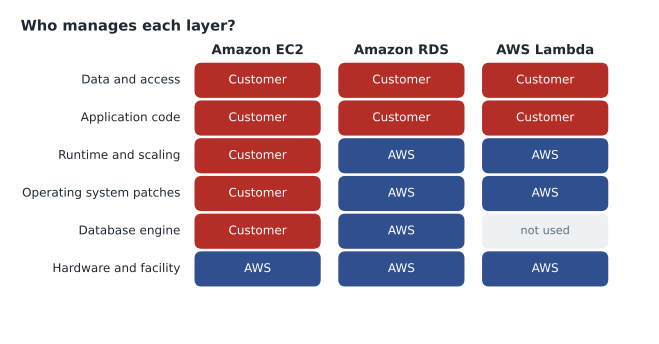
With Amazon EC2, the customer rents a virtual machine. AWS provides the hardware and the hypervisor; everything from the operating system upward is the customer's. If Mateo runs the VetLedger application servers on EC2 instances, he must patch Windows Server on them, configure the Windows firewall, install anti-malware software and manage the application.
With Amazon RDS, AWS runs the database engine for the customer. AWS patches the operating system under the database, installs database engine updates during a maintenance window the customer chooses, and runs the backups the customer configures. The customer still chooses who can connect, which network can reach the database, whether storage is encrypted, how long backups are kept, and of course what data goes into the tables. This is one reason Gwen recommended moving the VetLedger database to RDS for SQL Server: a whole category of night-time patching moves to AWS.
With AWS Lambda, the customer uploads code and AWS runs it when an event arrives. There is no server or operating system for the customer to manage at all. The customer is still responsible for the code, for the permissions the function has, for any secrets it uses and for the data it touches. When Kwame rewrites parts of BookVet as Lambda functions in phase two, his responsibilities shrink but do not disappear.
The pattern generalizes to other services. Infrastructure services such as EC2 leave the most with the customer. Container and managed platform services move the operating system to AWS. Abstracted or serverless services, such as Amazon S3, Amazon DynamoDB and Lambda, leave the customer responsible mainly for data, access settings and code. The one thing that never moves is the data itself: the customer always decides what is stored and who can see it.
Why the model matters for compliance
Hannah Weiss, Cascade Ridge's privacy and security lead, joined the second half of the session with a practical question. Under PIPEDA and the Alberta and B.C. private-sector privacy acts, we are accountable for our clients' personal information even when a service provider holds it. Does moving to AWS hand that accountability to Amazon?"
"No," Gwen said. "It hands Amazon some of the controls, and Amazon proves those through its audits. Accountability for the data stays with us. The model is how we explain to an auditor which controls we inherited from AWS and which ones we run and must evidence ourselves."
This is how organizations use the model in practice. When an auditor asks how physical access to the servers holding pet records is controlled, Cascade Ridge points to AWS's independent audit reports. When the auditor asks who can read those records, Cascade Ridge must show its own IAM policies, its sign-in logs and its access reviews. Both answers are needed, and neither party can give the other's.
# Who is responsible? A tiny lookup that mirrors the lesson's grid.
layers = ["data and access", "application code", "operating system patches",
          "database engine", "hardware and facility"]
model = {
    "Amazon EC2": ["customer", "customer", "customer", "customer", "AWS"],
    "Amazon RDS": ["customer", "customer", "AWS", "AWS", "AWS"],
    "AWS Lambda": ["customer", "customer", "AWS", "not used", "AWS"],
}
for service, owners in model.items():
    mine = [l for l, o in zip(layers, owners) if o == "customer"]
print(f"{service}: customer manages {len(mine)} of {len(layers)} layers -> {', '.join(mine)}")Amazon EC2: customer manages 4 of 5 layers -> data and access, application code, operating system patches, database engine Amazon RDS: customer manages 2 of 5 layers -> data and access, application code AWS Lambda: customer manages 2 of 5 layers -> data and access, application code
What this code does
A small table records who manages each of five layers, from data down to the physical hardware, for three AWS services. For each service it counts and lists the layers the customer is responsible for. The output shows the customer handling far more with virtual servers than with a managed database or serverless functions.
The model applies to resilience too
The same split applies to keeping systems running, not only to keeping them secure. AWS is responsible for the resilience of its infrastructure: building Regions with several isolated Availability Zones, replacing failed hardware and keeping services within their published service levels. The customer is responsible for designing its workloads to use that resilience. If Cascade Ridge runs VetLedger on a single EC2 instance in one Availability Zone, an outage in that zone takes the practice system down, and that design choice is Cascade Ridge's. Dr. Simone Kaur, the medical director, cared about this more than anything else in the meeting. "At three in the morning," she said, "I do not care whose fault the outage is. I care that the emergency team can see the patient's history." Gwen promised that the design would spread the system across Availability Zones, and noted it as a customer responsibility in the plan.
Common traps on exam questions
Scenario questions about the model usually describe a task and ask who performs it. A few patterns repay attention.
Common mistakes
MistakeThinking AWS secures customer data because the data sits in AWS.
InsteadThe customer is always responsible for its data: classification, access, encryption choices and retention.
MistakeAssuming AWS patches the operating system on EC2 instances.
InsteadOn EC2 the customer patches the guest operating system. AWS patches the operating system only under managed services such as RDS.
MistakeBelieving the customer must physically secure AWS data centres or dispose of AWS disks.
InsteadPhysical security and media destruction are AWS responsibilities the customer inherits.
MistakeTreating encryption as AWS's job because AWS provides KMS.
InsteadAWS provides the tools; turning encryption on and controlling key access are customer choices.
Worked problem
Sorting the Cascade Ridge task list
Mateo has five tasks on his list: replace a failed disk in an AWS storage server; patch Windows Server on the EC2 instances running VetLedger; apply a SQL Server engine update on the RDS database; decide which staff can read the imaging archive in S3; and make sure network traffic to BookVet uses TLS. Who does each?
Show solution
- A failed disk in AWS hardware is security of the cloud: AWS.
- Windows Server on EC2 is a guest operating system the customer installed and manages: Cascade Ridge.
- The SQL Server engine on RDS is managed by AWS, which applies updates in the maintenance window Cascade Ridge chooses: AWS performs it, Cascade Ridge picks the window.
- Access to data in S3 is always a customer decision: Cascade Ridge.
- Turning on TLS for the application is a customer configuration: Cascade Ridge, using tools AWS provides.
Answer: AWS: the disk and the RDS engine update. Cascade Ridge: the EC2 patching, the S3 access decisions and the TLS configuration.
By the end of the session the whiteboard had a third column. Mateo had written "ours" beside eleven items and "theirs" beside six. "Fewer air conditioners," he said, "and a lot more settings." Gwen nodded. "Settings are where the next eleven lessons live."
Summary and key terms
- The shared responsibility model divides security work between AWS and the customer.
- AWS is responsible for security of the cloud: facilities, hardware, the global network, the virtualization layer and the software of managed services.
- The customer is responsible for security in the cloud: its data, identities and access, encryption choices, network settings, guest operating systems and applications.
- Some controls, such as patch management, configuration management and training, are shared, with each party covering its own layer.
- The line moves with the service: the customer manages the most on EC2, less on RDS and least on Lambda, but always owns its data and access decisions.
- Customers inherit AWS's controls and evidence them with AWS audit reports, while proving their own controls themselves.
- Shared responsibility model
- The division of security and compliance work between AWS and the customer.
- Security of the cloud
- AWS's responsibility for the infrastructure that runs AWS services.
- Security in the cloud
- The customer's responsibility for its data, settings, identities and workloads on AWS.
- Shared control
- A control both parties perform, each in its own layer, such as patch management.
- Inherited control
- A control the customer relies on AWS to perform, such as physical security.
- Managed service
- A service where AWS operates the underlying servers and platform, such as Amazon RDS.
Practice problems
Work each problem on paper first, then reveal the answer to check.
On Amazon EC2, who patches the guest operating system?
Show answer
The customer.
On Amazon RDS, who applies database engine updates?
Show answer
AWS, during a maintenance window the customer chooses.
Name one responsibility that never moves to AWS.
Show answer
Customer data and decisions about who can access it.
Lesson quiz · 5 questions
Score 60% or more to complete this lesson.
Create a free account to save your progress, take quizzes and earn a certificate.