
ARCH-420 · Lesson 9 of 12 · 21 min
Quality control
By the ninth week the east wing package has reached what Brandt calls the dangerous stage: every sheet has something on it, every section has text, and the set looks finished. He prints it, binds it and hands a copy to each student with a red pencil, a green pencil and a yellow highlighter, and tells them that for the next two days nobody draws anything. They will check. By the end of the first afternoon the four of them have found two hundred and twelve marks on a set of thirteen sheets and eight sections. Some are trivial, such as a misspelled room name. Some are serious: a rated wall that stops at the ceiling instead of running to the CLT above, a window type on the elevation that does not exist in the window schedule, and a detail of the roof valley that sends water toward the glazing instead of away from it. Every one of them, Brandt reminds them, would have been found eventually. The only question is whether it is found by them, by the bidders, by the building official, by the roofer or by the occupants.
Quality assurance and quality control
Offices distinguish between quality assurance and quality control, though the terms are often blurred. Quality assurance is the system that makes good documents likely: the office standards, templates, master specifications, detail libraries, checklists, training and the habit of working in a particular way. Quality control is the checking of a particular set against requirements before it is issued. Assurance is preventive and continuous; control is a set of reviews at defined points. Both are needed. An office with excellent checking and no standards will find the same mistakes on every project; an office with excellent standards and no checking will issue sets that look right and are not.
The team writes a short quality control plan for the package at the start of the ninth week, adapting the one Brandt's own office uses. It names the reviews and when they happen, who performs each one, the checklists they use, how marks are recorded and how they are closed. The plan sets three formal reviews: at about half completion, when the organization of the set and the major coordination can still change cheaply; at about ninety-five out of a hundred, the full detailed check; and a final review of the issue set itself, to confirm that every mark from the earlier review has been picked up and that the set is complete.
The checking cycle
Each review follows the same cycle. First the author checks their own sheets, which catches most simple errors but very few errors of understanding, since the author knows what was meant. Then a reviewer from the same discipline, ideally someone senior who did not draw the sheets, checks each sheet against the checklist and marks it up in red. Then the cross-discipline review compares the architectural sheets with the structural, mechanical and electrical sheets and with the specifications. The marks are picked up: the author makes the corrections in the model and the drawings, highlighting each mark in yellow on the check print as it is done. Finally, the back-check: the reviewer compares the revised sheets with the marked print and ticks each mark in green when it has been corrected properly. Only then is the set issued.
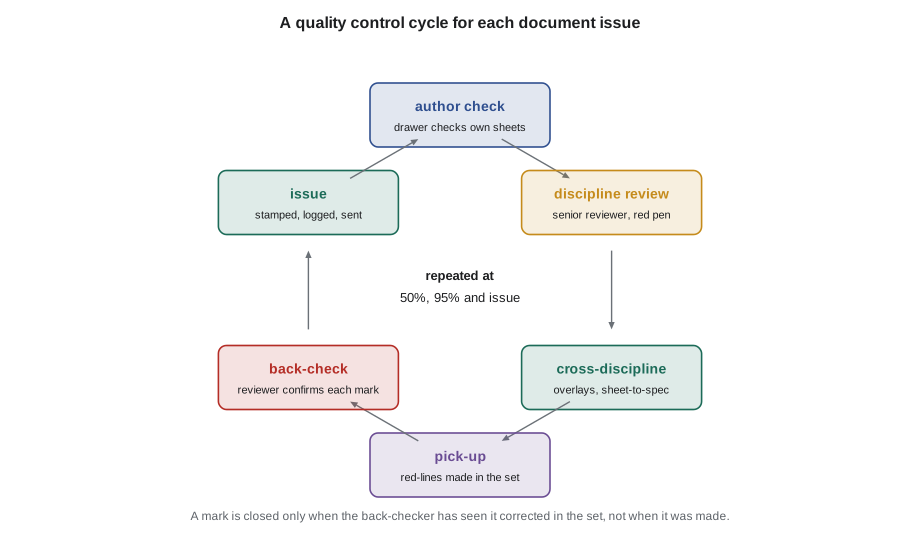
The back-check is the step most often skipped, and Brandt insists it is the most important. In his experience about one correction in ten is made wrongly or incompletely: the dimension is fixed on the plan but not on the enlarged plan, the door is changed in the schedule but not on the elevation, a new error is introduced while fixing the old one. Without the back-check, those errors go out in the set with the reviewer's apparent approval.
Red-lines
The marks themselves follow conventions so that anyone in the office can read them. Red indicates a correction to be made: circle or cloud the area, write the correction plainly, cross out what should be deleted. Questions are written as questions with a question mark, so that the author knows the reviewer is unsure rather than certain. Comments that are suggestions rather than corrections are marked as such, often in blue or with a note, so the author can decide. Yellow highlighting means a mark has been picked up; green ticks mean it has been back-checked. A check print with every red mark highlighted and ticked is a record that the review was completed.
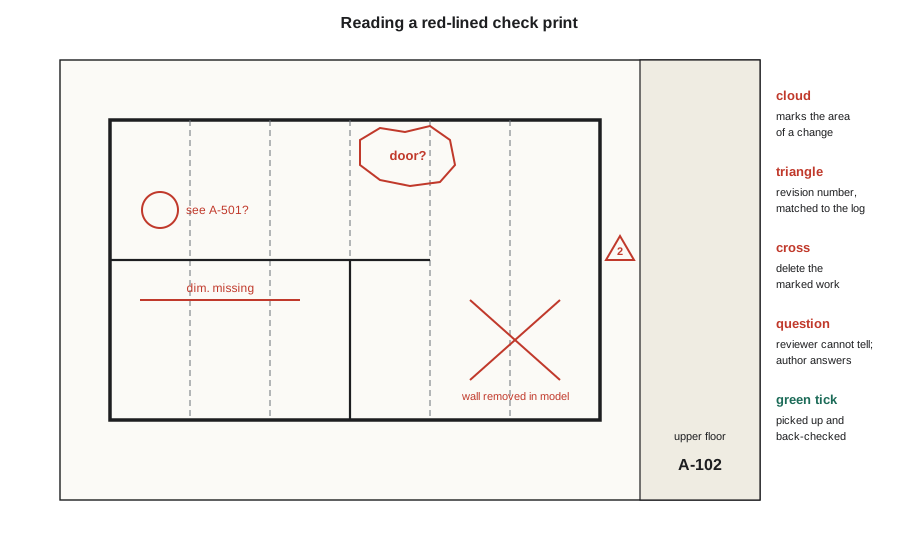
Most offices now mark up PDFs on screen rather than paper, with the same conventions applied as layers and stamps. Digital mark-up has real advantages: several reviewers can mark the same set at once, marks can be filtered by status, and a list of open marks can be exported. Brandt still asks for one full paper check of the issue set. People find different errors on paper than on screen, especially errors of scale and relationship, because the whole sheet is visible at once at its true size.
What to check
Checklists turn experience into habit. Brandt's office uses one for each sheet type and one for each specification section, and he gives the team an abridged version. For every sheet: the title block is complete and the sheet number and title match the index; the scale is stated and a bar scale is present; every reference symbol points to a drawing that exists; every drawing is referenced from somewhere; the north arrow is consistent; and the revision clouds and triangles match the revision log. For plans: the dimension strings close; the grid is complete; every door, window and wall has a tag that exists in its schedule; room names and numbers match the finish schedule; rated walls are shown and run where the code analysis says they must. For sections and details: heights agree with the elevations; the continuity of the air, water, vapour and thermal control layers is shown; the materials are named in the same terms as the specification; water is directed away from the building at every joint.
For the specifications: every section on the drawings is in the table of contents and every section in the table of contents is used; references to other sections point to sections that exist; reference standards are current; products named are still made; the submittals listed match what the consultant needs to review; and no paragraph describes work the project does not have. Across the set: every material on the drawings is specified; the specifications do not repeat quantities or dimensions; the terms are consistent; and the code analysis, life safety plan and door schedule agree on every rating.
# Two automated checks: keynotes used on the drawings against the keynote legend
# and the specification sections, and a weighted score for the checklist review.
legend = {"06 18 00.A": "glulam beam", "07 21 00.A": "mineral wool insulation",
          "07 27 00.A": "air barrier membrane", "07 41 13.A": "standing seam metal roofing",
          "09 29 00.A": "gypsum board"}
spec_sections = {"06 18 00", "07 21 00", "07 27 00", "07 41 13", "08 11 13", "08 71 00", "09 29 00", "09 91 00"}
used = {"A-311": ["06 18 00.A", "07 21 00.A", "07 27 00.A", "07 62 00.A"],
        "A-501": ["07 41 13.A", "07 27 00.A", "07 92 00.A"]}
for sheet, notes in used.items():
    for k in notes:
        if k not in legend:
            print(f"{sheet}: keynote {k} is not in the legend")
        if k.split(".")[0] not in spec_sections:
            print(f"{sheet}: keynote {k} refers to a section not in the project manual")
# Checklist results: item, weight, passed?
checks = [("index matches sheets", 2, True), ("references all resolve", 3, False),
          ("dimension strings close", 3, True), ("ratings agree across code plan and schedule", 4, False),
          ("control layers continuous in details", 4, True), ("terms match specifications", 2, False),
          ("no unused master paragraphs", 2, True)]
score = sum(w for _, w, ok in checks if ok) / sum(w for _, w, _ in checks)
print(f"checklist score: {score:.0%}")
for item, w, ok in checks:
    if not ok:
print(f" open: {item} (weight {w})")A-311: keynote 07 62 00.A is not in the legend A-311: keynote 07 62 00.A refers to a section not in the project manual A-501: keynote 07 92 00.A is not in the legend A-501: keynote 07 92 00.A refers to a section not in the project manual checklist score: 55% open: references all resolve (weight 3) open: ratings agree across code plan and schedule (weight 4) open: terms match specifications (weight 2)
The script finds two keynotes for sections that do not exist in the project manual: 07 62 00, sheet metal flashing and trim, and 07 92 00, joint sealants. Both are real requirements; the team had simply not planned to write those sections. Brandt points out that this is the most valuable kind of finding, because it is a scope gap that no single-sheet check would have caught. The score at the bottom, on the other hand, he treats with suspicion. A set can score well and still have one error that floods a building. The score tells you how the review is going; it does not tell you the set is safe.
Other kinds of review
Beyond the office's own checks, many projects add independent reviews. A constructability review, often by a contractor engaged during design or by a construction manager, asks whether the building can be built as drawn, in a sensible sequence, with available materials and trades. A code review by a code consultant, like the one Nadia Kostyshyn did for the students' comprehensive studio, checks the code analysis and the life safety plan before the permit submission. A building envelope review checks the details against the principles of the envelope course. Peer review by another senior architect in the office, who has had nothing to do with the project, is one of the most effective and least used checks of all, because a fresh eye sees what the team has stopped seeing.
Quality control is also a professional obligation. Architects are held to the standard of care of a reasonably competent professional in similar circumstances, not to perfection, and the courts do not expect a set with no errors. But a pattern of errors that a reasonable checking process would have caught is evidence that the standard was not met. Most architects in Canada carry professional liability insurance, and insurers increasingly ask firms about their quality control procedures. A documented review, with marked check prints and a closed log, is evidence that the firm took the care the standard requires.
Worked problem
Tracing one red mark to closure
The reviewer marks door 120 on A-101 with the question '60 min?' because the life safety plan on G-002 shows the stair enclosure as a two-hour separation, while the schedule gives the door a lower rating. Trace the mark to closure.
Show solution
- The author checks the code analysis and confirms that the stair enclosure in a building of this height needs only a one-hour rating, so G-002 is wrong, not the schedule.
- The author corrects the separation on G-002, adds a revision cloud and triangle, and checks every other sheet that shows the stair enclosure: A-401, A-311 and the wall type sheet.
- The author highlights the mark on the check print in yellow and notes the sheets changed.
- The reviewer back-checks G-002, A-401, A-311 and the wall type sheet, confirms the rating is consistent everywhere and ticks the mark green.
- The coordination log records the decision so that the mechanical engineer checks the fire dampers in the stair enclosure against the corrected rating.
Answer: The mark closes only when every affected sheet has been corrected and back-checked, and the decision is logged for the other disciplines.
Exercise 9: checking the package
- Write a checklist of twenty items for the east wing package, covering sheets, specifications and the whole set.
- Mark up another student's sheets in red using the office conventions, including questions and suggestions.
- Pick up the marks on your own sheets, highlighting each in yellow, and record which sheets changed.
- Back-check another student's pick-up and tick each mark in green or reopen it.
Self-check
- Did someone other than the author check each sheet?
- Has every red mark been picked up and back-checked?
- Have I checked across disciplines and between drawings and specifications?
- Is the review documented well enough to show the care taken?
Common mistakes
MistakeChecking your own work only.
InsteadHave a reviewer who did not draw the sheets check them against a checklist.
MistakeSkipping the back-check.
InsteadClose each mark only when the reviewer has seen it corrected on every affected sheet.
MistakeLeaving the review until the week of issue.
InsteadReview at about half completion and again near completion, when changes are still possible.
MistakeTreating a checklist score as proof of safety.
InsteadUse the score to track the review and judge the serious errors on their own.
MistakeChecking sheets one at a time only.
InsteadCheck across sheets, disciplines and the specifications as well.
Summary and key terms
- Quality assurance is the system that makes good documents likely; quality control is the checking of a particular set.
- Each review cycles through author check, discipline review, cross-discipline review, pick-up and back-check before issue.
- Red-line conventions let anyone in the office read and close the marks.
- Checklists cover each sheet type, each specification section and the set as a whole.
- Independent reviews and documented checking help meet the professional standard of care.
- Quality assurance
- The standards, templates and habits that make good documents likely.
- Quality control
- The checking of a particular set of documents against requirements before issue.
- Red-line
- A correction or question marked on a check print or PDF for the author to resolve.
- Back-check
- The reviewer's confirmation that each mark has been corrected properly on every affected sheet.
- Standard of care
- The care a reasonably competent professional would take in similar circumstances.
Practice problems
Work each problem on paper first, then reveal the answer to check.
What is the difference between quality assurance and quality control?
Show answer
Assurance is the ongoing system that makes good work likely; control is the checking of a particular set before issue.
Why is the author's own check not enough?
Show answer
The author knows what was meant and tends to read it into the drawings.
What do yellow highlights and green ticks mean on a check print?
Show answer
Yellow: the mark has been picked up; green: it has been back-checked.
Why might a reviewer use a question rather than a correction?
Show answer
When unsure, so the author can confirm the right answer rather than make a wrong change.
Does the standard of care require a set with no errors?
Show answer
No; it requires the care of a reasonably competent professional, which includes a reasonable checking process.
Lesson quiz · 5 questions
Score 60% or more to complete this lesson.
Create a free account to save your progress, take quizzes and earn a certificate.