
ARCH-420 · Lesson 6 of 12 · 21 min
Writing specifications
Ingrid's first draft of the door hardware section arrives on Tuesday of the sixth week. It is thorough, carefully formatted and fourteen pages long, and Brandt returns it the next morning with the red pencil having found something on almost every page: 'shall be of the best quality', 'install as required', 'hinges, closers, etc.', 'locksets and/or latchsets', 'to the satisfaction of the architect'. None of these phrases is wrong English. All of them, he explains, are wrong specification, because each one either says nothing a bidder can price or gives the designer a power the contract may not support. This lesson is about how specifications are written: the choice of method for each requirement, and the language that makes a requirement clear, enforceable and short.
Four methods of specifying
There are four basic ways to tell a contractor what to supply, and most sections use a mixture of them. A descriptive specification describes the product in detail: its materials, dimensions, composition and workmanship. It gives the designer control but transfers to the designer the responsibility that the product described will work. A performance specification states the result required, such as a fire rating, a sound transmission class, an air leakage rate or a number of opening cycles, and how compliance will be shown, usually by test. It gives the contractor freedom to choose the means, and it requires the designer to know which performance values matter and how they are measured.
A reference standard specification requires compliance with a published standard: a door must meet a named grade of a hardware standard, a glulam beam must be manufactured to the standard for structural glued-laminated timber, a fire door must be tested under the standard the code references. It is efficient, because one sentence brings in a document of many pages, and it is fair, because the standard is known to the whole industry. But it obliges the specifier to know what the standard contains, including its options, which must be chosen in the specification. A proprietary specification names products by manufacturer and model. It is precise and quick to write, and for some items, such as matching existing hardware or a particular finish of metal roofing, it is the only practical method.
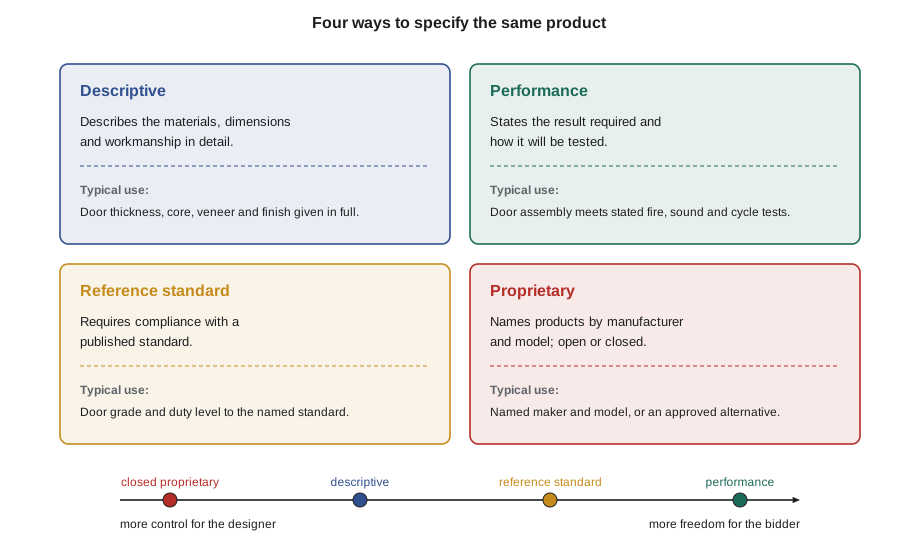
Proprietary specifications come in two forms. A closed proprietary specification names one product, or several, and allows nothing else. An open proprietary specification names products and then allows others that are shown to be equal, through a substitution procedure set out in Division 01. Public owners often require open specifications, because naming only one product prevents competition and can raise the price, and some require at least two or three named products for every item. Brandt warns the students about the phrase 'or approved equal' standing alone: it invites bidders to price a cheaper product on the assumption that it will be approved, and then leaves the consultant to decide, during construction and under pressure, whether it is equal. A good open specification names the products, sets out the criteria an alternative must meet and states when and how alternatives must be proposed, usually before the close of tenders so that every bidder prices the same thing.
The four Cs
Specification writers often summarize the qualities of good writing as four Cs: clear, concise, correct and complete. Clear means that each requirement can be read only one way, by someone who did not write it. Concise means saying it in as few words as possible, because every extra word is another place for ambiguity and another page for the bidder to read. Correct means technically right and consistent with the drawings, the codes and the rest of the specification. Complete means that nothing needed to price, build and accept the work has been left out.
These sound like platitudes until you try to meet them. Brandt takes a sentence from Ingrid's draft and works it on the board. 'The contractor shall furnish and install all door closers as required, which shall be of the heavy-duty type and shall be adjusted to the satisfaction of the architect.' Rewritten: 'Closers: surface-mounted, heavy duty, to the grade of the referenced standard, with adjustable backcheck and delayed action.' In Part 3: 'Adjust closers so that each door closes and latches from the 90-degree open position in not less than five seconds and opens with not more than the opening force required by the accessibility requirements of the code.' The rewrite is longer in one place and shorter overall, and every word of it can be checked on site.
The language of specifications
Modern specifications are written in the imperative mood, addressed directly to the contractor: 'Install insulation in continuous contact with the sheathing', not 'The contractor shall install insulation...'. The contractor is the only party who performs the work, so naming them in every sentence adds nothing. In Part 2, many offices use streamlined language: 'Gypsum board: Type X, 16 mm thick, tapered edges.' The colon stands for 'shall be', and a list of attributes replaces a paragraph of prose. Where a sentence must describe what someone other than the contractor will do, the word 'will' is used, as in 'The owner will provide the hardware keying schedule', so that 'shall' or the imperative always means an obligation of the contractor.
Some words should almost never appear. 'Etc.' leaves the list open, so no one knows what is included. 'And/or' can be read three ways. 'As required' does not say who requires it or by what. 'Approved' and 'to the satisfaction of' give the consultant a discretion that the contract may not support and that a court may read against the designer. 'Best quality', 'first class' and 'workmanlike' cannot be measured. 'Any' and 'all' are usually unnecessary, and 'it is the intent of these specifications' introduces an intent instead of a requirement. Brandt keeps a list of such words pinned above his desk, and Joon-ho turns it into a small checker.
# Flag weak or ambiguous wording in a specification draft.
import re
draft = """2.4 CLOSERS
A. The contractor shall furnish and install closers as required, of the best quality.
B. Locksets and/or latchsets: heavy duty, finishes to match hinges, etc.
C. Adjust closers to the satisfaction of the architect.
D. Closers: surface mounted, heavy duty, with adjustable backcheck and delayed action.
E. Provide all items necessary for a complete installation."""
weak = {
    r"\betc\b": "open-ended list: name every item",
    r"\band/or\b": "ambiguous: say 'and', 'or' or 'either or both'",
    r"\bas required\b": "required by whom? state the requirement",
    r"\bto the satisfaction of\b": "subjective acceptance: state a measurable criterion",
    r"\bbest quality\b|\bfirst class\b|\bworkmanlike\b": "unmeasurable quality",
    r"\bthe contractor shall\b": "use the imperative mood",
    r"\ball items necessary\b": "catch-all phrase: describe the work",
}
problems = 0
for line in draft.splitlines():
    hits = [msg for pat, msg in weak.items() if re.search(pat, line, re.I)]
    if hits:
        problems += len(hits)
        print(line.strip()[:60])
        for h in hits:
            print("    -> " + h)
print(f"{problems} problems in {len(draft.splitlines())} lines")A. The contractor shall furnish and install closers as requi
-> required by whom? state the requirement
-> unmeasurable quality
-> use the imperative mood
B. Locksets and/or latchsets: heavy duty, finishes to match
-> open-ended list: name every item
-> ambiguous: say 'and', 'or' or 'either or both'
C. Adjust closers to the satisfaction of the architect.
-> subjective acceptance: state a measurable criterion
E. Provide all items necessary for a complete installation.
-> catch-all phrase: describe the work
7 problems in 6 linesThe checker finds nine problems in five lines, and only paragraph D survives. Ingrid runs it over her whole draft and cuts it from fourteen pages to nine without removing a single requirement. Brandt cautions that a word list cannot judge whether the requirements are the right ones; it can only catch the phrases that make good requirements unreadable.
Reference standards and their editions
Canadian specifications draw on standards from several bodies: the CSA Group for concrete, steel, wood and many products; ULC Standards for fire testing and fire protection products; the Canadian General Standards Board; and American bodies such as ASTM International, whose test methods are widely used in Canada. The building code itself references many of them, so a specification that cites a different standard for a code-regulated item, such as a fire-resistance test under a standard other than CAN/ULC-S101, may create a product that the official cannot accept.
Standards are revised, so the specification must say which edition applies. Most offices handle this with a rule in Division 01: unless a section states an edition, the edition current on the date of the tender call applies, except where the code references a particular edition, in which case the code's edition governs. Each section's Part 1 lists the standards it cites, and the specifier checks during editing that each still exists and still says what the section assumes. Brandt has seen sections cite standards that were withdrawn a decade earlier, which tells any bidder who notices how carefully the rest of the document was edited.
Coordinating words with drawings
The final discipline is coordination with the drawings. The specification should not repeat what the drawings show: dimensions, locations and quantities belong on the drawings, and a specification paragraph that says 'provide 31 doors' will be wrong the day a door is added. The specification and the drawings must use the same names for the same things; if the wall sections say 'air barrier membrane' and the specification calls it 'vapour retarder', a bidder will wonder whether there are two products. And every material shown on the drawings must be covered by a section, while every section must describe something that appears on the drawings. Ingrid builds a table of every material label on the east wing's wall sections and details, with the section that covers each, and finds three labels with no section and one section, for a liquid-applied flashing, that no drawing uses.
Some work is specified for design by others. Curtain wall anchors, the connections of the glulam to steel, the engineering of the metal roofing's attachment for wind uplift and fire sprinkler layouts are often designed by an engineer working for the contractor or supplier, under criteria the specification sets. The section must state the performance criteria, the loads, the codes and the submittals required, including the sealed calculations and drawings, and the consultant reviews them for conformity with the design intent. Delegated design does not remove the responsibility for coordinating it with the rest of the building.
Worked problem
Rewriting a paragraph from the glulam section
Callum's draft of 06 18 00 contains: 'Glulam beams shall be of the best quality, manufactured by an approved supplier, and shall be sized as shown, etc. Contractor shall provide all connections as required.' Rewrite it as Part 2 and Part 3 paragraphs.
Show solution
- Identify what the reader needs: the standard of manufacture, the stress grade, the appearance grade, the moisture content, the connections and who designs them.
- Part 2, Products: 'Glued-laminated members: manufactured to the referenced standard for structural glued-laminated timber, stress grade as shown on the structural drawings, appearance grade suitable for exposed work, with a moisture content at manufacture not exceeding the standard's limit.'
- Part 2, Products: 'Connections: steel connectors as detailed on the structural drawings; connectors not detailed to be designed by a professional engineer engaged by the contractor, to the loads shown.'
- Part 3, Execution: 'Protect members from wetting during delivery, storage and erection; install to the tolerances in the referenced standard.'
Answer: Every requirement is now measurable, sized members are left to the drawings, and the design of undetailed connections is assigned clearly.
Exercise 6: editing a section
- Take the master specification section for door hardware and edit it for the east wing, deleting everything that does not apply.
- Choose a method for each requirement and justify it in a short note to the instructor.
- Run your draft through a word checker and rewrite every flagged phrase.
- Compare every term in your section with the labels on the drawings and reconcile the differences.
Self-check
- Can each requirement be read only one way and checked on site?
- Have I used the imperative mood and streamlined language consistently?
- Have I stated which standards apply and how editions are fixed?
- Does every material on the drawings have a section, and every section a material?
Common mistakes
MistakeRelying on 'or approved equal' alone.
InsteadName products, state the criteria for alternatives and set when they must be proposed.
MistakeWriting subjective acceptance criteria.
InsteadReplace 'to the satisfaction of' with measurable requirements and tests.
MistakeRepeating quantities and dimensions in the specification.
InsteadLeave them on the drawings, where they will be kept up to date.
MistakeCiting standards without checking their content or edition.
InsteadConfirm each standard and fix editions through a rule in Division 01.
MistakeUsing different names for the same product in drawings and specifications.
InsteadUse the same term everywhere and reconcile the labels with the sections.
Summary and key terms
- Requirements can be specified descriptively, by performance, by reference standard or by naming products.
- Open proprietary specifications need named products, criteria for alternatives and a procedure and deadline for proposing them.
- Good specifications are clear, concise, correct and complete, written in the imperative mood and streamlined language.
- Weak words such as etc., and/or, as required and to the satisfaction of should be removed.
- Specifications must cite standards by edition and use the same terms as the drawings.
- Performance specification
- A specification that states the result required and how compliance is shown, leaving the means to the contractor.
- Reference standard
- A published standard cited in a specification so that its requirements become part of the contract.
- Open proprietary specification
- A specification that names products and allows alternatives shown to be equal through a set procedure.
- Imperative mood
- Writing requirements as direct commands, such as Install insulation, addressed to the contractor.
- Delegated design
- Design of a part of the work by an engineer engaged by the contractor, to criteria set in the specification.
Practice problems
Work each problem on paper first, then reveal the answer to check.
What is the main advantage of a performance specification for the contractor?
Show answer
Freedom to choose the means of meeting the stated result.
Why is 'and/or' avoided?
Show answer
It can be read as and, or, or both, so its meaning is ambiguous.
How should a specification fix the edition of a cited standard?
Show answer
By stating the edition or by a Division 01 rule that the edition current at the bid date applies unless the code references another.
Where do quantities of doors belong?
Show answer
On the drawings and schedules, not in the specification.
What must a section for delegated design include?
Show answer
The performance criteria, loads, codes and the sealed submittals required.
Lesson quiz · 5 questions
Score 60% or more to complete this lesson.
Create a free account to save your progress, take quizzes and earn a certificate.