
ARCH-240 · Lesson 8 of 12 · 21 min
Finishes
For the finishes lesson Vasić takes the class to a daycare that opened nine years ago in a church hall across the city, the kind of place that Rita Moreau's daycare in the community hub will replace. The director walks them through. The vinyl floor in the playroom is scuffed but intact; the carpet in the reading corner has been replaced twice; the paint on the corridor walls is chipped to the height of a stroller handle; the acoustic ceiling tiles near the sink are stained; the wood handrail on the stair is worn smooth and glowing. 'The finishes are where the building meets the people,' Vasić says. 'They take the abuse, they make the room loud or quiet, bright or dull, easy or hard to clean. And they are the first thing everyone judges.'
What finishes do
A finish is the visible surface of a building element, usually a thin layer applied over a substrate. Finishes protect the substrate from wear, water, sunlight and dirt; make surfaces cleanable and hygienic; control light by their reflectance and gloss; shape acoustics by absorbing or reflecting sound; affect safety through slip resistance and fire behaviour; and carry much of a building's character through hue, texture and pattern.
Finishes also have short lives compared with structure. Structure may last a century; a floor finish fifteen or twenty-five years; paint five to ten; carpet seven to twelve. Over a building's life, finishes may be replaced many times, so their maintenance, replacement and carbon add up. ARCH-130 introduced Stewart Brand's idea of buildings as layers that change at different rates; finishes are among the fastest layers.
Coatings: what paint is
Paint is a liquid that dries to a solid film. It has three main parts: a binder that forms the film and makes it stick, such as acrylic, alkyd or epoxy resin; pigments that give opacity and hue, of which titanium dioxide is the most common white; and a carrier, water or solvent, that evaporates. Additives control flow, mildew and freeze-thaw stability. Most interior paints are now water-based acrylics, which have low odour, dry fast and stay flexible. Solvent-based alkyds level well and are hard but release volatile organic compounds (VOCs) as they dry. Canada limits the VOC content of architectural coatings by federal regulation, and many products are certified to lower levels by third-party programs.
Sheen describes how glossy a dried paint is, from flat or matte through eggshell, satin and semi-gloss to gloss. Flat paints hide surface flaws but mark easily; glossier paints are tougher and easier to clean but reveal every bump in the wall. A common rule is flat on ceilings, eggshell or satin on walls and semi-gloss on doors, trim and areas that are washed often.
Every coating is a system of layers, each with its job.
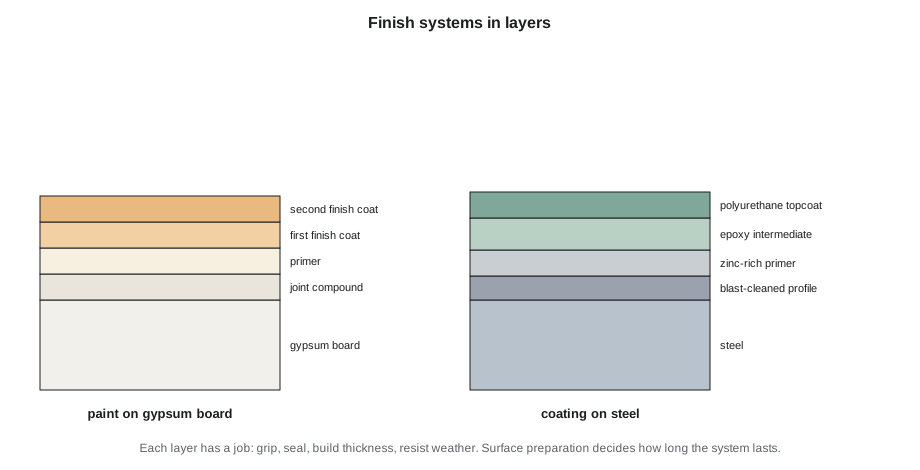
Preparation matters more than the paint. Coatings fail when they are applied over dirt, grease, moisture, loose old paint, mill scale or rust, or onto a surface that is too cold, too hot or too damp. A specification should name the surface preparation, the products for each coat, the number of coats, the dry film thickness and the conditions during application. For steel exposed to weather, Lesson 5 explained galvanizing and duplex systems; Ortega's colleagues at the fabrication shop blast-clean steel to bright metal before priming.
# Paint for the interior walls of the hub's wing
walls = {"playrooms": 620, "corridors": 480, "library": 540, "offices and meeting rooms": 410}   # m2 of wall
openings = 0.15          # share of wall area taken by doors and windows
spread = 9.5        # coverage of one coat, m2 per L (data sheet value)
coats = {"primer": 1, "finish": 2}
total = 0.0
for room, area in walls.items():
    net = area * (1 - openings)
    need = net * sum(coats.values()) / spread
    total += need
    print(f"{room:<26} net {net:7.0f} m2   paint {need:6.0f} L")
print(f"Total about {total:.0f} L; order {total * 1.1:.0f} L with 10% for waste and touch-up")playrooms net 527 m2 paint 166 L corridors net 408 m2 paint 129 L library net 459 m2 paint 145 L offices and meeting rooms net 348 m2 paint 110 L Total about 550 L; order 605 L with 10% for waste and touch-up
Wall and ceiling finishes
Gypsum board is the standard interior wall and ceiling surface in North America: a core of gypsum, a mineral that contains chemically bound water, between paper or glass-mat facers. In fire, the bound water absorbs heat as it is driven off, which is why gypsum board protects structure. Type X board has glass fibres in its core to hold it together longer in fire and is used in fire-rated assemblies. Moisture-resistant boards with glass-mat faces suit damp areas and the backs of tile; abuse-resistant boards with harder cores suit corridors, gymnasia and daycare rooms where carts, balls and children will bump them.
The joints and fasteners of gypsum board are covered with tape and joint compound, finished to one of several levels, from Level 0 (no finishing, for temporary work) to Level 5 (a thin skim coat over the whole surface). Level 4 is usual for walls with flat paint; Level 5 is recommended where strong light grazes along a wall or ceiling, such as beside a tall window, because raking light exaggerates every ripple.
Plaster, whether traditional lime, gypsum plaster or a thin veneer plaster over special board, makes harder, more durable and more seamless surfaces. Lime plaster is breathable and suits historic masonry. Wood panelling and slats bring warmth and, with absorptive backing, acoustic control. Ceramic and porcelain tile are durable and cleanable, ideal in washrooms and kitchens, but grout joints need sealing and maintenance.
Ceilings are acoustically the most important surface in most rooms, because they are large and unobstructed. Suspended acoustic tile ceilings, rated by their noise reduction coefficient (NRC) from 0 (fully reflective) to about 1 (highly absorptive), are cheap, accessible and quiet but can look institutional. Wood slats, perforated panels, sprayed acoustic plaster, wood-wool panels and fabric-wrapped panels give more character. The light reflectance value (LRV) of a ceiling, how much light it reflects, strongly affects how bright a daylit room feels; a white ceiling with an LRV above 80 reflects daylight deep into the room.
Floor finishes
Floors take the hardest wear of any finish. The choice balances durability, cleanability, comfort underfoot, acoustics, slip resistance, appearance, cost and carbon.
| Floor finish | Strengths | Weaknesses | Typical life |
|---|---|---|---|
| Polished concrete | Very durable, no added material, uses slab's thermal mass | Hard, noisy, cold if unheated, cracks show | Life of the slab, with periodic regrinding |
| Resilient sheet or tile (vinyl, rubber) | Cleanable, comfortable, inexpensive, seamless options | Vinyl is a PVC product; can dent | 15 to 25 years |
| Linoleum | Made of linseed oil, wood flour and jute; durable; renewable content | Needs proper maintenance; sensitive to excess water | 25 years or more |
| Porcelain and ceramic tile | Very hard, water-resistant | Hard and loud; grout needs care | 40 years or more |
| Terrazzo | Extremely durable and beautiful | Costly; heavy; installed by specialists | Life of the building |
| Wood (solid or engineered) | Warm, attractive, can be refinished | Moves with humidity; scratches; sensitive to water | Decades with refinishing |
| Carpet tile | Quiet, soft, warm, easy to replace one tile | Holds dirt and allergens; short life | 7 to 12 years |
Slip resistance is a safety requirement, especially where floors get wet: entries in winter, washrooms, kitchens and pool decks. It is measured by the coefficient of friction between a test foot and the floor, wet and dry. In practice, Canadian designers usually rely on the same test methods and values as their US colleagues; a wet dynamic coefficient of friction of at least 0.42 is commonly specified for level interior floors expected to be walked on wet. Polished concrete and glossy tile can be dangerously slippery when wet unless treated. In entries, walk-off mats or recessed grilles, at least four or five steps long, catch snow, grit and salt before they reach the main floor.
Acoustically, hard floors make impact noise, footsteps and dropped toys, that travels into rooms below and rings in the room itself. In the hub's two-storey wing, the library sits above the daycare. The CLT floor is light and lively, so the students propose a floating floor: a resilient mat under a concrete topping, with linoleum on top. The daycare below gets a wood-slat ceiling with acoustic backing to soak up the children's noise.
# Thirty-year cost of floor finishes for the commons (today's money, 3% discount rate)
area = 260            # m2
rate, years = 0.03, 30
options = {   # installed cost per m2, life in years, yearly maintenance per m2
    "polished concrete": (45, 30, 3.0),
    "linoleum sheet": (85, 25, 4.5),
    "porcelain tile": (140, 40, 2.5),
    "carpet tile": (70, 10, 6.0),
}
for name, (cost, life, maint) in options.items():
    pv = 0.0
    for year in range(0, years):
        if year % life == 0:
            pv += cost * area / (1 + rate) ** year      # first install and replacements
        pv += maint * area / (1 + rate) ** year
print(f"{name:<18} present cost over {years} years: {pv:10,.0f}")polished concrete present cost over 30 years: 27,447 linoleum sheet present cost over 30 years: 56,276 porcelain tile present cost over 30 years: 49,522 carpet tile present cost over 30 years: 73,313
For the busy commons, the comparison favours the polished slab Ingrid proposed in Lesson 4: it costs least to install, because the floor finish is the slab itself, and it lasts as long as the building. Carpet tile, cheap to buy, becomes the most expensive option because it is replaced three times. Porcelain tile beats linoleum here only because it lasts longer, a reminder that life expectancy often matters more than first cost. The analysis leaves out what cannot easily be priced: the hardness and noise of concrete and tile, the warmth of linoleum, and the risk of slips on a polished floor near a snowy entrance. The students conclude that the commons should have polished concrete with a long walk-off zone, an absorptive ceiling to control the noise and warmer resilient flooring wherever people sit for long.
Exterior finishes
Exterior finishes face sun, rain, snow, freeze-thaw and pollution. Wood siding can be left to weather, stained or painted. Penetrating stains soak in, do not form a film and so do not peel; they need renewing every few years but simply by recoating. Film-forming paints protect better but peel when moisture gets behind them, which is why back-priming boards and venting the cavity behind the cladding help. Clear finishes on exterior wood fail fastest, because sunlight passes through them and destroys the wood surface beneath.
Metals are commonly factory-finished. Coil-coated steel and aluminium sheet is painted before forming, with polyester for economy and silicone-modified polyester or PVDF (polyvinylidene fluoride) resins for long life. A 70% PVDF finish keeps its hue and gloss for decades in harsh sun. Aluminium extrusions can be powder-coated, a dry powder melted onto the metal in an oven, or anodized, which thickens the natural oxide layer electrochemically and can be dyed in bronze and black tones. Anodized finishes are very hard and do not peel, but scratches and variations in alloy show.
Mineral finishes, such as stucco, lime renders, silicate paints and sealers on concrete and masonry, need to let moisture out. A water-repellent that keeps rain out of brick while letting vapour escape can help in some conditions; a film-forming sealer that traps moisture in masonry can cause the spalling described in Lesson 3. Vasić's rule is never to coat masonry without understanding how it gets wet and how it dries.
Worked problem
Choosing floor finishes for the hub's daycare
Rita Moreau, the daycare director, wants floors that are warm for children who sit and crawl, easy to clean, quiet and durable for at least twenty years. Which finishes would you propose for the playrooms, the entrance and the washrooms?
Show solution
- Playrooms: linoleum or rubber sheet over the radiant slab, with welded seams and an integral cove at the walls for cleaning. Both are warm, resilient and quieter than tile.
- Entrance: a recessed walk-off grille and mat at least four steps long, then slip-resistant porcelain tile that resists salt and slush.
- Washrooms: slip-resistant porcelain tile or seamless resilient flooring with a cove base, sloped to a floor drain.
- Avoid carpet in playrooms because of spills and allergens; use washable area rugs in reading corners instead.
- Specify low-emission adhesives and finishes, because young children spend long hours close to the floor.
Answer: Seamless resilient flooring in playrooms, a long walk-off zone and slip-resistant tile at the entrance, and slip-resistant tile or seamless flooring in washrooms.
Exercise 8: finishes
- Visit a building at least ten years old and record which finishes have worn well and which have not, and why.
- Prepare a finish schedule for one floor of your community hub, giving floor, base, wall and ceiling finishes room by room.
- Estimate the paint needed for the hub's interior walls with the code above.
- Compare two floor finishes for the commons over thirty years, including replacement and maintenance.
- Choose an exterior finish for the hub's wood cladding and justify it in terms of maintenance and appearance.
Common mistakes
MistakeSpecifying paint without surface preparation.
InsteadName the preparation, primer, coats and conditions for every coating system.
MistakeUsing clear finishes on exterior wood.
InsteadUse pigmented penetrating stains or paint systems that block sunlight.
MistakeChoosing glossy floors for wet entries.
InsteadSpecify slip-resistant finishes and a long walk-off zone.
MistakeIgnoring raking light on gypsum walls and ceilings.
InsteadSpecify a Level 5 finish where light grazes a surface.
MistakeSealing masonry with a film that traps moisture.
InsteadUnderstand how the wall gets wet and dries before applying any coating.
Summary and key terms
- Finishes protect substrates and shape cleanliness, light, sound, safety and character.
- Paint is a system of binder, pigment and carrier, applied in layers over prepared surfaces.
- Gypsum board, plaster, wood and tile are the main interior wall finishes; ceilings dominate room acoustics.
- Floor finishes trade durability, comfort, cleanability, slip resistance, acoustics and cost.
- Exterior finishes face sun and water; stains, factory coatings, anodizing and mineral finishes each suit particular materials.
- Finishes are replaced many times over a building's life, so their life cycle cost and carbon matter.
- Binder
- The part of a paint that forms the film and makes it adhere.
- Sheen
- The glossiness of a dried coating.
- Type X gypsum board
- Gypsum board with glass fibres in the core for improved fire resistance.
- Noise reduction coefficient
- A single number rating of how much sound a surface absorbs.
- Light reflectance value
- The share of visible light a surface reflects.
- PVDF
- A durable fluoropolymer resin used for long-life coatings on metal.
Practice problems
Work each problem on paper first, then reveal the answer to check.
Why is a Level 5 gypsum finish recommended beside tall windows?
Show answer
Light grazing along the surface reveals every joint and fastener; a skim coat makes it uniform.
Why does a penetrating stain need less preparation at recoating than a paint film?
Show answer
It does not form a film that peels, so it can simply be cleaned and recoated.
Name two reasons linoleum suits a daycare floor.
Show answer
It is resilient and warm, cleanable and durable, with largely renewable content.
What does an NRC of 0.85 tell you about a ceiling tile?
Show answer
It absorbs most of the sound striking it, so the room will be relatively quiet.
Why do clear coatings on exterior wood fail quickly?
Show answer
Sunlight passes through them and degrades the wood surface underneath, so the film loses its grip.
Lesson quiz · 5 questions
Score 60% or more to complete this lesson.
Create a free account to save your progress, take quizzes and earn a certificate.