
ARCH-240 · Lesson 7 of 12 · 21 min
Plastics and composites
Vasić begins with a challenge. She asks the students to list every plastic in the studio, and they come back in ten minutes with forty-three items: the vinyl floor tiles, the window frames and their spacers, the electrical cable sheaths and boxes, the plumbing drains under the sink, the acoustic panels, the sealant around the windows, the foam behind the radiator covers, the paint, the adhesive holding the floor down, the nylon carpet, the acrylic display case, the roof membrane they glimpsed through a skylight and, under it, the insulation board. 'And in the walls you can't see,' she adds, 'vapour retarders, air barriers, sheathing membranes, tapes and pipe. Plastics are everywhere in a modern building. Most of them are hidden, most of them work well, and almost all of them would burn, so we had better understand them.'
What polymers are
Plastics are made of polymers: very long molecules built by linking thousands of small molecules, called monomers, into chains. Most building polymers are made from oil and natural gas, though some are partly bio-based. Additives such as plasticizers, stabilizers, pigments, fillers and flame retardants are mixed in to adjust their properties, which means two products sold under the same polymer name can perform quite differently.
Polymers fall into three families according to how their chains are arranged.
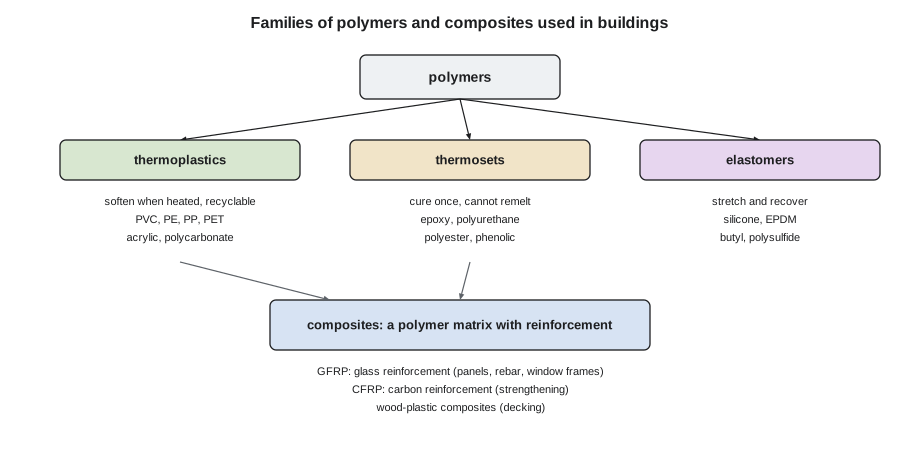
- Thermoplastics have separate chains that slide past one another when warm. They soften when heated and harden when cooled, so they can be extruded, moulded, welded and, in principle, recycled. Examples are polyvinyl chloride (PVC), polyethylene (PE), polypropylene (PP), polyethylene terephthalate (PET), acrylic (PMMA) and polycarbonate (PC).
- Thermosets have chains cross-linked into a three-dimensional network as they cure. Once cured, they cannot be melted again; they char instead. Examples are epoxy, polyester resins, phenolics and most polyurethanes.
- Elastomers are lightly cross-linked polymers that can stretch to several times their length and recover. Examples are silicone, EPDM rubber, butyl and polysulfide, used for gaskets, membranes and sealants.
Compared with traditional building materials, polymers are light, easily formed, water-resistant and often good insulators. They are also much less stiff, expand a great deal with temperature (Lesson 1 showed PVC expanding five times as much as steel), creep under sustained load, soften at moderate temperatures, degrade in sunlight and burn. Each of these weaknesses shapes how they are used.
Plastics in the building
| Polymer | Common building uses | Notes |
|---|---|---|
| PVC (vinyl) | Drain pipe, window frames, siding, roof membranes, flooring, cable sheaths | Rigid or, with plasticizers, flexible; contains chlorine |
| Polyethylene (PE) | Vapour retarder sheet, water pipe, geomembranes | PEX, cross-linked PE, for hot and cold water pipe |
| Polypropylene (PP) | Pipe, fibres in membranes and carpets | Tough and chemically resistant |
| Acrylic and polycarbonate | Skylights, glazing, signs, light diffusers | Polycarbonate is very tough; both scratch more easily than glass |
| Polystyrene (EPS, XPS) | Rigid insulation boards | Expanded beads (EPS) or extruded (XPS) |
| Polyisocyanurate and polyurethane | Insulation boards, spray foam, adhesives, coatings | Thermosets with high insulating value |
| EPDM, TPO and PVC sheet | Single-ply roof membranes | Large sheets seamed by adhesive or heat welding |
| Silicone, polyurethane, polysulfide | Sealants | Elastomeric joints that accommodate movement |
| ETFE | Inflated cushions and roofs | Very light, transparent, long-lasting fluoropolymer film |
Many of these products form the control layers of the envelope that ARCH-130 introduced. Sheathing membranes and self-adhered membranes keep water and air out; polyethylene sheet or smart vapour retarders control vapour on the warm side; foam boards insulate foundations and continuous exterior insulation; sealants and tapes join it all together. Their failures are among the most common causes of building envelope problems Vasić investigated as a consultant, usually at the joints rather than in the field of the product.
Foam insulation
Foam plastics insulate by trapping gas in tiny closed or open cells. Expanded polystyrene (EPS) is made of beads expanded with steam and fused into blocks; extruded polystyrene (XPS) is extruded as a continuous board with a smooth skin; polyisocyanurate (polyiso) boards have foil or glass-mat facers; spray polyurethane foam is mixed on site, as open-cell foam of low density or closed-cell foam that also acts as an air and vapour barrier.
Closed-cell foams contain a blowing agent, a gas that fills the cells and contributes to their insulating value. The blowing agents once used depleted the ozone layer; their replacements, hydrofluorocarbons (HFCs), are potent greenhouse gases, sometimes over a thousand times as powerful as carbon dioxide. In the last few years both countries have restricted high-warming-potential HFCs in foams, and manufacturers have moved to hydrofluoroolefins (HFOs) and hydrocarbons with far lower warming potential. When reading an EPD for an older XPS product, check the blowing agent: it can multiply the embodied carbon several times over.
Foam insulations differ in more than insulating value per unit thickness. EPS is cheap, vapour-permeable to a useful degree and stable over time. XPS resists water absorption, which suits it below grade. Polyiso has the highest insulating value per unit thickness at room temperature but loses some of it in very cold weather, which matters on the prairies. Mineral wool and wood fibre boards are alternatives that do not burn readily or, in the case of mineral wool, do not burn at all.
# Insulation for the hub roof: thickness, mass and carbon for the same thermal resistance
target = 3.5                       # RSI (m2 K/W) to reach
products = {   # name: (conductivity W/m K, density kg/m3, kg CO2e per kg, typical EPD values)
    "EPS board":         (0.036, 22, 3.3),
    "XPS board (HFO)":   (0.029, 30, 3.4),
    "polyiso board":     (0.024, 30, 3.3),
    "mineral wool board": (0.034, 130, 1.3),
    "wood insulation board":(0.04, 140, 0.5),
}
print(f"{'product':<22}{'thickness':>11}{'mass':>13}{'carbon':>14}")
for name, (k, dens, ef) in products.items():
    t = target * k * 1000                    # thickness, mm
    mass = t / 1000 * dens                 # kg per m2
    co2 = mass * ef * 1      # kg CO2e per m2
print(f"{name:<22}{t:8.0f} mm{mass:8.1f} kg{co2:9.1f} kg CO2e")product thickness mass carbon EPS board 126 mm 2.8 kg 9.1 kg CO2e XPS board (HFO) 102 mm 3.0 kg 10.4 kg CO2e polyiso board 84 mm 2.5 kg 8.3 kg CO2e mineral wool board 119 mm 15.5 kg 20.1 kg CO2e wood insulation board 140 mm 19.6 kg 9.8 kg CO2e
The result shows that the per-tonne chart in Lesson 11 can mislead. Foams have high carbon per unit mass but are so light that, for the same insulating value, they can be similar to or lower than heavier mineral wool. The best choice depends on the specific products' EPDs, the blowing agent, fire requirements, moisture conditions and whether the product can be recovered at the end of the building's life.
Plastics and fire
Nearly all plastics burn, and many produce dense, toxic smoke. Foam plastics are especially hazardous because they have a large surface area and may melt and drip. Building codes therefore restrict them. Foam insulation inside a building must generally be separated from occupied spaces by a thermal barrier such as 12.7 mm gypsum board. Exterior wall assemblies with combustible components in tall buildings must pass large-scale fire tests, such as CAN/ULC-S134, that show fire will not spread up the façade. The Grenfell Tower fire in London in 2017, which spread through combustible cladding panels with a polyethylene core and foam insulation, made this issue painfully clear.
Surface flame spread of interior finishes is classified by tests such as CAN/ULC-S102. Many plastics need flame retardants to meet them, and some halogenated flame retardants are persistent and toxic, which has pushed manufacturers towards alternatives.
Durability, sunlight and movement
Ultraviolet light breaks the bonds in polymer chains. Unprotected plastics exposed outdoors chalk, discolour, embrittle and crack, the fate of Joon-ho's spacer if it had been exposed. UV stabilizers, pigments such as carbon black and protective coatings slow the damage, and many products such as foam boards and sheathing membranes are designed only for limited exposure during construction and must then be covered.
Thermal movement is large. A white PVC trim board expands about five times as much as wood along the grain, and a dark one in sun moves more again. Long runs need gaps, slotted holes and fasteners that allow sliding. Creep, slow deformation under sustained load, means that plastics are rarely used for structural purposes without reinforcement and generous safety factors.
Sealants
Sealants are elastomers placed wet in joints between materials. They must stick to both sides, stretch and compress with movement and resist weather. Good sealant joint design follows a few rules. The joint must be wide enough that the sealant's movement capacity is not exceeded; typical products move plus or minus 25 or 50% of their width. The sealant should be about half as deep as it is wide, in an hourglass shape, so that it stretches easily; a closed-cell foam backer rod sets the depth and a bond breaker prevents the sealant from sticking to the back of the joint, because a sealant stuck on three sides tears. Surfaces must be clean, dry and, for many products, primed.
Silicone sealants have excellent UV resistance and movement capacity and are used in curtain walls and glazing; they cannot be painted and can stain porous stone. Polyurethane sealants are tough and paintable and suit concrete and masonry joints but degrade in sunlight faster than silicone. Polysulfides resist fuels and immersion. Butyl is used inside joints and laps, not exposed. All sealants have a limited life, typically ten to twenty years, and joints must be designed so they can be inspected and replaced.
Composites
A composite combines two or more materials so that each does what it does best. In fibre-reinforced polymers (FRP), strong, stiff fibres of glass, carbon or basalt carry load while a polymer matrix holds them in place and protects them. Glass-reinforced polymer (GFRP) is used for rebar in concrete exposed to salt, because it does not rust; for window and door frames, because it expands little and insulates well; for cladding panels and pultruded sections; and for thermal break connectors. Carbon-reinforced polymer (CFRP) sheets are glued to concrete or timber to strengthen existing structures. Wood-plastic composites, wood flour in polyethylene or PVC, are used for decking.
Composites are light and corrosion-resistant but expensive, usually combustible, hard to recycle and less familiar to building officials. They often need evaluation reports rather than relying on standards.
Health, carbon and the end of life
Plastics raise environmental and health questions that architects increasingly have to answer. Some contain additives of concern, such as phthalate plasticizers in flexible PVC, halogenated flame retardants and some per- and polyfluoroalkyl substances (PFAS) in coatings and membranes. Tools such as health product declarations and red lists help designers avoid them. Most building plastics come from fossil feedstocks and carry high carbon per unit mass, though they are used in small quantities. Very little building plastic is recycled; most goes to landfill, and some breaks down into microplastics. Designing for disassembly, choosing mono-material products and using take-back programs, such as those offered for some carpet tiles and roof membranes, are small steps towards better outcomes.
Worked problem
Specifying a sealant joint at the hub's precast sill
Precast concrete sills under the hub's windows are 2.4 m long, with sealant joints between them. The sills move about 1.5 mm each way with temperature. The chosen polyurethane sealant can move plus or minus 25%. What joint should be drawn?
Show solution
- Movement each way: 1.5 mm.
- Minimum width: movement divided by capacity, 1.5 / 0.25 = 6 mm.
- Add an allowance for construction tolerances and make the joint 12 mm wide, the practical minimum for good tooling.
- Set the sealant depth to about half the width, 6 mm, over a closed-cell backer rod slightly larger than the joint.
- Prime the concrete and tool the sealant concave.
Answer: A 12 mm joint with 6 mm of sealant over a backer rod, primed and tooled.
Exercise 7: plastics and composites
- Make your own list of every plastic you can find in one room, and identify each polymer if you can.
- For your community hub wall, list each plastic in the assembly and its function as a control layer.
- Compare three insulation options for the hub's roof by thickness, mass and carbon using the code above.
- Design three sealant joints on your hub elevation, giving width, depth and product type.
- Find one product's health product declaration or red list status and summarize what it tells you.
Common mistakes
MistakeLeaving foam insulation exposed inside a building.
InsteadCover it with a thermal barrier such as gypsum board, as the code requires.
MistakeSticking sealant to three sides of a joint.
InsteadUse a backer rod or bond-breaker tape so it sticks only to the two faces.
MistakeLeaving construction membranes exposed to sunlight for months.
InsteadCheck the allowed exposure time and cover them promptly.
MistakeFixing plastic trim tightly at both ends.
InsteadAllow for large thermal movement with gaps and slotted fixings.
MistakeComparing insulation carbon per tonne.
InsteadCompare per unit area at the same insulating value, using product EPDs.
Summary and key terms
- Polymers are long-chain molecules; thermoplastics remelt, thermosets do not, elastomers stretch and recover.
- Plastics are light, water-resistant and formable but have low stiffness, high thermal expansion, creep and UV sensitivity.
- Foam plastic insulations differ in insulating value, moisture behaviour and, through their blowing agents, carbon.
- Most plastics burn; codes require thermal barriers and fire tests of wall assemblies.
- Sealant joints must be sized for movement, shaped by a backer rod and treated as maintenance items.
- Composites such as GFRP and CFRP combine strong fibres with a polymer matrix.
- Polymer
- A very long molecule made of many repeating units.
- Thermoplastic
- A polymer that softens when heated and can be remelted.
- Thermoset
- A polymer that cures into a network and cannot be remelted.
- Blowing agent
- A gas used to form the cells of a foam plastic.
- Backer rod
- A foam rod placed in a joint to set the depth and shape of the sealant.
- Fibre-reinforced polymer
- A composite of strong fibres in a polymer matrix.
Practice problems
Work each problem on paper first, then reveal the answer to check.
Why can a thermoplastic be recycled more easily than a thermoset?
Show answer
It softens and can be remelted and reformed; a thermoset is cross-linked and cannot be remelted.
A sealant has a capacity of plus or minus 50%. What is the minimum joint width for 3 mm of movement each way?
Show answer
6 mm; in practice draw at least 12 mm.
Why is XPS often chosen for insulation below a slab or outside a foundation wall?
Show answer
It resists water absorption better than most other boards.
Why must spray foam inside a building normally be covered?
Show answer
It is combustible and produces toxic smoke; a thermal barrier protects it from fire.
Give one use of GFRP in buildings and explain why it suits that use.
Show answer
Rebar in salt-exposed concrete, because it does not corrode (window frames, because it expands little, is also acceptable).
Lesson quiz · 5 questions
Score 60% or more to complete this lesson.
Create a free account to save your progress, take quizzes and earn a certificate.