
ARCH-240 · Lesson 5 of 12 · 21 min
Steel and metals
The fabrication shop is a tall shed beside the railway, smelling of cutting oil and hot metal, and the shop manager walks the class past a beam line where a saw and drill cut and punch steel sections to the millimetre from a digital model. A welder lays a bead on a column base plate; sparks fly off a grinder. In the yard, a stack of wide-flange beams waits for shipping, already marked with piece numbers. Callum notices that some of the steel is dark grey with mill scale, some is painted red-brown primer and a few pieces are dull silver. 'Bare, primed and hot-dip galvanized,' says Vasić. 'Three answers to the same question: how long do you want it to last, and where?'
Iron and steel
Steel is iron with a small, controlled amount of carbon, usually less than 0.3% in structural steel, plus small additions of manganese, silicon and other elements. Pure iron is soft; a little carbon makes it strong; too much makes it brittle, as in cast iron, with 2 to 4% carbon. Wrought iron, used in nineteenth-century bridges and buildings, had very little carbon but contained fibrous slag.
There are two main routes to steel. In the integrated route, iron ore, coke and limestone are reduced in a blast furnace to make iron, which is refined into steel in a basic oxygen furnace; this route emits about two tonnes of carbon dioxide for each tonne of steel. In the electric arc furnace route, scrap steel is melted by an electric arc and refined. This route uses far less energy and emits far less carbon, especially where electricity is clean, and most structural sections rolled in North America are now made this way with a high recycled content. Plate, sheet and some hollow sections still often come from integrated mills. Emerging processes reduce iron ore with hydrogen instead of coke, and several plants are under construction worldwide.
Steel is shaped by hot rolling into wide-flange (W) sections, channels, angles, plates and bars; by cold forming of thin sheet into studs, joists and deck; and into hollow structural sections (HSS), the rectangular and round tubes beloved of architects for their clean look. In Canada, structural steel is generally made to CSA G40.20/G40.21, and the usual grade for W sections and HSS is 350W, with a yield strength of 350 MPa.
How steel behaves under load
Steel is strong, stiff and ductile. Under increasing load it first stretches elastically, returning to its original length when unloaded. At the yield point it begins to stretch permanently with little extra load, over a long plateau; then it strain-hardens to an ultimate strength before necking and breaking. This ductility is a great virtue: steel structures give warning before they fail, and connections can share load as parts yield. Concrete and clear wood, by contrast, fail in a brittle way.
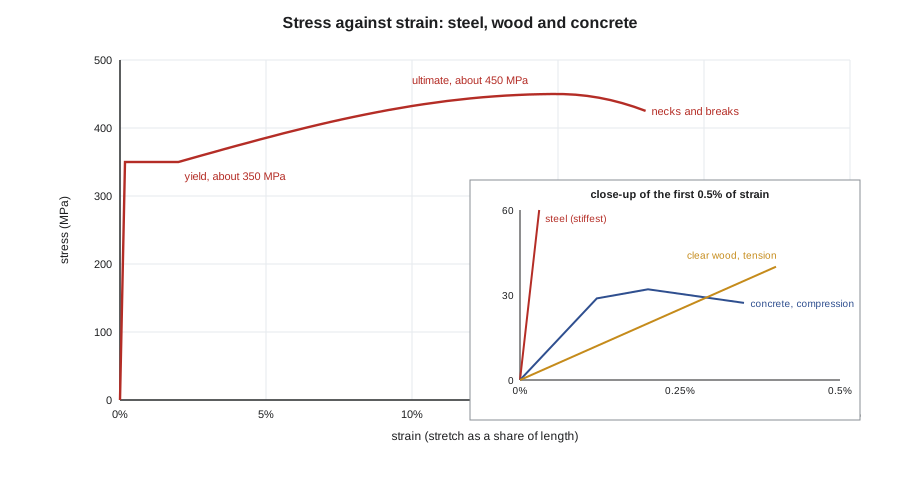
Steel's stiffness, with a modulus of about 200 GPa, is the same for every grade; a higher-strength steel lets a member carry more load but does not make it any stiffer. That is why a long-span steel beam is often sized for deflection, and why simply specifying a stronger grade rarely makes a floor bounce less.
Steel and heat
Two thermal properties shape steel detailing. First, steel conducts heat well, about four hundred times better than wood. A steel beam or balcony slab connector passing from inside to outside is a thermal bridge that wastes energy and can cause condensation and frost on the interior. Manufactured thermal break pads and connectors interrupt the path.
Second, steel loses strength in fire. At about 400 °C structural steel begins to lose strength; at about 550 °C it retains roughly half its strength at room temperature, enough to collapse under full design load. A severe fire can heat unprotected steel to that temperature within about fifteen to twenty minutes. Codes therefore require protection for steel in most buildings beyond a certain size: spray-applied fire-resistive materials, which are cheap but ugly and must be hidden; intumescent coatings, thin paints that swell into an insulating char in fire, which let steel stay visible; or encasement in gypsum board or concrete.
Steel also expands with temperature, by about 12 millionths per °C. The rule for all thermal movement is the same.
Here ΔL is the change in length, α the coefficient of thermal expansion, L the length and ΔT the change in temperature. Metals exposed to sun can be much hotter than the air: a dark metal panel on a south wall can reach 70 °C on a still summer afternoon and fall to -35 °C on a January night.
# Thermal movement of exposed elements on the community hub, from the coldest night to the hottest afternoon
alpha = {"steel": 1.2e-05, "Al alloy": 2.3e-05, "zinc sheet": 2.2e-05, "copper sheet": 1.7e-05, "PVC": 6e-05}   # per degree
cases = [  # element, material, length (m), low and high surface temperatures
    ("steel canopy beam", "steel", 8, -35, 50),
    ("curtain wall mullion", "Al alloy", 4.2, -35, 50),
    ("zinc standing-seam panel", "zinc sheet", 6, -35, 70),
    ("copper gutter run", "copper sheet", 12, -35, 70),
    ("PVC trim board", "PVC", 3.6, -35, 70),
]
for name, mat, length, lo, hi in cases:
    dl = alpha[mat] * length * 1000 * (hi - lo)
print(f"{name:<26} {length:>4} m moves {dl:5.1f} mm")steel canopy beam 8 m moves 8.2 mm curtain wall mullion 4.2 m moves 8.2 mm zinc standing-seam panel 6 m moves 13.9 mm copper gutter run 12 m moves 21.4 mm PVC trim board 3.6 m moves 22.7 mm
The results surprise the students. A 4.2 m window mullion moves as much as a steel beam twice its length, and a short PVC trim board moves almost as much as a long copper gutter. Each number becomes a detail. The canopy beam needs a slotted connection at one end so it can slide. The curtain wall mullions need a sliding joint at each floor, usually a sleeve called a stack joint. Zinc and copper sheets are held by sliding clips rather than nailed through, and long gutters need expansion joints. PVC trim, the worst offender, needs gaps at every butt joint and fasteners in oversized holes, or it will buckle in summer and open in winter.
Movement is also why metal cladding panels are rarely fixed rigidly on all four sides. A typical rule is to fix a panel at one point, guide it at others so it can slide, and cover the joints with laps or gaskets so water stays out while the panel moves. Vasić shows a photograph from her consultancy days of a run of flat metal panels bowed like pillows, the result of fixing them tightly at every edge on a west wall.
Corrosion
Iron and steel rust when water and oxygen are both present. Rust is iron oxide, weaker than steel and occupying several times its volume, so it flakes away, exposing fresh steel, and it can burst concrete or masonry around buried steel. Indoors, in heated dry air, bare structural steel hardly corrodes. Outdoors, in a wet or salty environment, unprotected steel can lose a significant amount of metal over a building's life.
Designers protect steel in four ways. Paint systems create a barrier; they work well if the steel is properly cleaned before painting and the paint is maintained. Hot-dip galvanizing dips the fabricated steel into molten zinc, which bonds metallurgically and protects in two ways: as a barrier and sacrificially, because zinc corrodes in preference to steel wherever the coating is scratched. A typical hot-dip coating lasts many decades in a rural or suburban atmosphere, less near salt. Duplex systems, paint over galvanizing, last longer than either alone. Finally, corrosion-resistant metals can replace carbon steel.
Weathering steel, with small additions of copper, chromium and nickel, forms a dense, stable rust layer that slows further corrosion in suitable conditions. CSA G40.21 350A are typical specifications. It needs alternate wetting and drying to form the patina and must not sit wet, be buried or face de-icing salts; its run-off stains concrete and paving below, so details must collect or direct the water.
Stainless steel contains at least 10.5% chromium, which forms an invisible, self-healing oxide film. Type 304 suits most building exteriors; Type 316, with molybdenum, resists chlorides better near roads treated with salt and by the sea. Stainless steel costs several times as much as carbon steel and is used for fasteners, ties, anchors, railings, flues and exposed fittings rather than main structure.
Galvanic corrosion
When two different metals touch in the presence of water, they form a battery, and the more active metal corrodes faster while the more noble one is protected. The galvanic series ranks metals for typical outdoor conditions.
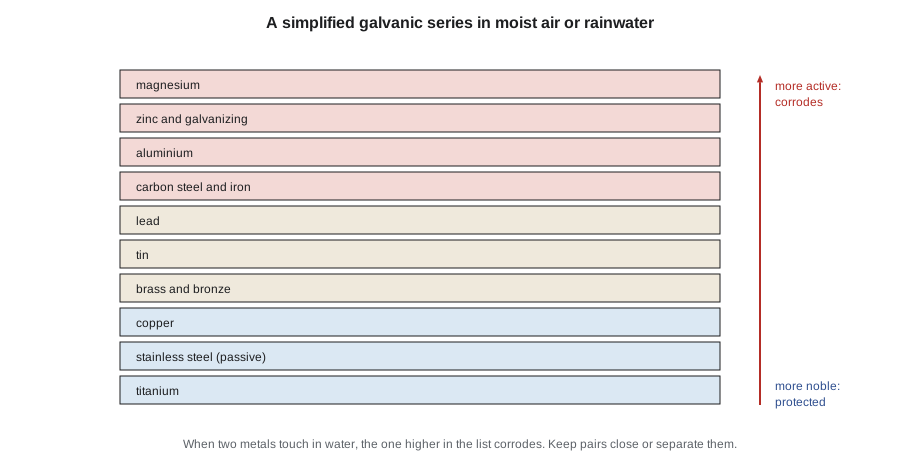
Practical consequences follow. Copper flashing must not drain onto galvanized steel or aluminium gutters; copper ions in the run-off will corrode them. Steel fasteners in copper roofing will rust quickly; stainless or copper fasteners are used instead. Aluminium windows fixed with plain steel screws corrode at the screws. Where dissimilar metals must meet, they are separated with non-conductive washers, tapes or coatings, and water is kept from bridging them. The rule also explains why galvanizing works: zinc sacrifices itself to protect steel.
Other metals in buildings
Aluminium is light, a third the density of steel, easily extruded into complex shapes and naturally protected by a thin oxide film. It is the usual material for window and curtain wall frames, sunshades, flashing and many cladding panels. Its weaknesses are a modulus a third of steel's, high thermal conductivity and high thermal expansion. Window frames therefore need thermal breaks of polyamide or polyurethane, and long extrusions need sliding joints. It is finished by anodizing, which thickens the oxide, or by baked-on coatings such as PVDF. Primary aluminium from bauxite is energy-intensive, with a large carbon footprint if made with fossil electricity; recycled aluminium uses about a twentieth of the energy, and much Canadian smelting uses hydroelectricity.
Copper has been used on roofs and domes for centuries. It weathers from bright salmon to brown to the familiar green patina over years or decades, depending on climate. It is soft, workable and very durable, but expensive. Zinc, sold as rolled sheet often alloyed with titanium and copper, forms a blue-grey patina and is used for standing-seam roofs and cladding; it needs a ventilated underside, because moisture trapped against its back side prevents the protective layer forming and causes corrosion. Lead, once standard for flashing, is now avoided in most applications because of its toxicity, especially near drinking water and children.
Light-gauge steel framing, studs and joists cold-formed from galvanized sheet, has become common for non-loadbearing interior walls, backup walls behind cladding and mid-rise loadbearing frames. Its galvanized coating protects it during construction and in dry walls, but it must be kept out of persistently wet assemblies.
Worked problem
Choosing metals for the warming hut
The warming hut needs a new flue for the wood stove through the roof, a canopy over the door to shed snow, flashings at the roof edges and fasteners for the cladding. The site is a lakeshore park where salt is used on the parking lot nearby. What metals would you choose?
Show solution
- Flue: a listed factory-built chimney with a stainless steel liner, because stove gases are hot and corrosive.
- Canopy frame: hot-dip galvanized steel, painted for appearance, because it will be wet and exposed to slush and salt spray.
- Flashings: prefinished galvanized steel or aluminium to match the roof; never copper above galvanized or aluminium parts.
- Fasteners: stainless steel near the parking lot and in any treated wood; hot-dip galvanized elsewhere.
- Check every contact between metals against the galvanic series and separate any distant pairs.
Answer: Stainless for the flue and fasteners at risk, galvanized and painted steel for the canopy, prefinished compatible flashings and no copper upstream of other metals.
Exercise 5: steel and metals
- Visit a steel fabricator or a building under construction and record the sections, connections and coatings you see.
- Find three examples in your city of corrosion on buildings and identify the cause, such as galvanic action, trapped water or salt.
- Calculate the thermal movement of a metal element on your community hub and show how the detail allows for it.
- Choose the fire protection for an exposed steel column in the hub's commons and explain the choice.
- Draw a detail where two different metals meet and show how they are separated.
Common mistakes
MistakeSpecifying a higher steel grade to reduce deflection.
InsteadRemember that all steels have the same stiffness; increase depth instead.
MistakeLetting copper run-off drain onto galvanized steel or aluminium.
InsteadArrange metals so water flows from less noble to more noble, or separate the drainage.
MistakeRunning steel beams through the envelope without thermal breaks.
InsteadUse thermal break connectors or keep structure inside the insulation.
MistakeExposing weathering steel to standing water or de-icing salt.
InsteadDetail it to drain and dry, and keep it away from salted surfaces.
MistakeForgetting the fire protection on exposed steel.
InsteadPlan for intumescent coating or encasement from the start, with its cost and thickness.
Summary and key terms
- Structural steel is iron with a little carbon; electric arc furnace steel from scrap has a much lower footprint than blast furnace steel.
- Steel is strong, stiff and ductile; all grades have the same stiffness.
- Steel conducts heat well, expands with temperature and loses about half its strength at about 550 °C.
- Steel corrodes with water and oxygen; paint, galvanizing, duplex systems and corrosion-resistant alloys protect it.
- Dissimilar metals in contact with water cause galvanic corrosion of the more active metal.
- Aluminium, copper, zinc and stainless steel each have particular strengths, finishes and detailing rules.
- Yield strength
- The stress at which steel begins to deform permanently.
- Ductility
- The ability to stretch a long way before breaking.
- Hot-dip galvanizing
- Coating steel with zinc by dipping it in molten zinc.
- Weathering steel
- A steel alloy that forms a stable, protective rust layer.
- Galvanic corrosion
- Accelerated corrosion of one metal in contact with a more noble metal in the presence of water.
- Intumescent coating
- A thin coating that swells into an insulating char in fire.
Practice problems
Work each problem on paper first, then reveal the answer to check.
A steel canopy beam 8 m long ranges from -35 to +50 °C. How much does it change in length?
Show answer
About 8.2 mm (12 × 10⁻⁶ × 8,000 × 85).
Why is galvanizing still effective where the coating is scratched?
Show answer
Zinc is more active than steel, so it corrodes sacrificially and protects the exposed steel.
Why might a designer choose Type 316 stainless steel rather than 304?
Show answer
Type 316 resists chlorides better, near salted roads or the sea.
What happens if copper flashing drains onto a galvanized steel roof?
Show answer
Copper ions in the water speed corrosion of the zinc and then the steel.
Name three ways to fire-protect structural steel.
Show answer
Spray-applied fire-resistive material, intumescent coating and encasement in gypsum board or concrete.
Lesson quiz · 5 questions
Score 60% or more to complete this lesson.
Create a free account to save your progress, take quizzes and earn a certificate.