
ARCH-240 · Lesson 1 of 12 · 23 min
Selecting materials
The materials library at Elmhurst is a long basement room lined with steel shelving, and on the first day of term Professor Teodora Vasić lets the four students loose in it before saying a word. There are bricks from a dozen plants, offcuts of cross-laminated timber, a slab of terrazzo, coils of copper, a sheet of perforated weathering steel, jars of cement and slag, cork, felt, a dented zinc panel and a cardboard box of failed sealant joints that she collected from a façade repair. After twenty minutes she asks each of them to bring back one object and say why they picked it. Wren holds up a rough Tyndall stone sample because it has fossils in it. Callum brings a brick that rings when he taps it. Ingrid has a piece of glulam whose end grain she likes. Joon-ho brings a cracked plastic window spacer and asks why anyone would make a window out of something that breaks like that. 'Good,' says Vasić. 'You chose by eye, by sound, by touch and by suspicion. This term you will learn to choose by evidence as well.'
Vasić trained as an architect, spent eleven years at a building envelope consultancy investigating leaks and failed cladding, and now runs the materials library and teaches this course. Her rule is that an architect does not have to be a materials scientist but must know enough to ask the right questions, read the answers and notice when something is wrong. This lesson sets out how to describe a material, where to find reliable data and how to choose between candidates in a way you can explain to a client, an engineer or a building official.
Why material choice matters
Materials are the physical substance of architecture. They decide how a building stands up, keeps out weather and fire, sounds, smells and ages. They make up most of a building's cost and, increasingly, a large share of its lifetime carbon emissions. A choice made casually in an early sketch, such as a dark metal panel on a south wall or a stone floor in a daycare, can commit a project to decades of consequences: heat, glare, cold feet, cracked joints, high maintenance or an early replacement.
Material choice is also cultural. Brick tells a story of craft and permanence; glass of openness; timber of warmth and, on the prairies, of a forest economy. In ARCH-130 the students learned how buildings are assembled from systems. In this course they look inside the systems at the materials themselves, ask what each one can and cannot do, and learn to combine them in assemblies that last.
Describing a material: families of properties
Engineers and scientists group the properties of materials into families. An architect should be able to name the important properties in each family and know roughly how the common building materials compare.
- Mechanical properties describe how a material carries load. Strength is the stress at which it yields or breaks; stiffness, measured by the modulus of elasticity, is how much it resists deforming; toughness is its ability to absorb energy before breaking; hardness is its resistance to scratching and denting.
- Physical properties include density, thermal conductivity (how readily heat flows through it), thermal expansion (how much it grows when warmed), specific heat and thermal mass, and its relationship with water: how much it absorbs, how vapour passes through it and how it swells or shrinks.
- Fire properties include whether it burns, how fast flame spreads across its surface, how much smoke it produces and how long it keeps its strength when heated.
- Acoustic properties include mass, which blocks sound, and absorption, which softens a room.
- Durability describes how a material resists weather, ultraviolet light, freeze-thaw cycles, corrosion, rot, insects and wear.
- Sensory properties include hue, texture, gloss, warmth to the touch, smell and how the material changes as it ages.
- Environmental and economic properties include embodied carbon, toxicity, recycled content and recyclability, cost, availability, lead time and the skills needed to install it.
Two terms cause particular confusion. Strength and stiffness are different. Glass is very stiff but breaks suddenly; rubber is flexible but tough. A floor can be strong enough not to collapse yet so flexible that it bounces uncomfortably. In building design, stiffness often governs: beams and floors are frequently sized to limit deflection rather than to avoid breaking. Similarly, thermal conductivity and thermal mass are different: concrete conducts heat fairly well and also stores a lot of it, while foam insulation does neither.
Comparing materials on a property chart
The materials scientist Michael Ashby popularized charts that plot one property against another on logarithmic scales, with each material family occupying a bubble. The most useful for architects plots stiffness against density. It shows at a glance why steel, concrete and wood behave so differently, and why wood is so competitive in light structures: along the grain, it is about a twentieth as stiff as steel but also about a sixteenth as dense, so its stiffness per unit weight is similar.
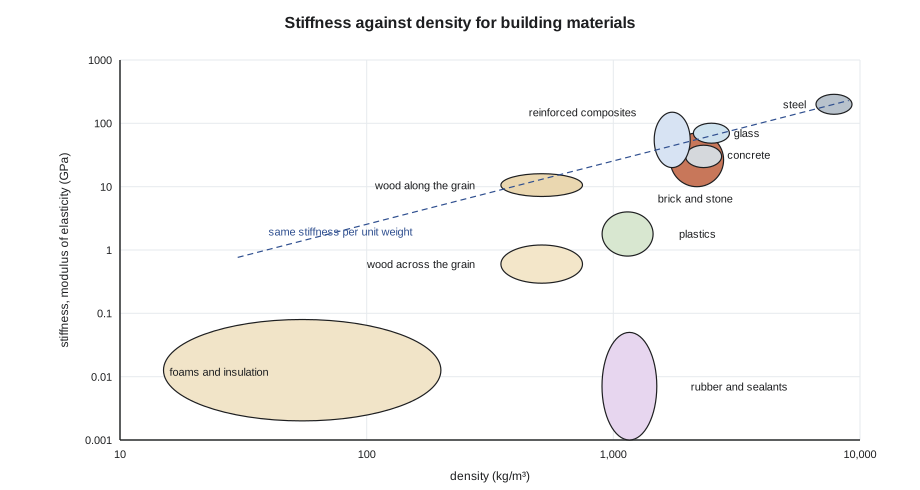
The chart also explains a basic fact of wood: its properties depend on direction. Along the grain wood is stiff and strong; across the grain it is ten or more times softer. Wood is said to be anisotropic. Steel, glass and, approximately, concrete are isotropic: the same in every direction. Engineered wood products such as cross-laminated timber arrange layers in different directions to even out these differences.
| Material | Density | Stiffness (modulus) | Thermal conductivity | Thermal expansion |
|---|---|---|---|---|
| Softwood lumber, along the grain | 450 kg/m³ | 10 GPa | 0.12 W/(m·K) | 4 × 10⁻⁶ per °C |
| Normal concrete | 2,400 kg/m³ | 25 to 30 GPa | 1.8 W/(m·K) | 10 × 10⁻⁶ per °C |
| Clay brick | 1,900 kg/m³ | 10 to 20 GPa | 0.8 W/(m·K) | 6 × 10⁻⁶ per °C |
| Structural steel | 7,850 kg/m³ | 200 GPa | 50 W/(m·K) | 12 × 10⁻⁶ per °C |
| Aluminium | 2,700 kg/m³ | 70 GPa | 160 W/(m·K) | 23 × 10⁻⁶ per °C |
| Float glass | 2,500 kg/m³ | 70 GPa | 1.0 W/(m·K) | 9 × 10⁻⁶ per °C |
| Rigid PVC | 1,400 kg/m³ | 3 GPa | 0.17 W/(m·K) | 60 × 10⁻⁶ per °C |
| Mineral wool batt | 35 kg/m³ | very low | 0.036 W/(m·K) | not relevant |
A few patterns in the table are worth remembering. Steel conducts heat about four hundred times better than wood, which is why a steel beam passing through a wall becomes a cold bridge. Aluminium and PVC expand about twice and five times as much as steel, which is why their joints must allow movement. Concrete and steel expand at nearly the same rate, one of the happy accidents that makes reinforced concrete possible. Mineral wool insulates because it traps still air, not because its fibres are special.
Where reliable data comes from
Architects meet material information in many forms, and they are not equally trustworthy. Vasić gives the students a ranking.
- Standards set minimum requirements and test methods. In Canada, the CSA Group publishes standards for wood design, concrete, masonry, steel and windows, among others, and the National Building Code of Canada refers to them. In the United States, ASTM International and bodies such as the American Concrete Institute and the American Institute of Steel Construction play a similar role, referenced by the International Building Code. A product that meets a named standard has been tested in a known way.
- Evaluation reports, such as those from the Canadian Construction Materials Centre or the ICC Evaluation Service, show that an innovative product meets the intent of the code where no standard yet covers it.
- Technical data sheets from manufacturers list tested properties, installation requirements and limits. They are reliable for the conditions stated, but read the footnotes.
- Environmental product declarations, or EPDs, are independently verified reports of a product's life cycle environmental impacts, prepared under ISO 14025 and product category rules. Health product declarations list ingredients and hazards.
- Trade literature, sample boards, showroom displays and online images are useful for inspiration but are marketing, not evidence.
Vasić's test for a claim is simple: who measured it, how, under what conditions, and who checked? A brochure that says a panel is 'fireproof' or 'maintenance-free' fails all four questions. A data sheet that says the panel achieved a certain flame-spread rating when tested to a named standard passes most of them.
A method for selection
Choosing a material is a design problem with many answers, so it helps to work in a structured way. Ashby's method begins by stating four things.
- Function: what must the component do? Carry load, keep out rain, insulate, finish a floor, shade a window.
- Constraints: what must it achieve without exception? A fire rating, a minimum strength, a maximum thickness, a code requirement, a budget ceiling.
- Objectives: what should be minimized or maximized? Cost, weight, embodied carbon, maintenance, thickness.
- Free variables: what can the designer change? The thickness, the profile, the finish, the spacing of supports.
Constraints screen out candidates that cannot work. Objectives rank the survivors. Where there are several objectives, which is nearly always the case in architecture, a weighted score makes the trade-offs explicit. Weights are a judgement, not a fact, and the point of writing them down is that the team and the client can see and question them.
The class tests the method on the warming hut at Kestrel Point. In ARCH-130 they converted the little boathouse into a heated shelter where skaters and skiers warm up beside the lake. Its cladding faces wind-driven snow, children's skates and boots, a wood stove inside and almost no maintenance budget. The constraints are that the cladding must be non-combustible within 1.2 m of the stove flue where it passes through the wall, resist impact up to shoulder height and last at least thirty years. The objectives are low embodied carbon, low maintenance, low cost and a good fit with the lakeside setting. Four candidates survive the screen: vertical wood boards with a stain, cement board panels reinforced with fibres, corrugated galvanized steel and thermally modified wood.
# Weighted comparison of cladding for the warming hut (scores 1 to 5, 5 is best)
weights = {"carbon": 0.3, "maintenance": 0.25, "cost": 0.15, "setting": 0.2, "impact": 0.1}
options = {
    "stained wood boards":       {"carbon": 5, "maintenance": 2, "cost": 4, "setting": 5, "impact": 3},
    "cement board panels":         {"carbon": 3, "maintenance": 4, "cost": 3, "setting": 3, "impact": 3},
    "corrugated galvanized steel": {"carbon": 2, "maintenance": 5, "cost": 5, "setting": 3, "impact": 5},
    "thermally modified wood":   {"carbon": 4, "maintenance": 4, "cost": 2, "setting": 5, "impact": 3},
}
assert abs(sum(weights.values()) - 1) < 1e-9
def score(o, w):
    return sum(w[k] * options[o][k] for k in w)
ranked = sorted(options, key=lambda o: -score(o, weights))
for o in ranked:
    print(f"{o:<30} {score(o, weights):.2f}")
# Sensitivity: swap the two largest weights
w2 = dict(weights)
big = sorted(w2, key=lambda k: -w2[k])[:2]
w2[big[0]], w2[big[1]] = w2[big[1]], w2[big[0]]
print("Swapping", big[0], "and", big[1], "->", max(options, key=lambda o: score(o, w2)), "ranks first")stained wood boards 3.90 thermally modified wood 3.80 corrugated galvanized steel 3.70 cement board panels 3.25 Swapping carbon and maintenance -> corrugated galvanized steel ranks first
The score is close, which is common. Vasić points out that the result depends on the weights: if the city valued low maintenance above low carbon, the galvanized steel would come first. She also points out what the table hides. Thermally modified wood is new to local installers; galvanized steel would be noisy in hail and cold to lean against; cement board needs careful cutting with dust control, because its dust contains silica. The score is a starting point for discussion, not the decision itself.
Stiffness per unit weight
One property ratio deserves special attention: stiffness divided by density, called specific stiffness. When a component must be stiff but light, as with a long roof beam or a cantilevered canopy, the material with the highest specific stiffness does best. The surprising result is that steel, aluminium, glass and wood along the grain have similar specific stiffness. That is why the decision between them rests on other properties: strength, cost, fire, durability, connections and carbon.
Worked problem
Comparing specific stiffness
Rank steel, aluminium, glass and softwood along the grain by specific stiffness, using the values in the table.
Show solution
- Steel: 200 GPa ÷ 7,850 kg/m³ ≈ 25.5 MN·m/kg.
- Aluminium: 70 ÷ 2,700 ≈ 25.9.
- Glass: 70 ÷ 2,500 ≈ 28.0.
- Softwood along the grain: 10 ÷ 450 ≈ 22.2.
- The four are within about a quarter of each other.
Answer: Glass is highest, then aluminium and steel almost equal, then softwood. In practice the choice is decided by strength, toughness and cost, not specific stiffness alone.
Thinking in the whole life of a material
A material's story does not start at the building site or end at the ribbon-cutting. It begins with extraction (a quarry, a forest, a mine), continues through processing and manufacture, transport, installation, decades of use and maintenance, and ends with demolition, reuse, recycling or disposal. Good selection considers the whole sequence. A cheap finish that must be replaced every eight years may cost more over a building's life than an expensive one that lasts forty. A low-carbon product shipped across an ocean may lose much of its advantage. A material that cannot be separated from its neighbours at the end of life will probably go to landfill.
Lesson 11 returns to these questions with the tools of life cycle assessment. For now, the students add two questions to their checklist for every candidate: how long will it last here, and what happens to it afterwards?
The course project
Throughout the term each student keeps a material notebook: samples, sketches of joints, photographs of weathering on real buildings, and notes from data sheets. In Lesson 12 each will research one material in depth for the community hub they designed in ARCH-200, test it against the hub's needs and recommend whether and how to use it. Vasić asks them to start looking now. Wren is drawn to the cross-laminated timber of the hub's wing, Callum to clay brick for the hall's base, Ingrid to low-carbon concrete for the slab on grade and Joon-ho, still suspicious of plastics, to glazing and its frames.
Exercise 1: selecting materials
- Visit the materials library (or a building supply yard) and handle at least ten materials. For each, note what you can learn by sight, touch, sound and weight.
- For one component of the warming hut, state its function, constraints, objectives and free variables.
- Shortlist three candidates and find a data sheet, a relevant standard and, if possible, an EPD for each.
- Build a weighted comparison like the one above, and test how the result changes if you swap the two largest weights.
- Photograph a building at least thirty years old and record how its materials have aged.
Common mistakes
MistakeChoosing a material from a photograph or a sample board alone.
InsteadCheck data sheets, standards and examples of real buildings that have aged.
MistakeConfusing strength with stiffness.
InsteadAsk whether the component must avoid breaking, avoid bending, or both.
MistakeTrusting marketing words such as 'maintenance-free' or 'fireproof'.
InsteadAsk who tested the claim, how and to what standard.
MistakeTreating a weighted score as the answer.
InsteadUse it to expose trade-offs, then decide with judgement and discussion.
MistakeIgnoring how a material behaves next to its neighbours.
InsteadConsider expansion, moisture, corrosion and fire at every junction.
Summary and key terms
- Material choices determine a building's structure, performance, appearance, cost, durability and carbon.
- Properties fall into families: mechanical, physical, fire, acoustic, durability, sensory, environmental and economic.
- Strength and stiffness are different, and stiffness often governs building design.
- Property charts show how material families compare; wood along the grain has a specific stiffness close to that of steel.
- Reliable data comes from standards, evaluation reports, data sheets and EPDs, not from marketing.
- Selection works by function, constraints, objectives and free variables, with weighted scores to make trade-offs explicit.
- Modulus of elasticity
- A measure of stiffness: the stress needed to produce a given strain in the elastic range.
- Strength
- The stress at which a material yields or breaks.
- Toughness
- The ability to absorb energy before breaking.
- Anisotropic
- Having different properties in different directions, as wood does.
- Specific stiffness
- Stiffness divided by density.
- Environmental product declaration
- A verified report of a product's life cycle environmental impacts, prepared to ISO 14025.
Practice problems
Work each problem on paper first, then reveal the answer to check.
Using the specific stiffness values, would a steel or a softwood member be lighter for the same stiffness, if each could take its best shape?
Show answer
Steel, slightly: its specific stiffness is about 15% higher. The difference is small, so cost, fire protection, connections and carbon usually decide.
Why does a PVC window frame need larger movement joints than a wood one?
Show answer
PVC expands roughly fifteen times as much as wood along the grain for the same temperature change.
Name one standards body in your country that writes material standards.
Show answer
CSA Group (others are acceptable).
In a weighted comparison, why should you change the weights and see if the result changes?
Show answer
To test whether the decision is robust or depends on one debatable judgement.
What four questions test a claim about a material?
Show answer
Who measured it, how, under what conditions, and who checked.
Lesson quiz · 5 questions
Score 60% or more to complete this lesson.
Create a free account to save your progress, take quizzes and earn a certificate.