
ARCH-220 · Lesson 12 of 12 · 23 min
Writing about architecture
On the last day of term, Dr. Arslan hands each student a sealed envelope. Inside is the paragraph they wrote on the first page of their theory journal in the first week, answering the question: what is architecture for? 'Read it,' she says, 'and then read the last entry in your journal.' Ingrid laughs at her first answer, which says architecture is for making beautiful objects. Joon-ho finds that he wrote almost the same thing twice, but that the second time he could explain why. Callum says his first answer was about buildings and his last is about people. Wren says nothing for a while, then says that she now disagrees with herself in a more interesting way. 'Good,' Dr. Arslan says. 'Now you are ready to write criticism. For the final assignment, you will each write a critical essay about a building in this city. Today we learn how.'
Writing is not separate from design. Architects write project descriptions, competition statements, proposals, reports, letters to clients and planning committees, and sometimes criticism and theory. The ability to explain what a building is, how it works and why it matters, clearly and persuasively, is one of the most useful skills an architect can have. This final lesson teaches the essentials of architectural criticism and gives you a method for your own writing, drawing together the theories of the whole course.
A tradition of architectural criticism
Architectural criticism for a general audience has a rich tradition in North America. Lewis Mumford wrote the Sky Line column in The New Yorker from 1931 to 1963, judging buildings and cities from the point of view of their effect on human life, and his book The City in History (1961) became a classic. Ada Louise Huxtable became the architecture critic of The New York Times in 1963 and in 1970 received the first Pulitzer Prize for criticism. Her columns, collected in books such as Kicked a Building Lately? (1976), combined deep knowledge with sharp, readable prose and helped build public support for preserving historic buildings. Later Pulitzer winners for criticism include Paul Goldberger (1984), Blair Kamin of the Chicago Tribune (1999) and Inga Saffron of The Philadelphia Inquirer (2019).
In Britain, Reyner Banham, whom you met in Lesson 6, wrote with equal enthusiasm about Los Angeles freeways, Californian surf culture and the history of air conditioning; his Los Angeles: The Architecture of Four Ecologies (1971) showed that a critic could take an unloved city seriously. In Canada, architecture critics at national newspapers and magazines such as Canadian Architect and Azure have written for decades about buildings across the country, and in Winnipeg local writers and organizations publish guides and reviews of the city's buildings. Criticism today also appears in podcasts, videos and social media, where the same skills of description and argument apply.
Four steps: describe, analyse, interpret, evaluate
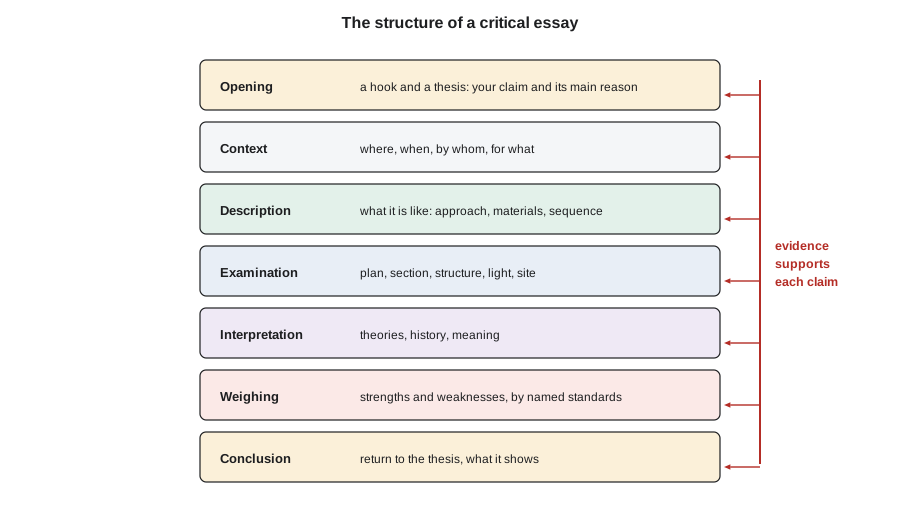
Most good architectural criticism follows, openly or not, a sequence of four steps, which you have practised all term. The first is description: telling the reader what the building is and what it is like, so that they can picture it. Where is it, what does it do, how big is it, what is it made of, how do you approach it and move through it? Description must be accurate and specific. Write with dimensions, materials and names, not vague adjectives. Rather than writing that a building is striking, write what strikes you and why.
The second step is analysis: explaining how the building works, its plan, section, structure, light, circulation and relationship to the site and city. Analysis connects the parts to the whole. The third step is interpretation: explaining what the building means, what ideas it expresses and how it relates to its context, its history and the theories you have studied. Here you might show that a building is an example of critical regionalism, or that its exposed structure follows a high-tech tradition, or that it is double coded. The fourth step is evaluation: judging whether the building succeeds, by what standards, and for whom. Evaluation is the point of criticism, but it must rest on the first three steps, or it is only opinion.
The thesis
A critical essay needs a thesis: a clear statement of your judgement and the main reason for it, usually in one or two sentences near the beginning. A thesis is not a topic. The Guthrie Theater is a building by Jean Nouvel is a topic. The Guthrie Theater's cantilevered lobby turns a visit to the theatre into a performance of the city, but its dark, closed exterior offers little to the street is a thesis. It makes a claim, it can be argued with and it tells the reader what the essay will do.
Good theses are specific, debatable and supported. Specific means they refer to particular features, not to the building in general. Debatable means a reasonable person could disagree; a statement that everyone accepts is not worth an essay. Supported means you can show evidence for it from the building itself, from drawings, from your observations and from other sources. Writing a thesis early forces you to decide what you think. You can revise it as you write; most good writers do.
Evidence and sources
Criticism depends on evidence. The most important evidence is your own experience of the building: visit it more than once, at different times, and take notes and sketches. Measure what you can by pacing, and photograph details. The second kind of evidence is documentary: drawings, the architect's statements, published reviews, historical records, and data such as energy use or visitor numbers. The third kind is the experience of others: talk to people who use the building, work in it or live near it.
When you use sources, cite them. Architectural writing commonly uses the Chicago style, either with footnotes or with author and date in the text and a list of references at the end. Quote sparingly and briefly, choosing only phrases that are distinctive or that you will argue with; paraphrase everything else in your own words and still cite it. Never present another writer's ideas as your own. If you use software tools, including artificial intelligence, to help with research or drafting, check every fact they provide against a reliable source, and follow your instructor's rules on disclosing their use.
| Step | Question | Evidence | Typical mistake |
|---|---|---|---|
| Describe | What is it and what is it like? | Visits, sketches, measurements, drawings | Vague adjectives instead of specifics |
| Analyse | How does it work? | Plans, sections, structure, site | Listing features without connecting them |
| Interpret | What does it mean? | Theories, history, context, the architect's statements | Repeating the architect's claims uncritically |
| Evaluate | Does it succeed, by what standard, for whom? | Experience of users, performance data, comparison | Opinion without reasons |
Standards of judgement
To evaluate a building you need standards, and this course has given you many. You can judge a building by Vitruvius's triad: is it sound, useful and delightful? By Jacobs's conditions: does it support the life of the street? By postmodern standards: does it communicate, and to whom? By Frampton's: does it belong to its place and engage the senses? By the standards of high-tech: is its structure clear and efficient? By minimalism: are its proportions and details precise? By sustainability: what are its energy use and embodied carbon, and will it last? By social justice: whom does it serve and exclude, and how was it made? A strong essay chooses the standards that matter most for the building in question and says so openly. A building may succeed by one standard and fail by another, and saying so is a sign of honest criticism, not indecision.
A sample critique
The following short critique is an original example, written for this lesson about an imaginary building. Read it and identify the four steps, the thesis and the evidence.
The new Riverside Branch Library sits at the end of a quiet residential street, where the grid of houses meets the river path. Its architects have given it two faces. Toward the street it is a low wall of dark brick, almost blank, with a single deep entrance porch. Toward the river it opens completely: a long reading room, about forty paces from end to end, is glazed from floor to roof, and a timber roof on thin steel columns floats above it, lifted on the river side to admit the low winter sun. The plan is simple, a band of service rooms against the street and one great room against the water, and the section does all the work. Coming in from the street, you pass through the dim porch and a short, low hall, and then the room and the river appear together, a sequence the building handles with real skill. The idea is familiar from critical regionalism: a closed face to the cold street, an open face to the sun and the landscape. Here it works. On a February afternoon the reading room was full and warm, and the children's corner, set in a bay of the glass wall, was the liveliest place in the neighbourhood. The street side is less successful. The brick wall is handsome but gives nothing to the sidewalk; a window into the children's corner from the street would have told passers-by what happens inside. Even so, the library shows that a modest public building can make a powerful place by doing one thing well.
The critique begins with description and location, moves to analysis of plan and section, interprets the building through critical regionalism, evaluates it with evidence from a visit, and names a weakness with a concrete suggestion. Its thesis, that the library makes a powerful place by doing one thing well, appears at the end, which is acceptable in a short piece; in a longer essay, you would usually state it near the beginning.
# Which words does the sample critique use most? Vague words are a warning sign.
text = """The new Riverside Branch Library sits at the end of a quiet residential street.
Toward the street it is a low wall of dark brick, almost blank, with a single deep
entrance porch. Toward the river it opens completely: a long reading room is glazed
from floor to roof, and a timber roof on thin steel columns floats above it. The plan
is simple and the section does all the work. Here it works. The street side is less
successful. Even so, the library shows that a modest public building can make a
powerful place by doing one thing well."""
stop = {"the", "a", "it", "of", "and", "to", "is", "on", "at", "by", "with", "from", "that",
        "can", "all", "even", "so", "here", "in", "an", "does", "toward"}
vague = {"amazing", "interesting", "beautiful", "striking", "nice", "stunning", "iconic"}
words = [w.strip(".,:;").lower() for w in text.split()]
counts = {}
for w in words:
    if w not in stop:
        counts[w] = counts.get(w, 0) + 1
top = sorted(counts.items(), key=lambda kv: (-kv[1], kv[0]))[:8]
print("Most used words:", ", ".join(f"{w} ({n})" for w, n in top))
print("Vague words found:", sorted(set(words) & vague) or "none")
print("Total words:", len(words))Most used words: street (3), library (2), roof (2), above (1), almost (1), blank (1), branch (1), brick (1) Vague words found: none Total words: 100
The script counts the words in part of the sample. Its most frequent words are concrete nouns, street, roof, river, room, rather than vague praise, and it finds none of the vague words on the list. You can run the same check on your own drafts. If your most frequent words are amazing, interesting and iconic, your essay probably needs more description and analysis.
Style: writing clearly
Architectural writing has a reputation for jargon, and some of it deserves the reputation. Write for an intelligent reader who is not an architect. Prefer short sentences and common words; use technical terms when they are needed, and define them. Prefer active verbs: the roof lifts toward the river is clearer than the roof is lifted. Avoid the language of the architect's press release, words like dialogue, journey and iconic, unless you can say exactly what you mean by them. Be fair: describe what the building is trying to do before judging whether it succeeds. And be brave: a critic who never says that a building fails is not doing the job.
Revision is where most good writing happens. Write a full draft, put it away for a day, then read it aloud. Cut every sentence that does not support the thesis. Check every fact, date and name. Make sure each paragraph has one main idea and that the paragraphs follow in a logical order. Finally, ask a classmate to read it and tell you, in one sentence, what your thesis is. If they cannot, revise again.
Worked problem
From topic to thesis
Callum has chosen to write about the Canadian Museum for Human Rights. His first sentence is: The Canadian Museum for Human Rights is a museum in Winnipeg designed by Antoine Predock that opened in 2014. Dr. Arslan tells him this is a topic, not a thesis. How should he develop it?
Show solution
- Visit the building and list the features that affected him most, positive and negative.
- Choose the standard that matters most for this building: for a museum about human rights, perhaps the experience of movement and the relationship to the city.
- Write a claim that is specific and debatable: The museum's long ramps through darkness toward light give visitors a powerful experience of moving from injustice toward hope, but the building's sculptural exterior speaks more to the skyline than to the people walking past it at The Forks.
- Check that he can support each half of the claim with evidence from visits, drawings and sources.
- Use the thesis to organize the essay: one section on the interior sequence, one on the exterior and the city, and a conclusion weighing the two.
Answer: A thesis makes a specific, debatable and supported claim, and it organizes the essay. Callum's revised thesis tells the reader what he thinks and what he will show.
Final assignment: a critical essay
This assignment takes about fifteen hours over three weeks.
- Choose a building in your city completed after 1960 that you can visit at least twice.
- Visit it, sketch it and take notes; collect drawings and at least three written sources, including one review.
- Identify the theories from this course that best illuminate it, and the standards by which you will judge it.
- Write an essay of 2,000 to 2,500 words with a clear thesis, following the four steps, with at least four of your own drawings or diagrams and full citations.
- Deliverable: the essay, your sketches and notes, and a one-paragraph reflection on how your answer to the question what is architecture for? has changed this term.
Self-critique checklist
- Can I state my thesis in one or two sentences?
- Have I described the building specifically enough for a reader who has never seen it?
- Have I named the standards by which I judge it, and considered more than one?
- Is every claim supported by evidence, and every source cited?
- Have I read my draft aloud and cut what does not support the thesis?
Common mistakes
MistakeWriting a topic instead of a thesis.
InsteadA thesis makes a specific, debatable claim that the essay will support.
MistakeJudging before describing.
InsteadReaders need to picture the building and understand how it works before they can accept a judgement.
MistakeRepeating the architect's own description.
InsteadTest the architect's claims against the building and its users; criticism is independent.
MistakeUsing vague praise or jargon.
InsteadWrite specific, concrete prose and define necessary technical terms.
Summary and key terms
- Writing is part of architectural practice, from project descriptions to criticism and theory.
- Criticism has a strong tradition in North America, from Mumford and Huxtable to today's critics in print, online and in audio and video.
- Good criticism moves through description, analysis, interpretation and evaluation.
- A thesis is a specific, debatable and supported claim that organizes the essay.
- Evaluation needs explicit standards; the theories of this course provide many, and a building may succeed by some and fail by others.
- Architectural criticism
- The informed judgement of buildings for a public audience.
- Thesis
- A specific, debatable and supported claim that states the writer's judgement and organizes the essay.
- Description
- An accurate, specific account of what a building is and what it is like.
- Interpretation
- An explanation of what a building means and how it relates to ideas, history and context.
- Evaluation
- A judgement of whether a building succeeds, by explicit standards.
Practice problems
Work each problem on paper first, then reveal the answer to check.
Who received the first Pulitzer Prize for criticism, in 1970?
Show answer
Ada Louise Huxtable, architecture critic of The New York Times.
What are the four steps of architectural criticism?
Show answer
Description, analysis, interpretation and evaluation.
What makes a good thesis?
Show answer
It is specific, debatable and supported by evidence.
Name three kinds of evidence a critic can use.
Show answer
Personal experience of the building, documents such as drawings and reviews, and the experience of users.
Why should a critic name the standards of judgement?
Show answer
Because a building may succeed by one standard and fail by another, and readers need to know which matter most.
Lesson quiz · 5 questions
Score 60% or more to complete this lesson.
Create a free account to save your progress, take quizzes and earn a certificate.