
ARCH-220 · Lesson 1 of 12 · 22 min
What is architectural theory
The first meeting of ARCH-220 takes place not in a classroom but on the ramps of the Canadian Museum for Human Rights at The Forks, where the glowing alabaster walkways climb through darkness toward the Tower of Hope. Dr. Selin Arslan, who teaches theory at Elmhurst School of Architecture, has brought the four students here before saying a word about books. She stops halfway up and asks Wren, Callum, Ingrid and Joon-ho a question. 'Antoine Predock designed this building, and it opened in 2014. Some critics loved it and some hated it. Before you decide which side you are on, tell me what you think a museum about human rights should be. Should it comfort you or disturb you? Should it look like other museums or like nothing you have seen?' Joon-ho says it should disturb you. Ingrid says it should welcome you. 'Then you already have theories,' Dr. Arslan says. 'This term we make them explicit, and we test them.'
ARCH-220 takes up the story where ARCH-121 ended, around 1960, and carries it to the present. But it is not only a history course. Its subject is the ideas that architects, critics and the public use to decide what buildings should be. In ARCH-120 and ARCH-121 you learned to describe a building by its context, structure and material, space and use, and meaning. In this course you will learn to read the arguments that buildings make, and to make arguments of your own, in drawings and in writing.
Theory, history and criticism
Architectural theory is a body of ideas about what architecture is, what it is for and how it should be made. It is closely related to two other ways of thinking about buildings. Architectural history asks what was built, when, by whom and why, and tries to explain the past on its own terms. Architectural criticism judges particular buildings, usually recent ones, and tells readers whether they succeed. Theory sits between them: it draws on history for evidence and gives criticism its standards. A critic who praises a building for being honest about its structure is applying a theory, whether the critic names it or not.
Theories come in several kinds. Normative theories say what architecture ought to be, and they often take the form of rules or manifestos: ornament is a crime, form follows function, less is more, less is a bore. Analytical theories describe how architecture works, for example how people perceive space, how buildings communicate meaning or how cities grow. Critical theories examine architecture as part of society, asking whose interests buildings serve, who is excluded and what assumptions are hidden in apparently neutral choices. Most important texts mix all three, and part of reading theory well is noticing when an author slides from describing to prescribing.
Theory also has a long history of its own. The oldest surviving architectural treatise, Vitruvius's Ten Books on Architecture, written in Rome around 25 BCE, set out the famous triad of firmness, commodity and delight, which you met in ARCH-120. Alberti's On the Art of Building (completed around 1452), Palladio's Four Books (1570), Laugier's Essay on Architecture (1753) and Le Corbusier's Towards an Architecture (1923) each tried to found architecture on first principles. The texts in this course are shorter, more argumentative and more varied, but they belong to the same tradition.
Why theory matters to a designer
Students sometimes ask whether theory is needed at all. A building has to stand up, keep out the weather, meet the code and satisfy the client; why read philosophy? There are three good answers. First, every design decision rests on assumptions about what is good, and theory lets you examine those assumptions instead of inheriting them. When you choose to expose a concrete wall rather than plaster it, you are taking a position on honesty, material and taste. Second, theory gives you a vocabulary for explaining your work to clients, juries, planning committees and the public. A design that cannot be explained is hard to defend. Third, theory connects your work to a larger conversation. Architects have argued about these questions for centuries, and knowing the arguments saves you from repeating old mistakes as if they were new ideas.
Theory can also be misused. It can become a jargon that excludes non-specialists, a fashion that architects follow without understanding, or a story told after the fact to justify forms chosen for other reasons. Throughout this course we will ask a simple test question of every theory: what difference does it make to a real building, for real people, in a real place? A theory that makes no difference to anything built is not useless, but it should be read with that in mind.
The theory map: where ARCH-220 goes
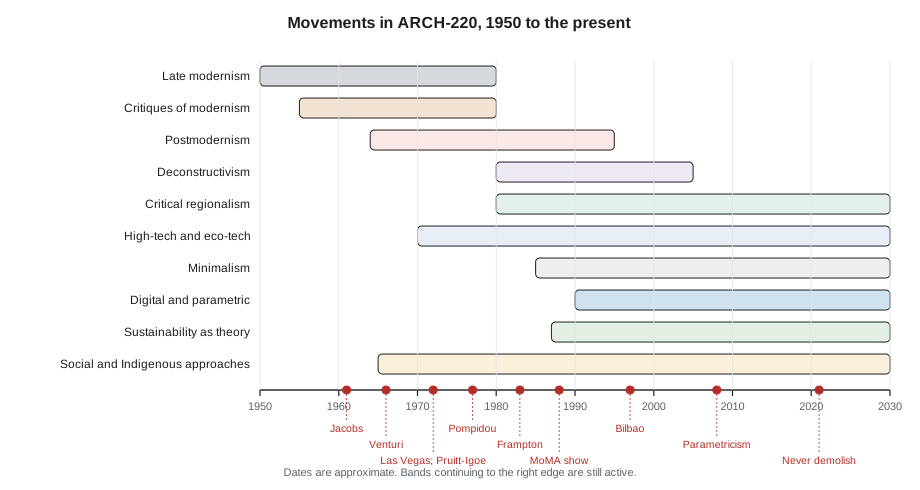
The course follows the main lines of architectural thought since about 1960. Lesson 2 examines the critiques of modernism: the attacks by Jane Jacobs and others on urban renewal, the failure of large housing projects such as Pruitt-Igoe, and the search for alternatives by groups such as Team 10. Lesson 3 studies postmodernism, which argued that architecture is a language and that modernism had made it mute. Lesson 4 turns to deconstructivism, which used philosophy and fragmentation to question the stability of form. Lesson 5 examines critical regionalism, an attempt to resist placeless global architecture by grounding buildings in climate, light, topography and craft.
Lessons 6 and 7 study two movements that continued modernism by other means: high-tech architecture, which celebrated structure and services, and minimalism, which reduced architecture to light, material and proportion. Lesson 8 looks at digital and parametric design, where the computer changed both how buildings are imagined and how they are made. Lesson 9 asks whether sustainability is merely a technical requirement or a theory in its own right, one that may change what architecture is for. Lesson 10 considers architecture and social justice, from housing and segregation to accessibility, gender and Indigenous design. Lesson 11 studies global practice: starchitects, international firms, the Bilbao effect and the ethics of building abroad. Lesson 12 teaches you to write about architecture, so that you can join the conversation yourself.
# How many of the course's movements were active in a given year?
movements = {
    "Late modernism": (1950, 1980),
    "Critiques of modernism": (1955, 1980),
    "Postmodernism": (1964, 1995),
    "Deconstructivism": (1980, 2005),
    "Critical regionalism": (1980, 2026),
    "High-tech": (1970, 2026),
    "Minimalism": (1985, 2026),
    "Digital and parametric": (1990, 2026),
    "Sustainability as theory": (1987, 2026),
    "Social and Indigenous approaches": (1965, 2026),
}

def active(year):
    return [name for name, (a, b) in movements.items() if a <= year <= b]

for year in (1960, 1975, 1990, 2005, 2026):
    names = active(year)
print(year, len(names), "active:", ", ".join(names))1960 2 active: Late modernism, Critiques of modernism 1975 5 active: Late modernism, Critiques of modernism, Postmodernism, High-tech, Social and Indigenous approaches 1990 8 active: Postmodernism, Deconstructivism, Critical regionalism, High-tech, Minimalism, Digital and parametric, Sustainability as theory, Social and Indigenous approaches 2005 7 active: Deconstructivism, Critical regionalism, High-tech, Minimalism, Digital and parametric, Sustainability as theory, Social and Indigenous approaches 2026 6 active: Critical regionalism, High-tech, Minimalism, Digital and parametric, Sustainability as theory, Social and Indigenous approaches
The dates in the script are approximate, and you could argue about each of them. That is the point of the exercise. In 1960 only two of the course's movements were active, and modernism still looked like the only serious option. By 1990 nearly all of them were active at once. Contemporary architecture is plural: there is no single accepted style, and every architect has to decide where to stand.
How to read a theoretical text
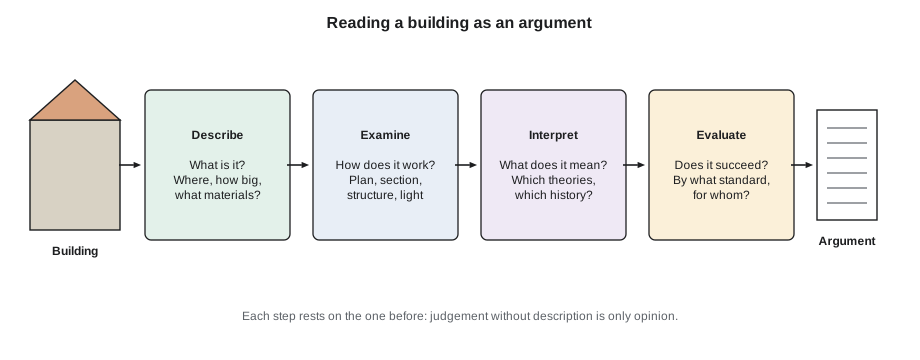
Theoretical writing in architecture is often difficult. Some of it is written by philosophers, some by architects writing outside their expertise, and some is deliberately provocative. The following method will help. First, identify the author's question. What problem is the text trying to solve, and why did it seem urgent at the time? Venturi's Complexity and Contradiction in Architecture of 1966 is easier to understand if you know that he was writing against the plain glass boxes being built in every American city. Second, identify the claims. Write them down in one sentence each, in your own words. Third, identify the evidence. Does the author rely on historical examples, on built work, on philosophy, on statistics or on personal experience? Fourth, test the claims against buildings you know. Fifth, ask what the text leaves out: which buildings, people, places or questions are missing.
Read with a pencil. Mark the sentences you would quote in an essay, and keep quotations short; the strongest essays paraphrase most of what they cite and quote only the phrases that cannot be improved. Note page numbers so you can cite them later. When a text uses an unfamiliar term, look it up in a dictionary of architecture before guessing. Finally, read the text twice, the first time quickly for the argument and the second time slowly for the details.
| Kind of text | Typical form | Example | Questions to ask |
|---|---|---|---|
| Manifesto | Short, polemical, rules | Loos, Ornament and Crime (1908 lecture, published 1910) | What is it against? What does it promise? |
| Treatise | Long, systematic | Vitruvius; Alberti; Le Corbusier, Towards an Architecture | What are the first principles? |
| Critical essay | Argument with examples | Frampton, Towards a Critical Regionalism (1983) | What evidence supports the claim? |
| Urban critique | Observation and argument | Jacobs, The Death and Life of Great American Cities (1961) | Whose experience does it describe? |
| Research study | Data and analysis | Learning from Las Vegas (1972) | How was the evidence gathered? |
| Exhibition catalogue | Curated selection | Deconstructivist Architecture, MoMA (1988) | Who was included and who was left out? |
Theory in buildings
Theory is not only written. Buildings themselves can be arguments. The Vanna Venturi House in Philadelphia (1962 to 1964), which Robert Venturi designed for his mother, was a manifesto in wood and plaster: a split gable, a broken arch, a chimney that pushes through the middle and a stair that squeezes around it, all in a small house that looks at first like a child's drawing. It argued against modernist purity more clearly than any essay. Similarly, Peter Eisenman's houses of the late 1960s and 1970s, numbered House I to House X, were built experiments in the idea that architecture could be a self-referential system of forms. Some were barely comfortable to live in, and that was part of the argument.
In Winnipeg you have a building of this kind not far from The Forks. The Saint-Boniface Cathedral, rebuilt by Étienne Gaboury within the walls of its predecessor after a fire in 1968 and completed in 1972, keeps the ruined stone façade of the old cathedral as a frame and places a new, lower church behind it. The design makes an argument about memory and continuity: the past is not restored, and it is not erased; it is held in view. As you study each movement in this course, look for buildings that argue, and practise reading the argument from the building itself before you read what the architect said about it.
Worked problem
Finding the theory in a design decision
Callum is designing a small library for studio. He proposes exposed glue-laminated timber columns and beams, left unfinished, with the ductwork visible below the roof deck. Dr. Arslan asks him to identify the theories behind his choice. What should he say?
Show solution
- Name the decision precisely: structure and services are left exposed, and the timber is not painted or covered.
- Identify the normative claim behind it: that a building should show how it is made, an idea of structural honesty that runs from Viollet-le-Duc through modernism to high-tech architecture.
- Identify a second claim: that natural materials are warmer and more appropriate for a library than plaster and paint, an idea associated with critical regionalism and with recent arguments about wood and carbon.
- Consider the counter-arguments: exposed services can be noisy and dusty, and honesty is not the only value; Venturi argued that a building may legitimately present a face different from its structure.
- Explain how the theory changes the design: if honesty matters, the connections between beams and columns must be designed to be seen, not hidden.
Answer: Callum's choice rests on at least two theories, structural honesty and the value of natural materials. Naming them lets him defend the decision, anticipate objections and design the details with more care.
Exercise 1: a theory journal
This exercise begins a journal you will keep all term. It takes about two hours each week.
- Buy or make a sketchbook used only for this course. On the first page, write your own answer to the question: what is architecture for? Keep it to one paragraph.
- Each week, visit one building in your city built after 1960, sketch it from at least two viewpoints and write one paragraph describing it and one paragraph identifying the theory or theories it seems to express.
- Each week, summarize the main reading in five sentences: the question, the main claims, the evidence, one example you agree with and one you doubt.
- At the end of the term, reread your first page and write a second answer to the same question.
- Deliverable this week: the first page, one building study and one reading summary.
Self-critique checklist
- Have I separated what I see in the building from what I think it means?
- Have I named the theory precisely, rather than saying a building is simply modern or interesting?
- Have I written the author's claims in my own words?
- Have I found at least one point where I disagree with the author or the architect?
Common mistakes
MistakeThinking theory is only for academics.
InsteadEvery design decision rests on assumptions about what is good; theory makes them visible and open to judgement.
MistakeConfusing theory with style.
InsteadA style is a set of visual features; a theory is an argument about what architecture should be. Several styles can follow from one theory.
MistakeReading only what the architect says about a building.
InsteadArchitects describe their intentions, but the building, its users and its critics may tell a different story.
MistakeQuoting long passages instead of explaining them.
InsteadParaphrase most of what you read and quote only short, essential phrases, with page numbers.
Summary and key terms
- Architectural theory is a body of ideas about what architecture is, what it is for and how it should be made; it connects history and criticism.
- Theories can be normative, analytical or critical, and most texts combine all three.
- The theory tradition runs from Vitruvius to the present; the texts in this course were written mostly after 1960.
- Contemporary architecture is plural: by 1990 nearly all the movements in this course were active at once.
- Buildings themselves can be arguments, and reading the argument in a building is a core skill of this course.
- Architectural theory
- A body of ideas about what architecture is, what it is for and how it should be made.
- Normative theory
- A theory that says what architecture ought to be, often expressed as rules or manifestos.
- Critical theory
- A theory that examines architecture as part of society, asking whose interests it serves.
- Manifesto
- A short, polemical text that declares a position and calls for change.
- Architectural criticism
- The judgement of particular buildings, usually recent ones, for a public audience.
Practice problems
Work each problem on paper first, then reveal the answer to check.
What is the difference between architectural history, theory and criticism?
Show answer
History explains what was built and why; criticism judges particular buildings; theory provides the ideas and standards that connect them.
Name the three parts of Vitruvius's triad.
Show answer
Firmness, commodity and delight.
What are the three kinds of theory described in this lesson?
Show answer
Normative, analytical and critical.
Give one example of a building that is also an argument.
Show answer
The Vanna Venturi House (1962 to 1964), which argued against modernist purity.
List the five steps for reading a theoretical text.
Show answer
Identify the question, the claims and the evidence; test the claims against buildings; ask what is left out.
Lesson quiz · 5 questions
Score 60% or more to complete this lesson.
Create a free account to save your progress, take quizzes and earn a certificate.