
ARCH-101 · Lesson 9 of 12 · 22 min
Iteration and development
Halfway through the term, Visser asks the students to lay out every drawing and model they have made for Margit's house on the long table in the corridor. Callum's pile is thin: one plan, refined many times, and one model. Wren's is enormous: dozens of tracing sheets, a row of little foam blocks, three cardboard models of different roof forms and a sketchbook full of arrows. Ingrid's and Joon-ho's fall somewhere in between. 'Callum,' Visser says, 'your plan is the most polished in the room. It is also the only idea you have had since week two.' Callum shrugs. 'It works.' 'It works,' she agrees. 'But you do not know whether it is the best answer, because you never asked another question. Wren, you have asked a hundred questions. This week you have to start answering them.' Both students, in different ways, have just met the central problem of design development.
Design is iterative
Few good designs arrive complete. Most develop through iteration: a repeated cycle of proposing an idea, representing it in a drawing or model, testing it against the program, the site and the designer's intentions, and revising it. Each cycle improves the design and, just as importantly, improves the designer's understanding of the problem. Early in a project, iterations are fast and loose, a sketch in a few minutes, a foam block in a few seconds. Later they slow down and grow more detailed, as each change has more consequences.
Researchers who study design describe this as a conversation between the designer and the work. Donald Schön, in The Reflective Practitioner (1983), described designers making a move, seeing what it does, and responding to the situation it creates, a process he called reflection-in-action. The drawing talks back. A line drawn to place a wall reveals that the room behind it has no light, which prompts a new move. Iteration is how this conversation happens.
Diverge, then converge
Design alternates between two kinds of thinking. Divergent thinking generates many possibilities, without judging them too early: different plan arrangements, roof forms, entry positions, structural systems. Convergent thinking evaluates, selects and refines, narrowing the options toward one. The psychologist J. P. Guilford described these two modes of thought in the 1950s; designers often draw the process as a series of diamonds, each widening as ideas are generated and narrowing as they are chosen.
Both are needed, in the right order. Callum converged too early: he chose his first idea and polished it, never testing whether another arrangement might be better. Wren diverged too long: she kept generating options and could not commit. Visser's rule is simple. At each major stage, develop at least three genuinely different options, evaluate them openly, choose one, and develop it, knowing that some of what was learned from the others will feed into it.
Genuinely different is the key phrase. Three versions of the same plan with the kitchen moved a little are one option, not three. Different options start from different ideas: a linear house along the terrace, a compact square house around a central hearth, a house in two wings around a courtyard. Each represents a different answer to the question of what this house should be.
Working at the right scale and speed
A common reason for slow progress is working at too large a scale too early. A house drawn at 1:50 in week two invites fiddling with wall thicknesses and door swings when the real question is still whether the house should be one bar or two. Early iterations belong at small scale, 1:200 or 1:500, with soft pencils, thick pens and rough models, where details cannot be drawn and only big ideas can. As the design converges, the scale increases: 1:100 for the developed plan and section, 1:50 for rooms and furniture, 1:20 for key details.
Speed matters too. Wren's foam blocks took seconds each, and she made twenty in an afternoon. A model that takes a week to build is too precious to be cut up and changed. Study models should be fast, cheap and expendable, made of foam, card, clay, wood scraps or anything at hand, so that the designer is happy to destroy them in favour of a better idea. Presentation models come at the end, once the design is settled.
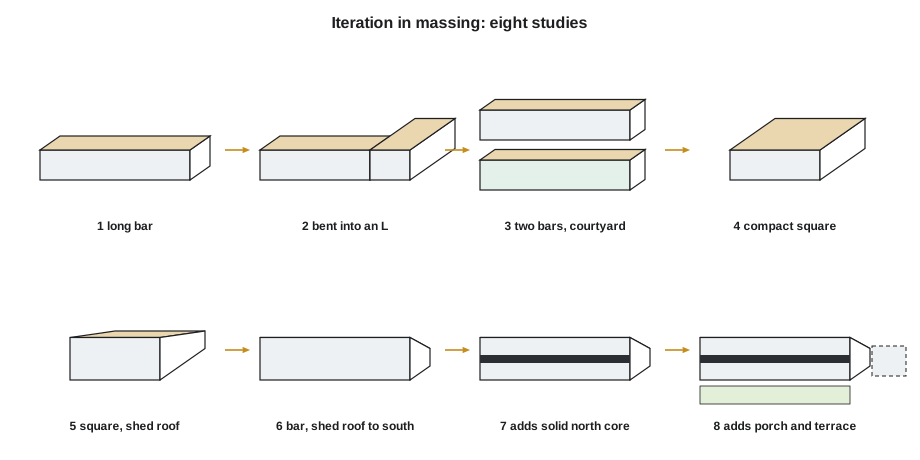
Testing options
Options are tested against criteria drawn from the program and the site analysis. For Margit's house these include: Does every room have the light and view it needs? Is daily circulation short and easy for a wheelchair? Are the bedrooms private and Elias's drums separated? Does the house shelter itself from the wind and admit the winter sun? Does it fit the setbacks and the budget area? Does it feel like a home rather than a facility? Some criteria are measurable, such as area, perimeter, travel distance or glazing ratio. Others are matters of judgement, such as character, delight or fit with the landscape.
A decision matrix lists the options in columns and the criteria in rows, assigns each criterion a weight according to its importance, and scores each option. The matrix does not make the decision. Its value is that it makes the reasoning explicit and shows which criteria the decision depends on. If a small change in weights would reverse the result, the options are close, and the designer should look for a hybrid that takes the best of both.
# A weighted decision matrix for three schemes, with a check of how sensitive it is
criteria = {           # weight (importance out of 5)
    "light and view": 5, "short daily routes": 5, "privacy and sound": 4,
    "winter sun and wind": 4, "compactness (heat, cost)": 3, "feels like home": 5,
}
scores = {             # 1 (poor) to 5 (excellent), from pin-up discussion
    "linear bar":  {"light and view": 5, "short daily routes": 3, "privacy and sound": 4,
                    "winter sun and wind": 5, "compactness (heat, cost)": 3, "feels like home": 4},
    "compact square": {"light and view": 3, "short daily routes": 5, "privacy and sound": 3,
                    "winter sun and wind": 3, "compactness (heat, cost)": 5, "feels like home": 4},
    "two wings, court": {"light and view": 4, "short daily routes": 3, "privacy and sound": 5,
                    "winter sun and wind": 4, "compactness (heat, cost)": 2, "feels like home": 5},
}
def total(w):
    return {k: sum(w[c] * s[c] for c in w) for k, s in scores.items()}
base = total(criteria)
best = max(base, key=base.get)
print("base weights:", base, "->", best)
for c in criteria:   # how much would one weight have to rise to change the winner?
    for extra in range(1, 6):
        w = dict(criteria); w[c] += extra
        t = total(w); win = max(t, key=t.get)
        if win != best:
            print(f"  '{c}' raised by {extra} -> {win} wins")
            break
    else:
print(f" '{c}': winner unchanged even if raised by 5")base weights: {'linear bar': 105, 'compact square': 99, 'two wings, court': 102} -> linear bar
'light and view': winner unchanged even if raised by 5
'short daily routes' raised by 4 -> compact square wins
'privacy and sound' raised by 4 -> two wings, court wins
'winter sun and wind': winner unchanged even if raised by 5
'compactness (heat, cost)' raised by 4 -> compact square wins
'feels like home' raised by 4 -> two wings, court winsThe matrix puts the linear bar only three points ahead of the two-wing scheme, and the sensitivity check shows that the courtyard would win if the students valued privacy or the feeling of home just a few points more. That is a useful finding: the choice between the two depends on judgements the group has not yet agreed. It leads Joon-ho to propose a hybrid: the linear bar of the first scheme, folded slightly at the west end to make a sheltered courtyard corner like the second, with the bathroom, kitchen and Margit's bedroom pulled together into a short loop as the compact scheme did.
Keeping a record
Iteration produces a large amount of material, and keeping it organized is part of the discipline. Drawings and models should be dated, numbered and kept, not thrown away when a new version appears. Tracing paper overlays make the history visible: each new layer refines the one beneath, and earlier ideas can be recovered. On the computer, saving numbered versions rather than overwriting a single file does the same job. A design journal or sketchbook, with notes on what was tried and why it was kept or dropped, is invaluable when the design must later be explained, and when a rejected idea suddenly becomes useful again.
Photographing study models from consistent viewpoints, including eye level, allows quick comparison. Wren lines up her twenty foam blocks on a strip of card, photographs them in sequence from the same angle and pins the strip to the wall. The sequence itself becomes a drawing of her thinking.
Letting go
Designers become attached to ideas. A favourite gesture, such as a dramatic roof or a beautiful corner, can survive long after it has stopped serving the project, because its designer cannot bear to lose it. Writers call this problem killing your darlings, and architects face it constantly. The test is whether the idea still does work for the design: if removing it makes the house worse, keep it; if the house is better without it, let it go. Ideas abandoned this way are rarely wasted. They return in later projects, often in better form.
Callum's difficulty is the opposite: attachment to a first plan simply because it was first and works well enough. The economist and design theorist Herbert Simon coined the word satisficing in the 1950s, and later applied it to design in The Sciences of the Artificial (1969), for the choice of the first solution that meets the minimum requirements, rather than the search for the best. Satisficing is sometimes sensible, when time is short and the stakes are low. In a design studio, where the point is to learn, it is a missed opportunity.
What design development means
In professional practice, design work is divided into phases. In Canada these are commonly called schematic design, design development and construction documents, followed by tendering and contract administration. Schematic design establishes the overall concept, the plan arrangement, the massing and the approximate cost. Design development refines it: every room is dimensioned, the structure and services are coordinated, materials and windows are selected, and the design is drawn at larger scales. Construction documents then describe the building in enough detail for a contractor to price and build it.
In studio, design development is the stage after a scheme has been chosen, when it is worked out in increasing depth. The danger at this stage is that the clarity of the original idea is lost under the pressure of practical demands: an extra closet here, a mechanical room there, a window moved for privacy. Good design development solves the practical problems in ways that strengthen the idea. If the idea is a bar one room deep along the south, the closet should go in the north core, not in a bump on the south wall.
Precedent: study models and process
Many architects are known for their working process as much as their finished buildings. Frank Gehry's office became famous for producing hundreds of study models of each project, in paper, card, wood and fabric, at several scales, so that ideas could be tested quickly and the most promising developed further; digital modelling came later and served to build what the models had found. Alvar Aalto worked through rapid, loose sketches in soft pencil, often drawing plan, section and perspective on the same sheet, so that ideas in one drawing fed the others. The forms differ, but the lesson is the same: the designer who tries many things quickly, and judges them honestly, learns faster than the one who perfects the first thing that works.
Worked problem
Choosing between two close schemes
The decision matrix gives the linear bar 105 points and the two-wing courtyard scheme 102. Ingrid wants to toss a coin. What should she do instead?
Show solution
- Recognize that a two-point difference is within the uncertainty of the scores; the matrix is telling her the schemes are equally good overall.
- List the criteria on which each scheme is clearly stronger: the bar wins on winter sun and compactness; the courtyard wins on privacy and on feeling like home.
- Ask whether a hybrid could combine the strengths: a bar with a small courtyard corner at its west end, or a courtyard scheme with a more compact north wing.
- Sketch the hybrid quickly at small scale and score it with the same matrix.
- If the hybrid is clearly better, develop it; if not, choose the scheme that best serves the criterion Margit cares about most, which from the interviews is feeling at home.
Answer: A close result is a signal to look for a hybrid, and if none emerges, to decide on the criterion that matters most to the client, not by chance.
Exercise 9: three and one
This exercise takes about twelve hours over a week.
- Develop three genuinely different schemes for Margit's house at 1:200, each with a plan, a section and a quick massing model.
- Write the criteria for evaluation from the program and site analysis, agree weights with your studio group and score the schemes in a decision matrix.
- Present the three to the group; listen to critique and record it.
- Choose one scheme, or a hybrid, and develop it at 1:100 with a revised plan, two sections and a better model.
- Keep and number every drawing and photograph every model; assemble them into a process sheet showing the sequence of iterations.
- Deliverable: the three schemes, the matrix, the developed scheme and the process sheet.
Self-critique checklist
- Are my three schemes based on different ideas, not variations of one?
- Have I tested them against explicit criteria?
- Have I carried the best lessons of the rejected schemes into the chosen one?
- Is my developed scheme clearer than the sketch it came from, or muddier?
- Can someone follow my thinking from the process sheet?
Common mistakes
MistakePolishing the first idea without testing alternatives.
InsteadDevelop at least three genuinely different options before choosing.
MistakeGenerating options endlessly without committing.
InsteadSet a deadline for each stage, evaluate and choose.
MistakeWorking at a large scale too early.
InsteadExplore big ideas at small scale; increase scale as the design converges.
MistakeThrowing away earlier drawings and models.
InsteadKeep, date and number everything; earlier ideas can return.
MistakeLetting practical additions blur the main idea.
InsteadSolve problems in ways that strengthen the concept.
Summary and key terms
- Design develops through iteration: propose, represent, test and revise, in repeated cycles.
- Divergent thinking generates options; convergent thinking evaluates and selects. Both are needed, in turn.
- Early iterations should be quick, cheap and at small scale; scale and detail increase as the design converges.
- Decision matrices make evaluation explicit; close results suggest hybrids.
- Design development refines a chosen scheme while keeping its idea clear.
- Iteration
- A repeated cycle of proposing, testing and revising a design.
- Divergent thinking
- Thinking that generates many possibilities.
- Convergent thinking
- Thinking that evaluates and narrows possibilities to one.
- Decision matrix
- A table scoring options against weighted criteria.
- Design development
- The phase in which a chosen scheme is refined and coordinated in detail.
Practice problems
Work each problem on paper first, then reveal the answer to check.
What did Schön mean by reflection-in-action?
Show answer
Making a design move, seeing what it does and responding to the new situation, in a conversation with the work.
Why should early study models be cheap and fast?
Show answer
So the designer is willing to change or destroy them in favour of better ideas.
Three plans differ only in the position of the kitchen. How many options are they?
Show answer
Essentially one; genuinely different options start from different ideas.
What is satisficing?
Show answer
Herbert Simon's term for accepting the first solution that meets minimum requirements rather than seeking the best.
What happens in design development?
Show answer
The chosen scheme is dimensioned, coordinated with structure and services, and drawn at larger scale while its idea is kept clear.
Lesson quiz · 5 questions
Score 60% or more to complete this lesson.
Create a free account to save your progress, take quizzes and earn a certificate.