
APT-310 · Lesson 9 of 12 · 23 min
Charging equipment and accessories
▶ Video coming soon A video version of this lesson is on the way.
Harlan Quistberg had signed for one of the dealership's first Marlo EVs, due in December, and in mid-November he came to the parts counter with a list. "What do I need to charge it at home? Can I put the charger in myself? And will it work at the fast chargers on the highway?" Talia had been reading Tessaro's charging guide for a week and was glad of the chance to use it. The car would come with a portable charging cord that plugged into an ordinary household outlet, slow but useful, and could also be used with the right outlet installed by an electrician. For daily charging, most owners chose a wall-mounted Level 2 unit, such as Tessaro's 48 A home charger sold through the parts department. The Marlo EV's charge port used the SAE J3400 connector, so it would plug straight into chargers with that connector; for public chargers with the older J1772 or CCS1 connectors, Tessaro supplied or sold approved adapters. And no, he should not install the wall unit himself. "That's a job for a licensed electrician," Talia said, "with the permit. I can sell you the unit and the electrician does the rest."
What is actually charging the car
In everyday speech, the box on the garage wall is the charger. Technically, for AC charging the charger is inside the car: the onboard charger converts AC from the grid into DC for the battery. The wall unit is electric vehicle supply equipment (EVSE): it supplies AC safely, talks to the car to agree how much current it may draw, and switches the power on only when the connector is locked in and everything checks out. At a DC fast charger, the charger is in the station, which sends DC straight to the battery, bypassing the onboard charger. These details matter at the counter because a customer may expect a wall unit to charge faster than the car's onboard charger allows.
Charging levels
Charging is described by levels, which group charging by voltage and power.
| Level | Supply | Typical power | Typical use |
|---|---|---|---|
| Level 1 (AC) | 120 V household outlet, usually 12 A | About 1.4 kW | Overnight top-up for short daily driving; plug-in hybrids |
| Level 2 (AC) | 208 V or 240 V, commonly 32 A, 40 A or 48 A, up to 80 A | About 7 to 11.5 kW; up to about 19 kW | Home, workplace and public chargers; full charge overnight |
| DC fast charging | DC from the station, at hundreds of volts | Typically 50 to 350 kW | Highway trips; limited by the vehicle's maximum and the battery's temperature and state of charge |
A vehicle charges at the lowest of three limits: what the supply can deliver, what the EVSE is set to provide, and what the car's onboard charger (for AC) or battery (for DC) can accept. The Marlo EV's onboard charger is rated 11 kW, so a 48 A Level 2 unit at 240 V (about 11.5 kW) is a good match; a larger unit would not charge it faster. DC fast charging slows as the battery fills, usually sharply above about 80 in 100 state of charge, and in cold weather until the battery warms.
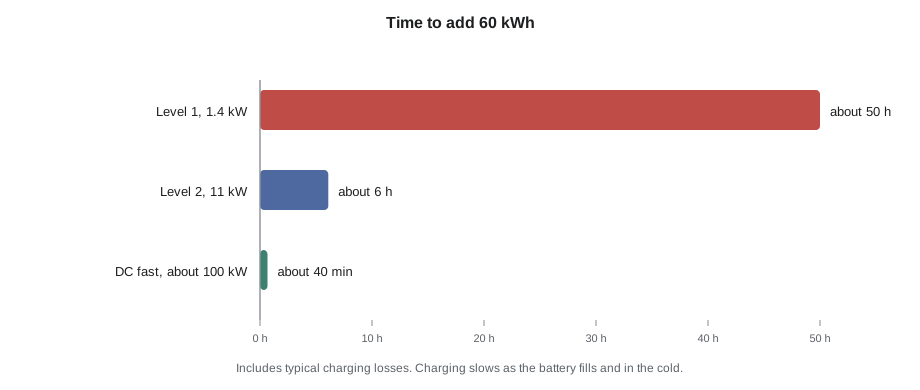
Worked problem
How long will a home charge take?
Harlan drives about 60 kWh worth of energy out of the Marlo EV's battery in a busy week and wants to replace it in one night on the 48 A Level 2 unit, which the car's onboard charger will accept at 11 kW. If about 90 in 100 of the energy drawn from the wall reaches the battery, how long will it take?
Show solution
- Energy drawn from the wall:
- \[\frac{60}{0.90} = 66.7 \text{ kWh}\]
- Time at 11 kW:
- \[\frac{66.7}{11} = 6.1 \text{ h}\]
- The same charge on Level 1 at 1.4 kW:
- \[\frac{66.7}{1.4} = 47.6 \text{ h}\]
Answer: About 6 hours on Level 2, so overnight is easy, against nearly two days on Level 1. Talia showed Harlan the comparison, and he decided on the wall unit. The efficiency figure is typical; losses vary with temperature and charging rate.
Connectors
Four connector types are common in North America, and a parts person needs to recognize each one.
- SAE J1772 (often called J-plug or Type 1): the AC connector used for Level 1 and Level 2 by almost all non-Tesla EVs and plug-in hybrids sold in North America until recently. Most public Level 2 chargers still have it.
- CCS1 (Combined Charging System): a J1772 connector with two large DC pins below it, used for DC fast charging by many EVs.
- SAE J3400, the North American Charging Standard (NACS): a compact connector, developed by Tesla and standardized by SAE, that carries both AC and DC through the same pins. From 2025, a growing number of makers fitted J3400 inlets to new models, and fast-charging networks have been adding J3400 cables alongside CCS1. Tessaro chose J3400 for the Marlo EV.
- CHAdeMO: an older DC fast-charging connector used by some earlier EVs, now rarely fitted to new vehicles in North America.
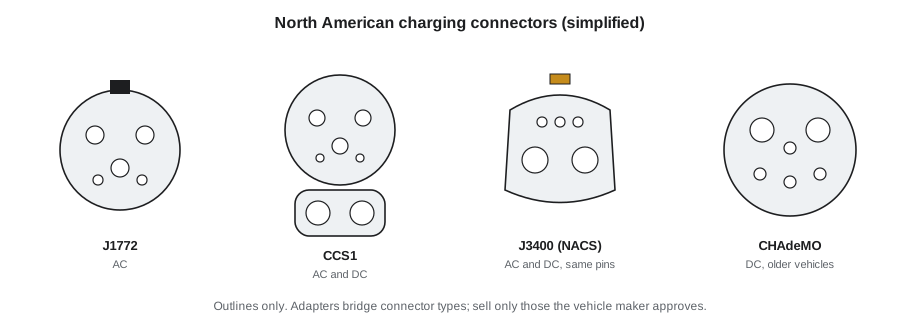
Because the changeover from J1772 and CCS1 to J3400 is still under way, adapters are a common sale. A J3400 vehicle such as the Marlo EV uses a J1772-to-J3400 adapter at J1772 Level 2 chargers and a CCS1-to-J3400 adapter at CCS1 fast chargers. A CCS1 vehicle uses a J3400-to-CCS1 adapter at J3400 fast chargers where its maker allows it. Adapter rules at the counter:
- Sell only adapters the vehicle maker lists or approves for the vehicle. DC adapters carry hundreds of amperes at hundreds of volts; a poor adapter can overheat or fail.
Check the certification mark. Charging equipment and adapters sold in Canada should carry a recognized Canadian certification mark, such as CSA or cUL.
- Explain the limits. Some adapters work only for AC, some only for DC, and some networks or vehicles do not allow adapters at certain stations.
- Never sell an adapter to plug an EV into an outlet it was not designed for, such as a dryer outlet adapter or a homemade cord. These cause fires.
Home charging equipment
The wall units and cords the parts department sells differ in:
- Maximum current (for example 32, 40 or 48 A), which sets the circuit it needs.
- Hardwired or plug-in. A hardwired unit is wired directly to its circuit. A plug-in unit plugs into a high-power receptacle, commonly a NEMA 14-50, which must be installed and protected as the electrical code requires.
- Connector type and cable length: J1772 or J3400; cables of 5 to 7.5 m (16 to 25 ft) are common.
- Indoor or outdoor rating, and suitability for cold climates.
- Smart features: scheduling for lower electricity rates, Wi-Fi, energy tracking, and load management, which reduces charging current when the house is drawing a lot, sometimes avoiding an electrical service upgrade.
Portable cords that come with many EVs can charge from a standard 120 V outlet and, with an interchangeable plug, from a 240 V receptacle. They are convenient but should be plugged only into receptacles in good condition that are rated for the load, and never through an extension cord unless the cord maker allows it.
Installation: licensed electricians, permits and code
A Level 2 unit draws a large, steady current for hours, which is exactly the kind of load that overheats poor wiring. Its installation is electrical work governed by the electrical code, and the parts counter's job is to sell the equipment and point the customer to a licensed electrician.
In Ontario, electrical work in a home must be done by a Licensed Electrical Contractor, licensed by the Electrical Safety Authority (ESA), and a notification of work must be filed with ESA before the installation starts; the contractor normally files it. The work must follow the Ontario Electrical Safety Code, which adopts the Canadian Electrical Code with Ontario amendments; Section 86 covers electric vehicle charging. ESA also advises that the equipment carry an official Canadian certification mark. A homeowner who does their own electrical work must also file with ESA and arrange inspection, but most owners and the parts department's advice choose a licensed contractor.
Electrical codes treat EV charging as a continuous load, which means the circuit's overcurrent device must be rated at least 125 in 100 of the charger's continuous current. That is why a 48 A unit needs a 60 A circuit. The electrician also checks that the home's electrical service can carry the extra load, and may recommend load management or a service upgrade.
Worked problem
Sizing the circuit
Harlan's electrician asks what circuit the Tessaro 48 A home charger needs. Using the continuous load rule, what is the minimum breaker rating?
Show solution
- Multiply the continuous current by 125 in 100:
- \[48 \times 1.25 = 60 \text{ A}\]
Answer: A 60 A breaker, with wire sized to match, as the electrician will determine under the code. A 40 A unit would need 50 A; a 32 A unit, 40 A. The parts counter can quote the unit's rating and the installation manual; the electrician designs the circuit.
Charging accessories at the counter
Charging brings a range of accessory sales, many of them new to a parts department used to gaskets and filters:
- Wall units, portable cords and replacement plugs for portable cords.
- Adapters, as described above, and protective cases for them.
- Cable holders, wall brackets and connector holsters, which keep connectors off the floor and away from damage.
- Charge port covers and inlet parts, sold by the service department after damage.
- 12 V battery maintainers suited to the EV's 12 V battery type.
Charging equipment is electronic and electrical, and Linmore treats it like other electronic parts for returns: unopened and unused units are returnable within the policy; installed units are handled through the maker's warranty, as lesson 11 explains. Cords and adapters are also common theft targets, so the display stock is locked or kept behind the counter.
Answering common charging questions
The parts counter is often where a new EV owner asks the questions the salesperson did not cover. Talia kept a short set of answers, checked against Tessaro's charging guide:
- "Can I charge in the rain or snow?" Yes. Charging equipment and vehicle inlets are designed for outdoor use, and the EVSE does not energize the connector until it is locked into the vehicle and has checked the connection. Damaged cords and connectors must not be used.
- "Should I charge to 100 every night?" Many makers recommend a daily limit below full, often around 80 in 100, and charging to full before long trips, to reduce battery wear. The vehicle's settings let the owner choose, and Tessaro's owner guide gives its recommendation.
- "Why does my car charge slowly in winter?" A cold battery accepts charge slowly until it warms. Scheduling the charge to finish shortly before departure, or preconditioning while plugged in, helps.
- "Can I use an extension cord with the portable cord?" Generally not, unless the cord maker allows it. Extension cords can overheat under the long, steady load of charging.
- "Can I charge another make of EV on my Tessaro wall unit?" Usually yes, with the right connector or adapter, since the charging protocols are shared.
- "Where are the public chargers?" The vehicle's navigation and the charging networks' apps show them, with their connectors and power levels.
When a question goes beyond the parts counter, such as electricity rates, rebates or electrical service upgrades, the right answer is a referral: the utility, the government program, or the electrician. A parts person who knows the limits of their own advice earns trust.
Warranty and returns also come up. A wall unit or cord that fails is covered by its maker's warranty, which usually needs proof of purchase and, for wall units, proof that a licensed electrician installed it. Keep that in mind when a customer mentions installing one themselves.
Talia also learned to ask where the customer will park. A garage, a carport and a driveway call for different cable lengths, mounting positions and outdoor ratings, and an apartment or condominium resident may need the building's permission and a shared charging solution rather than a wall unit of their own. Those questions take a minute and prevent a return.
Common mistakes
MistakeTelling a customer a bigger wall unit will always charge faster.
InsteadThe car charges at the lowest limit: supply, EVSE or onboard charger.
MistakeSelling any adapter that fits.
InsteadSell adapters the vehicle maker lists or approves, with a recognized certification mark.
MistakeSuggesting the customer install a Level 2 unit themselves.
InsteadPoint them to a licensed electrician and the permit or notification the code requires.
MistakeQuoting a 48 A unit on a 50 A circuit.
InsteadEV charging is a continuous load; 48 A needs at least a 60 A circuit.
MistakeLeaving charging cords on an open display.
InsteadKeep high-value cords and adapters locked or behind the counter.
Summary and key terms
- For AC charging the charger is in the car; the wall unit is EVSE. DC fast chargers send DC directly to the battery.
- Level 1 is about 1.4 kW, Level 2 about 7 to 11.5 kW, DC fast charging typically 50 to 350 kW; the car charges at the lowest limit.
- Connectors are J1772 (AC), CCS1 (AC and DC), J3400 (AC and DC in one) and older CHAdeMO; adapters bridge them during the changeover.
- Level 2 installations need a licensed electrical contractor and an ESA notification of work in Ontario, under the Ontario Electrical Safety Code.
- EV charging is a continuous load: the circuit must be rated at least 125 in 100 of the charger's current.
- EVSE
- Electric vehicle supply equipment: the wall unit or cord that safely supplies AC power to the vehicle.
- Onboard charger
- The unit in the vehicle that converts AC into DC for the battery during Level 1 and Level 2 charging.
- SAE J1772
- The North American AC charging connector used by most non-Tesla EVs until recently.
- CCS1
- The Combined Charging System connector: J1772 plus two DC pins for fast charging.
- SAE J3400
- The North American Charging Standard connector, carrying AC and DC through the same compact plug.
- Continuous load
- A load that runs for three hours or more; its circuit must be rated at least 125 in 100 of the load current.
Practice problems
Work each problem on paper first, then reveal the answer to check.
What minimum circuit rating does a 40 A wall unit need?
Show answer
40 × 1.25 = 50 A.
A car's onboard charger is rated 7.2 kW. Will an 11.5 kW wall unit charge it faster than a 7.7 kW unit?
Show answer
No; the car is limited to 7.2 kW by its onboard charger.
About how long does it take to put 30 kWh into a battery from the wall at 7 kW, ignoring losses?
Show answer
30 ÷ 7 = about 4.3 hours.
Which connector carries both AC and DC through the same pins?
Show answer
SAE J3400 (NACS).
Why should only maker-approved adapters be sold for DC fast charging?
Show answer
They carry very high current and voltage; a poor adapter can overheat or fail.
Lesson quiz · 5 questions
Score 60% or more to complete this lesson.
Create a free account to save your progress, take quizzes and earn a certificate.