
APT-310 · Lesson 7 of 12 · 21 min
Hybrid vehicle components
▶ Video coming soon A video version of this lesson is on the way.
In mid-October, a technician on the quick-service line asked the front counter for "a battery for the Vela in bay three". Talia, who by then knew the Vela's H7 AGM battery by heart, had pulled one from the shelf and was printing the ticket when Imani glanced at the repair order. The VIN's eighth character showed a hybrid powertrain. "Bay three is a Vela Hybrid," she said. "No alternator, no starter, and the 12 V battery is a small AGM in the trunk, a different group size. The big battery under the back seat is the high-voltage one, and we don't touch that." Talia put the H7 back, found the Vela Hybrid's auxiliary battery, and added a note to her own checklist: decode the powertrain, every time. It was the first time she realized how many of the parts she sold for the Vela were different on its hybrid twin.
Kinds of hybrid
A hybrid vehicle combines an internal combustion engine with at least one electric motor and a battery that the vehicle charges itself, mostly by regenerative braking: using the motor as a generator to slow the vehicle and recover energy. The kinds differ by how much the electric side does.
| Kind | Battery and voltage | What the electric side does | Examples in this course |
|---|---|---|---|
| Mild hybrid | 48 V lithium-ion, usually under 1 kWh | Restarts the engine, assists it briefly, recovers braking energy; cannot drive the vehicle on electricity alone for any distance | Arden with option MH4 (2026 on) |
| Full hybrid | High voltage, typically 200 to 300 V and about 1 to 2 kWh | Can drive the vehicle on electricity at low speed, assists the engine strongly, recovers braking energy | Vela Hybrid (2025 on), about 260 V |
| Plug-in hybrid (PHEV) | High voltage, larger pack, often 10 to 25 kWh | Drives on electricity for a useful distance, then works as a full hybrid; charged from the grid through a charge port | Not in the Tessaro lineup yet |
| Battery electric (BEV) | High voltage, large pack, often 40 to 100 kWh or more | Drives on electricity only; no engine | Marlo EV (2027), lesson 8 |
Full hybrids are built in two common layouts. In a power-split design, a planetary gear set joins the engine and two motor-generators, so the engine and motors share the work in any proportion. In a parallel (P2) design, one motor sits between the engine and the transmission, with a clutch so the engine can be disconnected. The Vela Hybrid uses a power-split transaxle with two motor-generators, called MG1 and MG2 in Tessaro's literature. A parts person does not need to diagnose either layout, but the layout explains why the transaxle, its fluid and its cooling are different from the conventional Vela's.
High-voltage components
The full hybrid's high-voltage system, and an EV's, is built from the same family of parts. Each is a separate service part, and some are among the most expensive parts a dealer stocks or orders.
- HV battery: lithium-ion on most current vehicles, nickel-metal hydride (NiMH) on many older hybrids. It contains modules of cells, a battery management system that watches every cell's voltage and temperature, contactors (heavy relays) that connect and disconnect the pack, and fuses. Hybrid packs are usually air-cooled by a fan drawing cabin air, or liquid-cooled.
- Service disconnect: a plug or switch, often under a cover near the battery, that breaks the pack's circuit so a trained technician can make the system safe. Only trained technicians remove it.
- Inverter (power control unit): turns the battery's DC into the three-phase AC that drives the motors, and the motors' AC back into DC when they generate. It usually has its own coolant loop with an electric pump and its own coolant.
- Motor-generators: electric machines that drive the wheels, start the engine and generate electricity.
- DC-DC converter: steps high voltage down to about 14 V to run the 12 V system and charge the 12 V battery. It takes the place of the alternator. It is often inside the inverter housing.
- Electric A/C compressor: driven by an HV motor instead of a belt, so the cabin can be cooled with the engine off.
- High-voltage cables: thick cables with orange insulation or orange covering, the industry's colour code for high voltage under SAE J1673. Orange means: trained people only.
- High-voltage interlock loop (HVIL): a low-voltage circuit through the HV connectors and covers; if a connector or cover is removed, the system opens its contactors.
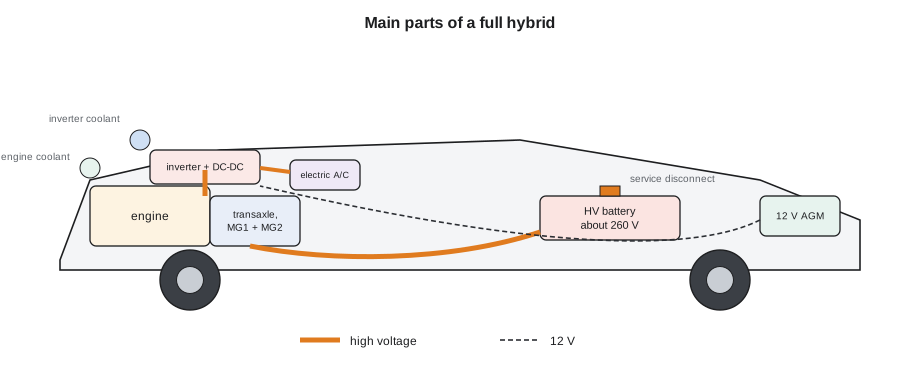
The parts that change on a hybrid
Many parts on a hybrid look like their conventional twins' but are different. A short list for the Vela Hybrid against the Vela 2.0 L turbo shows how far the differences go:
- 12 V battery: a smaller AGM auxiliary battery in the trunk, because it only has to wake the system and power accessories, not crank an engine. Hybrids are often towed in with a flat 12 V battery after sitting; the HV battery may be fully charged.
- No starter or alternator: the motor-generators start the engine and the DC-DC converter charges the 12 V battery.
- Engine: a different engine tuned for efficiency, with its own oil specification, often a very low viscosity such as 0W-16, spark plugs and filters.
- Coolant: two loops, one for the engine and one for the inverter, often with different coolants or service intervals. Selling the right coolant for each loop matters, as APT-230 showed for engine coolant.
- Brakes: regenerative braking does much of the stopping, so pads last longer, but rotors can rust and seize from light use. Many hybrids have an electrically controlled brake system that needs a maintenance mode before brake work.
- A/C: the electric compressor needs a special non-conductive compressor oil, usually a POE oil specified by the maker. Ordinary PAG oil in an electric compressor lowers the insulation between the HV windings and the case, and can set insulation faults or create a hazard. Service equipment used on electric compressors must be flushed or dedicated. When a shop buys A/C oil or a compressor for a hybrid, confirm the oil the maker specifies.
- Battery cooling filter: many air-cooled hybrid packs draw cabin air through an intake grille, often under or beside the rear seat, with a small filter. A clogged intake or filter, often from pet hair, makes the pack run hot. It is an easy, overlooked sale.
- Transaxle: a hybrid transaxle with its own fluid.
Mild hybrid parts
The 48 V mild hybrid, such as the Arden MH4, is closer to a conventional vehicle, but it has its own parts:
- Belt starter-generator (BSG): on the accessory belt in place of the alternator, restarting the warm engine, assisting it and recovering energy. Because it drives the engine through the belt, the belt and tensioner are heavier duty, and the correct parts matter even more.
- 48 V battery: lithium-ion, often under a seat or in the trunk, with its own management electronics.
- 48 V to 12 V DC-DC converter, charging the 12 V battery.
- 12 V battery: still present, often an AGM or EFB.
48 V parts are below the 60 V high-voltage line, but they still carry large currents and lithium-ion fire risk, and makers often require trained technicians and specific procedures for them. 48 V batteries are shipped as lithium-ion batteries, Class 9, as APT-220 described.
Worked problem
How much current does the DC-DC converter draw?
On the Vela Hybrid, the DC-DC converter supplies the 12 V system at 14 V and 150 A at full load. If the converter is 93 in 100 efficient, how much power does it draw from the 260 V HV battery, and how much current is that?
Show solution
- Output power on the 12 V side:
- \[P = 14 \times 150 = 2100 \text{ W}\]
- Input power, allowing for efficiency:
- \[P_{in} = \frac{2100}{0.93} = 2258 \text{ W}\]
- Input current at 260 V:
- \[I = \frac{2258}{260} = 8.7 \text{ A}\]
Answer: About 2,260 W and 8.7 A from the HV battery to supply 150 A on the 12 V side. The high voltage needs only a small current for the same power, as lesson 1 showed. The figures are typical teaching values, not Tessaro specifications.
Identifying hybrids at the counter
A hybrid badge on the back of a vehicle is not a reliable guide; badges come off, and some models carry none. Use these instead:
- The VIN. The vehicle descriptor section usually encodes the engine and powertrain. Tessaro's eighth character identifies the Vela Hybrid. Decode it every time.
- The catalogue's powertrain selection. Many catalogues list the hybrid as a separate engine or sub-model.
- What the technician sees: orange cables, an inverter in the engine bay, a READY light on the dash, no starter.
If the request says "Vela" and the parts differ by powertrain, ask. The few seconds it takes saved Talia a wrong battery and a second trip to the bay.
HV batteries as service parts
When a hybrid's HV battery fails, the dealer may replace the whole pack, a module or, on some vehicles, only a component such as a contactor or a fan. Packs are sold new or remanufactured, with a core charge, and the old pack goes back through the maker's return program. A hybrid pack is a lithium-ion battery (UN3480, Class 9) or a nickel-metal hydride battery with its own shipping entry, and it arrives in the maker's packaging with the maker's instructions. The parts department receives, stores and ships packs, following lesson 8 and the training in lesson 10, but never opens one. Only technicians trained and equipped for HV work remove, install or open a pack.
Everyday hybrid service parts
Most of what a hybrid owner buys at the parts counter is ordinary maintenance, and that is where the differences catch people out. A hybrid's engine may run only part of the time, so it often runs cooler and collects more moisture in its oil; its maker may specify a low-viscosity oil and a particular oil change interval, and the oil filter may differ from the conventional model's. Spark plugs may be iridium or platinum with long intervals. The cabin air filter matters more on vehicles whose HV battery breathes cabin air. The 12 V auxiliary battery is a frequent sale, especially on hybrids that sit unused for weeks, and a battery maintainer is a sensible add-on for owners who park for long periods.
Brake parts need a word of explanation. Because regenerative braking does much of the work, a hybrid's pads can last a very long time, but rotors and caliper slides can rust and seize from light use, especially where roads are salted. A hybrid that comes in with a grinding noise at a modest mileage may need rotors and caliper service long before its pads are worn. Many hybrid brake systems also have a high-pressure accumulator or electric pump that can apply the brakes on its own when a door opens; technicians must put the system into service mode before touching it, and the parts counter can remind a retail customer of that when selling hybrid brake parts.
Cooling parts follow the same pattern. The inverter loop has its own reservoir, pump and often its own radiator section. An electric water pump for the inverter loop is a common hybrid repair, and it must be matched exactly to the vehicle. Bleeding air from that loop usually needs a scan tool to run the pump, which is worth mentioning when a do-it-yourself customer buys inverter coolant.
Tires and wheels on hybrids are often low rolling resistance models chosen to save fuel. A replacement tire with a different design will fit and work, but the owner may notice the change in fuel economy, so the counter can point out the original tire specification when quoting.
Finally, remember that the hybrid's 12 V system still has fuses, relays, bulbs and sensors much like the conventional model's, and that most of the hybrid's electrical parts can be sold like any others. The difference lies in the orange-cabled components, the fluids, the batteries and the questions that come with them.
When in doubt about any hybrid part, the safest step is to check the catalogue note and, if the part touches the high-voltage system, to confirm with the service department that a trained technician will install it.
Common mistakes
MistakeSelling parts for a hybrid by model name alone.
InsteadDecode the powertrain from the VIN; many parts differ between a model and its hybrid.
MistakeSelling a conventional starting battery for a hybrid's 12 V auxiliary battery.
InsteadLook up the hybrid's own 12 V battery; it is often a smaller AGM in a different location.
MistakeSelling ordinary PAG oil for an electric A/C compressor.
InsteadUse the maker's specified non-conductive oil; check before selling oil or a compressor.
MistakeTreating the inverter coolant as engine coolant.
InsteadLook up each coolant loop separately; they may use different coolants.
MistakeForgetting the hybrid battery cooling filter.
InsteadCheck whether the vehicle has a battery intake filter and suggest it at service.
Summary and key terms
- Mild hybrids use 48 V; full hybrids and plug-in hybrids use high voltage; battery electric vehicles have no engine.
- HV components include the battery with BMS and contactors, service disconnect, inverter, motor-generators, DC-DC converter, electric A/C compressor, orange cables and HVIL.
- Hybrids differ from their conventional twins in the 12 V battery, engine, coolant loops, brakes, A/C oil, battery cooling filter and transaxle.
- Mild hybrids add a belt starter-generator, 48 V battery and DC-DC converter.
- Identify hybrids by VIN and catalogue powertrain, not badges; HV packs are received, stored and shipped, never opened, by parts staff.
- Regenerative braking
- Using the drive motor as a generator to slow the vehicle and recover energy into the battery.
- Inverter
- The unit that converts the HV battery's DC into AC for the motors and back again.
- Service disconnect
- A plug or switch that breaks the HV battery circuit so trained technicians can make the system safe.
- High-voltage interlock loop
- A low-voltage circuit through HV connectors and covers that opens the contactors if one is removed.
- Belt starter-generator
- A motor-generator on the accessory belt of a mild hybrid that restarts, assists and recovers energy.
- Contactor
- A heavy-duty relay that connects or disconnects the HV battery.
Practice problems
Work each problem on paper first, then reveal the answer to check.
What colour marks high-voltage cables, and what does it tell a parts person?
Show answer
Orange; trained HV technicians only.
Why do many hybrid 12 V batteries differ from the conventional model's?
Show answer
They do not crank the engine, so they are smaller, often AGM, and in a different location.
A DC-DC converter supplies 14 V at 100 A and is 95 in 100 efficient. What power does it draw?
Show answer
1,400 ÷ 0.95 = about 1,474 W.
What oil does an electric A/C compressor need?
Show answer
The maker's specified non-conductive oil, usually a POE oil, not ordinary PAG oil.
Name three parts of a 48 V mild hybrid system.
Show answer
Belt starter-generator, 48 V battery, 48 V to 12 V DC-DC converter (and a 12 V battery).
Lesson quiz · 5 questions
Score 60% or more to complete this lesson.
Create a free account to save your progress, take quizzes and earn a certificate.