
APT-310 · Lesson 5 of 12 · 23 min
Sensors and electronic modules
▶ Video coming soon A video version of this lesson is on the way.
Wen Okafor-Lund came to the back counter in late October with a body control module in a torn silver bag. The module had been ordered for a 2022 Arden with intermittent power-window and interior-light faults. Before installing it, Wen had opened the bag to compare the new module with the old one on the bench, touched the connector pins while checking their numbers, then gone back to the car and found a corroded ground strap behind the kick panel. Cleaning the ground fixed the fault. "So I don't need the module," Wen said. "Can it go back?" Talia looked at the torn static-shielding bag, the fingerprints near the pins and the note on the invoice: "Electronic parts: non-returnable once the static-shielding bag is opened." Imani backed her up, politely, and they talked through why. The module might be perfect. It might also carry hidden static damage that would show up months later in someone else's car. No one could tell, and the store could not sell it as new. Wen, who knew the rule, nodded and kept the module for the shop's own test bench. The lesson stuck with Talia: with electronic parts, how they are handled matters as much as what they are.
Sensors: what they measure
A sensor turns a physical condition into an electrical signal that a module can read. You studied how sensors work in AUTO-220. At the counter, it helps to group them by what they measure:
| Measures | Examples | Parts-counter notes |
|---|---|---|
| Position | Throttle position, accelerator pedal position, crankshaft and camshaft position, steering angle, ride height | Crank and cam sensors differ by engine and sometimes by bank; steering angle sensors often need calibration after replacement |
| Speed | Wheel speed (ABS), vehicle speed, transmission input and output speed | Wheel speed sensors are side- and axle-specific; some are built into hub bearings |
| Temperature | Engine coolant, intake air, exhaust gas, battery, cabin and outside air | Thread size, sealing washer or O-ring, and connector decide fit |
| Pressure | Manifold absolute pressure (MAP), fuel rail, oil, A/C refrigerant, tire pressure (TPMS) | Ranges differ; a turbo engine's MAP sensor reads higher than a non-turbo engine's |
| Exhaust gas | Oxygen and air-fuel ratio sensors, NOx sensors on diesels | Upstream and downstream differ; lead length and connector differ; threads usually come with anti-seize applied |
| Airflow and knock | Mass airflow (MAF), knock sensors | MAF sensors are fragile; knock sensors need the specified torque |
| Driver assistance | Radar, cameras, ultrasonic parking sensors, blind-spot sensors | Almost always need calibration after replacement; parking sensors may come painted or primed |
Most sensors are identified by the VIN, the engine and the option codes, then confirmed by the connector and the mounting. Sensors on the same engine can differ by production date when the maker changes the supplier or the connector. If the technician brings the old sensor, compare the connector shape, pin count, thread, sealing method and lead length before the new one leaves the counter.
TPMS sensors
Tire pressure monitoring system (TPMS) sensors are among the most-sold sensors at any counter, especially in tire season. A direct TPMS sensor sits inside each wheel, usually as part of the valve stem, measures the tire's pressure and temperature, and sends it by radio to the vehicle. Sensors differ by:
- Radio frequency. Many North American vehicles use 315 MHz, and many others, including many European and newer vehicles, use 433 MHz. A sensor on the wrong frequency will never be heard.
- Protocol. Each maker's sensors send data in their own format. Programmable aftermarket sensors, from makers such as Corvane, are loaded with the right protocol by a TPMS tool before installation.
- Valve type. Clamp-in stems with an aluminium stem and nut, or snap-in rubber stems.
- Relearn method. After new sensors or tire rotation, the vehicle must learn the sensor IDs, by a tool, by a driving procedure or automatically. The catalogue or the TPMS tool gives the method.
TPMS service kits (valve core, cap, seal, grommet and nut) are sold whenever tires are changed, because the seals age. A winter tire and wheel package with new sensors is a common sale in the fall, and it needs four sensors, a relearn and often the customer's choice of stem style.
Electronic modules
A module, also called a control unit or controller, is a small computer that reads sensors, makes decisions and drives actuators. A modern vehicle may have from a few dozen to over a hundred. Common names a parts person sees:
- Engine control module (ECM) or powertrain control module (PCM), which controls the engine and sometimes the transmission.
- Transmission control module (TCM), sometimes built into the transmission's valve body.
- Body control module (BCM), which runs lighting, locks, windows, wipers and much more, often with the fuse box.
- ABS or electronic stability control module, often joined to the hydraulic unit.
- Airbag or SRS (supplemental restraint system) module, which decides when to fire the airbags and stores crash data.
- Gateway module, which connects the vehicle's networks and, on many newer vehicles, controls secure access for scan tools.
- Instrument cluster, infotainment and telematics modules, and modules for driver assistance, keyless entry, seats, doors and lift gates.
- On hybrids and electric vehicles: the battery management system, the inverter controller, the onboard charger and the DC-DC converter, covered in lessons 7 to 9.
A module has more than one part number. The hardware number identifies the physical unit, the software or calibration number identifies the program loaded on it, and the service part number is what you order. Two modules with the same hardware and different software are different parts as far as the vehicle is concerned. Many service modules are supplied blank or with base software and must be programmed and set up for the vehicle, which is the subject of lesson 6.
Static electricity: the invisible damage
Electrostatic discharge (ESD) is the sudden flow of static electricity between two objects at different charges: the spark you feel touching a door handle after walking across a carpet. A person walking on a carpet or sliding across a vehicle seat can build up thousands of volts. You can only feel a discharge above roughly 3,000 V, but the tiny circuits inside modules and many sensors can be damaged by discharges well below 100 V. The damage may be immediate, or it may weaken a circuit so that it fails weeks or months later, in the customer's car, as an intermittent fault no one can trace.
That is why electronic parts arrive in static-shielding bags, usually silver or metallic grey, sometimes with a printed ESD symbol, and why makers' service instructions say to leave them sealed until the moment of installation. Pink or blue bags are usually antistatic only: they do not build up a charge themselves, but they do not shield the contents from an outside discharge. Do not swap parts between the two.
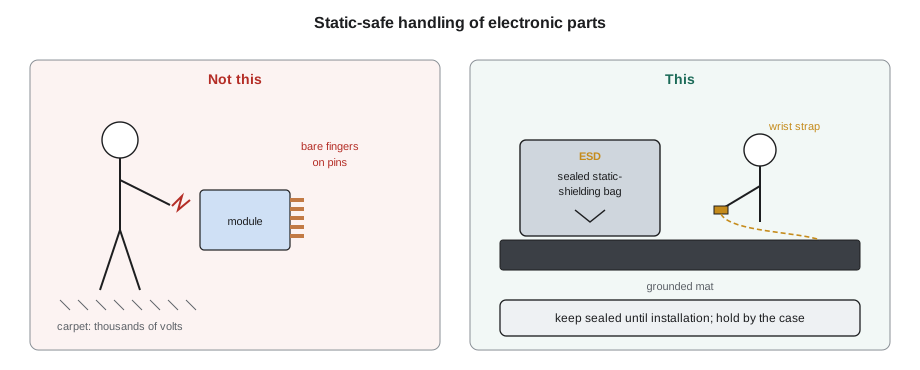
ESD habits for parts staff:
- Keep it sealed. Do not open a static-shielding bag at the counter to show the customer or to compare part numbers. The numbers are on the label outside.
- If a part must come out, touch bare grounded metal first, or wear a grounded wrist strap at a bench with a grounded mat, and hold the part by its case. Never touch connector pins or exposed circuit boards.
- Do not put electronic parts on carpets, seats or plastic surfaces, and do not carry them in a pocket.
- Inspect on receiving, outside the bag. Check the outer box, the bag's seal and the label. A damaged outer box is noted on the delivery receipt as APT-220 described; the bag stays sealed.
- Store in the original packaging, away from heat, magnets and moisture, and on shelves rather than the floor.
Worked problem
Too small to feel
A person can feel a static discharge from about 3,000 V. Some module circuits can be damaged by a discharge of 100 V. How many times smaller is the damaging discharge than the smallest one a person can feel?
Show solution
- Divide:
- \[\frac{3000}{100} = 30\]
Answer: Thirty times smaller. A part can be damaged by a discharge that is far too small for anyone to notice, which is why an opened bag cannot be taken on trust and why Wen's module could not go back on the shelf. The figures are typical; the exact thresholds depend on the part.
Airbag parts
Airbag and SRS parts have extra rules. The airbag modules themselves, in the steering wheel, dash, seats and roof rails, contain inflators that are dangerous goods (UN3268, as APT-110 explained) and must be stored, handled and shipped accordingly; never drop one or store it face down where it could launch upward. The SRS control module and crash sensors are electronic parts: many must be replaced after a deployment, many are VIN-programmed, and some makers forbid reusing them. Sell SRS parts only to qualified technicians, follow the maker's instructions to the letter, and never sell a used or salvaged airbag module.
Ordering sensors and modules well
Imani's checklist for any sensor or module order:
- VIN, options and production date. Decode every time.
- What led to the part? Ask for the code or test result. A sensor bought because a code names its circuit may not be the fault: a code for an oxygen sensor circuit can come from wiring, a connector or an exhaust leak, which Wen's ground strap shows.
- Does it need programming, coding, calibration or a relearn? Read the catalogue note and tell the customer.
- Is there a core? Some modules, ABS units and instrument clusters are sold remanufactured with a core charge.
- Is it returnable? Say so at the time of sale. Electronic parts are normally non-returnable once the static-shielding bag is opened, once installed and once programmed, as APT-130 and lesson 11 explain.
Worked problem
Sensors for winter wheel packages
In the fall, the service department expects to sell 18 winter tire and wheel packages with new TPMS sensors for the Vela. Rolf wants to keep 10 in 100 extra sensors on hand for damaged or faulty units. How many programmable sensors should Talia order?
Show solution
- Sensors for the packages:
- \[18 \times 4 = 72\]
- Extra sensors:
- \[72 \times 0.10 = 7.2\]
- Total, rounded up to whole sensors:
- \[72 + 7.2 = 79.2 \to 80\]
Answer: 80 sensors, with 80 TPMS service kits to match. Talia also checks the frequency and stem style the Vela uses before ordering, so that all 80 are right for the vehicle.
Sensors and modules on the shelf
Sensors and modules are small, expensive and easy to mix up, so their storage deserves care:
- Bin by part number, not by type. Two oxygen sensors in one bin will be swapped eventually. Each part number gets its own location, as APT-210 described.
- Keep packaging intact. The box protects the connector and the sensing tip; the bag protects the electronics. A sensor with a bent connector or a cracked tip is scrap.
- Watch the date. Some sensors, such as oxygen sensors with pre-applied anti-seize, and some modules with batteries inside, age on the shelf. Rotate them first in, first out.
- Protect fragile sensors. Mass airflow sensors and camera modules are easily damaged by a drop. Store them on lower shelves, not in overhead bins.
- Count them often. High value per piece makes sensors and modules A items in the counting plan, and small boxes make them easy to lose.
On receiving, check the label against the order, the outer box for damage and the bag's seal, without opening it. A module that arrives in an open or torn bag is reported to the supplier as damaged, not sold.
The parts counter is also where technicians come for small electrical repair items: connector release tools, terminal kits, heat-shrink, fuses, relays and bulbs. Keeping those drawers complete and labelled is part of looking after the electrical wall, and Talia checked them every Monday morning.
One more habit applies to every sensor sale: ask whether the technician needs the related small parts. A new oxygen sensor may need a gasket; a coolant temperature sensor may need a new O-ring or sealing washer and a top-up of the correct coolant; a crankshaft sensor may need a new O-ring and a spacer. Those are small sales, but leaving them out means a second trip, as Talia's own accuracy figures in lesson 12 show.
Common mistakes
MistakeOpening a static-shielding bag at the counter to compare part numbers.
InsteadRead the label outside the bag; keep it sealed until installation.
MistakeSelling a sensor because the code names its circuit.
InsteadAsk what test confirmed the fault; wiring, connectors and leaks set the same codes.
MistakeSelling a TPMS sensor without checking frequency and protocol.
InsteadCheck the frequency, program aftermarket sensors to the vehicle, and explain the relearn.
MistakeTreating two modules with the same hardware number as the same part.
InsteadThe software and service part numbers also matter; order by the service part number for the VIN.
MistakeStoring airbag modules face down or dropping them.
InsteadStore and handle airbag modules face up, as dangerous goods, following the maker's instructions.
Summary and key terms
- Sensors measure position, speed, temperature, pressure, exhaust gas, airflow and the vehicle's surroundings; fit depends on VIN, connector, thread and sealing.
- TPMS sensors differ by frequency, protocol, valve type and relearn method; sell service kits with tires.
- Modules have hardware, software and service part numbers; many are supplied blank and need programming.
- Static discharges too small to feel can damage electronics; keep parts sealed in static-shielding bags until installation.
- SRS parts need extra care; electronic parts are normally non-returnable once opened, installed or programmed.
- Sensor
- A device that turns a physical condition into an electrical signal for a module.
- Module
- A small computer in the vehicle that reads sensors, makes decisions and drives actuators.
- Electrostatic discharge
- A sudden flow of static electricity that can damage electronic parts, often without anyone feeling it.
- Static-shielding bag
- A metallic bag that protects electronic parts from outside static discharges.
- TPMS
- Tire pressure monitoring system, using sensors in each wheel to report pressure to the vehicle.
- Service part number
- The number used to order a part, which may differ from the hardware and software numbers on the unit.
Practice problems
Work each problem on paper first, then reveal the answer to check.
Why is a pink antistatic bag not enough for a module?
Show answer
It does not build up charge itself but does not shield the part from an outside discharge; modules need static-shielding bags.
What three details separate TPMS sensors?
Show answer
Radio frequency, protocol and valve type (also relearn method).
A technician asks for an oxygen sensor because of a circuit code. What should you ask?
Show answer
What testing confirmed the sensor is at fault, since wiring, connectors and leaks can set the same code.
How many TPMS sensors are needed for 12 four-wheel packages plus 10 in 100 spares, rounded up?
Show answer
48 + 4.8 = 52.8, so 53.
Name two hybrid or EV modules that a parts person may order.
Show answer
Battery management system, inverter controller, onboard charger, DC-DC converter (any two).
Lesson quiz · 5 questions
Score 60% or more to complete this lesson.
Create a free account to save your progress, take quizzes and earn a certificate.