
APT-310 · Lesson 2 of 12 · 24 min
Batteries: types, ratings and testing
▶ Video coming soon A video version of this lesson is on the way.
Saturday, September 26 was Talia's first Saturday on the counter, with Imani Grantham beside her and Rolf off for the weekend. At 8:20 a.m. a retail customer, Agnieszka Thorvald, came in holding her keys. Her 2019 Vela had cranked slowly for a week, and that morning it had barely started. "I just want a battery," she said, "the same as the one in there." Imani walked out to the lot with Talia and the counter's battery tester. The old battery read 12.38 V at rest. The tester, set to the rating on its label, 760 cold cranking amps, measured 412 and printed "Replace". Talia looked up the Vela: an AGM battery, group size H7 (also listed as BCI group 94R), with a note she had not seen before: "Battery registration required after replacement." By 9:00 the new battery was in, the service department's Saturday technician had registered it with the scan tool, and the old battery was on the core pallet. On the way back inside, Imani said, "That note is the part most people miss. Now let's go through what's on those labels."
How a lead-acid battery works, in parts-counter terms
A 12 V lead-acid battery is six cells in one case, each about 2.1 V when fully charged, joined in series for about 12.6 V. Each cell has lead plates in a dilute sulphuric acid electrolyte. Discharging turns some of the plate material into lead sulphate; charging turns it back. If a battery sits discharged, the lead sulphate hardens into crystals that charging cannot reverse, called sulphation. Sulphation is the reason a discharged battery on a shelf, or in a car parked for months, loses capacity for good. Heat shortens battery life even more than cold: a hot summer does the damage, and the first cold morning reveals it.
Battery types
Lead-acid batteries for vehicles come in several constructions, and the vehicle maker chooses one for a reason.
| Type | Construction | Strengths | Typical use |
|---|---|---|---|
| Flooded (standard) | Plates in liquid electrolyte; most are sealed "maintenance-free" with vents | Lowest cost; good cranking | Vehicles without start-stop or heavy electrical loads |
| EFB (enhanced flooded battery) | Flooded, with added carbon and plate improvements | Handles more charge cycles than standard flooded | Entry-level start-stop vehicles |
| AGM (absorbent glass mat) | Electrolyte held in glass-fibre mats; valve-regulated; spill-resistant | High cycle life, fast recharge, vibration resistance; can be mounted inside the vehicle | Start-stop with energy recovery, high electrical loads, batteries under seats or in the trunk |
| Gel | Electrolyte thickened to a gel | Deep cycling; sensitive to charging voltage | Some motorcycles, marine and specialty uses; rare in cars |
| Lithium-ion 12 V (usually lithium iron phosphate) | Lithium cells with a built-in battery management system | Light, long life | Some performance cars, some EVs and hybrids as the 12 V battery; only where the maker specifies it |
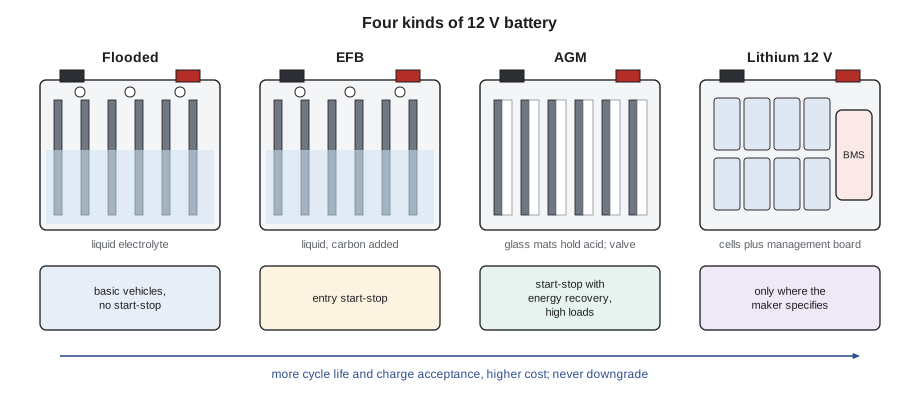
The most important rule at the counter is to replace like with like or better, never worse. A vehicle built with an AGM battery must get an AGM battery. A start-stop vehicle built with an EFB may take an EFB or an AGM if the maker allows it, but never a standard flooded battery: it will fail early under the start-stop cycling, and the start-stop system may stop working. A flooded battery can usually be upgraded to AGM, with the charging system coded to match where the vehicle has a battery monitoring system. A 12 V lithium battery is never a simple swap for a lead-acid battery, or the other way round, because the charging voltages and the vehicle's software are matched to the chemistry. Sell lithium only where the maker or the battery maker lists it for that vehicle.
Battery ratings
The battery label carries several ratings, and each answers a different question.
- Cold cranking amps (CCA). The current a new, fully charged 12 V battery can deliver for 30 seconds at −18 °C (0 °F) while holding at least 7.2 V. This is the SAE J537 test used in North America, and it answers: will it start the engine on a cold morning? Match or exceed the vehicle's specified CCA.
- Cranking amps (CA), also called marine cranking amps (MCA). The same test at 0 °C (32 °F). The number is higher than CCA for the same battery, so never compare a CA figure with a CCA figure.
- Reserve capacity (RC). The number of minutes a fully charged battery can supply 25 A at 27 °C (80 °F) before falling to 10.5 V. It answers: how long will the vehicle run if the alternator fails, or how well will the battery handle loads with the engine off?
- Ampere-hours (Ah). Capacity, usually at the 20-hour rate: the current the battery can supply steadily for 20 hours, multiplied by 20. A 70 Ah battery can supply 3.5 A for 20 hours. European and many AGM batteries list Ah prominently, and vehicles with battery monitoring use it in registration.
- European CCA (EN). Batteries made to European standards may list CCA measured by a different test. An EN rating and an SAE rating are not directly comparable, so use the figure the catalogue gives for the vehicle and the same test standard when comparing.
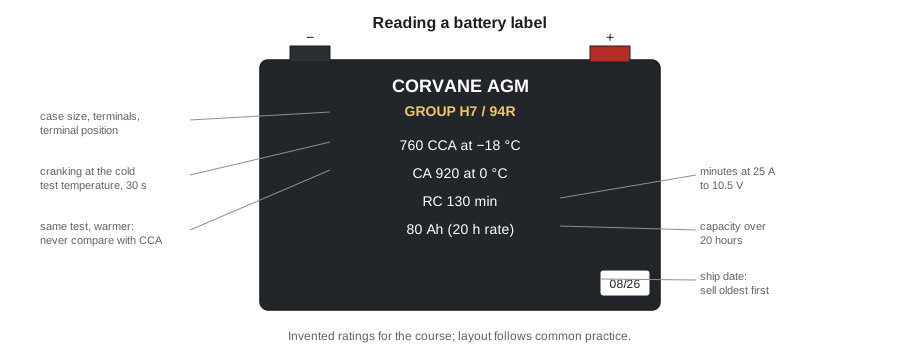
Higher CCA than specified is fine and often better in a cold climate. Lower CCA is not. Higher reserve capacity helps vehicles with many electrical loads, short trips or long periods parked with modules awake.
Worked problem
From reserve capacity to ampere-hours
Agnieszka asks why her new battery is labelled 130 minutes and 80 Ah. Imani shows Talia how to estimate the energy available in the reserve capacity test. How many ampere-hours does a reserve capacity of 130 minutes represent, and why is it less than 80 Ah?
Show solution
- Reserve capacity draws 25 A for 130 minutes. Convert minutes to hours:
- \[130 \div 60 = 2.17 \text{ h}\]
- Multiply by the current:
- \[25 \times 2.17 = 54.2 \text{ Ah}\]
- Compare with the 20-hour rating:
- \[54.2 \text{ Ah} < 80 \text{ Ah}\]
Answer: About 54 Ah. It is less than the 80 Ah rating because 25 A is a much heavier load than the 4 A of the 20-hour test, and a battery delivers less total capacity when discharged quickly. The ratings measure different things, and both matter.
Size, terminals and fit
A battery with the right ratings is still the wrong battery if it does not fit. BCI group sizes (24F, 35, 48, 51R, 65, 94R and others) set the case dimensions, the terminal type and the terminal position. The "R" usually means reversed: the positive terminal is on the opposite side. European-style DIN or EN sizes, often marked H5, H6, H7 and H8 (or LN2 to LN5), cross-reference to BCI groups such as 47, 48, 94R and 49. Check also:
- Terminal type: top posts, side terminals (common on older North American vehicles) or both.
- Terminal position: the cables will not reach if the positive post is on the wrong side.
- Hold-down: a bottom ledge, a top bar or a clamp. A loose battery vibrates to death and can short against the hood or body.
- Venting: a battery mounted inside the cabin or trunk needs a vent tube or an AGM battery that the maker approves for that location.
Testing batteries
Batteries are tested at the counter more often than any other part, and a good test protects both the customer and the store. The steps, and what each result means, are summarised in the figure below.
- State of charge first. Measure the open-circuit voltage after the battery has rested, with surface charge removed. As a guide for a flooded battery at about 21 °C (70 °F): 12.6 V or more is fully charged, about 12.4 V is three-quarters, about 12.2 V is half, and 12.0 V or less is discharged. AGM batteries read slightly higher when full, often 12.8 V or so.
- Conductance testing. A hand-held tester sends a small signal through the battery and estimates its cranking ability from its internal conductance. Enter the rating from the label (and the rating standard), and it reports good, good-recharge, charge and retest, or replace. It takes seconds, works on a partly discharged battery, and prints a slip that warranty claims usually need.
- Load testing. The older method: apply a load of half the CCA rating for 15 seconds on a charged battery. At about 21 °C (70 °F) the voltage should stay at or above 9.6 V. Load testing needs a charged battery, makes heat and sparks a risk, and is now used mostly to confirm a borderline result.
- Charge and retest. A battery that tests low because it is discharged should be charged and tested again before it is condemned. Many good batteries are returned as bad because someone tested them flat.
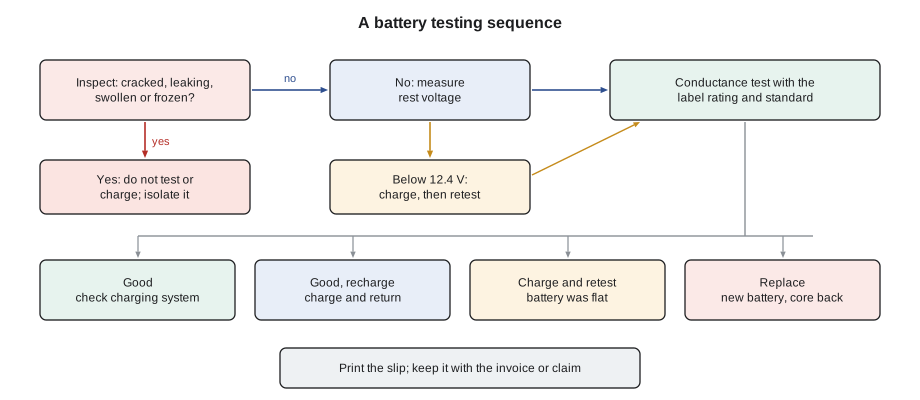
A test also checks the rest of the system. A good battery that keeps going flat points to a charging problem or a parasitic draw, not a battery problem, and selling another battery will not fix it. Most conductance testers include a quick starter and charging test; run it before the customer leaves.
Worked problem
Is the old battery worth keeping?
Agnieszka's old battery was rated 760 CCA. The tester measured 412 CCA. Imani's rule of thumb at the counter is that a battery measuring below about two-thirds of its rating, once charged, is near the end of its life. What fraction of its rating did it measure?
Show solution
- Divide the measured value by the rating:
- \[\frac{412}{760} = 0.54\]
- Express it in hundredths:
- \[0.54 = 54 \text{ in } 100\]
- Compare with two-thirds:
- \[\frac{2}{3} \approx 0.67, \quad 0.54 < 0.67\]
Answer: It measured about 54 in 100 of its rating, well below two-thirds, and the tester agreed: replace. The two-thirds figure is Imani's guide, not a standard; the tester's own result and its slip are what count.
Battery registration and battery monitoring
Many newer vehicles, including the Vela, have an intelligent battery sensor on the negative terminal and a battery monitoring system in the body or power management module. The system tracks the battery's age, state of charge and health, and adjusts charging to suit it. A new battery is charged differently from an old one, so after replacement the technician must register the new battery with a scan tool, telling the system that a new battery is fitted. On some vehicles the battery's type (flooded, EFB, AGM), capacity in Ah and even serial number must also be entered or coded.
Skipping registration does not stop the vehicle from starting, which is why it gets skipped. But the system goes on charging the new battery as if it were the worn one, usually overcharging it, and the battery's life is shortened. Start-stop may also stay disabled. Tell the customer, and if the store or the service department offers registration, offer it. Lesson 6 covers coding and programming in general.
Storing and maintaining battery stock
A battery begins to lose charge from the day it is made, faster in warm storage. A discharged battery sulphates on the shelf and may be ruined before it is sold. Good stock practice:
- First in, first out. Each battery carries a ship date or date code. Sell the oldest first.
- Check and charge. Check open-circuit voltage on a schedule, typically monthly, and recharge any battery below about 12.4 V with a charger set for its type.
- Store upright, off hot floors and away from sunlight and heat. Cool storage slows self-discharge.
- Never stack batteries directly on one another unless the maker allows it; cases and terminals can be damaged.
- Keep the charging area ventilated, away from sparks and flames, with eye protection and an eyewash station nearby, as APT-110 described.
Cores and recycling
Almost all of a lead-acid battery can be recycled, and it is one of the most recycled consumer products in North America. Batteries carry a core charge refunded when the old battery comes back. Linmore Tessaro's core charge on a car battery was 25 dollars. Old batteries go on the core pallet, upright, terminals protected, leaking ones in a leak-proof container, and are collected by the battery supplier or a recycler.
In Ontario, the province's Batteries Regulation (O. Reg. 30/20 under the Resource Recovery and Circular Economy Act) makes producers responsible for collecting and recycling batteries of 5 kg or less, such as key fob coin cells, power tool packs and small rechargeable batteries; producer responsibility organizations such as Call2Recycle run drop-off programs for them. A car battery weighs well over 5 kg and is outside that regulation; it returns through the long-standing core and scrap system. Either way, a used battery never goes in the garbage.
Lithium batteries, including 12 V lithium starter batteries and small consumer cells, must never go on the lead-acid core pallet. A lithium battery mixed into a lead recycling stream can start a fire. Keep them separate, tape or cap the terminals, and send them through the right program.
Common mistakes
MistakeReplacing an AGM battery with a cheaper flooded battery.
InsteadReplace like with like or better: AGM for AGM; EFB or AGM for EFB, as the maker allows.
MistakeComparing a cranking amps figure with a cold cranking amps figure.
InsteadCCA is at −18 °C (0 °F), CA at 0 °C (32 °F); compare like with like, and SAE with SAE.
MistakeCondemning a discharged battery after a quick test.
InsteadCharge it and retest; keep the printed slip.
MistakeSkipping battery registration.
InsteadTell the customer the vehicle needs it; offer the service if the store or shop provides it.
MistakePutting a lithium battery on the lead-acid core pallet.
InsteadKeep lithium batteries separate, terminals protected, in their own recycling stream.
Summary and key terms
- Main types: flooded, EFB, AGM, gel and 12 V lithium; replace like with like or better, and lithium only where specified.
- CCA is the SAE J537 rating at −18 °C (0 °F) for 30 seconds holding 7.2 V; CA is at 0 °C (32 °F); RC is minutes at 25 A; Ah is the 20-hour capacity.
- Fit depends on group size, terminal type and position, hold-down and venting.
- Test state of charge first, then conductance; charge and retest a discharged battery; check the charging system too.
- Many vehicles need battery registration after replacement; stock must be rotated and kept charged; cores are recycled, lithium separately.
- Cold cranking amps
- The current a 12 V battery can supply for 30 seconds at −18 °C (0 °F) while staying at or above 7.2 V.
- Reserve capacity
- Minutes a charged battery can supply 25 A at 27 °C (80 °F) before falling to 10.5 V.
- AGM battery
- An absorbent glass mat battery, valve-regulated, used in start-stop and high-load vehicles.
- EFB
- Enhanced flooded battery, built for more charge cycles than a standard flooded battery.
- Battery registration
- Telling the vehicle's battery monitoring system with a scan tool that a new battery is fitted.
- Conductance tester
- A hand-held tester that estimates a battery's cranking ability from its internal conductance.
Practice problems
Work each problem on paper first, then reveal the answer to check.
A battery's reserve capacity is 90 minutes. About how many ampere-hours does that represent at 25 A?
Show answer
90 ÷ 60 = 1.5 h; 25 × 1.5 = 37.5 Ah.
A vehicle specifies 650 CCA. The customer wants a battery rated 800 CA. Is that enough?
Show answer
Not necessarily; CA is measured at a warmer temperature. Find the battery's CCA and compare that with 650.
A battery on the shelf reads 12.2 V. What should happen?
Show answer
It is about half charged; charge it with the right charger before it sulphates or is sold.
Can an EFB start-stop vehicle take a standard flooded battery?
Show answer
No. Use EFB, or AGM if the maker allows it.
Why must the old battery go on the core pallet upright with its terminals protected?
Show answer
To prevent acid leaks and short circuits; leaking batteries go in a leak-proof container.
Lesson quiz · 5 questions
Score 60% or more to complete this lesson.
Create a free account to save your progress, take quizzes and earn a certificate.