
APT-310 · Lesson 3 of 12 · 23 min
Starters and alternators
▶ Video coming soon A video version of this lesson is on the way.
Corinne Ferraby at Bramhall Auto Service phoned the back counter one morning in October for an alternator for a 2017 Arden 1.8. Talia found two in the catalogue: a 120 A unit and a 150 A unit, split by option code CW3, the cold-weather package. Corinne did not have the VIN handy. "Just send the bigger one," she said. "More is better, right?" Talia asked her to read the VIN off the work order instead. It decoded without CW3. When Talia compared the two listings, the 150 A unit had a larger pulley diameter and a different connector, and it would not have fitted the 120 A vehicle's harness. Corinne got the 120 A reman unit on the 10 a.m. van, and the old one came back the next day as the core. Later Imani said the call was a good example of a rule for rotating electrical parts: "Bigger isn't a fit. The output, the pulley, the mounting and the plug all have to match."
Starters
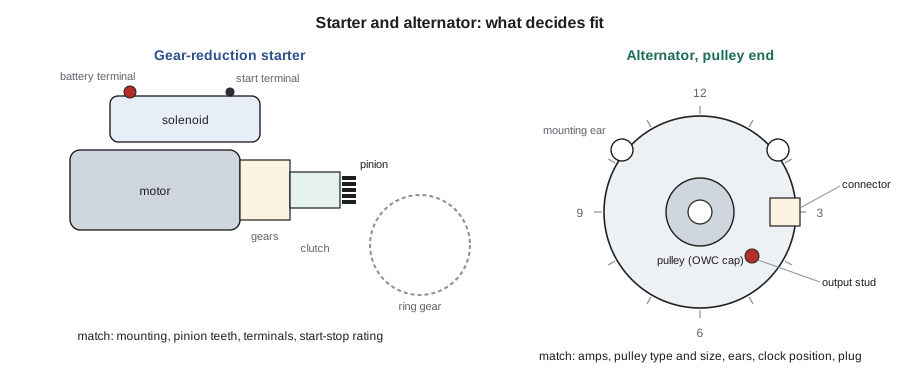
A starter is a powerful 12 V electric motor that turns the engine fast enough to start it. When the key or start button is used, a small current energizes the solenoid, which does two jobs: it pushes the starter's pinion gear forward to mesh with the ring gear on the engine's flexplate or flywheel, and it closes heavy contacts that send battery current, often 150 to 300 A or more, to the motor. Once the engine starts, an overrunning clutch in the drive lets the pinion spin freely until it pulls back, so the engine cannot spin the starter to destruction.
Starter designs a parts person meets:
- Direct drive: the motor turns the pinion directly. Older and heavier.
- Gear reduction: a small, fast motor drives the pinion through reduction gears, giving more torque from a lighter unit. Most modern starters are gear reduction, many with permanent magnet fields (PMGR).
- Start-stop starters: reinforced versions built for many more starts, with stronger brushes, bearings, pinions and solenoids. A vehicle with start-stop may start its engine dozens of times on one trip. A standard starter fitted to it will wear out quickly.
- Belt starter-generators (BSG) on 48 V mild hybrids, such as the Arden MH4: a motor-generator on the accessory belt that restarts the warm engine, assists it and recovers energy. Most such vehicles keep a conventional 12 V starter for cold starts. Lesson 7 returns to the BSG.
Starters are identified by the vehicle, engine and transmission (manual and automatic versions often differ, because the flywheel and flexplate differ), and by the number of teeth on the pinion, the mounting bolt pattern and the solenoid terminals. A starter listing may also be split by start-stop equipment.
Alternators
The alternator is a generator driven by the accessory belt. Spinning magnets inside its stator produce alternating current; a rectifier of diodes turns it into direct current; and a voltage regulator controls the output. It recharges the battery and supplies every electrical load while the engine runs.
What separates one alternator from another at the counter:
- Output rating in amperes, such as 120 A or 150 A. It is set by the vehicle's electrical equipment; heated seats, a heated windshield, premium audio and trailer packages often bring a higher-output unit.
- Pulley type and size. A solid pulley; a one-way clutch pulley (OWC), which lets the alternator overrun the belt when the engine slows; or an overrunning alternator decoupler (OAD), which adds a spring to smooth the belt's pulses. Many diesel and small turbo engines need an OWC or OAD; a solid pulley fitted in its place causes belt noise, tensioner wear and belt failure. Pulley diameter changes alternator speed, so a different diameter changes output.
- Mounting and clocking. The mounting ears must match the bracket, and the clock position, the position of the connector and output terminal relative to the mounting ears, must match the vehicle's wiring. Rebuilders describe it as a clock position, such as 3 o'clock or 9 o'clock, seen from the pulley end.
- Regulator control and connector. Older alternators regulate themselves at about 14 V. Many newer ones are smart-charging units controlled by the engine or power management module through a signal wire or a LIN bus connection, varying voltage to save fuel and protect the battery. The connector and the control type must match exactly.
New, remanufactured and the core
Starters and alternators are sold new (from the vehicle maker or an aftermarket maker) or remanufactured. A remanufacturer takes a used unit, the core, takes it apart, cleans it, replaces wear and failure-prone parts such as bearings, brushes, the regulator, diodes and seals, reassembles it and tests it to the original specification. A good reman unit is as reliable as a new one, often cheaper, and it keeps metal and energy in use. Tessaro's own service parts program sells reman starters and alternators with a core charge, and the aftermarket brands Linmore stocks, Corvane and Torvale, do the same.
The core charge is refunded when the old unit comes back acceptable. Core rules, which you met in APT-220, are strict for rotating electrical parts:
- Same type. The core must be the same part, or one the remanufacturer accepts in its place.
- Complete and assembled. Pulley, regulator and housing in place; not taken apart.
- Not broken. A cracked housing or mounting ear, a melted case from a fire, or a unit damaged by impact or water is usually rejected. Talia saw a cracked starter core come back in APT-130.
- Drained and clean enough to handle. Oil-soaked units may be refused.
Put the old unit in the new unit's box, tag it with the invoice number, and keep the paperwork. Lost and rejected cores cost real money, as Sasha's core statements in APT-220 showed.
Before and after replacing a starter or alternator
Starter and alternator failures are often blamed for problems that start elsewhere, and parts people can save the customer a second visit:
- Test the battery first. A weak or shorted battery makes a good starter crank slowly and can overload a new alternator until it fails. A new alternator is not a battery charger for a dead battery: charge the battery first.
- Check the connections. Corroded terminals, loose grounds and high resistance in the cables cause slow cranking and charging faults that look like failed parts. A voltage drop test, which AUTO-220 covered, finds them.
- Check the belt and tensioner. A slipping belt, a weak tensioner or a failed OAD pulley shows up as low charging. A new alternator on an old belt and tired tensioner often comes back as noise.
- Run the charging test. Most conductance testers check charging voltage and ripple, a sign of failed diodes. Remember that smart-charging systems can read as low as about 12.8 V or as high as 15 V at times by design, so a single voltage reading does not prove a fault on a modern vehicle.
- Ask about start-stop. A start-stop vehicle needs the start-stop rated starter and usually an AGM or EFB battery in good health.
Worked problem
Is the 120 A alternator enough?
Corinne's customer asks whether his 120 A alternator can keep up on a winter night drive with the headlamps, blower, rear defrost and both heated seats on. The base load of the engine, modules and fuel pump is about 60 A. The extras draw about 9 A for headlamps, 15 A for the blower, 18 A for the rear defrost and 5 A for each heated seat. What is the total load, and what fraction of the alternator's rating is it?
Show solution
- Add the loads:
- \[60 + 9 + 15 + 18 + 5 + 5 = 112 \text{ A}\]
- Compare with the rating:
- \[\frac{112}{120} = 0.93 = 93 \text{ in } 100\]
Answer: About 112 A, or 93 in 100 of the rating. Alternators produce much less than their rating at idle, so in slow traffic the battery would make up the difference and slowly discharge. That is why the cold-weather package came with a 150 A unit. The loads here are typical figures for teaching, not Arden specifications; the answer for the customer is that the alternator suits the vehicle as built, and that adding large accessories calls for a conversation with the service department, not a bigger alternator from the shelf.
Identifying rotating electrical parts at the counter
When a technician or customer brings in an old starter or alternator, compare it with the new one before it leaves the counter:
- Part number and maker's label, if still readable.
- For an alternator: output rating, pulley type (look for a cap on the pulley nose, the sign of an OWC or OAD), pulley diameter and groove count, clock position, connector shape and pin count, and the output stud.
- For a starter: mounting flange and bolt holes, pinion tooth count, solenoid terminals and the position of the starter in the bell housing.
- Whether the vehicle has start-stop or the 48 V MH4 system.
If anything differs, stop and recheck the VIN and the option codes. The listing may have a split you missed, or a previous repair may have fitted the wrong unit, in which case the old unit is not a reliable guide.
Core credit in practice
Rotating electrical cores are worth more than most, so the paperwork matters. Each reman unit's invoice shows the core charge as its own line. When the core comes back, the counter checks it, issues the core credit against the original invoice, and tags the core for the supplier. Cores that arrive later than the supplier's deadline, usually 30 to 90 days, may earn no credit from the supplier even if the store refunds the customer.
Worked problem
A core return with one rejection
Bramhall returns three alternator cores in one week, each carrying a core charge of 75 dollars. The remanufacturer accepts two and rejects one for a cracked mounting ear. If Linmore's policy is to credit the customer only for cores the supplier accepts, how much core credit does Bramhall receive?
Show solution
- Cores accepted:
- \[3 - 1 = 2\]
- Credit:
- \[2 \times 75 = 150 \text{ dollars}\]
Answer: 150 dollars. The rejected core is returned to Bramhall with the remanufacturer's reason, and the 75 dollars stays charged. A clear core policy, explained at the time of sale, prevents arguments later.
Storage and handling
Starters and alternators are heavy, and a dropped unit can crack a housing that no one notices until the remanufacturer rejects it as a core or the customer finds it on installation. Store them in their boxes on lower shelves, heavier units nearer the floor. Keep reman units and cores physically separate and clearly labelled, so a core cannot be sold by mistake as a good part. Protect pulleys and connectors from damage, and never hang a unit by its wiring or pulley.
Customer descriptions and the parts they point to
Customers describe starting and charging problems by what they hear and see. The counter can link each description to the likely parts, while leaving the diagnosis to a technician or to the counter tester.
- A single click and no crank: often a weak battery, a poor connection at the battery or starter, or a failed solenoid. Test the battery and the cables before selling a starter.
- Slow cranking: a weak or cold battery, corroded terminals, a poor ground, or a starter drawing too much current. Cold weather exposes all of these.
- Grinding when starting: the pinion not meshing properly with the ring gear. The ring gear may be damaged too, and the starter's mounting should be checked.
- Battery warning light or dim, flickering lights: a charging fault, which can be the alternator, the belt, the tensioner, a connection, or a smart-charging control problem.
- Whining that rises with engine speed: often alternator bearings or a failing decoupler pulley.
- Battery keeps going flat overnight: a parasitic draw or a charging fault, not usually the battery, as AUTO-220's capstone showed.
Offer the counter's charging and starting test before the sale. A five-minute test that finds a loose ground saves the customer the price of an alternator and saves the store a warranty claim that is not really a warranty claim. When the test does point to the starter or alternator, sell the related parts with it: a belt, a tensioner if it is weak, battery terminal cleaner and protector, and, for a battery that tested marginal, a new battery.
Heavy-duty and fleet vehicles add one more question. Delivery vans like Orland Courier's, with frequent stops and many electrical accessories, may have high-output or dual alternators, and their starters work far harder than a commuter's. Check whether the fleet has a heavy-duty package before quoting.
Common mistakes
MistakeSending the higher-output alternator because "more is better".
InsteadMatch output, pulley, mounting, clock position and connector to the VIN and option codes.
MistakeFitting a solid pulley where the vehicle needs an OWC or OAD.
InsteadCheck the pulley type; the wrong pulley causes belt and tensioner failures.
MistakeInstalling a new alternator to recharge a dead battery.
InsteadCharge and test the battery first; a dead battery overloads the alternator.
MistakeSelling a standard starter for a start-stop vehicle.
InsteadUse the start-stop rated starter listed for the vehicle.
MistakeAccepting a cracked or disassembled unit as a core.
InsteadInspect the core at the counter: same type, complete, assembled and unbroken.
Summary and key terms
- A starter's solenoid engages the pinion and switches battery current to a motor; most starters are gear reduction, and start-stop vehicles need reinforced starters.
- An alternator is identified by output rating, pulley type and size, mounting, clock position and connector or control type.
- Smart-charging alternators are controlled by a module and may show a wide range of voltages by design.
- Remanufactured units are rebuilt and tested to the original specification and carry core charges; cores must be the same type, complete and unbroken.
- Test the battery, connections, belt and tensioner before blaming a starter or alternator.
- Solenoid
- The switch on a starter that engages the pinion and sends battery current to the motor.
- Gear reduction starter
- A starter whose small, fast motor turns the pinion through reduction gears for more torque.
- Overrunning alternator decoupler
- An alternator pulley with a one-way clutch and spring that smooths belt pulses.
- Clock position
- The position of an alternator's connector and output terminal relative to its mounting ears.
- Smart charging
- Charging in which a module varies alternator output to save fuel and protect the battery.
- Remanufactured
- Rebuilt from a used core to the original specification, with wear parts replaced and tested.
Practice problems
Work each problem on paper first, then reveal the answer to check.
A vehicle's loads total 96 A and its alternator is rated 120 A. What fraction of the rating is in use?
Show answer
96 ÷ 120 = 0.80, or 80 in 100.
How can you often tell that an alternator has an OWC or OAD pulley?
Show answer
There is a plastic cap over the pulley nose, and the pulley spins freely in one direction.
Why might manual and automatic versions of the same engine use different starters?
Show answer
The flywheel and flexplate differ, which can change the pinion, the mounting or the starter's position.
Name two reasons a remanufacturer might reject a starter core.
Show answer
A cracked housing or mounting ear; a disassembled, burned or water-damaged unit; the wrong type.
A smart-charging vehicle shows 12.9 V with the engine running. Is the alternator faulty?
Show answer
Not necessarily; smart systems vary voltage by design. Use a proper charging test or the maker's procedure.
Lesson quiz · 5 questions
Score 60% or more to complete this lesson.
Create a free account to save your progress, take quizzes and earn a certificate.