
APT-310 · Lesson 6 of 12 · 21 min
Programmed parts and module coding
▶ Video coming soon A video version of this lesson is on the way.
In the first week of November, Rosalind Meeker came to the parts counter after losing both keys to her 2023 Vela on a hiking trip. The car was in the dealership lot, towed in that morning. "Can I just buy two new keys?" she asked. Talia knew from Imani that a lost-key sale was one of the most careful transactions at the counter. She asked for the vehicle's registration and photo identification, checked that the names and the VIN matched, and recorded both in the key-request log with Rosalind's signature. Then she ordered two proximity fobs and an emergency key blade cut to the VIN's key code, through Tessaro's secure key-code system, which only authorized dealer staff could use and which logged every request. The fobs would take two business days to arrive, and the car would then need the service department to program them, along with an all-keys-lost reset that erased the old, missing keys from the vehicle. "So whoever finds my old keys can't drive off with the car?" Rosalind asked. "That's right," said Talia. "Once the new ones are programmed, the old ones won't start it."
Why so many parts need software
A part that bolts on and works is becoming the exception among electronic parts. Many need the vehicle's software to recognize them, and many need software loaded into them. The parts counter does not usually do this work, but it needs to know what each part will need, because it changes the price, the time, who can install the part and whether it can be returned. The kinds of setup, from least to most involved:
| Setup | What happens | Examples |
|---|---|---|
| Plug and play | Install and it works | Many sensors, bulbs, switches |
| Relearn or adaptation | The vehicle learns the new part's values, by a tool or a procedure | Battery registration, throttle body relearn, TPMS relearn, window pinch protection, transmission adaptations |
| Configuration or coding | The module is told which options and equipment the vehicle has | BCM coded for lamp types and region; battery type and capacity |
| Programming (flashing) | Software is downloaded from the maker's server and written into the module | Blank service ECMs, TCMs, BCMs; software updates |
| Security initialization | The part is linked to the vehicle's immobilizer and security system, with security credentials | Keys and fobs, ECMs and BCMs that hold immobilizer data, some steering locks |
| Calibration | A sensor's aim or zero point is set with targets or a drive procedure | Front cameras, radar, steering angle sensors, ride height sensors |
VIN-coded and VIN-locked modules
When a service module is programmed, the maker's software usually writes the vehicle's VIN into it along with the configuration. That module is now VIN-coded: it belongs to one vehicle. Some modules, especially those holding immobilizer or odometer data, are also VIN-locked: they cannot be reprogrammed for another vehicle at all, or only by the maker. This has three consequences at the counter.
- A programmed module cannot be returned for resale. It is no longer a new, blank part. This is the main reason store policies, including Linmore's from APT-130, make programmed modules non-returnable.
- A used module from a salvage vehicle may not work. It may be VIN-locked to the vehicle it came from, carry the wrong configuration, or fail the immobilizer check. Customers who buy a used module elsewhere and ask the dealer to program it should be told that it may not be possible, and that the programming time is charged either way.
- Some modules are ordered by VIN. For keys, some immobilizer-related modules and some pre-programmed units, the maker builds or programs the part for one VIN, so the VIN is part of the order and the part cannot be returned.
Keys, fobs and immobilizers
An immobilizer stops the engine from running unless it recognizes a key. A small transponder chip in the key or fob answers a coded challenge from the vehicle; if the answer is wrong, the engine control module will not run the engine, or an electric vehicle will not enter ready mode. Vehicle keys now come in several forms:
- Transponder keys: a cut metal blade with a chip in the head.
- Remote head keys: a blade and transponder with lock and unlock buttons in one head.
- Proximity fobs (smart keys): the vehicle detects the fob nearby, unlocks the doors when a handle is touched and starts with a button. They usually hide an emergency blade for the door lock.
- Phone-as-key and key cards on many newer vehicles, including the Marlo EV, set up through the owner's account and the vehicle.
Key parts are ordered by VIN. The key code, from which the blade is cut, and the security data needed to program the immobilizer are released only through secure systems, to identified people, with every request logged. The reason is obvious: anyone who could get a key code and program a fob could steal the vehicle.
That is why the counter's routine for keys is strict. Linmore Tessaro's rules, like most dealers':
- Proof of ownership and identity: the vehicle's registration or ownership document and government photo identification, with matching names and VIN. A lease or company vehicle needs a letter from the owner.
- A signed request in the key log, kept as the maker requires.
- No key codes by phone or email, and no key codes given to the customer at all; the dealership cuts the blade.
- Programming at the vehicle. The vehicle and, where possible, all existing keys come in, because many systems erase keys not present during programming. If all keys are lost, the vehicle is towed or the technician goes to it.
- Non-returnable. Keys and fobs ordered by VIN, cut or programmed cannot be returned.
Key and fob batteries are another matter: coin cells such as CR2032 are ordinary stock items, though they are lithium batteries, so store them in their packaging and recycle used ones through the small-battery program described in lesson 2.
Who can program: access for dealers and independents
The vehicle maker's software and security systems sit at the centre of programming. Dealers reach them through the maker's dealer systems. Independent repair shops reach them through paid subscriptions to the maker's service information sites and programming software, using either the maker's own scan tool or a pass-thru device built to SAE J2534, a standard interface that lets a shop's computer connect the maker's software to the vehicle. Many newer vehicles also have a secure gateway that blocks a scan tool from changing settings until the user logs in with a registered account.
In Canada, independent shops' access is set out in the Canadian Automotive Service Information Standard (CASIS), a voluntary agreement signed in 2009 by the vehicle makers' associations and the aftermarket's association. Under CASIS, makers agree to give independent shops access to the same service information, training, tools and software they give their dealers, on reasonable terms. Security-related information, such as key codes and immobilizer data, is released to registered professionals through the National Automotive Service Task Force (NASTF) Vehicle Security Professional registry, which accepts Canadian businesses with a Canadian Business Number, and through the makers' own secure systems.
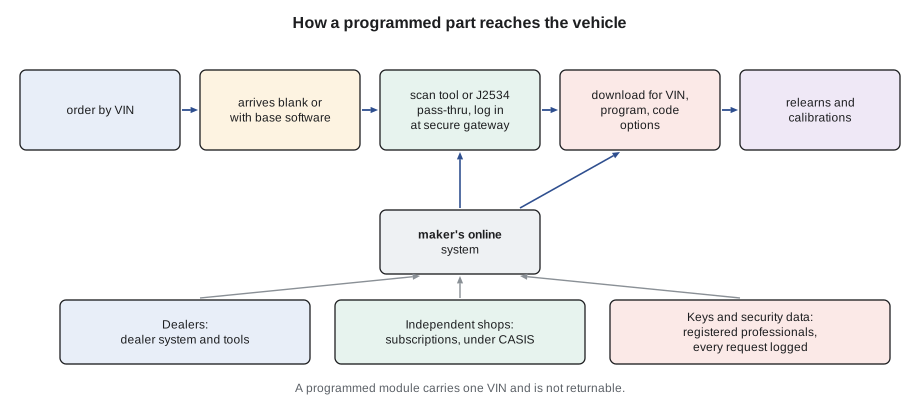
For the parts counter, the practical point is to know who can do the work. When Bramhall Auto Service buys a blank ECM, Corinne's technicians may have the subscription and pass-thru device to program it; if not, the vehicle may have to come to the dealer, or to a shop that specializes in programming. Ask before selling.
Power supply during programming
Programming can take from a few minutes to more than an hour, and the vehicle's modules are awake the whole time, drawing a large current from the 12 V battery. If the voltage falls during the download, the programming can fail and leave the module unusable, sometimes beyond repair. Makers therefore require a programming power supply, a stable, high-current supply that holds the voltage steady, not an ordinary battery charger. Shops sometimes ask the parts counter for one, and the specification matters.
Worked problem
Can a small charger support programming?
A programming session on the Vela takes 45 minutes, and the vehicle draws 40 A with its modules awake. A shop proposes to use a 10 A battery charger. How much charge would the battery lose during the session, and what does that mean?
Show solution
- Current the charger cannot supply:
- \[40 - 10 = 30 \text{ A}\]
- Session length in hours:
- \[45 \div 60 = 0.75 \text{ h}\]
- Charge taken from the battery:
- \[30 \times 0.75 = 22.5 \text{ Ah}\]
Answer: About 22.5 Ah would come out of the battery, and as it discharged the voltage would sag, risking a failed programming session. The shop needs a programming power supply rated at least for the vehicle's draw, here 40 A or more, set to the maker's voltage. The 40 A figure is a typical teaching value; the maker's procedure gives the real requirement.
Telling the customer what the part will need
Most disputes over programmed parts come from surprises. A retail customer who buys a module online or at a counter and learns at home that it needs dealer programming feels misled, even if the catalogue said so. A good counter habit is to say, at the time of sale:
- "This part needs programming to your VIN. Your shop will need the maker's software or a pass-thru tool, or the car will need to come to us."
- "After it's installed, the shop will need to run a relearn or calibration."
- "Once it's programmed, it can't be returned."
Write the same on the invoice. In Imani's words, "If they hear it, see it and sign it, nobody's surprised."
ADAS calibration
Advanced driver assistance systems (ADAS), such as automatic emergency braking, lane keeping and adaptive cruise control, depend on cameras and radar aimed precisely. After a windshield, front bumper, grille emblem, radar sensor or camera is replaced, or after a wheel alignment on many vehicles, the system must be calibrated, either with targets in a measured bay (static calibration) or by a road drive with a scan tool (dynamic calibration). The parts counter's job is to recognize the parts that trigger calibration, such as a windshield with a camera bracket, a radar-transparent grille emblem or a bumper cover with sensor mounts, and to make sure the order notes it. A wrong emblem or a bumper cover painted with the wrong paint thickness over a radar sensor can stop the radar from seeing properly.
Privacy and security at the key counter
Key requests combine two concerns from earlier courses: privacy, which APT-130 covered, and vehicle security. The key log holds names, addresses, identification details and VINs. It is kept secure, used only for its purpose and kept as long as the maker and the law require. Staff never discuss a key request with anyone but the owner or the owner's authorized representative.
Watch for warning signs in a key request: a customer who cannot produce matching documents, who wants the key code rather than a key, who is in a hurry and wants the fob programmed without bringing the vehicle, or who asks for keys for a vehicle registered to someone else without a letter of authority. A polite refusal and a referral to the manager is always the right answer. Stolen vehicles are often driven away with keys programmed from stolen or bought codes, and the counter is one of the places where that can be stopped.
Phone-as-key systems on the Marlo EV move much of this to the owner's account: the owner adds and removes phones and key cards through the vehicle and the account, with the dealer helping when a phone is lost or replaced. The parts department still sells key cards and backup fobs, and the same identity checks apply.
Finally, a practical point: key and fob programming often needs every key at once, and some vehicles limit how many keys they can store. Ask how many keys the customer wants in total before ordering, so they are not short a spare after the programming session.
Programming also takes time, and the counter can help the service department plan it. When a programmed part is ordered, note on the order that programming is needed, so the advisor books the vehicle for long enough and the technician has the programming power supply and the maker's software ready when the part arrives.
Common mistakes
MistakeSelling keys without checking ownership and identity.
InsteadCheck registration and photo ID with matching names and VIN, and log the request.
MistakeGiving a key code by phone or to the customer.
InsteadKey codes stay within secure systems; the dealer cuts the blade.
MistakeSelling a blank module without saying it needs programming.
InsteadSay, show and record that it needs programming and is non-returnable once programmed.
MistakeTelling a customer a used salvage module will work after programming.
InsteadUsed modules may be VIN-locked or fail the immobilizer check; warn them first.
MistakeUsing an ordinary battery charger during programming.
InsteadUse a programming power supply rated for the vehicle's draw.
Summary and key terms
- Electronic parts may need relearns, coding, programming, security initialization or calibration; the catalogue note says which.
- Programmed modules are VIN-coded, often VIN-locked, and not returnable; used modules may not program.
- Keys and fobs are ordered by VIN with proof of ownership and identity, logged, and programmed at the vehicle; codes never leave secure systems.
- Independent shops reach maker software through subscriptions and J2534 pass-thru devices, under CASIS in Canada; security data goes through the NASTF registry.
- Programming needs a stable programming power supply; ADAS parts often need calibration.
- VIN-coded
- Programmed with one vehicle's VIN and configuration.
- Immobilizer
- A security system that stops the vehicle from running unless it recognizes a programmed key.
- Transponder
- A chip in a key or fob that answers the immobilizer's coded challenge.
- J2534
- An SAE standard for pass-thru devices that connect a maker's programming software to a vehicle.
- Programming power supply
- A stable, high-current 12 V supply that holds voltage steady while modules are programmed.
- Calibration
- Setting a sensor's aim or zero point, such as for ADAS cameras and radar.
Practice problems
Work each problem on paper first, then reveal the answer to check.
What two documents does Linmore require before ordering a key?
Show answer
The vehicle's registration or ownership document and government photo ID, with matching names and VIN.
Why should all existing keys come in when new keys are programmed?
Show answer
Many systems erase any key not present during programming.
A session takes 30 minutes at 35 A with a 15 A charger. How much charge leaves the battery?
Show answer
20 A × 0.5 h = 10 Ah.
Name three parts whose replacement often triggers ADAS calibration.
Show answer
Windshield with a camera bracket, radar sensor or its bracket, front camera, front bumper cover, grille emblem over radar (any three).
Why are programmed modules non-returnable?
Show answer
They carry one vehicle's VIN and configuration and can no longer be sold as new; some are VIN-locked.
Lesson quiz · 5 questions
Score 60% or more to complete this lesson.
Create a free account to save your progress, take quizzes and earn a certificate.