
APT-120 · Lesson 9 of 12 · 27 min
Hoses, belts and filters
▶ Video coming soon A video version of this lesson is on the way.
On Friday, October 16, the first cold morning of the fall, the front counter ran out of patience before it ran out of serpentine belts. A customer brought in a belt so worn that its part number had rubbed off, from a pickup his brother-in-law had fitted with a different engine. A second customer wanted "a heater hose, the long one". A third had an oil filter in a plastic bag from a generator. Imani handled the first, Talia the second and third, and by lunch Talia had learned that hoses, belts and filters are where the catalogue and the measuring tape meet.
Hoses, belts and filters are the routine replacement parts of every engine. They wear out on schedule, they are bought in large numbers, and most of them can be identified either by vehicle in the catalogue or by size and specification when the vehicle is unknown. This lesson covers the main types of each, how they are described, how to cross-reference them between brands, and when a vehicle-specific part is essential.
Hoses
Vehicles use many kinds of hose, each built for its fluid, pressure and temperature:
- Coolant hoses, including radiator hoses and heater hoses. Radiator hoses are usually moulded, formed into the exact bends needed for one engine, and are looked up by vehicle. Heater hoses and bypass hoses are often sold as straight bulk hose by inside diameter and cut to length.
- Fuel and vapour hoses, which must be rated for the fuel, the pressure and, for modern fuel injection systems, the higher pressures and ethanol blends. Fuel hose is marked with its rating, and a hose rated only for low-pressure carburettor fuel lines must never be used on an injection system.
- Brake hoses, which carry hydraulic pressure to the calipers and wheel cylinders. They are safety-critical parts that must meet the federal brake hose standard, CMVSS 106 in Canada, and are sold complete with their end fittings, looked up by vehicle and side. They are never assembled from bulk hose at the counter.
- Power steering, transmission cooler and air conditioning hoses, which handle high pressure or refrigerant and are usually vehicle-specific assemblies with crimped fittings.
- Vacuum and air intake hoses, from small vacuum lines to large moulded intake ducts.
Bulk hose is described by its inside diameter, its type and rating, and its length. Inside diameter is what matters, because the hose slides over a fitting or pipe of that outside diameter. Heater hose, for example, is commonly 16 mm (5/8 in) or 19 mm (3/4 in) inside diameter. Measuring the outside of the old hose, or the fitting it came off, and subtracting a guess is unreliable; measure the fitting's outside diameter, or the inside of an undamaged section of hose.
Worked problem
Cutting a heater hose
The customer who wanted "the long one" brought a split heater hose from an older car with no moulded bends. It measures 16 mm (5/8 in) inside and 1,240 mm (49 in) long. Bulk heater hose is sold by the metre at 9.50 dollars. Talia adds 150 mm (6 in) so the customer can trim it to fit. What length and price should she sell?
Show solution
- \[1{,}240 + 150 = 1{,}390\ \text{mm} = 1.39\ \text{m}\]
- Round up to the next selling unit:
- \[1.4\ \text{m} \times 9.50 = 13.30\ \text{dollars}\]
Answer: Sell 1.4 m of 16 mm heater hose for 13.30 dollars, plus two clamps if the old ones are corroded. Prices are sample values.
Hose clamps are sold with hoses more often than customers expect. Worm-drive clamps, spring clamps and the constant-tension clamps fitted at the factory each have their place; a technician replacing a factory constant-tension clamp with a worm-drive clamp may get a leak in cold weather when the hose shrinks. The parts technician asks what the old clamps were.
Belts
Engines drive their accessories, and some drive their camshafts, with belts:
- V-belts, the older wedge-shaped belts, still used on older vehicles, heavy equipment, farm machinery and industrial drives. They are described by cross-section and length.
- Serpentine belts, also called multi-rib, poly-V or micro-V belts, which drive several accessories from one belt winding around many pulleys. Almost all modern cars and light trucks use them.
- Timing belts, toothed belts that drive the camshafts in step with the crankshaft. They are always vehicle-specific, are often sold in kits with the tensioner, idlers and sometimes the water pump, and must be replaced at the interval in the service schedule, because a broken timing belt can destroy some engines.
- Stretch-fit belts, a type of serpentine belt with no tensioner that is stretched onto the pulleys with a special tool.
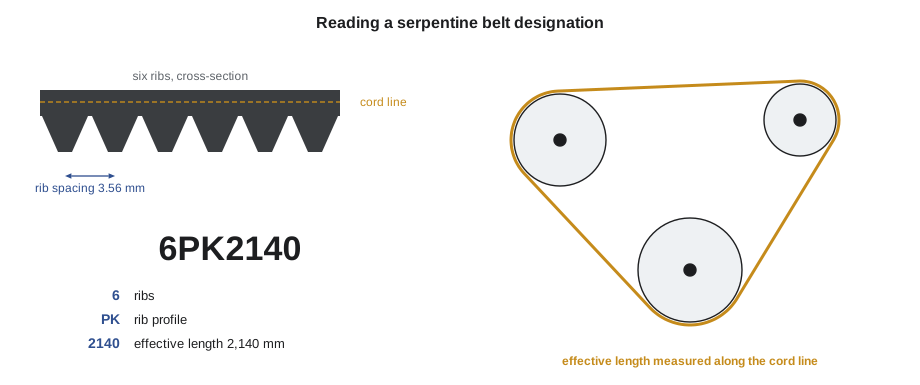
Serpentine belts are described by the number of ribs and the effective length. The common metric designation uses the profile PK, which has a rib spacing of 3.56 mm, so 6PK2140 is a belt with 6 ribs and an effective length of 2,140 mm. North American aftermarket brands often express the same belt in inches: 2,140 mm is about 84.3 in, so the belt might be described as a 6-rib, 84-1/4 inch belt in an aftermarket catalogue.
Worked problem
Identifying the worn belt
The worn belt from the pickup has no readable number. Imani counts 6 ribs and measures it with a belt measuring tool at 2,195 mm. Belts are made in steps of a few millimetres, and the nearest stock lengths are 6PK2185 and 6PK2205. Which should she sell, and why might the measurement be off?
Show solution
- Measured length: 2,195 mm. Candidates: 2,185 mm and 2,205 mm.
- A worn belt has usually stretched, so its true new length is likely to be shorter than measured.
Answer: She sells the 6PK2185, the shorter of the two, because a used belt stretches in service. She also asks the customer to check the tensioner's range marks after fitting: if the tensioner sits at the end of its travel, the belt is the wrong length. The engine swap was the reason the catalogue could not be trusted for this pickup, so measurement was the right method.
Belt tensioners and idler pulleys wear along with the belt. A noisy belt is often a worn tensioner or a pulley bearing, and the parts technician can suggest checking them. For timing belts, the kit is almost always the better sale: replacing the belt alone and leaving a worn tensioner risks the engine.
Filters
Filters protect the engine, the fuel system, the transmission and the passengers. The main types are:
- Oil filters, either spin-on canisters that screw onto a threaded stud, or cartridge elements that fit inside a housing. Cartridge filters come with new O-rings, which must be fitted.
- Engine air filters, usually flat panels, round or cone-shaped elements, sized to the air box.
- Cabin air filters, which clean the air entering the passenger compartment. Some include activated carbon to reduce odours.
- Fuel filters, inline or in the fuel tank module on many modern vehicles, and separate fuel and water separators on diesel engines.
- Transmission filters, usually inside the transmission pan and sold in kits with the pan gasket.
- Hydraulic, coolant and air dryer filters on heavy trucks and equipment.
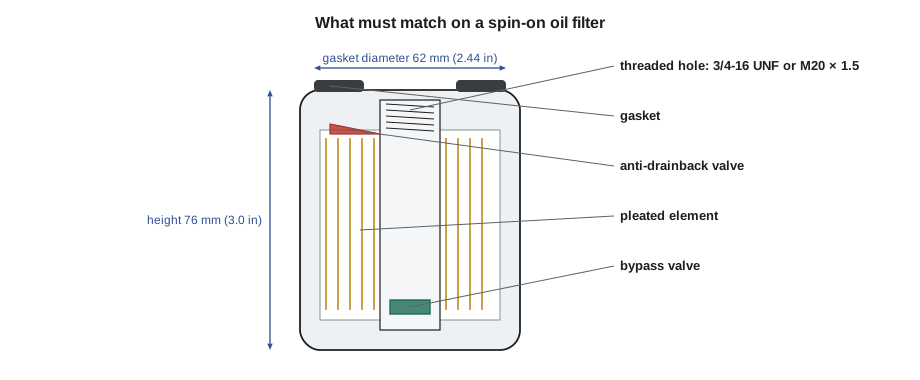
A spin-on oil filter is defined by more than its size. The things that must match are the thread (for example M20 × 1.5 or 3/4-16 UNF, both common), the gasket diameter that seals against the engine, the height that fits the space, the bypass valve setting that lets oil flow if the filter clogs, and whether it has an anti-drainback valve to keep oil in the filter when the engine stops. Two filters with the same thread can have different bypass settings, and the wrong one can starve or damage the engine.
Worked problem
The generator filter
The oil filter from the generator has a faded label. Talia measures the gasket at 62 mm (2.44 in) outside diameter and the height at 76 mm (3.0 in), and the thread gauge shows 3/4-16 UNF. The filter catalogue lists two filters with that thread and gasket: one 76 mm (3.0 in) tall with a 55 kPa (8 psi) bypass, and one 89 mm (3.5 in) tall with a 83 kPa (12 psi) bypass. The customer has the generator's model number. What should Talia do?
Show solution
- Size alone narrows it to the shorter filter, but the bypass setting is not visible on the old filter.
- Look up the generator by its model number in the filter maker's small-engine listing to confirm the bypass setting.
Answer: She looks up the generator model and finds that the shorter filter with the lower bypass setting is listed for it, which agrees with the measurements. If the model number had been missing, she would have told the customer which features matched and which could not be confirmed. The sizes and settings are sample values.
Cross-referencing between brands
Hoses, belts and filters are some of the most cross-referenced parts in the trade. Filter, belt and hose makers publish cross-reference tables that link their numbers to OEM numbers and to other brands, and aftermarket catalogues show them automatically. Cross-references are very useful, but a few habits keep them safe:
- Check the attributes, not just the number. A cross-reference should agree on size, thread, gasket, bypass setting, rib count or inside diameter. If it does not, the cross-reference is wrong or has conditions.
- Watch for "replaces" with conditions, such as a filter that fits only with a different adapter, or a belt that is one rib wider and meant for a modified drive.
- Prefer the vehicle lookup when the vehicle is known. A cross-reference from an old part's number is a fallback, not the first choice.
- Record the cross-reference on the invoice, so the next sale for the same equipment is quick.
| Part | Identify by vehicle | Identify by specification |
|---|---|---|
| Moulded radiator hose | Almost always | Rarely possible |
| Bulk heater hose | Catalogue gives size | Inside diameter, type, length |
| Brake hose | Always (with side) | Never assembled at the counter |
| Serpentine belt | Usually | Ribs and effective length |
| Timing belt | Always, usually as a kit | Not recommended |
| Spin-on oil filter | Usually | Thread, gasket, height, bypass, anti-drainback |
| Air and cabin filters | Usually | Dimensions and shape |
Maintenance parts and the service schedule
Hoses, belts and filters are maintenance parts, replaced at intervals set out in the vehicle's maintenance schedule or when inspection shows wear. Dealership parts departments stock them by the service department's busiest jobs: oil filters and air filters for every common model, cabin filters, wiper blades and the belts for the most common engines. APT-210 covers stocking these parts, and APT-230 covers the systems they come from. A parts technician who knows the schedule can suggest the related parts: a customer buying a timing belt kit at the scheduled interval may also be due for coolant, and a customer buying an engine air filter may be due for the cabin filter as well.
By the end of the cold Friday, Talia had sold nine serpentine belts, four heater hoses, eleven oil filters and a generator filter, and had written the generator's model number and filter cross-reference on the customer's account for next time.
Hose clamps and fittings
A hose is only as good as the way it is held on. Cooling and heater hoses on modern vehicles usually use spring clamps, which keep tension as the hose expands and shrinks with temperature. Worm-drive clamps, tightened with a screw, are common on older vehicles, on bulk hose repairs and on many machines. Fuel and emissions hoses often use quick-connect fittings, which snap onto a tube and need a specific retainer or tool. Each kind is sized to the hose's outside diameter, not its inside diameter, so a parts technician measures the hose's outside diameter, or the old clamp, before selling clamps.
Worked problem
Pricing a bulk heater hose repair
A technician needs 1.4 m of 16 mm heater hose at 9.50 dollars a metre, and two worm-drive clamps sized for the hose's 25 mm outside diameter at 2.25 dollars each. What do the parts cost?
Show solution
- Hose:
- \[1.4 \times 9.50 = 13.30\ \text{dollars}\]
- Clamps:
- \[2 \times 2.25 = 4.50\ \text{dollars}\]
- Total:
- \[13.30 + 4.50 = 17.80\ \text{dollars}\]
Answer: The parts cost 17.80 dollars before tax. Talia checked the clamp range printed on the band against the hose's outside diameter before selling them. The prices are sample values.
Molded hoses from the catalogue often come without clamps, because the original clamps are meant to be reused. A parts technician asks whether the old clamps are in good condition and offers new ones when they are rusted or have lost their tension.
Common mistakes
MistakeUsing low-pressure fuel hose on a fuel injection system.
InsteadCheck the hose's rating for the fuel system's pressure and fuel type.
MistakeMaking up a brake hose from bulk hose.
InsteadSell the complete, approved brake hose assembly for the vehicle and side.
MistakeChoosing a used belt's replacement by its measured length.
InsteadAllow for stretch; choose the next shorter stock length and check the tensioner marks.
MistakeChoosing an oil filter by thread alone.
InsteadMatch the gasket, height, bypass setting and anti-drainback valve too.
MistakeAccepting a cross-reference number without checking its attributes.
InsteadConfirm the size, thread, ribs or other attributes agree.
Summary and key terms
- Hoses are built for their fluid, pressure and temperature; moulded hoses are vehicle-specific and bulk hose is sold by inside diameter.
- Brake, power steering, transmission cooler and air conditioning hoses are sold as complete assemblies.
- Serpentine belts are described by ribs and effective length, such as 6PK2140 for 6 ribs and 2,140 mm.
- Timing belts are vehicle-specific and are best sold as kits with the tensioner and idlers.
- Spin-on oil filters must match in thread, gasket, height, bypass setting and anti-drainback valve.
- Cross-references are useful but must agree on the attributes; vehicle lookup comes first when the vehicle is known.
- Maintenance schedules guide which related parts to suggest.
- Moulded hose
- A hose formed into the bends needed for one engine.
- Bulk hose
- Straight hose sold by length and inside diameter.
- Serpentine belt
- A flat multi-rib belt that drives several accessories.
- Effective length
- A belt's length measured at its cord line, used in its designation.
- Timing belt
- A toothed belt that drives the camshafts in step with the crankshaft.
- Bypass valve
- A valve in an oil filter that lets oil flow if the element clogs.
- Anti-drainback valve
- A valve that keeps oil in the filter when the engine stops.
Practice problems
Work each problem on paper first, then reveal the answer to check.
What does 5PK1500 describe?
Show answer
A serpentine belt with 5 ribs and an effective length of 1,500 mm.
Why are brake hoses never made up at the counter?
Show answer
They are safety-critical and must meet the federal standard as complete assemblies.
A worn belt measures between two stock lengths. Which do you choose?
Show answer
The shorter one, because used belts stretch.
Name three features that must match on a spin-on oil filter.
Show answer
Thread, gasket diameter, height, bypass setting and anti-drainback valve.
Which dimension of bulk hose matters most?
Show answer
The inside diameter.
Lesson quiz · 5 questions
Score 60% or more to complete this lesson.
Create a free account to save your progress, take quizzes and earn a certificate.