
APT-120 · Lesson 3 of 12 · 28 min
Model, serial and build data
▶ Video coming soon A video version of this lesson is on the way.
On Friday, September 25, a body shop phoned the wholesale desk for a front bumper cover for a 2024 Tessaro Arden. Talia found two covers in the catalogue, one with holes for parking sensors and one without, and each came in a primed version for painting. The body shop's estimator knew the colour but not whether the car had parking sensors. "Don't guess," Imani said. "Ask them for the VIN and to read the option codes on the door label." Ten minutes later the estimator called back: the car had the sensor package, and the paint code was 7QK, a metallic grey.
The VIN identifies the vehicle, but much of the detail a parts technician needs is in the vehicle's build data: the record of how that particular vehicle was equipped when it left the factory. This lesson covers where build data comes from, the labels on the vehicle, how to read option, paint, engine and transmission codes, how production dates affect parts, and how serial numbers do the same job for engines, transmissions and equipment.
What build data is
When a vehicle is built, the manufacturer records its full specification: model, trim, engine, transmission, axle ratio, paint and interior colours, and every option and package. This record is linked to the VIN in the manufacturer's database. When a parts technician enters a VIN into the manufacturer's electronic catalogue, the catalogue reads the build record and hides the parts that do not apply. This is called VIN filtering, and it is the main reason dealership catalogues are more precise than catalogues that work only by year, make, model and engine.
Build data reaches the counter in three ways: through the catalogue's VIN lookup, through labels on the vehicle itself, and through codes stamped or printed on major components. Each is useful when the others are missing. A vehicle imported from another market, a vehicle the manufacturer's database does not cover, or a vehicle whose body panels have been replaced may need the labels and stampings to fill the gaps.
The certification label
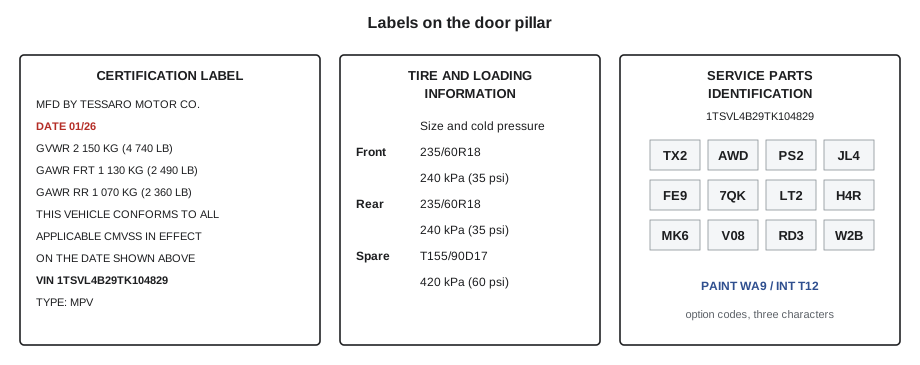
Every vehicle built for the Canadian or US market carries a certification label, usually on the driver's door edge or door pillar. It states that the vehicle meets the safety standards that applied when it was built, and it shows:
- the manufacturer's name;
- the month and year of manufacture, which is the production date, not the model year;
- the gross vehicle weight rating and the gross axle weight ratings;
- the VIN; and
- the vehicle type, such as passenger car, multipurpose passenger vehicle or truck.
For parts work, the date of manufacture is the most useful item on the label. Catalogue notes such as "from 03/26" or "up to 10/25" refer to it. It also explains why two vehicles of the same model year can need different parts: a 2026 model built in July 2025 and one built in May 2026 are nearly a year apart in production.
Next to the certification label, or combined with it, is the tire and loading information placard, which shows the original tire size and the recommended cold inflation pressure, for example 240 kPa (35 psi), and the vehicle's seating and load capacity. Tire size on the placard confirms the original wheel and tire fitment even if the current tires are different.
Option codes and the service parts label
Many manufacturers put a service parts identification label on the vehicle, often inside the glove box, on the door pillar or under the trunk floor. It lists the vehicle's option codes: short codes, often three characters, each standing for an option, package or component. A label might list 40 or more codes covering the engine, transmission, axle, brakes, suspension, seats, radio, wheels and so on. Some manufacturers call them regular production option codes; others use their own name.
Each code is defined in the manufacturer's catalogue or service information. For example, in Tessaro's invented scheme:
| Option code | Meaning (invented) | Parts it affects |
|---|---|---|
| PS2 | Front and rear parking sensors | Bumper covers, sensor brackets, wiring harness |
| TX2 | 2.0 L turbocharged engine | Engine, cooling, intake, exhaust and many filters |
| FE9 | Heavy-duty cooling | Radiator, fan, coolant hoses |
| JL4 | Larger front brakes | Calipers, rotors, pads, wheels |
| V08 | Trailer towing package | Hitch, wiring, transmission cooler |
| 7QK | Paint: metallic grey | Painted parts, touch-up paint |
Option codes matter most for parts that change with equipment: brakes, cooling, suspension, wheels, seats, lighting, audio and anything painted. They also explain catalogue lines that say "with JL4" or "except V08": the line applies only to vehicles that have, or do not have, that code.
Worked problem
Choosing the brake pads
A 2025 Vela has two front brake pad sets in the catalogue: one "with JL4 larger brakes" and one "except JL4". The service parts label lists these codes: TX2, AWD, PS2, JL4, FE9 and 7QK. Which pad set fits?
Show solution
- Look for JL4 on the label: it is listed.
- The vehicle has the larger brakes.
Answer: The "with JL4" pads fit. Talia also noticed FE9, heavy-duty cooling, which would matter if the same customer later needed a radiator or fan. Reading the whole label once saves questions later.
Paint codes
The paint code identifies the vehicle's original body colour. It is usually on the certification label or the service parts label, and the catalogue lists colour-specific parts, such as mirror covers, trim, bumper covers that come painted, and touch-up paint, by paint code. A colour name alone is not enough: a manufacturer may offer three different shades all called "grey" over the years, and a part painted in the wrong one stands out the moment it is fitted.
Body shops usually buy primed parts and paint them to match, mixing the paint from the code and adjusting it to the actual car. Even so, they need the code to order the right paint and sometimes the right primer colour. Interior colour, or trim code, works the same way for seats, carpets, panels and dashboard parts.
Engine and transmission codes
The engine and transmission are the components most often fitted in several versions to one model, and the ones with the most parts depending on them. They are identified by:
- the VIN, where the engine code is often part of the vehicle descriptor section, as in lesson 2;
- option codes on the service parts label;
- labels and stamped numbers on the components themselves. Engines usually carry a stamped or laser-etched engine number on the block, and transmissions carry a tag or label with a model code and serial number;
- the emissions label under the hood, which states the engine size and the emission control systems fitted.
Component numbers are most useful when a vehicle's engine or transmission has been replaced. A used or remanufactured engine may be a different version from the one the VIN shows, and only the number on the engine itself reveals it. When a technician says "the catalogue part doesn't fit," one of the first questions is whether the major components are original.
Worked problem
A transmission that was not original
A customer's 2019 Arden needs a transmission filter kit. The VIN shows transmission code 8T45, but the technician reads 8T50 on the transmission's tag. The catalogue lists different filter kits for the two transmissions. What should Talia do?
Show solution
- The VIN shows the original build; the tag shows the transmission actually fitted.
- The transmission has been replaced with a different version.
Answer: Sell the filter kit for the 8T50 shown on the tag, and add a note to the customer's record that the transmission is not original. The VIN-filtered catalogue would have shown the wrong kit, which is exactly the situation that verification is meant to catch. The codes are invented.
Production dates and production changes
Manufacturers change parts constantly during a model year. A supplier changes, a part fails in service and is redesigned, a cheaper design is introduced, or a new feature is phased in. When the change affects fit, the catalogue shows two or more parts with a production split: one used up to a certain date, VIN or component serial number, and another used from that point on.
A production split can be marked in several ways, and the catalogue line tells you which to check:
| Catalogue note | What to check | Where to find it |
|---|---|---|
| Up to 10/25; from 11/25 | Date of manufacture | Certification label |
| Up to VIN 106200; from VIN 106201 | Production sequence number, same model year and plant | VIN positions 10 to 17 |
| With engine number up to 2R118400 | Engine serial number | Stamped on the engine block |
| With part number ending -B on the old part | Number on the part being replaced | Label or casting on the old part |
Worked problem
A date split
The catalogue shows two water pumps for the 2026 Vela with the 2.0 L engine: one "up to 01/26" and one "from 02/26". The certification label says the vehicle was manufactured 01/26. Which pump fits?
Show solution
- Date of manufacture: January 2026.
- The first pump covers vehicles built up to and including 01/26.
Answer: The "up to 01/26" pump fits. Vehicles built close to a split are where mistakes happen, so for a vehicle built in the split month itself Imani also asked the technician to compare the old pump with the illustration before the new one was opened.
Serial numbers on equipment and components
For heavy trucks, construction and agricultural equipment, engines, generators and many industrial machines, the serial number does the job the VIN does for cars. Machines of one model can differ a great deal from one production run to another, so manufacturers' catalogues for equipment are organized by model and serial number range. A note might read "serial numbers 2J005001 and up". Hamish Corrigall at Linmore Truck and Equipment told Talia that his counter would not quote a machine part without the serial number, "because the model number only gets you close."
Serial plates can be hard to find, painted over or damaged on old equipment. Parts technicians learn where each manufacturer puts them, and keep a record of serial numbers for regular customers' fleets so the customer does not have to read the plate every time. APT-310 covers heavy equipment and industrial parts in more detail.
Keeping build data with the customer
Build data is valuable, and it is easy to lose. The DMS can store the VIN, the option codes and notes such as "transmission replaced with 8T50" or "aftermarket 18 inch wheels" on the customer's or vehicle's record. Wholesale accounts often provide a VIN with every order once they learn that the parts come back right. Talia added the Arden's VIN, the PS2 code and the paint code to the body shop's order before it was sent, so the shop's invoice showed exactly what had been sold and why.
Modified, imported and rebuilt vehicles
Build data describes a vehicle as it left the factory, and some vehicles have changed since. A parts technician should watch for four common cases:
- Modified vehicles. Owners fit larger wheels and brakes, different suspension, aftermarket lamps or a replacement engine. The catalogue's VIN lookup still shows the original parts, so the parts technician asks whether anything has been changed and, when a part does not match, asks to see the old one.
- Imported vehicles. A vehicle built for another market may have a VIN and labels that differ from the local versions, with different lamps, emissions parts and options. The local catalogue may not decode it, and parts may have to come through a different channel.
- Rebuilt vehicles. A vehicle repaired after serious damage may have body panels, airbags or modules from other vehicles. The paint code and option codes on the labels may no longer describe what is fitted.
- Replaced components. An engine or transmission replaced under warranty or from a recycler may be a different version from the original, as the transmission tag example in this lesson showed.
In each case the vehicle in the bay is the final authority. Talia learned to add a short line to the vehicle's record whenever a technician found a difference, such as "18 inch aftermarket wheels, original rotors", so the next lookup would start from the truth.
Worked problem
Counting the cost of a missed modification
A customer orders front brake pads for an Arden by VIN. The car has been fitted with a larger brake kit from another model, and the pads do not fit. The return and reorder take 35 minutes of a technician's time at 140 dollars an hour, plus 12 dollars of courier cost. What did the missed question cost?
Show solution
- Technician time:
- \[35 \div 60 \times 140 \approx 81.67\ \text{dollars}\]
- Add the courier:
- \[81.67 + 12 = 93.67\ \text{dollars}\]
Answer: About 94 dollars, all avoidable by asking "has anything been changed on the brakes?" before ordering. The times and costs are sample values for this course.
Common mistakes
MistakeUsing the model year to decide a production split marked by date.
InsteadRead the date of manufacture on the certification label.
MistakeOrdering a painted part by colour name.
InsteadOrder by the paint code; several shades can share a name.
MistakeIgnoring codes such as "with JL4" on a catalogue line.
InsteadCheck the vehicle's option codes for the code named in the note.
MistakeAssuming the engine or transmission is original.
InsteadRead the number on the component when a VIN-filtered part does not fit.
MistakeQuoting equipment parts by model alone.
InsteadGet the machine's serial number and check it against the catalogue's serial ranges.
Summary and key terms
- Build data is the record of how a vehicle was equipped at the factory, linked to its VIN.
- VIN filtering uses build data to hide parts that do not apply to a vehicle.
- The certification label shows the date of manufacture, which production splits often depend on.
- Option codes on the service parts label show packages and components such as brakes, cooling and sensors.
- Paint and trim codes identify colours more reliably than colour names.
- Engine and transmission numbers reveal replaced components that the VIN cannot show.
- Equipment catalogues use serial number ranges in the way car catalogues use VINs.
- Build data
- The factory record of a vehicle's specification, linked to its VIN.
- VIN filtering
- A catalogue showing only the parts that apply to a vehicle's build.
- Certification label
- The label on the door edge or pillar showing the manufacturer, date of manufacture, weight ratings and VIN.
- Option code
- A short code standing for an option, package or component fitted to a vehicle.
- Paint code
- A code identifying a vehicle's original body colour.
- Production split
- A point in production where one part is replaced by another, marked by date, VIN or serial number.
- Serial number
- A number identifying one machine or component, used by equipment catalogues in place of a VIN.
Practice problems
Work each problem on paper first, then reveal the answer to check.
Where is the date of manufacture usually found?
Show answer
On the certification label on the driver's door edge or pillar.
A catalogue line says "except V08". What does it mean?
Show answer
It applies only to vehicles without option code V08.
Why is a paint code better than a colour name?
Show answer
Several shades can share one name, and the code identifies the exact one.
A vehicle was manufactured 02/26. Which pump fits: "up to 01/26" or "from 02/26"?
Show answer
The "from 02/26" pump.
What does a serial number range on an equipment catalogue line tell you?
Show answer
Which machines, by serial number, the part fits.
Lesson quiz · 5 questions
Score 60% or more to complete this lesson.
Create a free account to save your progress, take quizzes and earn a certificate.