
APT-120 · Lesson 12 of 12 · 26 min
Lookup practice: ten customer requests
▶ Video coming soon A video version of this lesson is on the way.
On Thursday, November 12, two months into her apprenticeship, Talia arrived to find Imani at the back counter with a stack of ten repair orders, phone notes and sticky notes. "These all came in yesterday," Imani said. "I already know the answers. You're going to work them, one at a time, and tell me what you'd sell and why. No guessing, no shortcuts." Rolf, walking past with a coffee, added: "And write down every step. That's what you'll do on the day nobody's checking."
This lesson works through those ten requests. Each uses skills from earlier lessons: decoding a VIN, reading build data, using the electronic catalogue and its illustrations, following supersession, choosing between OEM, aftermarket and remanufactured parts, identifying fasteners, bearings, seals, belts and filters, measuring, and searching for hard-to-find parts. For each request, try the lookup yourself before reading Talia's answer.
A routine for every request
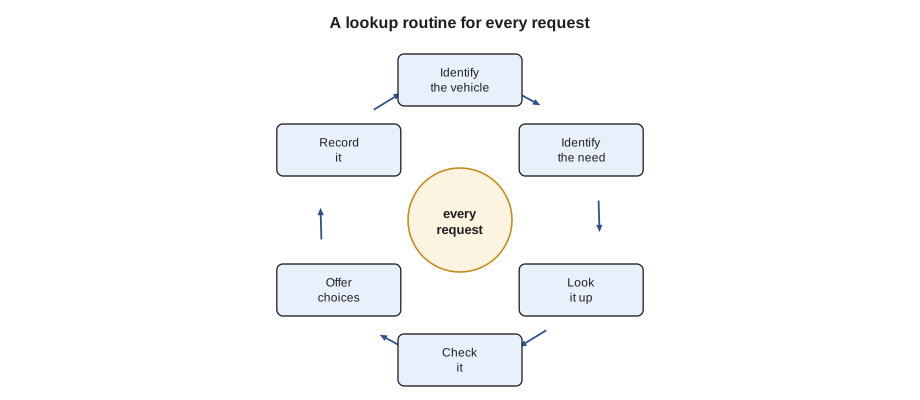
Before starting, Imani had Talia write the routine on a card taped beside her screen. Experienced parts technicians follow it without thinking; new ones need to think about every step:
- Identify the vehicle: the full VIN, decoded; the build date and option codes when the catalogue asks for them.
- Identify the need: what part, which side or position, and why the customer needs it.
- Look it up: find the part in the illustration, read every note, and follow supersession to the current number.
- Check it: match against the old part or a measurement when possible, and confirm stock and price.
- Offer choices: OEM, aftermarket or remanufactured where they exist, with warranty and timing.
- Record it: VIN, part numbers, measurements and decisions on the repair order or invoice.
Request 1: Which model year?
A wholesale customer phoned for front brake pads for a Tessaro Arden and read out the VIN: 2TSMK7C59TH203117. The customer said it was "a 2025, I think".
Talia checked the VIN before believing the year. Position 10, the model year code, is T. Position 7 is a letter (C), so the year is in the 2010 to 2039 cycle, and T means 2026. Then she ran the check digit, because a misheard character would make the year meaningless.
Worked problem
Request 1: confirming the VIN
Confirm the check digit of 2TSMK7C59TH203117 and the model year.
Show solution
- Transliterated values with weights 8, 7, 6, 5, 4, 3, 2, 10, 0, 9, 8, 7, 6, 5, 4, 3, 2 give products:
- \[16 + 21 + 12 + 20 + 8 + 21 + 6 + 50 + 0 + 27 + 64 + 14 + 0 + 15 + 4 + 3 + 14\]
- Sum:
- \[295\]
- Remainder:
- \[295 = 26 \times 11 + 9 \to 9\]
- Position 9 is 9, which matches.
- Position 10 is T, and position 7 is a letter, so the model year is 2026.
Answer: The VIN is valid and the vehicle is a 2026 Arden, not a 2025. Talia confirmed with the customer and looked up pads for the 2026, which have a different number from the 2025's. Model years from the VIN beat memory every time.
Request 2: A production split
Priyanka's service team needed a water pump for a 2026 Vela with the 2.0 L engine. The catalogue listed two pumps, one "up to 01/26" and one "from 02/26". The model year was no help, because both pumps fit 2026 models.
Talia asked the technician to read the certification label on the driver's door pillar. The date of manufacture was 02/26, so the pump marked "from 02/26" was correct. She added the build date to the vehicle's record in the DMS so the next person would not need to ask.
Request 3: Left or right
A retail customer at the front counter wanted a mirror glass for "the passenger side" of a 2024 Arden. The catalogue listed left and right glasses.
In Canada and the United States, vehicles are left-hand drive, and catalogues define left and right as seen from the driver's seat facing forward. The passenger side is the right side. Talia also checked for a heated mirror option on the build data, because heated and non-heated glasses have different numbers. The customer's car had heated mirrors, so she sold the right-hand heated glass.
Request 4: Following supersession
A technician needed a coolant thermostat for a Vela built 05/26. The bin label showed TS-21380-VL07, and the bin held three VL07 and two VL09 thermostats. The catalogue note read: "VL07 superseded by VL09, one-way. Vehicles from 04/26 require VL09."
One-way supersession means the new part fits the old vehicles, but the old part does not fit the new ones. The vehicle was built after 04/26, so only VL09 would do. Talia sold a VL09, then flagged the bin so that Sasha could relabel it and sell the remaining VL07 parts only to vehicles built before 04/26, as lesson 6 described.
Request 5: A remanufactured part with a core
Gordon Achterhof, the retail customer from lesson 7, came back for a starter for his 2017 Vela. A new OEM starter was 465 dollars. A remanufactured starter was 238 dollars plus a 70 dollar core charge.
Worked problem
Request 5: the remanufactured starter
What does Gordon pay at the counter for the remanufactured starter, and what does it cost him once he returns his old starter as the core?
Show solution
- At the counter:
- \[238 + 70 = 308\ \text{dollars}\]
- Core refund when the old starter is returned:
- \[70\ \text{dollars}\]
- Final cost:
- \[308 - 70 = 238\ \text{dollars}\]
- Saving against new:
- \[465 - 238 = 227\ \text{dollars}\]
Answer: Gordon pays 308 dollars today and gets 70 dollars back when he brings in a complete, uncracked old starter, for a final cost of 238 dollars, 227 dollars less than new. Talia explained the core condition rules and wrote the core deposit on the invoice. The prices are sample values for this course.
Request 6: A bearing by its number
Hamish Corrigall at Linmore Truck and Equipment called about a bearing for a shop fan. The old bearing was marked 6205-2RS.
Talia decoded it. The 6 means a single-row deep groove ball bearing, the 2 a light series, and the bore code 05 means a bore of 5 × 5 = 25 mm. A 6205 is 25 mm bore, 52 mm outside diameter and 15 mm wide, and 2RS means rubber seals on both sides. She measured the old bearing with the caliper to confirm the bore and outside diameter, then sold a sealed 6205 from an aftermarket bearing line. Bearing numbers like these are standard across makers, so the same number from any reputable bearing brand fits.
Request 7: A belt with no number
Gideon brought in a cracked serpentine belt from an independent garage. The printing had worn off.
Talia counted six ribs. She measured the belt's length with the belt measuring tool and got about 1,822 mm. Used belts stretch a little, and catalogue lengths are effective lengths measured at the cord line, so a reading slightly under or over is expected. The nearest 6-rib belt in stock was 6PK1830, with an effective length of 1,830 mm. She asked the garage for the VIN, looked up the belt by vehicle, and found 6PK1830 listed, which confirmed the measurement.
Worked problem
Request 7: checking the length
How far is the measured length of 1,822 mm from 6PK1830's 1,830 mm, as a number in 100?
Show solution
- Difference:
- \[1830 - 1822 = 8\ \text{mm}\]
- As a fraction of the catalogue length:
- \[8 \div 1830 \approx 0.0044\]
- In 100:
- \[0.0044 \times 100 \approx 0.44\]
Answer: The measured length is less than half of 1 in 100 from the catalogue length, well within normal measuring error for a used belt. The vehicle lookup confirmed 6PK1830.
Request 8: An aftermarket filter cross-reference
A fleet customer asked for twelve oil filters for its Arden vans, in an aftermarket brand the fleet already stocked for other vehicles. The OEM filter number was in the catalogue; the aftermarket supplier's cross-reference listed one filter for it.
A cross-reference is a starting point, not proof. Talia compared the specifications on the supplier's catalogue page with the OEM filter's: the same thread size, the same gasket diameter, the same height within a few millimetres, the same bypass valve setting and an anti-drainback valve on both. Every point matched. She sold the twelve aftermarket filters and noted the cross-reference on the fleet's account.
Request 9: A part that is NLA
A retail customer needed a rear wiper motor for a 2008 Tessaro Marlo. The catalogue showed the part NLA with no replacement.
Talia followed the search order from lesson 11. The dealer locator showed none. The aftermarket supplier listed one rear wiper motor for the 2008 to 2011 Marlo at 96 dollars, in stock. A recycler network showed two used motors at 45 and 55 dollars. She called the customer with both choices, explaining that the aftermarket motor was new with a one-year warranty, and the used motors had 30-day warranties. The customer chose the aftermarket motor. Talia added it to the department's hard-to-find list.
Request 10: An unknown bolt
A technician brought a bolt that had come out of a suspension bracket and asked for two more. The head was marked 10.9.
The 10.9 marking showed it was a metric property class 10.9 bolt, a high-strength class. Talia measured the thread diameter with the caliper at 9.86 mm, so it was M10. The 1.5 mm and 1.25 mm pitch gauge leaves are close, so she tried both: the 1.25 leaf sat perfectly, and the 1.5 leaf rocked. She measured the length from under the head to the end at 60 mm. The bolt was an M10 × 1.25 × 60, class 10.9. She also checked the catalogue for the bracket, because suspension bolts are often specified by part number with a particular finish or a torque-to-yield design that must be replaced, not reused. The catalogue listed the bolt by number, so she sold two OEM bolts rather than hardware from the bin.
Imani's review
When Talia finished, Imani read the notes and asked one question about each answer. Where did the year come from? From the VIN, checked. Why that pump? The build date. Why not the cheaper starter? It was the cheaper starter, once the core came back. Why OEM bolts? The catalogue listed them. Talia had got all ten right, and Imani pointed out the pattern: every right answer came from checking, not remembering.
| Request | Skill used | Key check | Answer |
|---|---|---|---|
| 1 Brake pads | VIN decoding | Check digit and year code | 2026 Arden pads |
| 2 Water pump | Build data | Date of manufacture | Pump from 02/26 |
| 3 Mirror glass | Left and right | Driver's seat view; heated option | Right heated glass |
| 4 Thermostat | Supersession | One-way and build date | VL09 |
| 5 Starter | Reman and cores | Core charge arithmetic | Reman, 238 dollars final |
| 6 Bearing | Standard numbers | Bore code and measurement | Sealed 6205 |
| 7 Belt | Measuring | Ribs, length and VIN lookup | 6PK1830 |
| 8 Oil filters | Cross-reference | Thread, gasket, height, valves | Aftermarket filter |
| 9 Wiper motor | Hard-to-find search | Search order and options | Aftermarket motor |
| 10 Bolt | Fastener ID | Pitch gauge and catalogue | OEM M10 × 1.25 × 60, 10.9 |
Speed comes from accuracy
New parts technicians often worry about speed. Imani's view was that speed comes from accuracy: a parts technician who checks every step sells the right part the first time, and a parts technician who sells the right part the first time never spends half an hour on a return, a reorder and an apology. Measured over a day, the careful parts technician is the faster one.
Worked problem
The cost of a wrong part
A wrong part costs the shop about 25 minutes: the technician's lost time, the return and the reorder. If a parts technician makes 40 lookups a day and gets 1 in 20 wrong, how much time is lost each day? How much if the error rate drops to 1 in 100?
Show solution
- Wrong parts at 1 in 20:
- \[40 \div 20 = 2\]
- Time lost:
- \[2 \times 25 = 50\ \text{minutes}\]
- Wrong parts at 1 in 100:
- \[40 \div 100 = 0.4\]
- Time lost:
- \[0.4 \times 25 = 10\ \text{minutes}\]
Answer: Cutting errors from 1 in 20 to 1 in 100 saves about 40 minutes a day, far more than the extra minute or two that careful checking adds. The times are sample values for this course.
Rolf's advice was simpler. "The customer never remembers how fast you were," he said. "They remember whether it fit."
Building your own practice
The best practice is real requests. Parts technicians in training can build their skill by:
- Decoding every VIN they see for a week, including the check digit.
- Reading the whole note on every catalogue line, even when the answer seems obvious.
- Measuring returned parts and comparing the measurements with the catalogue.
- Keeping a notebook of tricky lookups and how they were solved.
- Asking experienced colleagues how they would have handled a request, after solving it themselves.
Common mistakes
MistakeTaking the customer's model year on trust.
InsteadDecode it from the VIN and confirm the check digit.
MistakeChoosing between production split parts by model year.
InsteadUse the date of manufacture from the certification label.
MistakeSelling an old supersession number to a newer vehicle.
InsteadRead whether the supersession is one-way and check the build date.
MistakeTrusting a filter cross-reference without checking.
InsteadCompare thread, gasket, height and valves.
MistakeSelling bin hardware where the catalogue lists a specific bolt.
InsteadSell the catalogue part when one is specified.
Summary and key terms
- Use the same routine for every request: vehicle, need, lookup, check, choices, record.
- The VIN's year code and check digit settle the model year.
- Build dates settle production splits; option codes settle variants such as heated mirrors.
- Supersession notes and build dates decide which number fits.
- Remanufactured parts are priced with a core charge that is refunded on return.
- Standard bearing and belt numbers can be decoded and confirmed by measuring.
- Cross-references and interchange are checked against specifications.
- Speed comes from accuracy: the right part the first time saves the most time.
- Lookup routine
- A fixed sequence of steps a parts technician follows for every request.
- Effective length
- A belt's length measured along its cord line, used in its designation.
- Cross-reference
- A list matching one maker's part number to another maker's equivalent.
- Property class
- The strength marking on a metric bolt, such as 8.8 or 10.9.
Practice problems
Work each problem on paper first, then reveal the answer to check.
Position 10 of a VIN is S and position 7 is a letter. What is the model year?
Show answer
2025.
A remanufactured part is 180 dollars plus a 45 dollar core. What is paid at the counter?
Show answer
225 dollars, with 45 refunded when the core is returned.
What does 6PK1830 describe?
Show answer
A 6-rib serpentine belt with an effective length of 1,830 mm.
What is the bore of a 6204 bearing?
Show answer
4 × 5 = 20 mm.
Forty lookups a day at 1 in 40 wrong, each costing 25 minutes: how much time is lost?
Show answer
One wrong part, 25 minutes.
Lesson quiz · 5 questions
Score 60% or more to complete this lesson.
Create a free account to save your progress, take quizzes and earn a certificate.