
APT-120 · Lesson 6 of 12 · 25 min
Part numbers, interchange and supersession
▶ Video coming soon A video version of this lesson is on the way.
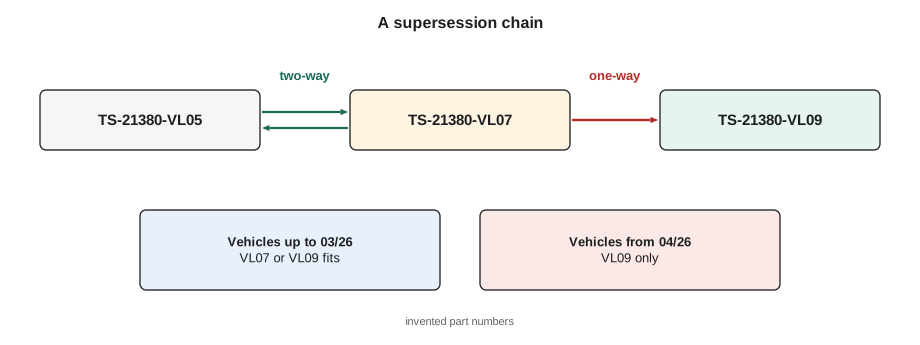
On Wednesday, October 7, Sasha Esparza, the warehouse lead, called Talia into the warehouse and pointed at a bin. The label said TS-21380-VL07, a coolant thermostat for the Vela. The bin held three thermostats in boxes printed TS-21380-VL07, and two in boxes printed TS-21380-VL09. "The catalogue says VL07 was replaced by VL09 in the spring," Sasha said. "Receiving put the new ones in the old bin. Are they the same part, or do we have a problem?" Talia opened the catalogue, searched the old number and read the supersession note. The answer was that they were interchangeable in one direction only, and that mattered.
Every part has a part number, and much of parts work is about understanding what those numbers mean, how they change, and how one number relates to another. This lesson explains how part numbers are built, how to read numbers found on old parts, what interchange means, how supersession works, and how to handle supersession chains in stock and at the counter.
What a part number is
A part number is a code that identifies one design of part, so that every part carrying that number is interchangeable with every other part carrying it. Manufacturers and suppliers each have their own numbering systems. Some are purely sequential, with no meaning in the digits. Others are structured, with sections that indicate the part's group, its basic type and its version.
In this course, the fictional manufacturer Tessaro uses a structured format such as TS-46010-VL22:
| Section | Example | Meaning (invented Tessaro scheme) |
|---|---|---|
| Prefix | TS | Tessaro genuine part |
| Base number | 46010 | Part type: 46 is the brake group; 46010 is a front pad set |
| Suffix | VL22 | Version: VL for the Vela family, 22 for the design version |
A structured number helps a parts technician recognize what a part is from its number alone. All Tessaro front pad sets have the base 46010, so a customer who reads "46010" off a box is talking about front pads, whatever the suffix. The suffix, however, is where the differences are: VL22 and VL31 fit different brakes (lesson 4). The whole number, not just the base, identifies the part.
Aftermarket suppliers use their own numbers, often with a short brand prefix. An aftermarket pad set for the same Vela might be sold by the invented brand Corvane as CV-1583 and by the invented brand Torvale as AX-D2241. Catalogues and cross-reference tables connect these numbers to each other and to the OEM number.
Reading numbers on old parts
Old parts often carry numbers that help identify them, but not every number on a part is a part number. A part may carry:
- the service part number, printed on a label or tag, which is what the catalogue uses;
- a supplier's or manufacturer's engineering number, which may differ from the service part number;
- a casting or forging number, cast into the metal, which identifies the raw casting rather than the finished part and may be shared by several finished parts;
- a date code or batch code, showing when the part was made;
- the supplier's own part number and logo.
Engineering and casting numbers can still be very useful: searching the catalogue for them sometimes finds the service part, and an experienced parts technician learns which numbers on which parts are reliable. But a casting number alone is not a part number, and a part that matches a casting number may have been machined differently. When in doubt, use the number as a clue and confirm with the VIN-filtered catalogue.
Interchange
Two parts interchange when one can be used in place of the other. Interchange is the reason catalogues and cross-reference tables exist: one part often fits many vehicles, and one vehicle's part can often be replaced with another brand's part.
- Application interchange: the same part number fits several models or years. The Vela and the Arden may share a starter motor, so one number covers both.
- Brand interchange or cross-reference: an aftermarket part replaces the OEM part, or one aftermarket brand replaces another. Cross-reference tables connect the numbers.
- Salvage interchange: a used part from one vehicle fits another. Recyclers use interchange databases that group parts by what fits what (lesson 11).
Interchange claims should be read carefully. A cross-reference table may say that a part "replaces" another when it fits only with a modification, a different connector or an adapter, and the note explaining that may be in small print. The parts technician reads the whole cross-reference line before quoting it.
Supersession
Supersession happens when a manufacturer replaces one part number with another. The old number is said to be superseded by the new one. Supersession happens for many reasons: a design improvement, a fix for a failure, a change of supplier, a material change, combining two parts into one, or simply a new numbering system. When a part is superseded, the catalogue shows the new number in place of, or alongside, the old one, with a note explaining the relationship.
The most important question about any supersession is which way the parts interchange:
- Two-way (fully interchangeable). The old and the new parts can each be used in place of the other. Old stock can be sold for any vehicle the new part fits, and vice versa.
- One-way. The new part can replace the old one, but the old part cannot be used where the new one is required. Old stock can be sold only for the vehicles the old part originally fitted, and the new part must be used for later vehicles.
- Not interchangeable with conditions. The new part fits only if other parts are changed too, for example a new hose with a new thermostat housing. The catalogue lists the parts that must be used together, often as a kit.
Worked problem
The thermostats in Sasha's bin
The catalogue note reads: "TS-21380-VL07 superseded by TS-21380-VL09, one-way. VL09 replaces VL07 on all vehicles. Vehicles from 04/26 require VL09." The bin holds three VL07 and two VL09. A technician needs a thermostat for a Vela built 05/26. Another needs one for a Vela built 11/25. What can each receive?
Show solution
- Vela built 05/26: from 04/26, so VL09 is required. VL07 must not be used.
- Vela built 11/25: before 04/26, so either VL07 or VL09 fits.
- Sell the remaining VL07 stock on the earlier vehicles, and keep VL09 for later ones.
Answer: The 05/26 Vela gets a VL09; the 11/25 Vela should get a VL07, using up the old stock where it fits. Talia moved the two VL09 thermostats to their own bin and labelled the old bin "VL07: only up to 03/26", so nobody would pull a VL07 for a newer car by mistake.
Supersession chains
A part may be superseded more than once, creating a supersession chain: A replaced by B, B replaced by C, C replaced by D. Catalogues usually show the latest number and keep the chain in a history. When a customer brings in an old part, or an old repair record shows a number, the parts technician follows the chain forward to the current number.
Chains matter for stock in two ways. First, old stock under earlier numbers may still be on the shelf, or at a nearby dealer, and may be perfectly good for the vehicles it fits. Second, a chain with a one-way link in it limits where the old stock can be used. The DMS can often show a combined stock figure for all the numbers in a chain, but the parts technician still has to read each link.
Worked problem
Following a chain
A wholesale customer brings in a water pump box printed TS-21010-AR03 and wants the same pump. The catalogue history shows: AR03 superseded by AR04 (two-way); AR04 superseded by AR06 (two-way, AR05 skipped as a cancelled number); AR06 is current. Stock: AR03 none, AR04 one, AR06 four. What should Talia sell?
Show solution
- Follow the chain: AR03 → AR04 → AR06.
- Both links are two-way, so AR04 and AR06 both fit wherever AR03 did.
- Sell the oldest stock that fits first: AR04, one in stock.
Answer: Sell the AR04, which uses up the old number, and keep the AR06 stock for later sales. If a link had been one-way, Talia would have checked the customer's vehicle before selling the older number. Selling the oldest fitting stock first is called rotating stock, and APT-210 explains why it matters.
Kits, combined parts and split parts
Some supersessions change more than a number. A manufacturer may replace a single part with a kit: a gasket and its bolts, a thermostat with its housing and seal, or a timing belt with its tensioner and idler. The kit's price is higher than the old single part, and customers sometimes object, so the parts technician explains that the kit is now the only way to buy the part and that it includes everything the repair needs.
Supersession can also go the other way: an assembly may be split so that a component becomes available separately, which is good news for the customer. And two parts may be combined into one, such as a left and right part replaced by a single part that fits both sides. Each change shows in the catalogue as a supersession note, and each needs the same care: read the note, check the direction of interchange, and check what else is needed.
When a number is no longer available
At the end of a part's life, the manufacturer may mark it no longer available (NLA) or discontinued, with no replacement. The catalogue may show "NLA, no replacement", "NLA, use kit", or "see dealer bulletin". Before telling a customer a part is gone, the parts technician checks other dealers' stock through the manufacturer's dealer locator, the aftermarket, and remanufacturers. Lesson 11 covers this research.
Recording numbers correctly
Part numbers are copied constantly: from boxes, from old parts, from customers' notes, from phone calls. A small copying error can turn one part into another. Good habits include:
- scanning barcodes rather than typing whenever possible;
- reading numbers back in groups, such as "T S, four six oh one oh, V L two two";
- using "oh" or "zero" consistently and never confusing O with 0, or I with 1, the same care taken with VINs in lesson 2;
- keeping the whole number, including the prefix and suffix; and
- searching the number in the catalogue to confirm the description before selling.
Sasha's bin problem was not a copying error, but it came from the same root: someone treating two different numbers as the same part. Receiving now checks every incoming part number against the bin label and flags supersessions to the warehouse lead, a step APT-220 covers.
Supersession and the value of stock on the shelf
Supersession also affects money. Old stock under a superseded number is still inventory the department paid for. If the change is two-way, it can be sold to any vehicle and costs nothing. If the change is one-way, the old stock can be sold only to the vehicles it still fits, and it may sit on the shelf for a long time. Many manufacturers let dealers return a limited amount of stock each year, and parts managers often use that allowance for old supersession stock.
Worked problem
Valuing old stock after a one-way change
Sasha's bin holds three VL07 thermostats at a cost of 18.40 dollars each. After the one-way change, the department sells about one thermostat a month to vehicles built before 04/26. What is the old stock worth at cost, and about how long will it take to sell?
Show solution
- Value at cost:
- \[3 \times 18.40 = 55.20\ \text{dollars}\]
- Time to sell at one a month:
- \[3 \div 1 = 3\ \text{months}\]
Answer: The stock is worth 55.20 dollars at cost and should sell within about three months, so Rolf decided to keep it rather than return it. The costs and sales rate are sample values for this course.
The decision changes with the numbers. Twenty units of an expensive one-way part that sells once a year would be a candidate for return, while a handful of cheap, fast-moving parts can simply be sold through. Either way, the bin label must show which vehicles the old number still fits, so that no one sells it to a vehicle it does not.
Common mistakes
MistakeReading a casting number as a part number.
InsteadUse it as a clue and confirm the service part number in the catalogue.
MistakeTreating every supersession as two-way.
InsteadRead the note; a one-way supersession limits where the old part can be used.
MistakeStoring old and new numbers in one bin after a one-way supersession.
InsteadSeparate them and label the old bin with its date or VIN limit.
MistakeQuoting a cross-reference without reading its conditions.
InsteadCheck for adapters, connectors or other parts the replacement needs.
MistakeTelling a customer a part is gone as soon as the catalogue says NLA.
InsteadCheck other dealers, the aftermarket and remanufacturers first.
Summary and key terms
- A part number identifies one design of part; every part with that number is interchangeable.
- Structured numbers have sections for type and version; the whole number identifies the part.
- Old parts may carry service, engineering, casting and date numbers; only the service number is a part number.
- Interchange means one part can be used in place of another, by application, by brand or from salvage.
- Supersession replaces an old number with a new one; it may be two-way, one-way or conditional.
- Supersession chains are followed forward to the current number, and old stock is used where it fits.
- Parts may be superseded by kits, split, combined or discontinued, and each change needs its note read.
- Part number
- A code identifying one design of part.
- Interchange
- The ability of one part to be used in place of another.
- Cross-reference
- A table linking one maker's part number to equivalent numbers from others.
- Supersession
- The replacement of an old part number by a new one.
- One-way supersession
- A supersession where the new part replaces the old, but the old cannot replace the new.
- Supersession chain
- A series of supersessions from an original number to the current one.
- No longer available
- A part the manufacturer no longer supplies, often written NLA.
- Casting number
- A number cast into a raw part, identifying the casting rather than the finished service part.
Practice problems
Work each problem on paper first, then reveal the answer to check.
What are the three sections of the invented Tessaro number TS-46010-VL22?
Show answer
The prefix TS, the base number 46010 and the suffix VL22.
In a one-way supersession, can the new part be used on older vehicles?
Show answer
Yes; the new part replaces the old, but the old part cannot be used where the new one is required.
A chain runs A → B → C, all two-way, with one B in stock. A customer needs A. What do you sell?
Show answer
The B in stock, using up the older fitting stock first.
Name two reasons a manufacturer supersedes a part.
Show answer
A design improvement, a failure fix, a supplier change, a material change, combining parts or a new numbering system.
Why read part numbers back in groups?
Show answer
It makes copying and hearing errors much less likely.
Lesson quiz · 5 questions
Score 60% or more to complete this lesson.
Create a free account to save your progress, take quizzes and earn a certificate.