
APT-120 · Lesson 7 of 12 · 25 min
OEM, aftermarket and remanufactured parts
▶ Video coming soon A video version of this lesson is on the way.
On Friday, October 9, a retail customer named Gordon Achterhof came to the front counter with an alternator quote from another shop and a question. "They want 640 dollars for a new one from you guys, and the store down the road has one for 289. What's the difference?" Imani let Talia answer. Twenty minutes later Gordon left with a remanufactured Tessaro alternator, a core charge on his receipt, and an understanding of what he had bought. "He came in thinking we were overcharging him," Imani said afterwards. "He left knowing what each choice gets him. That's the job."
Most parts can be replaced with more than one kind of part. A brake pad, an alternator or a door mirror might be available as a part from the vehicle's manufacturer, from several aftermarket brands at different quality levels, as a remanufactured unit, or as a used part from a recycler. This lesson explains each kind, how they differ in quality, price and warranty, how core charges work, what consumer law says about telling customers which kind they are getting, and how to help customers choose.
OEM and genuine parts
Original equipment manufacturer (OEM) parts are the parts the vehicle manufacturer sells for its own vehicles, usually in the manufacturer's packaging. Dealers often call them genuine parts. Most OEM parts are not made by the vehicle manufacturer itself: they are made by supplier companies to the manufacturer's design and specifications, tested to its standards, and sold through its parts distribution system.
OEM parts have clear advantages: they are designed for the vehicle, fit exactly, carry the manufacturer's part warranty, and are the parts the manufacturer's service information is written for. They are usually required for warranty repairs and often preferred for collision repairs, safety systems and electronic modules. Their disadvantages are price, which is often the highest, and availability, which is limited to the manufacturer's dealers.
Because suppliers make OEM parts, the same supplier often sells a very similar part in its own box through the aftermarket. This is sometimes called an original equipment supplier (OES) part. An OES part may be identical to the OEM part, or it may differ in small ways, such as packaging, markings or a design version, so it is still a separate part number.
Aftermarket parts
Aftermarket parts are made by independent companies to fit many makes of vehicle. They range from economy parts designed for the lowest price to premium parts that match or exceed the original. A large aftermarket brand may offer two or three lines of the same part, such as a basic, a standard and a premium brake pad, with different friction materials, noise control features, hardware and warranties.
Aftermarket parts have real strengths: lower prices, wide availability through jobbers and warehouse distributors, choices to suit the customer's budget and plans for the vehicle, and sometimes improvements over the original design. Their risks are variable quality, especially at the economy end, fitment errors in catalogue data, and differences in fit or performance that a customer may not expect.
For collision parts such as bumper covers, hoods and lights, some aftermarket parts are certified by independent programs that test fit and quality against the OEM part. The best-known in North America is the Certified Automotive Parts Association. Insurers and body shops often specify certified parts when aftermarket collision parts are used.
Remanufactured parts
A remanufactured part is a used part that has been completely disassembled, cleaned, inspected, and rebuilt with new or reconditioned components to meet the original specifications, then tested. Alternators, starters, brake calipers, steering racks, transmissions, engines, turbochargers, injectors and electronic modules are commonly remanufactured. Remanufacturers may be the vehicle manufacturer's own program or independent companies.
The word "rebuilt" is sometimes used for the same thing, but quality varies more with rebuilt parts: a rebuilder may replace only the components that failed, while a remanufacturer replaces all the wear components and tests the unit to a standard. Reconditioned or refurbished usually means cleaned and repaired as needed rather than fully remanufactured. The parts technician reads the supplier's description and warranty to know what is actually being sold.
Remanufacturing depends on a supply of used units, called cores. To keep cores flowing back, remanufactured parts are sold with a core charge: an extra amount added to the price and refunded when the customer returns the old unit in rebuildable condition. APT-110 introduced cores; this lesson shows how they affect the customer's price.
Worked problem
Gordon's alternator
Gordon's choices were: a new genuine Tessaro alternator at 640 dollars; a genuine Tessaro remanufactured alternator at 312 dollars plus a 95 dollar core charge; and an aftermarket remanufactured alternator at 289 dollars plus a 70 dollar core charge. Gordon will return his old alternator, which is in rebuildable condition. What does each choice cost him in the end, before tax?
Show solution
- New genuine:
- \[640\ \text{dollars, no core}\]
- Genuine reman, core refunded:
- \[312 + 95 - 95 = 312\ \text{dollars}\]
- Aftermarket reman, core refunded:
- \[289 + 70 - 70 = 289\ \text{dollars}\]
- Difference between the two reman units:
- \[312 - 289 = 23\ \text{dollars}\]
Answer: Once the cores are returned, the two remanufactured units differ by only 23 dollars, and both cost less than half the new one. Gordon chose the genuine remanufactured unit for its longer warranty. He paid 407 dollars at the counter and got 95 dollars back when he returned the old alternator the next day. Prices are sample values.
Core charges confuse customers when they are not explained. The parts technician tells the customer the price with and without the core, what condition the core must be in (complete, not broken, not disassembled, usually returned in the new part's box), and how long they have to return it.
Used and recycled parts
Used parts, also called recycled or salvage parts, come from vehicles taken apart by automotive recyclers. They are common for body panels, doors, glass, mirrors, wheels, engines, transmissions and interior parts, especially on older vehicles and for insurance repairs where cost matters. Recyclers grade parts by condition and mileage, record the donor vehicle's VIN, and often offer a short warranty.
Used parts have obvious advantages: low price, availability for old vehicles, and, for painted parts, sometimes a matching colour. Their risks are unknown history, wear, and fitment: a used part from a vehicle with a different option package or production date may not fit (lesson 3). Recyclers use salvage interchange databases that group parts by what fits what, and the parts technician should give the recycler the full VIN and option codes, not just the year and model. Lesson 11 returns to recyclers when searching for hard-to-find parts.
Comparing the kinds of parts
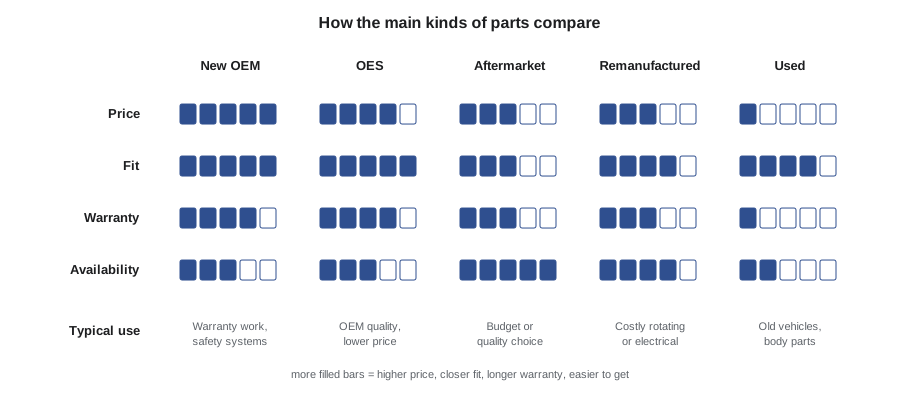
| Kind of part | Typical price | Typical warranty | Good choice when |
|---|---|---|---|
| New OEM (genuine) | Highest | Manufacturer's part warranty | Warranty work, safety systems, exact fit needed |
| OES | Below OEM | Supplier's warranty | OEM quality wanted at a lower price |
| Aftermarket | Wide range | Varies by brand and line | Budget or choice of quality levels |
| Remanufactured | Well below new, plus core | Often good; varies | Costly rotating or electrical units |
| Used (recycled) | Lowest | Short, if any | Old vehicles, body parts, insurance repairs |
Warranty on parts
Every part comes with some kind of warranty, and the parts technician should know the main ones. A new OEM part usually has the manufacturer's parts warranty, often longer when the part is installed by a dealer. Aftermarket brands set their own warranties, from a few months to a "limited lifetime" for some brake and suspension parts, which usually covers the part but not the labour to replace it. Remanufactured units have their own warranties and conditions, and used parts may have a short one or none.
Warranty conditions matter as much as the length: whether labour is covered, whether the part must be installed by a professional, whether the original receipt is needed, and whether commercial or fleet use is excluded. APT-130 covers warranty claims at the counter.
Consumer protection law adds its own rules when a business repairs a vehicle. In Ontario, the Consumer Protection Act, 2002 requires a repairer's estimate to list the parts it plans to install and to say whether each is new, used or reconditioned, and the invoice to say the same for the parts actually installed. The Act also gives repairs a minimum warranty on new or reconditioned parts and the labour to install them, of 90 days or 5,000 km, whichever comes first, with some exceptions such as fluids, filters, tires and batteries. A parts department that supplies a repair shop helps it comply by describing every part accurately on the invoice.
Helping a customer choose
Customers choose between kinds of parts for different reasons, and the parts technician's job is to give them the information to choose well, not to push the most expensive part or the cheapest. Good questions include:
- "How long do you plan to keep the vehicle?" A customer selling next spring may prefer the economy part; one keeping it for ten years may want the premium or genuine part.
- "Is this a warranty or insurance repair?" Warranty repairs usually require genuine parts; insurers may specify certified aftermarket or used parts.
- "Who is installing it?" Some warranties require professional installation, and some parts need programming or special tools.
- "Do you have the old part to return for the core?"
Imani's rule was to describe the choices in the same order every time, with the price, the warranty and one honest sentence about the difference. "Never run down another store's part," she told Talia. "Explain what ours is and let the customer decide."
Worked problem
Comparing warranty value
A customer chooses between two front pad sets: a standard set at 68 dollars with a one-year warranty, and a premium set at 104 dollars with a three-year warranty. Ignoring the difference in quality, what is the cost per year of warranty for each?
Show solution
- Standard:
- \[68 \div 1 = 68\ \text{dollars per year}\]
- Premium:
- \[104 \div 3 \approx 34.67\ \text{dollars per year}\]
Answer: The premium set costs about half as much per year of warranty. That does not make it the right choice for every customer, but it is a fair, factual way to describe the difference. Prices and warranties are sample values.
Describing parts honestly
Honesty is central to selling different kinds of parts. A remanufactured part must never be sold as new, a used part must be described as used, and an aftermarket part must not be described as genuine. Boxes, invoices and the DMS should use the right description and the right part number. Misdescribing parts is unfair to customers, can expose the dealership to legal action under consumer protection law, and destroys trust in the whole counter.
Cost over the life of the part
Price at the counter is not the only way to compare parts. For parts that wear out, such as brake pads, wiper blades, filters and belts, the cost over the part's life is often a better guide. A cheaper part that wears out sooner can cost more over time, especially when labour is paid for each replacement.
Worked problem
Comparing two brake pad sets
A customer is choosing between an economy pad set at 48 dollars, expected to last about 40 000 km, and a premium set at 72 dollars, expected to last about 70 000 km on the same car. Compare the parts cost per 10 000 km.
Show solution
- Economy:
- \[48 \div 4 = 12.00\ \text{dollars per 10 000 km}\]
- Premium:
- \[72 \div 7 \approx 10.29\ \text{dollars per 10 000 km}\]
Answer: The premium set costs more at the counter but less per distance driven, and it saves the labour of one extra pad change over the life of the car. The prices and pad life are sample values for this course; actual life depends on driving and the vehicle.
This kind of comparison helps customers make an informed choice without pressure. Some customers plan to sell the vehicle soon and sensibly choose the cheaper part; others keep vehicles for many years and value the longer life. The parts technician's job is to give them the numbers, not to decide for them.
Common mistakes
MistakeCalling an aftermarket part "genuine" or an OEM part.
InsteadUse the right description: genuine means the vehicle manufacturer's part.
MistakeQuoting a remanufactured part without the core charge.
InsteadGive the price with and without the core, and explain the return conditions.
MistakeTreating rebuilt, remanufactured and reconditioned as the same.
InsteadRead the supplier's description and warranty to see what was actually done.
MistakeGiving a recycler only the year and model.
InsteadGive the full VIN and option codes so the used part fits.
MistakePushing the most expensive part on every customer.
InsteadExplain each choice's price, warranty and differences, and let the customer decide.
Summary and key terms
- OEM or genuine parts are sold by the vehicle manufacturer; most are made by suppliers to its specifications.
- OES parts come from the same suppliers in their own packaging and may be identical or slightly different.
- Aftermarket parts fit many makes and range from economy to premium lines.
- Remanufactured parts are rebuilt from cores to original specifications and are sold with a refundable core charge.
- Used parts come from recyclers and need the full VIN and option codes to fit.
- Warranties differ by kind of part, and consumer law requires repairers to say whether parts are new, used or rebuilt.
- The parts technician explains each choice honestly and lets the customer decide.
- OEM part
- A part sold by the vehicle manufacturer for its own vehicles, also called a genuine part.
- OES part
- A part from an original equipment supplier sold in the supplier's own packaging.
- Aftermarket part
- A part made by an independent company to fit many makes of vehicle.
- Remanufactured part
- A used part fully rebuilt and tested to original specifications.
- Core charge
- An amount added to a part's price and refunded when the old unit is returned in rebuildable condition.
- Used part
- A part removed from a salvaged vehicle and resold, also called a recycled part.
- Certified part
- An aftermarket collision part tested for fit and quality by an independent program.
Practice problems
Work each problem on paper first, then reveal the answer to check.
Who usually makes an OEM part?
Show answer
A supplier company, to the vehicle manufacturer's design and specifications.
A reman starter is 220 dollars plus a 60 dollar core. What does the customer pay at the counter, and in the end?
Show answer
280 dollars at the counter, and 220 dollars once the core is refunded.
What must a core be like to earn the refund?
Show answer
Complete, not broken or disassembled, and usually returned in the new part's box within the time allowed.
Why should a recycler get the full VIN?
Show answer
Used parts from vehicles with different options or production dates may not fit.
A part costs 90 dollars with a two-year warranty. What is its cost per year of warranty?
Show answer
45 dollars per year.
Lesson quiz · 5 questions
Score 60% or more to complete this lesson.
Create a free account to save your progress, take quizzes and earn a certificate.