
APT-110 · Lesson 7 of 12 · 26 min
Batteries, fluids and other hazardous parts
▶ Video coming soon A video version of this lesson is on the way.
On Tuesday, October 6, 2026, the morning delivery from the battery supplier came in with one carton wet on the bottom. Sasha stopped Talia before she picked it up. Through the cardboard they could see a white crust forming where acid had leaked from a cracked case. Sasha put on a face shield and chemical gloves, lifted the battery into a plastic battery tray with a carrier, sprinkled the wet cardboard and the floor with the neutralizer from the spill kit, and showed Talia how to tell from the fizzing when the acid had been neutralized. The cracked battery went into the damaged-goods bin in the battery cage, tagged for the supplier's credit claim. "Batteries look harmless," he said. "They're full of acid, they're heavy, and they can explode. Every one gets treated like that."
Some of the most common parts in a parts department are also some of the most hazardous: lead-acid batteries, lithium-ion batteries, automotive fluids, refrigerants, and the airbags and seat belt pretensioners that contain small explosive charges. This lesson covers the hazards of each, how to store and handle them, and how used products and cores are returned or disposed of. It builds on the hazard information system in lesson 6.
Lead-acid batteries
Most cars and trucks still use a 12-volt lead-acid battery for starting and accessories. Each battery holds lead plates in sulfuric acid electrolyte inside a plastic case. The three main hazards are:
- Acid: sulfuric acid causes severe burns to skin and eyes, and eats through clothing and cardboard. Flooded batteries can leak if tipped or cracked; sealed AGM and gel batteries leak much less, but a cracked case can still release acid.
- Hydrogen gas: batteries give off hydrogen and oxygen when charging, and sometimes when stored. Hydrogen is extremely flammable, and a spark near a battery's vents can cause an explosion that sprays acid and plastic.
- Weight: a typical car battery weighs about 18 kg (40 lb), and heavy truck batteries more. Lesson 4's lifting rules apply.
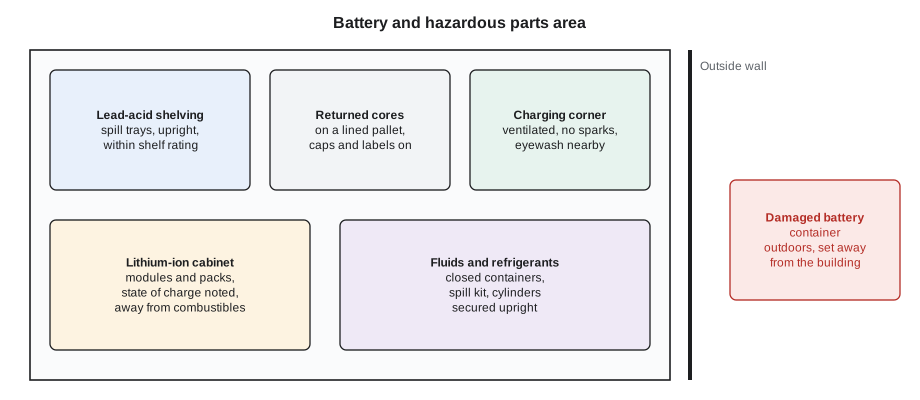
Linmore Tessaro stores batteries upright on low, sturdy shelving in the battery cage, never stacked directly on each other unless the maker's packaging is designed for it, with a spill tray beneath and a spill kit, eyewash and neutralizer close by. Batteries are moved with a battery carrier or on a cart, never by their terminals. Workers handling batteries wear safety glasses and gloves, and a face shield for any damaged or leaking battery.
Worked problem
Checking a battery shelf's load
A battery shelf is rated for 450 kg per shelf. Sasha wants to put 24 group-size batteries on one shelf, each weighing 18.2 kg. Is the shelf strong enough?
Show solution
- Total weight:
- \[24 \times 18.2 = 436.8\ \text{kg}\]
- Compare with the rating:
- \[436.8 \le 450\]
Answer: Yes, but only just: 437 kg against a 450 kg rating leaves about 13 kg spare, less than one battery. Sasha put 22 batteries on the shelf, about 400 kg, to keep a margin and leave room to lift them out without reaching.
Lead-acid batteries are one of the most recycled products in the world, and parts departments play a large part. When a customer buys a new battery, the price usually includes a core charge, refunded when the old battery is returned. Returned batteries are stored upright in the cage, on a pallet or in an acid-resistant container, until the supplier collects them. They must never go in the garbage. Lesson 1 introduced cores; APT-210 explains how core charges are managed.
Lithium-ion batteries
Lithium-ion batteries now turn up in many places in a parts department: 12-volt auxiliary batteries in some vehicles, key fob and tire pressure sensor batteries, jump starters and power packs sold at the counter, cordless tool batteries, and the high-voltage battery modules and packs of hybrid and electric vehicles. Lithium-ion cells store a lot of energy in a small space and contain a flammable electrolyte. If a cell is damaged, overcharged, overheated or short-circuited, it can go into thermal runaway: a chain reaction in which the cell heats itself, vents flammable and toxic gases and can catch fire or explode, spreading to neighbouring cells. Lithium-ion fires are hard to put out and can reignite hours later. Lesson 8 covers lithium-ion fires.
High-voltage battery modules and packs from hybrid and electric vehicles add a second hazard: electrical shock. A pack may operate at several hundred volts, and even a single module can deliver a dangerous shock. In a parts department, high-voltage batteries are received, stored and shipped in the manufacturer's packaging; parts technicians never open the packaging to inspect the battery, never touch its terminals, and leave any work on the battery to trained electric vehicle technicians.
Linmore Tessaro's rules for lithium-ion products are:
- Store them in their original packaging, away from heat, sunlight and flammable materials, and not near the lead-acid charging area.
- Protect terminals from short circuits; loose small batteries go in their own bags or with taped terminals.
- Inspect incoming high-voltage batteries for damage to the packaging. A damaged, swollen, hot, smoking or leaking battery is isolated at once outdoors or in the designated damaged-battery container, away from the building, and the manufacturer's instructions for damaged batteries are followed.
- Never ship a damaged or defective lithium battery without the special packaging and documents the transport rules require.
Worked problem
How much energy is in a battery module?
A replacement high-voltage module for a hybrid arrives in a large crate. Its label gives a nominal voltage of 44.4 V and a capacity of 64 Ah. The energy in watt-hours is the voltage times the amp-hours. How much energy does it store, and how does that compare with a 100 Wh power bank of the kind often allowed in airline carry-on luggage?
Show solution
- Energy in the module:
- \[44.4 \times 64 = 2{,}841.6\ \text{Wh} \approx 2.84\ \text{kWh}\]
- Compared with a 100 Wh power bank:
- \[2{,}841.6 \div 100 \approx 28\]
Answer: The module holds about 2.8 kWh, roughly 28 times as much energy as a large power bank, and a full electric vehicle pack may hold many times more. That stored energy is why damaged modules are treated as a serious fire risk, and why lithium batteries above certain watt-hour ratings face strict transport rules.
Automotive fluids
Fluids are a large share of parts sales, and many are hazardous:
- Engine coolant (antifreeze): most is based on ethylene glycol, which is poisonous if swallowed and tastes sweet, so it is a danger to children and pets. Spills are cleaned up at once, and containers kept closed.
- Brake fluid: glycol-based fluids absorb moisture from the air, so containers are kept sealed and opened only when needed. They also strip paint, so spills on a painted surface must be wiped and washed at once. Different grades must not be mixed; silicone-based fluid must never be added to a system designed for glycol fluid.
- Windshield washer fluid: winter fluid often contains methanol, which is flammable and poisonous if swallowed. Concentrate is more hazardous than ready-to-use fluid.
- Engine oil, transmission fluid and gear oil: combustible rather than flammable, but slippery when spilled. Used oil is a regulated waste.
- Fuel additives, cleaners and solvents: often flammable and harmful, stored with the flammables.
- Diesel exhaust fluid: a urea solution that is not very hazardous but crystallizes when spilled and damages some metals.
Because fluids are heavy, pails and cases are stored low, and drums are moved with a drum dolly or forklift attachment. Linmore Tessaro's bulk oil is pumped from large totes in the service shop, and the parts department sells the packaged fluids.
Used fluids from the service shop, such as used oil, used coolant and old brake fluid, are collected in labelled containers and picked up by a licensed carrier. In Ontario, used oil and other liquid industrial wastes are regulated under the Environmental Protection Act, and businesses that generate them must register as waste generators and use licensed carriers. Many parts stores also accept used oil from do-it-yourself customers through industry stewardship programs.
Refrigerants
Vehicle air conditioning systems use refrigerants such as R-134a in older vehicles and R-1234yf in most newer ones. Parts departments sell refrigerant in cylinders to professional shops and, in some places, in small cans to do-it-yourself customers. Refrigerant cans are pressurized containers: they must be kept away from heat and never heated to increase pressure. R-1234yf is mildly flammable, and both refrigerants can cause frostbite if liquid contacts the skin and can displace oxygen in an enclosed space.
Sales and handling of refrigerants are controlled by federal and provincial environmental rules, and only certified technicians may work on vehicle air conditioning systems. Linmore Tessaro sells refrigerant cylinders only to its own service shop and to trade accounts, and follows the supplier's and the dealership's environmental guidance for small cans.
Airbags, pretensioners and other energetic parts
Airbag modules, inflators and seat belt pretensioners contain small pyrotechnic charges that fire in a crash. Before they are installed, they can still fire if dropped, heated, exposed to static or wired to power, and a deploying airbag can cause serious injury. In storage and transport they are treated as dangerous goods. Depending on how the manufacturer has had the design tested and approved, they ship either as Class 9 safety devices (UN3268) or, less often, as Division 1.4 explosives, and the packaging and documents differ.
Linmore Tessaro's rules for these parts are:
- Keep them in their original packaging in a designated, locked cabinet away from heat, flames and electrical equipment.
- Carry an airbag module with the trim cover, the side that deploys, facing away from your body, and never by its wires or connector.
- Set a module down with the trim cover facing up, so that if it did fire it would not launch itself.
- Never open, probe or apply power to an airbag part in the parts department.
- Return recalled inflators and removed modules exactly as the manufacturer instructs, in the packaging it supplies.
Other parts carry small hazards of their own: some older vehicles have mercury switches that must be recycled, not thrown away; brake dust on returned brake parts may be harmful to breathe, so returned pads and shoes are bagged and not blown off with air; and stored tires are a heavy fire load, kept in racks away from heat sources.
Returns and disposal
A parts department sends a steady stream of used and returned products back out: battery cores, used oil, empty containers, damaged products, recalled parts and warranty parts. Each stream has its own procedure, but the common rules are to keep each kind separate and labelled, keep hazardous returns in their proper storage until collected, use the supplier's or manufacturer's packaging and documents, and never put hazardous products in the general garbage or down a drain. The receiving and shipping course, APT-220, covers reverse logistics in detail.
By the end of October, Talia had handled most of these streams under Sasha's supervision. On Wednesday, November 4, she helped Sasha receive a replacement hybrid battery module for a warranty repair and prepare the removed module for return. They followed the manufacturer's return instructions word for word: the shop's EV technician confirmed the module was undamaged and isolated, it went into the returnable container the new one had come in, the label was completed, and the paperwork went to Gideon, who was trained to ship it.
Tires, glass and sheet metal
Some parts are hazardous for physical rather than chemical reasons. Tires are heavy, roll unexpectedly and are a serious fire load; they are stored in tire racks or stacked no higher than the rack maker or the fire safety plan allows, away from heaters and electrical equipment, and never in exit routes. Windshields and glass can shatter and cut, and are carried by two people with cut-resistant gloves, kept in their racks and padding until they leave the building. Sheet metal body panels, such as hoods, fenders and doors, have sharp edges and act like sails when carried outside in the wind; they are carried by two people and stored upright in the body parts rack.
The parts department also handles some products that are hazardous only when they are damaged. A dented aerosol can may leak or burst; a cracked brake fluid bottle soaks into cardboard and strips the paint of anything it touches; a split bag of oil-absorbent granules makes a dangerous slip on concrete. The rule for all of them is the same as for the leaking battery: stop, set the damaged item aside in its designated area, clean up, and record it for the supplier's credit.
Worked problem
Weight of a tire stack
A customer's set of four winter tires on steel rims weighs about 15 kg per wheel. How much does a stack of four weigh, and how does each wheel compare with the 23 kg lifting benchmark from lesson 4?
Show solution
- Weight of the stack:
- \[4 \times 15 = 60\ \text{kg}\]
- One wheel compared with the benchmark:
- \[15 \div 23 \approx 0.65\]
Answer: The stack weighs about 60 kg, so it moves on a tire dolly, not by hand. Each wheel alone is about 65 in 100 of the benchmark, but rolling it is still easier on the back than lifting it.
Common mistakes
MistakeCarrying a battery by its terminals or against your chest.
InsteadUse a battery carrier or cart, keep it upright and wear eye protection and gloves.
MistakeCharging or storing lead-acid batteries near sparks or flames.
InsteadCharge in a ventilated area and keep ignition sources away because of hydrogen.
MistakePutting a swollen or hot lithium-ion battery back on the shelf.
InsteadIsolate it at once in the designated damaged-battery container away from the building.
MistakeCarrying an airbag module with the trim cover against your body.
InsteadCarry it with the deploying side facing away, and set it down cover up.
MistakeThrowing a returned battery or used oil in the garbage.
InsteadKeep each return stream separate and labelled for its proper collection.
Summary and key terms
- Lead-acid batteries contain sulfuric acid, give off hydrogen and are heavy; store them upright and low, with spill trays, eyewash and neutralizer nearby.
- Battery cores carry a core charge and are returned for recycling, never discarded.
- Lithium-ion batteries can go into thermal runaway; damaged ones are isolated at once, and high-voltage packs are left to trained EV technicians.
- Energy in watt-hours is voltage times amp-hours; large modules store several kilowatt-hours.
- Coolant, brake fluid, washer fluid and solvents have specific hazards; used fluids go to licensed carriers.
- Refrigerant cans are pressurized and some refrigerants are flammable; sales and service follow environmental rules.
- Airbags and pretensioners ship as Class 9 safety devices or Division 1.4 explosives and are stored and carried with care.
- Lead-acid battery
- A battery with lead plates in sulfuric acid electrolyte, used for starting vehicles.
- Thermal runaway
- A self-heating chain reaction in a lithium-ion cell that can lead to fire or explosion.
- Watt-hour
- A unit of stored energy: volts times amp-hours.
- Ethylene glycol
- The poisonous main ingredient of most engine coolants.
- Hygroscopic
- Absorbing moisture from the air, as glycol-based brake fluid does.
- Pretensioner
- A device that tightens a seat belt in a crash, using a small pyrotechnic charge.
- Core charge
- A deposit added to the price of a part, refunded when the used part is returned.
Practice problems
Work each problem on paper first, then reveal the answer to check.
What three hazards does a lead-acid battery present?
Show answer
Sulfuric acid, flammable hydrogen gas and weight.
A module is rated 44.4 V and 64 Ah. How much energy does it store?
Show answer
About 2,842 Wh, or 2.84 kWh.
What should you do with a swollen lithium-ion battery?
Show answer
Isolate it at once in the designated damaged-battery container away from the building and follow the maker's instructions.
Why must glycol brake fluid containers be kept closed?
Show answer
The fluid absorbs moisture from the air, which lowers its boiling point.
How should an airbag module be set down?
Show answer
With the trim cover, the deploying side, facing up.
Lesson quiz · 5 questions
Score 60% or more to complete this lesson.
Create a free account to save your progress, take quizzes and earn a certificate.