
APT-110 · Lesson 3 of 12 · 25 min
Warehouse hazards and safe work
▶ Video coming soon A video version of this lesson is on the way.
On Tuesday, October 13, 2026, Sasha Esparza was walking the warehouse at 7:05 a.m., as he did every morning before the rush, when he stopped at the end of aisle 4. One of the front uprights of the pallet racking had a fresh crease about 40 cm (16 in) above the floor, and a smear of yellow paint at the same height. Somebody had clipped it with a forklift the evening before and said nothing. Sasha roped off the aisle with yellow tape, put a red tag on the upright, and called Rolf. By 8:00 the three loaded levels above the damaged upright had been emptied, and by noon the rack supplier's inspector had confirmed the upright had to be replaced. Talia spent the morning helping move 1,900 kg (4,200 lb) of brake rotors and drums to a temporary location, and learned more about warehouse safety in four hours than in her first month.
This lesson describes the main hazards in a parts warehouse, the laws that protect the people who work there, and the habits that keep a warehouse safe. Lessons 4 to 8 then take the biggest hazards one at a time: lifting and ladders, forklifts, hazardous products, batteries and fluids, and fire.
Why warehouses are dangerous
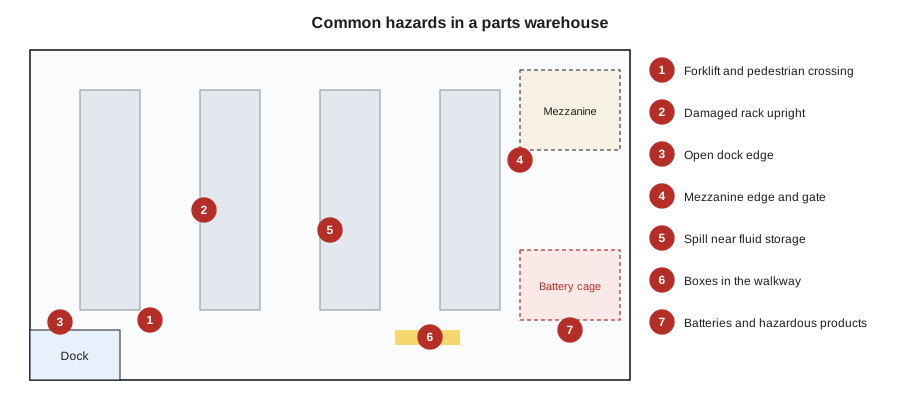
A parts warehouse combines several things that can hurt people: heavy and awkward loads, storage that rises well above head height, powered equipment moving in narrow aisles, people working on foot among it, and products that can burn, corrode or poison. Most warehouse injuries come from a short list of causes:
- Struck by or caught between: forklifts and pallet jacks hitting pedestrians, objects falling from shelves or racks, fingers caught in overhead doors or dock levellers.
- Falls: from ladders, mezzanine edges and loading docks, and on the same level from slips and trips on spilled fluid, packaging and pallets.
- Overexertion: back, shoulder and knee injuries from lifting, carrying, pushing and reaching, covered in lesson 4.
- Cuts: from box cutters, banding straps, sheet metal body parts and broken glass.
- Exposure to hazardous products: battery acid, brake fluid, solvents, aerosols and other chemicals, covered in lessons 6 and 7.
- Fire: from flammable products, damaged lithium-ion batteries, electrical faults and hot work, covered in lesson 8.
Many injuries happen during the busy times: the first hour when the overnight shipment is being put away, a big body shop order being pulled in a hurry, the end of the day when people are tired. A safe warehouse is one where the habits hold even when everyone is rushed.
The law: who is responsible for what
In Ontario, warehouse safety falls under the Occupational Health and Safety Act (OHSA) and its regulation for Industrial Establishments, R.R.O. 1990, Reg. 851, which covers factories, warehouses, shops and offices. The Act places duties on everyone in the workplace. Employers must provide a safe workplace, information, instruction and supervision, and must take every precaution reasonable in the circumstances. Supervisors must make sure workers follow the law and the company's procedures, and must tell workers about hazards. Workers must work safely, use the protective equipment the employer requires, and report hazards and contraventions to their supervisor. Regulation 851 adds specific rules, among them that materials and racks must be stored and secured so they cannot tip, collapse or fall, and that lifting devices such as forklifts must be operated by competent workers.
Ontario workers have three basic rights under the OHSA: the right to know about hazards, the right to participate in health and safety through a joint health and safety committee or representative, and the right to refuse work they believe is likely to endanger them, following the procedure in the Act. Linmore Tessaro has more than twenty employees, so it has a joint health and safety committee with worker and management members. Imani is one of its certified worker members, and the committee inspects the parts department every month.
Walkways, aisles and traffic
The single best way to prevent people being struck by forklifts is to keep the two apart. Linmore Tessaro's warehouse has painted pedestrian walkways along the main aisles and a marked crossing at each aisle end, where forklift drivers stop and sound the horn. Talia was taught four rules on her first day:
- Walk in the marked walkways and cross only at the marked crossings.
- Never walk behind or beside a moving forklift, and never walk under a raised load.
- Make eye contact with a forklift driver before crossing in front of the truck, and wait for a signal.
- Wear the high-visibility vest at all times in the warehouse and on the dock.
Aisles and walkways must be kept clear. Cartons waiting to be put away go on a marked staging area, not in the aisle; empty pallets go back to the pallet stack at once; banding and plastic wrap go in the bins. A walkway that is clear at 7 a.m. can be blocked by 7:30 if nobody is watching.
Storage, shelving and racking
Parts are stored on three main kinds of fixture. Steel shelving holds small and medium boxes in bins and on shelves, usually up to about head height or on a mezzanine. Pallet racking holds pallets and large items on horizontal beams supported by uprights, often several levels high, and is loaded by forklift. Special racks hold long parts, tires, sheet metal panels and bulk fluids. Each has load limits and rules for safe use.
Pallet racking is engineered for specific loads, and every installation should carry a load sign giving the maximum load per beam level and per bay. The racks are designed for loads spread evenly across the beams; a heavy load set at one end, or a pallet hanging off the front, puts more force on one beam or upright than it was designed for. Racks must be anchored to the floor, kept plumb, and inspected regularly for damage. Bent, creased or cracked uprights and beams, missing safety locks on beam connectors, and anchors that have pulled loose are all signs that a rack may collapse. A creased upright is the most dangerous kind of damage, because the upright carries the weight of every level above it.
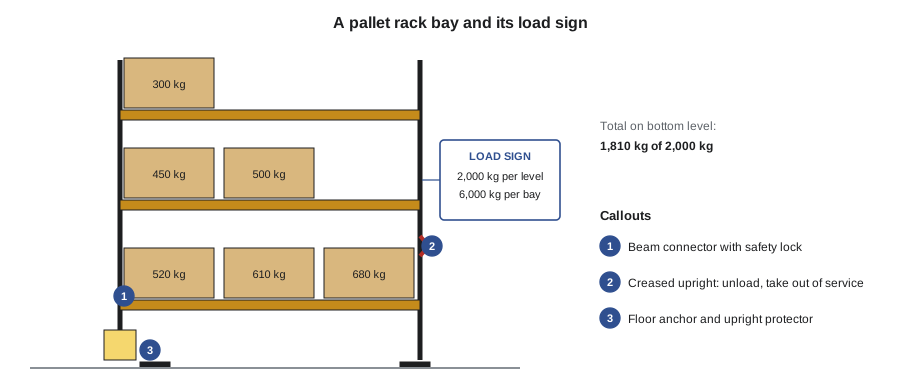
In Canada, the design, installation and use of steel storage racks are covered by a CSA standard (A344), and Ontario's Regulation 851 requires material and racking to be stored and maintained so they will not collapse. Linmore Tessaro follows the rack manufacturer's instructions for loads and damage, has the racking inspected every year by a qualified inspector, and does its own monthly checks through the joint health and safety committee.
Worked problem
Checking a rack level against its load sign
The load sign on aisle 4 gives each beam level a maximum of 2,000 kg, evenly distributed. Talia needs to put three pallets of brake rotors on one level, weighing 520 kg, 610 kg and 680 kg. Can they go on the same level?
Show solution
- Total load on the level:
- \[520 + 610 + 680 = 1{,}810\ \text{kg}\]
- Compare with the limit:
- \[1{,}810 \le 2{,}000\]
- Spare capacity:
- \[2{,}000 - 1{,}810 = 190\ \text{kg}\]
Answer: Yes. The three pallets total 1,810 kg, under the 2,000 kg limit, with 190 kg to spare, provided each pallet sits squarely on both beams and the heaviest one goes nearest the middle. A fourth pallet of 520 kg would take the level over its limit.
When a rack is damaged, the rule is the one Sasha followed: stop using it, unload the affected bays from the top down, keep people out of the aisle, and have it assessed before it is used again. Anyone who hits a rack must report it at once. The worst outcome is not the dent; it is the dent nobody reports.
Loading docks
The receiving dock is one of the most dangerous places in the building. A dock edge is a fall of about 1.2 m (4 ft) onto concrete, and the gap between the dock and a trailer can open without warning if the trailer creeps forward or the truck driver pulls away while someone is inside. Linmore Tessaro's dock rules are written on a sign at each door:
- Keep the dock door closed when no trailer is at it, or put up the yellow barrier chain.
- Before anyone enters a trailer, the trailer's wheels are chocked or the dock's vehicle restraint is engaged, and the driver hands the keys to the receiving lead.
- Check the trailer floor before driving a pallet jack or forklift into it; a weak or wet floor can give way.
- Use the dock leveller properly and never stand on the lip while it moves.
- Never jump from the dock to the ground; use the stairs.
Lesson 5 covers forklifts on docks and in trailers in more detail.
Slips, trips, cuts and everyday hazards
Not every warehouse hazard is dramatic. Spilled oil, coolant and windshield washer fluid make concrete slippery; shrink-wrap and banding on the floor catch feet; a box cutter used toward the body can open a forearm. The habits that prevent these are simple and boring: clean spills at once with absorbent and report leaking products; keep packaging off the floor; cut away from the body with a retractable or self-closing knife; wear cut-resistant gloves for sheet metal and glass; keep bins and drawers closed; and look before reaching into a shelf where a sharp part might be stored.
Finding and reporting hazards
A safe warehouse depends on people noticing and reporting problems. Linmore Tessaro uses three tools. A daily walk, like Sasha's at 7:05, catches overnight problems before the rush. A monthly inspection by the safety committee uses a written checklist and records what was found and who will fix it. And a hazard report form, on paper at each counter and on the dealership's intranet, lets anyone report a hazard at any time. Every report gets an answer within a week, and Rolf posts the results on the department's notice board.
Worked problem
Tracking hazard reports
In September and October 2026, the parts department received 27 hazard reports. Twelve were about housekeeping, 6 about racking and shelving, 5 about the dock, and the rest about other things. What share of reports were about housekeeping?
Show solution
- Other reports:
- \[27 - 12 - 6 - 5 = 4\]
- Housekeeping share:
- \[12 \div 27 \approx 0.444\]
Answer: About 44 in 100 of reports were about housekeeping, mostly cartons in walkways and spilled fluid. Rolf added a ten-minute tidy-up at 11:30 every day, before the lunch rush, and the number of housekeeping reports fell in November.
Talia's first hazard report, on September 29, was about a wobbling step on the mezzanine stairs. It was fixed the next morning. "That's what we want," Rolf told her. "Everybody here should feel like it's their job to say something."
Temperature, lighting and noise
Some warehouse hazards build up over a shift rather than happening in a moment. The receiving dock is cold in winter when the doors are open and hot in summer when trailers have been sitting in the sun, and both extremes cause fatigue, which leads to mistakes. Linmore Tessaro keeps the dock doors closed between deliveries in winter, provides heated jackets and gloves for receiving staff, and in summer runs fans and keeps water at the dock. Workers who feel dizzy, confused or unusually tired in the heat must stop and tell a supervisor.
Poor lighting makes labels hard to read, hides trips and spills, and increases picking errors, so burned-out lights are reported and replaced quickly. Noise in a parts warehouse is usually modest, but the dock can be loud when trucks idle and the compactor or baler runs; hearing protection is available at the dock, and trucks are asked to switch off their engines while they are unloaded.
Worked problem
Counting hours of exposure on the dock
In December, Sasha's receiving team of three each spends about 2.5 hours a day on the open dock during the morning unload, five days a week. How many person-hours of cold exposure does the team have in a four-week month, and how many would be saved by closing the dock doors between the two daily deliveries, which Sasha estimates would cut each person's time near the open door to 1.5 hours a day?
Show solution
- Current person-hours in four weeks:
- \[3 \times 2.5 \times 5 \times 4 = 150\]
- With doors closed between deliveries:
- \[3 \times 1.5 \times 5 \times 4 = 90\]
- Saving:
- \[150 - 90 = 60\]
Answer: About 60 fewer person-hours of cold exposure a month. Closing the doors also cut the warehouse heating bill, which made the change easy to approve.
Common mistakes
MistakeWalking down the middle of an aisle to save time.
InsteadUse the marked walkways and crossings, and make eye contact with forklift drivers.
MistakePutting a heavy pallet on the end of a beam because the middle is full.
InsteadSpread loads evenly and check the total against the load sign.
MistakeLeaving a dented upright in use because "it's only a small dent".
InsteadStop using the bay, unload it from the top down and have it assessed.
MistakeEntering a trailer before its wheels are chocked or restrained.
InsteadConfirm the wheels are chocked or the restraint engaged and the keys are handed over.
MistakeStepping over a small spill to deal with later.
InsteadClean it at once with absorbent and find the source.
Summary and key terms
- Most warehouse injuries come from being struck, falling, overexertion, cuts, hazardous products and fire.
- Ontario's OHSA and Regulation 851 set duties for employers, supervisors and workers, and give workers the rights to know, participate and refuse unsafe work.
- Pedestrians and forklifts are kept apart with walkways, crossings, eye contact and high-visibility vests.
- Racks must be loaded within their load signs, evenly, and taken out of service when damaged.
- Loading docks need closed doors or barriers, chocked or restrained trailers and checked trailer floors.
- Daily walks, monthly inspections and hazard reports find problems before they cause injuries.
- Pallet racking
- Steel storage with uprights and horizontal beams that holds pallets loaded by forklift.
- Load sign
- A sign on a rack giving its maximum load per beam level and per bay.
- Upright
- The vertical frame member of a rack that carries the beams and their loads.
- Dock leveller
- A hinged plate at a loading dock that bridges the gap and height difference to a trailer.
- Vehicle restraint
- A device at a dock that hooks a trailer to keep it from moving away.
- Hazard report
- A written notice of a hazard so that it can be assessed and fixed.
- Safety committee
- A group of workers and managers that inspects the workplace and recommends improvements.
Practice problems
Work each problem on paper first, then reveal the answer to check.
What did Sasha do when he found the damaged upright?
Show answer
Taped off the aisle, tagged the upright, reported it, had the levels above unloaded and had the rack inspected.
Three pallets weigh 520, 610 and 680 kg (1,150, 1,345 and 1,500 lb). Is a 2,000 kg (4,400 lb) beam level enough?
Show answer
Yes: 1,810 kg (3,995 lb) is under the limit.
Name two things that must be done before anyone enters a trailer at the dock.
Show answer
Chock the wheels or engage the restraint, and take the driver's keys; also check the trailer floor.
Why is a creased upright especially dangerous?
Show answer
The upright carries every level above it, so it can fail and bring them all down.
12 of 27 hazard reports were about housekeeping. About what share is that?
Show answer
About 44 in 100.
Lesson quiz · 5 questions
Score 60% or more to complete this lesson.
Create a free account to save your progress, take quizzes and earn a certificate.