
APT-110 · Lesson 1 of 12 · 23 min
The parts technician trade
▶ Video coming soon A video version of this lesson is on the way.
At 7:40 a.m. on Monday, September 14, 2026, Talia Brankovic walked through the back door of Linmore Tessaro, a car dealership on Rymal Road East in Hamilton, for her first day as a parts apprentice. She was nineteen. She had spent two summers changing tires at a tire shop and had finished a high school co-op placement in a parts store, so she knew what a brake rotor looked like and how to find one in a catalogue. What she did not yet know was how a dealership parts department worked: who its customers were, how parts arrived and left, how the computer systems tied it together, and how many ways a warehouse can hurt the people who work in it.
Her parts manager, Rolf Ingvaldsen, had been in the trade for twenty-eight years. He met her at the receiving door, handed her a safety vest and a pair of steel-toed boots in her size, and introduced her to Imani Grantham, the journeyperson parts technician who would be her mentor. "Imani will show you everything," he said. "For the first two weeks you'll mostly watch, ask questions and learn where things are. Nobody here expects you to know it all. We expect you to ask before you guess."
This course follows Talia's first two months at Linmore Tessaro, from September to mid-November 2026. The people, the building and the procedures she meets here come back throughout the Parts Technician program. This first lesson describes the trade itself: what parts technicians do, where they work, what makes a good one, and how the work is organized in a typical dealership parts department. Linmore Tessaro sells new and used vehicles of the Tessaro brand, a fictional automaker invented for this program, so that the course can describe a dealership without promoting any real company.
What a parts technician does
A parts technician identifies, orders, receives, stores, sells and ships the parts that keep vehicles and machines running. The job sits between two kinds of customers. On one side are the people who need a part: a technician in the dealership's own service shop, a body shop across town, a fleet manager, a farmer, a homeowner with a lawn tractor. On the other side are the suppliers who make and distribute parts: the vehicle manufacturer's parts distribution centre, aftermarket warehouses, remanufacturers and local jobbers. The parts technician's work is to connect the two quickly and correctly.
That sounds simple, but it rests on a lot of knowledge. A modern car has tens of thousands of parts, and the right one depends on the vehicle's model year, engine, transmission, trim level, build date and options. A water pump for one engine may look almost identical to the pump for another engine in the same model and still not fit. Parts are revised, renumbered and replaced by newer numbers. Some parts are sold only as part of an assembly; some are sold by the metre or the litre; some must be ordered from the manufacturer and take a week to arrive. A good parts technician knows how to find the right part, how to explain the choices to a customer, and how to keep enough of the right stock on the shelf without filling the building with parts nobody buys.
The work falls into a few broad areas, and a parts technician in a small department may do all of them in a single day:
- Counter work: serving customers in person, by phone and online; identifying parts from vehicle information; quoting prices and availability; selling and invoicing.
- Service support: supplying the dealership's own shop technicians with parts for repair orders, often at a separate back counter.
- Ordering and inventory: placing stock and special orders, tracking what is on hand, counting stock, and deciding what to keep and what to return.
- Warehouse work: receiving shipments, checking them against the order, putting parts away, picking and packing orders, and shipping.
- Returns, cores and warranty: processing customer returns, sending core parts back for remanufacturing credit, and handling warranty parts that the manufacturer wants returned.
- Business tasks: pricing, handling accounts, reporting sales and stock figures, and helping the department meet its targets.
Later courses cover each of these in depth: parts identification and lookup in APT-120, counter sales in APT-130, inventory control in APT-210, receiving and shipping in APT-220, and management in the final level. This course is about the foundation under all of them: the trade, its workplaces and how to work safely in them.
A typical dealership parts department
Imani's first tour took Talia through the department from back to front, following the path a part takes. Linmore Tessaro's parts department occupies about 1,400 square metres (15,000 square feet) at the back of the dealership, with these areas:
- Receiving dock: two overhead doors, one at truck height with a dock leveller and one at ground level for vans. The manufacturer's truck arrives every weekday night around 2 a.m. and leaves its shipment in a locked, caged area; aftermarket suppliers deliver during the day.
- Warehouse: rows of steel shelving and pallet racking, a mezzanine for small and light parts, a bulk area for fluids and batteries, a separate hazardous materials cage, and a long-parts rack for exhaust pipes, wiper blades and trim.
- Back counter: a service window opening onto the shop, where the dealership's technicians bring repair orders and collect parts.
- Front counter: a retail counter facing the showroom, where walk-in customers and wholesale customers such as independent garages are served.
- Shipping area: where wholesale orders are packed and loaded into the delivery van, and where returns and cores wait to go back to suppliers.
- Office: Rolf's office and a small room with the parts department's computers, printers and the safe for cash.
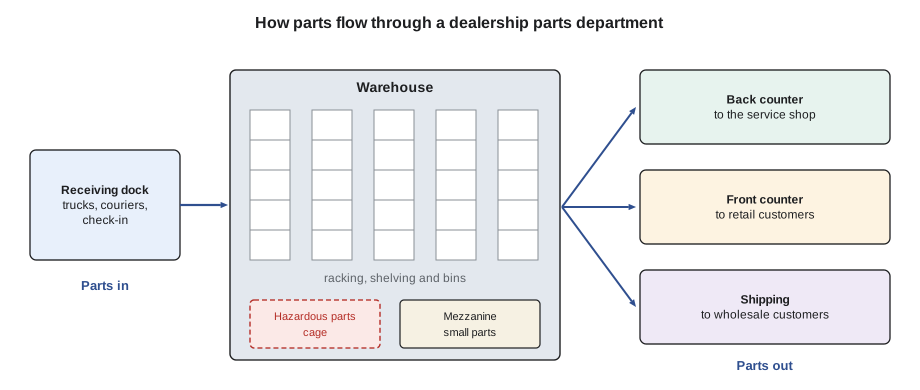
The department had seven people when Talia joined: Rolf as manager; Imani and two other journeypersons who worked the counters; Sasha Esparza, the warehouse lead, who ran receiving and shipping; Gideon Achebe, who drove the delivery van; and Talia. The dealership's service manager, Priyanka Rautela, was the parts department's biggest single customer, and the general manager, Walter Bisset, watched the department's monthly figures closely.
Who the customers are
A dealership parts department serves three main groups, and each one behaves differently:
- Internal service: the dealership's own technicians, working on customer-paid repairs, warranty repairs and used vehicles being reconditioned for sale. They need parts fast, because a car on a lift waiting for a part is a technician who is not earning.
- Wholesale: independent repair shops, body shops, fleets and other businesses that buy parts at a discount and often have them delivered. Body shops in particular buy large volumes of the manufacturer's sheet metal, lights and trim after collisions.
- Retail: individual customers buying for their own vehicles at the front counter or online: accessories, floor mats, wiper blades, oil and filters, and the occasional do-it-yourself repair part.
Each group has different prices, different expectations and different paperwork. Internal parts are charged to a repair order; wholesale customers usually have a charge account and a negotiated discount; retail customers pay at the counter. APT-130 deals with each of these in detail.
Worked problem
Reading the department's sales mix
In September 2026 Linmore Tessaro's parts department sold 412,000 dollars of parts at selling price: 188,000 dollars to the dealership's own service department, 147,000 dollars wholesale to other businesses, and the rest at the retail counter. What share did each group make up?
Show solution
- Retail sales:
- \[412{,}000 - 188{,}000 - 147{,}000 = 77{,}000\]
- Internal service share:
- \[188{,}000 \div 412{,}000 \approx 0.456\]
- Wholesale share:
- \[147{,}000 \div 412{,}000 \approx 0.357\]
- Retail share:
- \[77{,}000 \div 412{,}000 \approx 0.187\]
Answer: About 46 in 100 of sales went to the dealership's own shop, about 36 in 100 to wholesale customers and about 19 in 100 to retail. That is a typical pattern for a dealership: the shop and the wholesale trade carry the department, and retail is the smallest part. The figures here are sample values for this course.
What makes a good parts technician
On her second morning Talia asked Imani what separated a good parts person from an average one. Imani thought about it and gave her a list she had heard from her own mentor years before:
- Accuracy. The wrong part costs everyone: the technician loses time, the customer's car stays on the lift, the part has to be returned, and the department pays freight both ways. The best parts people check the vehicle information twice and confirm the part before it leaves the counter.
- Product knowledge. You do not need to be able to rebuild an engine, but you need to know what a part does, what it connects to and what the technician will need with it: the gasket with the water pump, the bolts that are single-use, the fluid that goes with the repair.
- Organization. A warehouse where every part has a location and every part is in its location is a fast warehouse. One misplaced box can cost an hour of searching.
- Communication. Counter customers range from expert technicians to people who do not know what their car is called. A parts technician has to listen, ask the right questions and explain choices clearly.
- Computer skills. Almost all lookup, ordering, invoicing and inventory work is done on computers, and the systems change often.
- Safety. Warehouses have forklifts, ladders, heavy and awkward parts, sharp edges, batteries, chemicals and flammable products. Parts technicians who work safely for decades are the ones who learned the habits in their first months.
Imani added one more: honesty. "If you don't know, say so and find out. If you made a mistake, say so before the customer finds it. Everybody here makes mistakes. The ones who hide them are the ones who don't last."
How the trade is recognized
In Ontario, Parts Technician is a skilled trade with a registered apprenticeship, listed by Skilled Trades Ontario under the trade code 240P. It is a Red Seal trade: apprentices who complete their training can write the interprovincial Red Seal exam, and the endorsement is recognized across Canada. The trade is voluntary in Ontario, which means a person may work in a parts department without being certified, but registered apprentices receive structured training, and many dealerships and distributors prefer or require certified staff. Skilled Trades Ontario's trade report gives the program as about 5,460 hours of on-the-job training and 540 hours of in-school training in two levels. Talia's agreement with Linmore Tessaro was registered in her first month, and lesson 11 describes the apprenticeship path in detail.
Whatever the credential, the trade's knowledge is the same on both sides of the border: identifying parts accurately, serving customers well, managing inventory, running a safe warehouse and understanding the business.
The working day
Linmore Tessaro's service shop opens at 7:30 a.m., so the parts department opens at 7:00. The first hour is busy: Sasha's team unloads and checks the overnight shipment, technicians line up at the back counter with the first repair orders of the day, and the phones start ringing with body shops ordering parts for the day's jobs. The middle of the day is steadier, with wholesale deliveries going out at 10:00 and 1:30 and counter customers coming and going. The last hour is spent placing the night's stock order with the manufacturer, which must be submitted by 5:00 p.m. to arrive the next morning, and tidying the warehouse.
Parts work involves a lot of standing and walking. Imani's step counter showed about 14,000 steps on an ordinary day, more on a day when she was pulling parts for a large body shop order. It also involves lifting, climbing ladders and stairs to the mezzanine, and working at a computer. Lessons 3 to 5 cover the safety side of all that movement.
Worked problem
How far a parts technician walks
Imani's step counter showed 14,200 steps on Wednesday, September 16. If her average step is 0.7 m (2.3 ft), about how far did she walk?
Show solution
- Distance:
- \[14{,}200 \times 0.7 = 9{,}940\ \text{m}\]
- In kilometres:
- \[9{,}940 \div 1{,}000 \approx 9.9\ \text{km}\]
Answer: About 10 km in a working day, most of it on concrete. Good footwear and anti-fatigue mats at the counters are not luxuries.
Common mistakes
MistakeGuessing at a part when the vehicle information is incomplete.
InsteadAsk for the VIN or the missing details and confirm the part before it leaves the counter.
MistakeLeaving a part out of its location "just for now".
InsteadPut every part back in its labelled location, or tag it and tell the warehouse lead.
MistakeSelling the main part without the gaskets, seals or single-use bolts the job needs.
InsteadAsk what the repair is and check what else it requires.
MistakeHiding a mistake and hoping the customer will not notice.
InsteadReport it at once so it can be fixed before it costs more.
MistakeTreating safety rules as something for the warehouse staff only.
InsteadEveryone in a parts department lifts, climbs and walks near forklifts; the rules apply to all.
Summary and key terms
- A parts technician identifies, orders, receives, stores, sells and ships parts, connecting customers who need parts with the suppliers who make them.
- The work covers counter sales, service support, ordering and inventory, warehouse work, returns and cores, and business tasks.
- A dealership parts department runs from the receiving dock through the warehouse to the back counter, the front counter and shipping.
- Its customers are the dealership's own service shop, wholesale businesses and retail customers, each with different prices and expectations.
- Accuracy, product knowledge, organization, communication, computer skills, safety and honesty mark a good parts technician.
- In Ontario, Parts Technician (240P) is a voluntary Red Seal trade of about 5,460 hours on the job and 540 hours in school over two levels.
- The working day is shaped by the service shop's hours, wholesale delivery runs and the nightly stock order deadline.
- Parts technician
- A worker who identifies, orders, stores, sells and ships replacement parts.
- Back counter
- The service window where a dealership's own technicians collect parts for repair orders.
- Front counter
- The retail counter where walk-in and wholesale customers are served.
- Wholesale customer
- A business, such as an independent garage or body shop, that buys parts for resale or for repairs it does for its own customers.
- Repair order
- The document that records a repair in the service shop, including the parts charged to it.
- Stock order
- A regular order placed with a supplier to replenish the parts the department keeps on hand.
- Core
- A used part, such as an alternator or brake caliper, returned to a remanufacturer for credit.
Practice problems
Work each problem on paper first, then reveal the answer to check.
Name three areas of work in a parts department.
Show answer
Any three of: counter work, service support, ordering and inventory, warehouse work, returns and cores, business tasks.
Which customer group at Linmore Tessaro buys the most parts by value?
Show answer
The dealership's own service department, about 46 in 100 of sales in September 2026.
Why does a wrong part cost the department money even if it is returned?
Show answer
The technician loses time, the vehicle waits, freight is paid both ways, and the return takes staff time.
What did Imani say to do when you are not sure of a part?
Show answer
Say so, ask for the missing information and find out before guessing.
If parts sales were 412,000 dollars and retail sales were 77,000 dollars, what share was retail?
Show answer
About 0.19, or 19 in 100.
Lesson quiz · 5 questions
Score 60% or more to complete this lesson.
Create a free account to save your progress, take quizzes and earn a certificate.